Roundtable on Entrepreneurship Education (REE) Oct 22-24, 2003 Page - - PDF document

roundtable on entrepreneurship education ree oct 22 24
SMART_READER_LITE
LIVE PREVIEW

Roundtable on Entrepreneurship Education (REE) Oct 22-24, 2003 Page - - PDF document

Roundtable on Entrepreneurship Education (REE) Oct 22-24, 2003 Page 1 Resources for Entrepreneurship Educators October 23, 2003 10:30-11:30am Panel Discussion Phil Weilerstein, NCIIA Moderator < pweilerstein@nciia.org> Katherine


slide-1
SLIDE 1

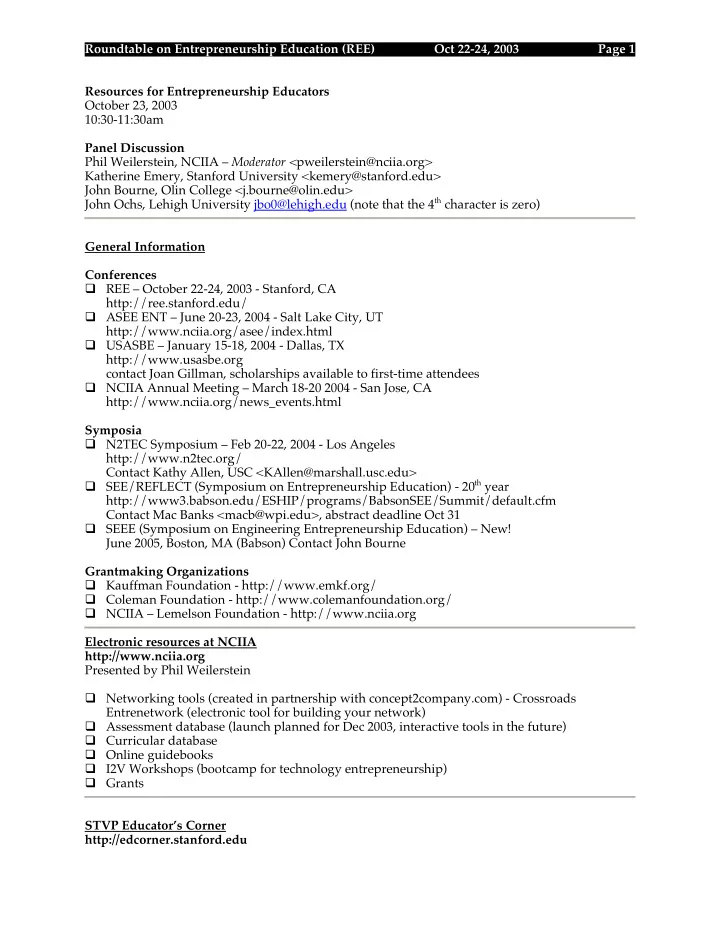
Roundtable on Entrepreneurship Education (REE) Oct 22-24, 2003 Page 1 Resources for Entrepreneurship Educators October 23, 2003 10:30-11:30am Panel Discussion Phil Weilerstein, NCIIA – Moderator <pweilerstein@nciia.org> Katherine Emery, Stanford University <kemery@stanford.edu> John Bourne, Olin College <j.bourne@olin.edu> John Ochs, Lehigh University jbo0@lehigh.edu (note that the 4th character is zero) General Information Conferences q REE – October 22-24, 2003 - Stanford, CA http://ree.stanford.edu/ q ASEE ENT – June 20-23, 2004 - Salt Lake City, UT http://www.nciia.org/asee/index.html q USASBE – January 15-18, 2004 - Dallas, TX http://www.usasbe.org contact Joan Gillman, scholarships available to first-time attendees q NCIIA Annual Meeting – March 18-20 2004 - San Jose, CA http://www.nciia.org/news_events.html Symposia q N2TEC Symposium – Feb 20-22, 2004 - Los Angeles http://www.n2tec.org/ Contact Kathy Allen, USC <KAllen@marshall.usc.edu> q SEE/REFLECT (Symposium on Entrepreneurship Education) - 20th year http://www3.babson.edu/ESHIP/programs/BabsonSEE/Summit/default.cfm Contact Mac Banks <macb@wpi.edu>, abstract deadline Oct 31 q SEEE (Symposium on Engineering Entrepreneurship Education) – New! June 2005, Boston, MA (Babson) Contact John Bourne Grantmaking Organizations q Kauffman Foundation - http://www.emkf.org/ q Coleman Foundation - http://www.colemanfoundation.org/ q NCIIA – Lemelson Foundation - http://www.nciia.org Electronic resources at NCIIA http://www.nciia.org Presented by Phil Weilerstein q Networking tools (created in partnership with concept2company.com) - Crossroads Entrenetwork (electronic tool for building your network) q Assessment database (launch planned for Dec 2003, interactive tools in the future) q Curricular database q Online guidebooks q I2V Workshops (bootcamp for technology entrepreneurship) q Grants STVP Educator’s Corner http://edcorner.stanford.edu

slide-2
SLIDE 2

Roundtable on Entrepreneurship Education (REE) Oct 22-24, 2003 Page 2 Presented by Katherine Emery q Designed for faculty, this is a database of teaching entrepreneurship and community resources (with a focus on engineers and scientists, yet it has a broader application) q Diverse resources can be downloaded to help faculty to:

  • 1. Build a center

ß risks and rewards ß work/study programs ß grants

  • 2. Design a course

ß syllabi ß reading lists ß videos of leading entrepreneurs/thought leaders ß case studies

  • 3. Network with colleagues

ß conferences ß associations ß newsgroups ß journals ß awards Searchable Index q The Entrepreneurial Perspective q The Entrepreneurial Process q Skill Development q Theoretical Concepts What we’d like from REE participants: As this is version 1.0, we would appreciate your feedback on and contributions to: q Course outlines from your school q Other content, e.g., video clips q Modifications to the index or improvements on the search tools q Sign up online! SEEE (Symposium on Engineering Entrepreneurship Education) Presented by John Bourne SEEE is a new meeting being planned for June 2005, at Babson College in Boston, MA. Tentative topics include: q Business simulation during 4-day symposium q Link to SBIR – teaching with research q Timmons model of entrepreneurship q Case teach method q Case writing sessions Your ideas would be welcome. Top 10 Resources to Build your Entrepreneurship Initiative Presented by John Ochs

  • 1. Cross disciplinary teams of faculty (action-oriented)
  • 2. Keep administration on your side
slide-3
SLIDE 3

Roundtable on Entrepreneurship Education (REE) Oct 22-24, 2003 Page 3

  • 3. Use internal and external evaluators to help you continually improve
  • 4. Engage support from alumni and industrial partners
  • 5. Engage students in design and evaluation of courses
  • 6. Start with your existing curriculum (build on successes, pilot courses)
  • 7. Industry support (dollars, time and knowledge)
  • 8. Seek sustainable funding for infrastructure (staff support, materials, etc.)
  • 9. Internal and external public relations
  • 10. Surround yourself with positive, excellent people

Q. How do you get faculty involved? A. John O: Find people like-minded. Financial incentives are not very sustainable. Phil: Think long-term and build this into the culture. John B.: And, get to the students early (through courses in the first few semesters). Q. The engineering curriculum is already so crowded. How do you get around this? A. Phil: integrate the topics into existing courses. John O.: Engineering workshop (a course requirement) incorporates entrepreneurship concepts, 5 out of 7 majors’ interdisciplinary capstone projects. Accreditation was aided by having this program.