Road Reserve Dungog Shire Council Regional Contaminated Land - - PowerPoint PPT Presentation

road reserve
SMART_READER_LITE
LIVE PREVIEW

Road Reserve Dungog Shire Council Regional Contaminated Land - - PowerPoint PPT Presentation

Rehabilitation of UPSS within Road Reserve Dungog Shire Council Regional Contaminated Land Capacity Building Program Council Roles and Responsibilities 9th February 2017 Or $200k to remove 4 tanks WHAT THA? Background POEO (UPSS)


slide-1
SLIDE 1

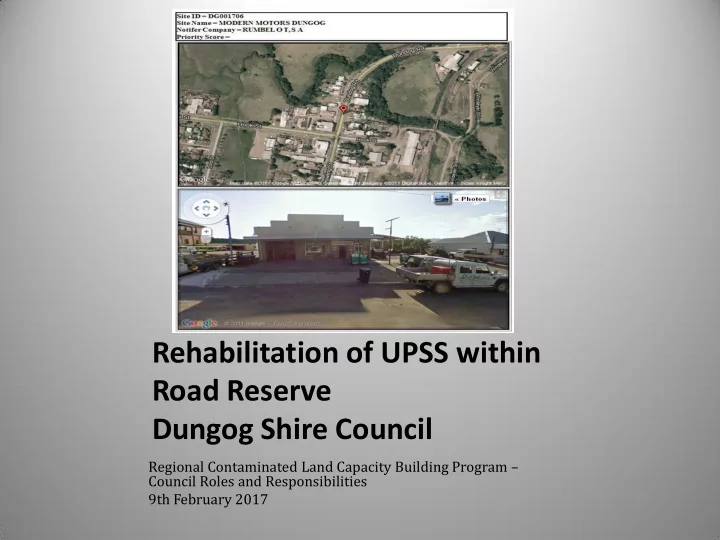
Rehabilitation of UPSS within Road Reserve Dungog Shire Council

Regional Contaminated Land Capacity Building Program – Council Roles and Responsibilities 9th February 2017
slide-2
SLIDE 2

Or $200k to remove 4 tanks

WHAT THA?

slide-3
SLIDE 3

Background

  • POEO (UPSS) Regulation 2008 – 1st June 2008
  • Prior to commencement of Regulation Dungog

Shire Council made submissions in relation to proposed Regs-

  • Cost to proprietors
  • Cost of compliance- cost shifting to Councils
  • Sought clarification over responsibility for

UPSS on public land

  • Motion to LGSA conference that the

Government be lobbied to address these issues.

slide-4
SLIDE 4

Background

  • May 2011 NSW Environmental Trust approved

pilot program- Derelict UPSS Pilot Program

  • 3 years – shared $2m funding with Innocent
  • wners scheme and Council Gasworks scheme
  • Programs managed by DECC under the

combined Contaminated Land Management Program

  • EPA shortlisted 37 Councils based on an

assessment of sensitive environments, use of groundwater, number of potential derelict UPSS.

slide-5
SLIDE 5

Background

  • October 2011 – Top 5 Councils on list

invited to participate in First Stage of Pilot program

  • Dungog, Liverpool Plains, Muswellbrook,

Wellington , Dubbo.

slide-6
SLIDE 6

Why Dungog?

  • Selected due to high number of UPSS

present under Public Roads.(12 known)

  • Dungog had also agitated since 2008 about

impact of UPSS Regs, cost shifting and responsibility for redundant and abandoned tanks.

slide-7
SLIDE 7
slide-8
SLIDE 8

What did Dungog hope to achieve from Pilot Program?

  • Development of tools to assist future UPSS

projects eg breifing notes/scope of work for consultants, standard contract templates.

  • Get an understanding of costs involved
  • Staff skills capacity building
  • Chance to eliminate at least one problem

site.

slide-9
SLIDE 9

Stage 1 of the UPSS Pilot Program

  • Preliminary investigation of 5 sites within each
  • f the 5 council areas.
  • Objective to prioritise derelict sites for detailed

investigation and subsequent remediation work

  • Passive Soil gas sampling- screening tool to

identify extent of contamination and risk

  • Tank inspections –assess access, tank contents
  • $10,000 per site – Managed by OEH and funded

by ET.

slide-10
SLIDE 10

Results of Stage 1

Sites prioritised

  • Investigations carried out in

February 2012

  • 5 sites in Dungog Shire
  • EPA concluded that Modern

Motors- Dowling street Dungog was the highest priority

  • Proximity to waterways
  • Possibly 4 derelict tanks within

road reserve as well as several derelict on private land adjacent

  • Residential premises adjacent
slide-11
SLIDE 11

Progression to Stage 2 of the Pilot

  • EPA pre approved progression to Stage 2-

Remediation.

  • Condition that this stage managed by Council
  • Funding of up to $200K- subject to lodgement

and approval of grant application to ET

  • Council concerned that $200K insufficient if

additional tanks found

  • EPA funded Ground Penetrating Radar

(Pennoscan) for site

slide-12
SLIDE 12
slide-13
SLIDE 13

Learnings

  • GPR recommended to avoid surprises
  • Budget should have contingencies
slide-14
SLIDE 14

Remediation Grant application

  • May 2012 grant application lodged to Env

trust- EPA assisted

  • Remediation grant under Derelict

Underground Petroleum Storage System Pilot Program

  • Stage to be managed by Council with

assistance from EPA

  • February 2013 grant approved- funding

received in full.

slide-15
SLIDE 15

Learnings

  • The Environmental Trust

takes a long time to determine grant applications (9 months)

  • The provision of 100% of

funding upfront is rare but appreciated.

slide-16
SLIDE 16

The Remediation Project

  • No experience within Council in relation to

remediation projects

  • Decision made to contract the project
  • Scope of works developed in consultation

with EPA

  • Close communication at all times with

proprietor of Modern Motors

slide-17
SLIDE 17

Tender process

  • Tender advertised

nationally

  • 11 tenders received
  • Tendered amounts

varied between $62K- $229K

  • Standard cost schedule

simplified comparisons

  • Contract awarded to

Robert Carr and associates ($104,000)

slide-18
SLIDE 18

Learnings

  • Imperative that all tenderers use same

costing schedules for comparisons

  • Remediation experts essential to assess

tenders

  • Important to look for what isn’t included eg

waste disposal fees, wet weather contingencies.

  • Qualifications and experience of tenderers

needs to be analysed

slide-19
SLIDE 19

Stage 1 (Pre- work)

  • Clarify some unknowns
  • Confirm type and size of UST’s and their content
  • Establish if any contingencies or variations to scope
  • f works was required.
  • Integrity testing of tanks
  • Consideration of Heritage status of nearby buildings

including dilapidation survey of Service Station

  • Soil testing for pre-classification of material to be

excavated.

slide-20
SLIDE 20

Stage 1- Remediation Action Plan

  • RAP was prepared and submitted in December

2013 having regard to pre work carried out.

  • Removal of 4 tanks and supporting

infrastructure

  • Excavation of contaminated soil to supporting

bedrock for disposal at a licenced waste facility.

  • Backfill with VENM
  • Re-establishment of site
  • Note: Site no longer used for fuel sales and 6

redundant tanks to remain on private property

slide-21
SLIDE 21

Stage 2 - Works

  • Remediation works considered to be Type 2

under SEPP 55 notwithstanding location on edge of heritage precinct.

  • Permits and plans –safe work method

statements, WHS plans, Pedestrian and Traffic plan, Waste Management plan

  • Temporary fencing, underground service

location and redirection (Telstra)

slide-22
SLIDE 22

Stage 2 works

  • Removal of concrete driveway.
  • Excavation of UPSS pit – no space at

working premises to store material- 100tonnes transported to hardstand area at Dungog waste facility

  • Removal and cutting of 4 tanks- disposal at

waste facility.

  • Sampling of soil in excavated pit
slide-23
SLIDE 23

Stage 2 works

  • Extreme rainfall whilst awaiting soil test

results filled excavated pit.

  • 1000 litres of effluent removed by tanker

disposed of at liquid waste facility

  • After soil test results received – excavation

backfilled and compacted with VENM.

  • Disturbed area re-concreted by contractor 3

weeks later

slide-24
SLIDE 24
slide-25
SLIDE 25
slide-26
SLIDE 26

Validation sampling results

  • Validation samples collected on walls and

base of excavation

  • Some contamination ( benzine) remained in

excess of human health and ecological criteria of the NEPM

  • Owing to transient use and intended

concrete capping- consultant recommended no further remediation works

slide-27
SLIDE 27

Stage 3- Assessment of downgradient impacts

  • Objective to determine migration of

contaminants

  • Soil samples taken downgradient
  • 2 groundwater monitoring wells installed
  • Vapour monitoring carried out in subfloor

areas of 2 nearby residences

  • Groundwater sampling
slide-28
SLIDE 28
slide-29
SLIDE 29

Stage 3 – Validation results

  • Samples for –
  • Soil
  • Vapour
  • Groundwater
  • All within NEPM criteria
  • No further down gradient remediation

required.

  • Existence of redundant UST’s on private

property noted.

slide-30
SLIDE 30
slide-31
SLIDE 31

Costs

  • Grant $200K
  • Total expenditure

$195K

  • Consultant $116K
  • Re-establish site $35K
  • Waste disposal $27K
  • Council admin costs

$17K

slide-32
SLIDE 32

Challenges

  • Starting from scratch with no internal

expertise in remediation projects

  • Reliance on external parties – EPA,

Consultant and subcontractors

  • Evolving work environment- not all matters

are known upfront

slide-33
SLIDE 33

Opportunities

  • Development of tools – eg Scope of work

and brief for consultants, template contract documents

  • Better understanding of applicable costs
  • Development of staff skills
  • Enhanced relationship with EPA
  • Example of project process for owners of

UPSs (including council)

slide-34
SLIDE 34