
Pilot Residential Occupancy Scheme - BALLINROBE Project Summary Name of Local Authority: Mayo County Council Name of Town: Ballinrobe Town Profile: Ballinrobe is identified in the Mayo County Development Plan as a ‘key town’. Strategically located in the south of the county, mid-way between Castlebar and Galway, it is a long- established market town for a sizeable hinterland in south Co. Mayo. A patent for a market was
- btained in 1605. A strong central urban block (6ha) is bounded and defined by Main Street, Glebe
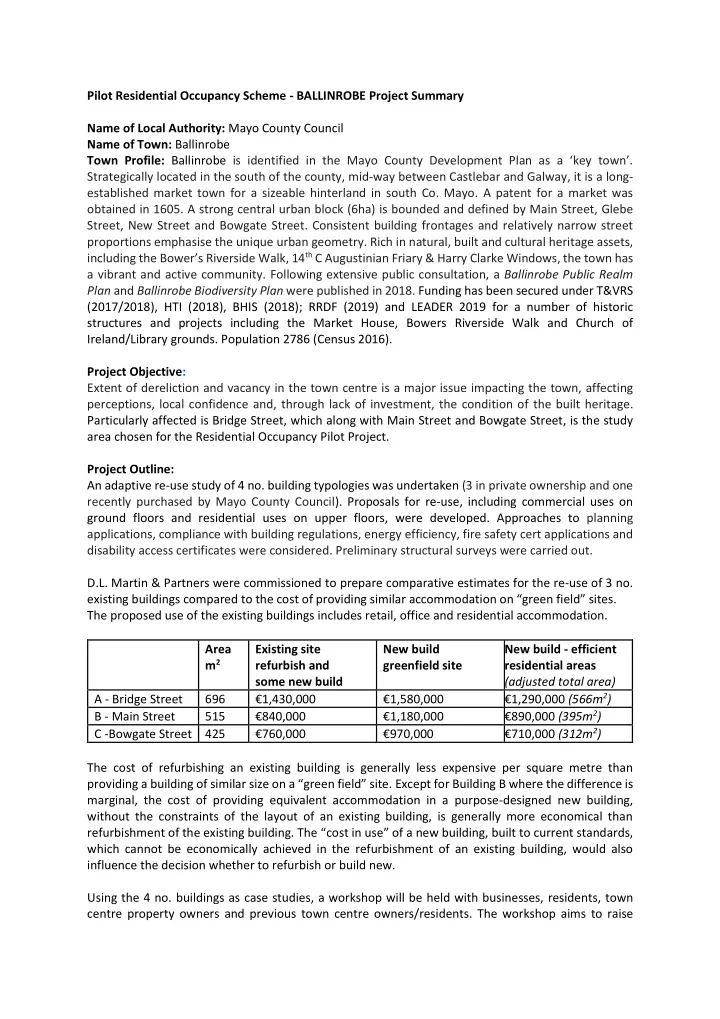
Street, New Street and Bowgate Street. Consistent building frontages and relatively narrow street proportions emphasise the unique urban geometry. Rich in natural, built and cultural heritage assets, including the Bower’s Riverside Walk, 14th C Augustinian Friary & Harry Clarke Windows, the town has a vibrant and active community. Following extensive public consultation, a Ballinrobe Public Realm Plan and Ballinrobe Biodiversity Plan were published in 2018. Funding has been secured under T&VRS (2017/2018), HTI (2018), BHIS (2018); RRDF (2019) and LEADER 2019 for a number of historic structures and projects including the Market House, Bowers Riverside Walk and Church of Ireland/Library grounds. Population 2786 (Census 2016). Project Objective: Extent of dereliction and vacancy in the town centre is a major issue impacting the town, affecting perceptions, local confidence and, through lack of investment, the condition of the built heritage. Particularly affected is Bridge Street, which along with Main Street and Bowgate Street, is the study area chosen for the Residential Occupancy Pilot Project. Project Outline: An adaptive re-use study of 4 no. building typologies was undertaken (3 in private ownership and one recently purchased by Mayo County Council). Proposals for re-use, including commercial uses on ground floors and residential uses on upper floors, were developed. Approaches to planning applications, compliance with building regulations, energy efficiency, fire safety cert applications and disability access certificates were considered. Preliminary structural surveys were carried out. D.L. Martin & Partners were commissioned to prepare comparative estimates for the re-use of 3 no. existing buildings compared to the cost of providing similar accommodation on “green field” sites. The proposed use of the existing buildings includes retail, office and residential accommodation. Area m2 Existing site refurbish and some new build New build greenfield site New build - efficient residential areas (adjusted total area) A - Bridge Street 696 €1,430,000 €1,580,000 €1,290,000 (566m2) B - Main Street 515 €840,000 €1,180,000 €890,000 (395m2) C -Bowgate Street 425 €760,000 €970,000 €710,000 (312m2) The cost of refurbishing an existing building is generally less expensive per square metre than providing a building of similar size on a “green field” site. Except for Building B where the difference is marginal, the cost of providing equivalent accommodation in a purpose-designed new building, without the constraints of the layout of an existing building, is generally more economical than refurbishment of the existing building. The “cost in use” of a new building, built to current standards, which cannot be economically achieved in the refurbishment of an existing building, would also influence the decision whether to refurbish or build new. Using the 4 no. buildings as case studies, a workshop will be held with businesses, residents, town centre property owners and previous town centre owners/residents. The workshop aims to raise