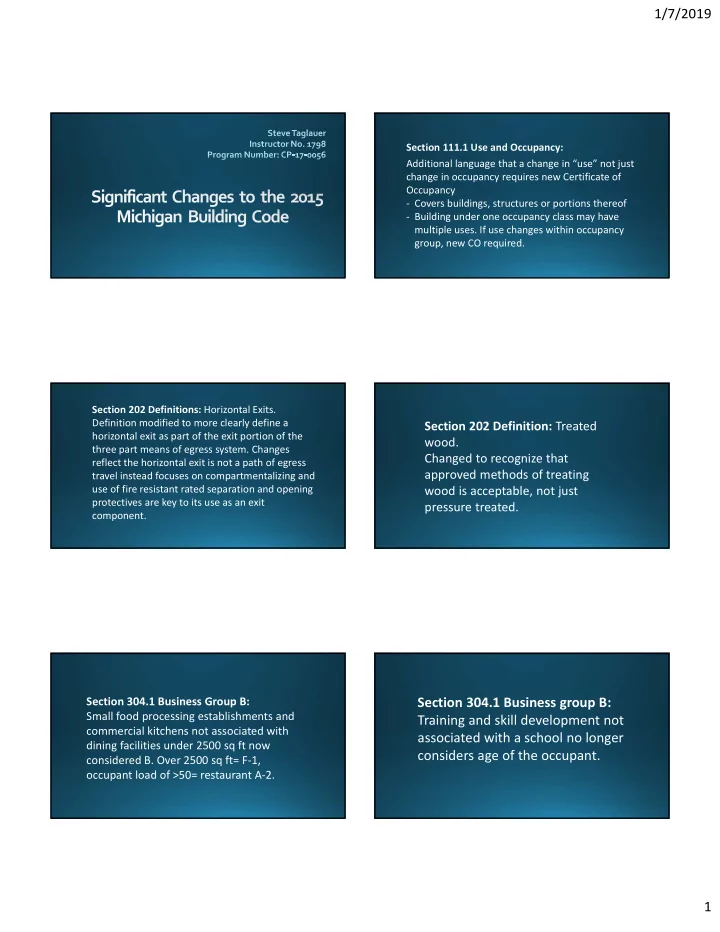
SLIDE 1 1/7/2019 1
Section 111.1 Use and Occupancy: Additional language that a change in “use” not just change in occupancy requires new Certificate of Occupancy ‐ Covers buildings, structures or portions thereof ‐ Building under one occupancy class may have multiple uses. If use changes within occupancy group, new CO required. Section 202 Definitions: Horizontal Exits. Definition modified to more clearly define a horizontal exit as part of the exit portion of the three part means of egress system. Changes reflect the horizontal exit is not a path of egress travel instead focuses on compartmentalizing and use of fire resistant rated separation and opening protectives are key to its use as an exit component.
Section 202 Definition: Treated wood. Changed to recognize that approved methods of treating wood is acceptable, not just pressure treated.
Section 304.1 Business Group B: Small food processing establishments and commercial kitchens not associated with dining facilities under 2500 sq ft now considered B. Over 2500 sq ft= F‐1,
- ccupant load of >50= restaurant A‐2.
Section 304.1 Business group B: Training and skill development not associated with a school no longer considers age of the occupant.
SLIDE 2
1/7/2019 2 Section 306.2 Moderate Hazzard Factory F‐1: Reflects changes from the B group in regard to size of commercial kitchens or food processing establishments. Section 308.3 Institutional Group I‐1: Expands allowable uses that can be considered as Group I‐1. Defines two new conditions;
‐ Condition 1. (308.3.1) Includes buildings in which custodial care is given to occupants capable of self‐preservation. ‐ Condition 2 (308.3.2) Includes buildings in which custodial care is given to occupants who require “limited verbal or physical assistance” while responding to an emergency. Group I‐1 Condition 2 occupancies include more stringent requirements for story limitations, smoke barriers, sprinkler protection and smoke detection.
Section 308.4 Institutional Group I‐2: Similar to Group I‐1 occupancies, new code section breaks Group I‐2 occupancies into two separate conditions. ‐ Condition 1 (308.4.1.1) Facilities for longer term care that do not do surgeries or emergency treatment. (Nursing Homes) ‐ Condition 2 (308.4.1.2) Facilities for shorter term care where surgeries and emergency care is provided. (Hospitals)
SLIDE 3 1/7/2019 3 Section 310.5 Residential R‐3 Lodging Houses: New definitions in Chapter 2: Guest Room. A room used or intended to be used by one or more guests for living or sleeping purposes.
Section 310.5 Residential R‐3 Lodging Houses: New definitions in Chapter 2: Lodging House. A one family dwelling where one or more occupants are primarily permanent in nature and rent is paid for guest rooms. (Does not need to be
310.5.2 Lodging houses‐Owner
- ccupied lodging houses with 5 or
fewer guest rooms are allowed to be constructed using the MRC.
Section 310.6 Residential Group R‐4: Similar to changes in Section 308, now breaks Group R‐4 occupancies into two separate conditions. ‐ Condition 1 (310.6.1) Residential Care facility of 5‐16 occupants capable of self‐ preservation. ‐ Condition 2 (310.6.2) Residential care facility of 5‐16 occupants that may require limited verbal or physical assistance responding to an emergency. Look for increased protections in Condition 2. Section 311.1.1 Accessory Storage Spaces: Now mandates that storage spaces 100 sq ft
- r less shall not be classified as Group S, but
the same occupancy Group as the rest of the
- space. It is still appropriate to classify a
storage room greater than 100 sq ft the same as the space as long as the use does not constitute an increase in the hazard.
SLIDE 4 1/7/2019 4
Section 404.5 Smoke Control Exception: All Group I‐1 Condition 2 and all I‐2
- ccupancies with an atrium that
connects only two stories are required to contain a smoke control system. Section 404.9/10 Exit Access Travel Distance (Atriums): New section detailing requirements associated with the 3 distinct travel distance conditions.
‐ (404.9.1) Travel not through Atrium travel distance per Section 1017. ‐ (404.9.2) Through atrium on level of exit discharge per Section 1017. ‐ (404.9.3) Through atrium on other than exit discharge, 200 feet maximum in atrium. ‐ (404.10) Maximum 50% of interior exit stairways are allowed through atriums.
Section 407.2.5 Nursing Home Housing Units: Spaces in Group I‐2 Condition 1 including shared living spaces, group meeting rooms,
- r multi‐purpose therapeutic rooms are
permitted to be open to the corridor if all five conditions are met:
‐ Walls and ceiling constructed as required for corridors. ‐ Spaces are not used as residential sleeping rooms. ‐ Space is protected by automatic fire detection system. ‐ Corridor is protected by automatic fire detection system or, equipped throughout with quick response sprinklers. ‐ The space is arranged as to not obstruct access to exits.
Section 407.2.6 Cooking Facilities: Specific to I‐2 Condition 1 occupancies. Cooking facilities with domestic cooking appliances shall be permitted to be open to the corridor if 13 conditions are met.
SLIDE 5 1/7/2019 5
‐ Number of residence in smoke compartment does not exceed 30. ‐ Cooking facility services maximum 30 residence. ‐ One cooking facility per smoke compartment. ‐ The corridor is clearly identifies by construction, floor pattern material or color. ‐ Space is arraigned as to not obstruct exit access. ‐ Cooktop or range shall have a domestic cooking hood installed per the MMC. ‐ Hood shall be equipped with an automatic fire extinguishing system. ‐ A manual actuation device for the hood shall be installed.
‐ Interlocking device that shuts down cooking appliance when fire extinguishing system is activated. ‐ Shutoff of the fuel and electrical power supply to the cooking equipment installed accessible by staff only. ‐ A timer that automatically deactivates the cooking appliance within a period of not more than 120 minutes. ‐ Portable fire extinguishers installed per Section 906 if the IFC.
Section 407.5 Smoke Barriers: In Group I‐2 Condition 2 occupancies, the size of the smoke compartment has increased to 40,000 sq ft with a maximum travel distance of 200 feet to a smoke barrier door. Section 503 General Building Height and Area Limitations: This section has been totally rewritten to break the old Table 503 down into separate tables dealing with specific building
- limitation. No technical changes, just
presentation. Table 504.3 Allowable Building Height in Feet Above Grade Plane: New table gives allowable building height values per occupancy, type of construction and whether the building is sprinklered or not. Table 504.4 Allowable Number of Stories Above Grade Plane: New table give allowable number of stories above plane based on occupancy, type of construction and whether the building is sprinklered or not.
SLIDE 6 1/7/2019 6
Tables 504.3 and 504.4: Both Tables provide values for increased height and number of stories based of fully sprinklered so no further calculations are required. Section 505.2.3 Exception 2 Mezzanine Openness: Exception 2 has been modified to no longer require “direct access to an exit” from enclosed or partially enclosed mezzanines.
Table 506.2 Building Area: New table lists allowable building area with consideration to allowable increases for sprinkler protection for single or multi‐story buildings based on occupancy and type of construction. Gives allowable area increases for:
‐ NS= Non‐sprinklered ‐ S‐1= Sprinklerd one story ‐ Sm= Sprinklered multi‐story ‐ S13R= Sprinklered residential structures of less than four stories in height and 60 feet above grade plane. Section 507.1 Basements in Unlimited Area Buildings: Basements under an unlimited area building that are no more than one story below grade plane are now specifically allowed. Section 507.9 Unlimited Mixed Occupancy Buildings with Group H‐5. Fully sprinklered buildings a maximum two stories in height, with a minimum of 60 feet
- pen space on all sides can contain
unlimited Group H‐5 occupancies provided:
SLIDE 7
1/7/2019 7
‐ Construction Type I or II ‐ Each Group H‐5 area separated per the requirements of 415.11 (special provisions for H‐5 occupancies) and 508.4 (required separation per occupancies). ‐ Each H‐5 area must not exceed the maximum allowable area per 503.1 as modified by 506.
Exception: Where H‐5 areas exceed allowable area, the H‐5 areas shall be subdivided into areas separated by 2—hour fire barriers. Table 509 Fire Protection from Incidental Uses: Table 509 has been modified to include areas specific to ambulatory care facilities and Group I‐2 occupancies.
Ambulatory Care Facilities: ‐ Labs not classified as H 1 hour separation OR sprinklered ‐ Waste and linen collection rooms 1 hour separation where containers have an aggregate volume of 10 cubic feet or more ‐ Storage rooms over 100 sq ft 1 hour separation
Group I‐2 ‐ Labs not considered H 1 hour separation AND sprinklered ‐ Laundry rooms 1 hour separation where more than 100 sq ft ‐ Patient rooms with padded walls 1 hour separation ‐ Physical plant maintenance shops 1 hour separation ‐ Waste and Linen collection rooms where containers have an aggregate volume of 10 cubic feet or more 1 hour separation ‐ Storage rooms over 100 sq ft 1 hour separation
SLIDE 8 1/7/2019 8
Section 510.2 Horizontal Building Separation: Section modified to allow for unlimited number
- f stories below 3 hour horizontal assemblies as
long as total building height does not exceed allowable height in Table 504.3. The following conditions must be met: ‐ 3 hour horizontal assembly ‐ Below horizontal assembly, only Type IA construction allowed ‐ Shaft, ramps, stairways and escalator enclosures must have minimum protection
- f 2 hour fire protection rating and opening
protectives ‐ Cont’d ‐ Occupancies allowed above horizontal assembly limited to A, with occupant load of 300 or less, B, M , R, or S. ‐ Below horizontal assembly, no restrictions on
- ccupancies except for Group H
‐ Total building height does not exceed limits in 504.3. Table 601 footnote d: Footnote d has been eliminated due to its extremely limited application and misuse. In conjunction with 901.2, it is more advantageous to sprinkler a building and classify it as unprotected. Previous footnote d allowed a substitution of 1 hour construction if an NFPA 13 sprinkler system was installed provided it was not required elsewhere in the code or if used for an increase in area and height for other than exterior walls. Section 603.1 item 26 Allowable Materials: Wall framing for wall freezers or coolers have been added to the list of allowable combustible items in Type I or II constructed buildings as long as: ‐ Coolers and freezers are less than 1000 sq ft ‐ Both sides are lined with non‐combustible material ‐ Building protected throughout with an automatic sprinkler system
SLIDE 9 1/7/2019 9
Table 705 2 Minimum Distance of Projections: Fire Separation Distance (FSD) Minimum Distance from Line Used to determine FSD 0‐2 feet No projection permitted <2‐3 feet 24 inches <3‐ <30 feet 24” plus 8” for each foot
30’ or more 20 feet
Section 705.2.3 Combustible Projections: Combustible projections located within 5 feet of the line used to determine FSD shall be of not less than 1 hour construction, Type IV construction, or of fire retardant treated wood.
Section 705.3 Buildings on Same Lot: When built on the same lot with zero separation distance, Group R‐2 and S‐2 buildings can now have openings between them if: ‐ Built as separate buildings ‐ R‐2 any type of construction ‐ S‐2 Type I or IIA ‐ Openings must be 90 minute fire rated from S‐2 side only ‐ No longer need fire walls.
Section 705.6 Structural Element Bracing of Exterior Walls: Interior structural elements such as a floor or roof element that brace exterior walls are no longer required to be regulated for fire resistance due to the exterior wall rating, regardless of buildings proximity to a lot line.
Section 705.8.5 Vertical Separation of Openings: Clarification in the text where vertical separation of openings is required, the fire resistance rating of exterior walls shall be rated for exposure from both sides.
SLIDE 10
1/7/2019 10
Section 706.2 Structural Stability of Fire Walls: Modification that now recognizes the three specific types of fire wall construction methods outlined in NFPA 221, tied, cantilevered, and double wall fire wall construction. All three methods are recognized to meet the code requirements for a fire wall that allows collapse of the surrounding structure without collapse of the fire wall.
Section 709.4 Continuity of Smoke Barriers: Clarifies continuity requirements for smoke barrier walls utilized in two specific uses: ‐ 709.4.1 Smoke barrier walls separating smoke compartments: Smoke barrier walls must be continuous from exterior wall to exterior wall
‐ 709.4.2 Smoke barrier walls enclosing areas of refuge or elevator lobbies: Smoke barrier walls may terminate at another smoke barrier, fire barrier or exterior wall. Also, a smoke and draft control door assembly is not required at each elevator hoistway or each exit doorway between an area of refuge and the exit enclosure.
Sections 711/712 Horizontal Assemblies and Vertical Openings: Change in formatting of text for clarification separates the requirements for horizontal and vertical openings into separate sections. ‐ Section 711 now only covers the requirements for horizontal assemblies including floors, ceilings and roofs. ‐ Section 712 now only covers vertical opening protection requirements.
Section 714.4.2 Membrane Penetrations: When a double top plate interrupts a rated horizontal assembly, the wall must be sheathed with Type X drywall on both sides. The wall does not need to be fire rated unless otherwise required to be elsewhere in the code.
SLIDE 11 1/7/2019 11
Section 717.1.1 Duct and Air transfer Openings: Ducts transitioning between shafts shall not require a shaft enclosure provided that the duct penetrations between each shaft is protected with dampers.
Section 717.3 & 717.5 Corridor Dampers: Clarification in code text with added definition for Corridor Dampers in Chapter 2. ‐ Corridor Dampers. A Listed device intended for use where air ducts penetrate or terminate at horizontal openings in the ceiling of fire‐resistance‐ rated corridors, where the corridor ceiling is permitted to be constructed as required for the corridor wall. Corridor dampers are required in “tunnel corridor construction” where a rated assembly is laid horizontal under the floor/ roof assembly above. Air duct penetrations in this assembly must be protected by corridor dampers a minimum of 1 hour fire resistance rating and carry a Type I or II air leakage rating. Section 903.2.1.6 Assembly Occupancies of Roofs: New code section that requires all floors between the level of exit discharge and an occupied roof to be fire sprinkler protected when a Group A‐2 occupancy with an occupant load of over 100 or other group A
- ccupancies with an occupant load of greater than 300.
Exception to this is the sprinkler protection is not required over open parking garages or buildings of Type I or II construction. Section 903.2.1.7 Multiple Fire Areas: New code section that requires an automatic sprinkler system to be installed when multiple fire areas of Groups A‐1, A‐2, A‐3 or A‐4 share a common exit or exit access component when the combined fire area occupant load exceeds 300.
Section 903.2.8 Sprinkler Systems‐ Group R Occupancies: Modified code section that defines requirements for automatic sprinkler systems in group R‐4 Conditions 1 and 2 including attics depending on their use.
SLIDE 12 1/7/2019 12
‐ 903.2.8.2 Group R‐4 Condition 1 require NFPA 13‐D system ‐ 903.2.8.3 Group R‐4 Condition 2 required NFPA 13‐R system. Attic protection based on use. ‐ 903.2.8.3.1 Attics in Group R‐4 Condition 2 used for living purposes, storage or fuel fired equipment shall be protected with a NFPA 13‐R system. ‐ 903.2.8.3.2 Attics in Group R‐4 Condition 2 not used for living purposes, storage or contain fuel fired equipment shall be protected by one of the following:
- Heat detectors connected to fire alarm system
- Be of non‐combustible construction
- Constructed with fire retardant treated wood
- Extension of the fire sprinkler system throughout
entire attic Section 903.3.1.1.2 NFPA13 Sprinkler Systems: Sprinklers are no longer required in Group R
- ccupancies, other than Group R‐4, in small
bathrooms less than 55 sq ft in area located in individual dwelling or sleeping units provided walls and ceilings are of non‐combustible or limited combustible material with a 15‐minute thermal barrier including behind the tub/ shower unit.
Section 903.3.1.2.2 Open Ended Corridors: Where a NFPA 13‐R sprinkler system is installed, it must extend to open ended corridors and associated exterior stairways
Section 903.3.8 Limited Area Sprinkler Systems: Further restrictions have been placed of limited area sprinkler systems where the maximum number of sprinkler heads in this type of system has been lowered from 20 to 6.
Section 904.13 Domestic Cooking Systems in Group I‐2 Condition 1: Domestic cooking hoods over the cooktop or range installed in Group I‐2 Condition 1 must now be protected with automatic fire extinguishing equipment with manual activation interconnected with the hood suppression. A portable fire extinguisher must be mounted within 30’ of the cooking appliance.
SLIDE 13 1/7/2019 13
Section 907.2.3 Fire Alarms‐ Group E Occupancies: Manual fire alarm systems are required when the
- ccupant load of a Group E building is greater
than 50. Emergency voice/ alarm communication (EVAC) system is required with an occupant load greater than 100.
‐ 0‐50 occupants No fire alarm required ‐ 51‐100 occupants Manual fire alarm required ‐ 100+ occupants Manual fire alarm with EVAC system required.
Section 907.2.9.3 Alarm System Group R‐2 College and University Buildings: Group R‐2 buildings used for student or staff housing associated with a college or university shall be equipped with an automatic smoke detection system tied into the buildings fire alarm system and notification devices whether or not the school actually owns the building. (Fraternity/ Sorority houses, private dormitories, apartment house rented exclusively to students…)
Section 907.2.11.3/ 907.2.11.4 Smoke Alarms near Cooking Appliances / Bathrooms: New wording in the MBC that matches that in the 2015 MRC. These restrictions are not valid if these are the only locations available to meet code for location of alarms.
Location near cooking appliance: ‐ Ionization alarms w/ alarm silencing switch must be 10’ from cooking appliances ‐ Ionization type smoke alarms not installed within 20 feet horizontal from permanently installed cooking appliances ‐ Photoelectric alarms‐ not within 6 feet from permanently installed cooking appliances
Bathrooms: Smoke alarms should not be installed within 3 feet from the door to bathrooms with tubs or showers
SLIDE 14 1/7/2019 14
Section 910 Smoke and Heat Removal: The format and technical requirements for smoke and heat removal systems have been revised, including a new allowance permitting a mechanical smoke removal system as an alternative to smoke and heat vents. Section 915 Carbon Monoxide Detection: New code section bringing together all the requirements for carbon monoxide detection into one section. Adds group E
- ccupancies and eliminates Group I‐3.
‐ 915.1 Details about which occupancy group require CO detectors with specific requirements for each group ‐ 915.2 Details specific locations required to have CO detectors ‐ 915.3 Where carbon monoxide detection shall be provided, it shall be provided by CO alarms
‐ 915.4 Requires CO alarms to be hard wired with battery back‐up and allows for combination CO/ smoke alarms ‐ 915.5 Carbon monoxide detections systems are an acceptable alternative to CO alarms. ‐ 915.6 Carbon Monoxide alarms and detection systems shall be maintained in accordance with the International Fire Code.
Chapter 10 Means of Egress‐ General: The entire Chapter 10 has been re‐formatted to hopefully become more user friendly. In MBC 2012 edition Section 105 covered the number and arrangement of the means
- f egress from a space. Section 1021 dealt with the story
- r building as a whole. Provisions for each section have
been combined, or if duplicated, eliminated. New section 1006 covers the required number of exits and 1007 now covers the arrangement and separation of the means of egress routes to add continuity.
Section 1004.1.1 Cumulative Occupant Loads: Requires that occupant load from intervening or accessory spaces must be added together with all interconnected spaces that share egress components to determine egress component width, door swing direction, and number of required exits or exit access doorways, including mezzanines that egress thru rooms they are in. Other than egress components in areas of convergence, the occupant load from other stories shall not be factored in.
SLIDE 15 1/7/2019 15
Table 1004.1.2 Occupant Load Factor: The occupant load for Mercantile
- ccupancies has been changed to one
- ccupant per 60 sq ft regardless of
story. Section 1006/ 1007 Number of Exits and Exit Access Doorways: Reformatted sections with emphasis
- n “common path of egress travel”
instead of “exit access distance”.
‐ 1006.2 Defines the number of exits or access to exits from spaces including mezzanines and number based on occupant load and common path of egress travel distance. ‐ 1006.3 Covers the number of egress components from stories and occupied roofs. ‐ 1007 Addresses the arrangement and separation between the egress components.
Section 1007.1 Exit and Exit Access Doorway Configuration: Gives specific information of how the points
- f exit separation are to be measured for
exits or exit access doorways, stairways and
- ramps. Also new language to ensure paths
are adequately separated when three or more means of egress are required. Section 1009.8 Two Way Communication Systems: Clarification of code text to better highlight that a two‐way communication system may serve multiple elevators where there is a bank
- f elevators and that two way communication
systems are not required at service, freight or private residence elevators. Section 1010.1.9 Door Operations‐Locking Systems: Relocated from Section 1008, several modifications to help clarify requirements. New terminology includes the phrase “access control system units” which is consistent with terminology in the lock industry and standard UL 294.
SLIDE 16 1/7/2019 16 Section 1011.15 Ships Ladders: Covers the design requirements and locations ships ladders can be utilized in a means of egress system.
Section 1011.16 Ladders: New code section that prohibits ladder to be utilized in a means of egress system but can be utilized for access to specific
- locations. Also the ladders must be
designed and constructed per Section 306.5
- f the Michigan Mechanical Code.
Section 1016.2 Egress Through Intervening Spaces: Enclosed elevator lobbies shall not be considered intervening spaces and egress through an enclosed elevator lobby is acceptable where access to at least one exit is available without passing through the elevator lobby. 1017.2.2 Travel Distance Group F‐1 and S‐1 Increase: The maximum travel distance from Group mF‐ 1 and S‐1 has increased to a maximum of 400 feet provided the portion of the F‐1 or S‐1 in
- ne story, minimum ceiling/ roof height above
finished floor is 24 feet and building is equipped throughout with an NFPA 13 sprinkler system.
Section 1018.3 Aisles in Group B and M: Aisles must be sized per the requirements
- f Section 1005.1 for the occupant load it
serves but be not less than what is required for corridors in Section 1020.2.
Section 1018.5 Exception Aisle in Other Than Assembly or Group B and M: Adds the exception found in 1018.3 that non‐public aisles serving less than 50
- ccupant that do not otherwise need to be
accessible in Chapter 11 need not exceed 28”.
SLIDE 17 1/7/2019 17
Section 1020.2 Corridor Width and Capacity: Allows a reduction in the required width of a corridor in I‐2 occupancies where bed and stretcher movement is not necessary
- r part of the defend in place strategy
required in Section 407.5.1. Section 1023.3.1 Stairway Extension: The door separating an interior exit stairway to an exit passageway may be eliminated if there are no openings into the exit passageway except the exit. Section 1103.2.8 Areas in Places of Religious Worship: Raised or lowered areas less than 300 sq ft and located 7 inches or more above or below the finished floor do not need to be accessible. Section 1107.5.1.1 Accessible Units in Assisted Living Facilities‐ Group I‐1: Change in required accessible units in Group I‐1 now based on Condition. ‐ Group I‐1 Condition 1= 4% of total but not less than 1 ‐ Group I‐1 Condition 2= 10% of total but not less than 1 Section 1107.6.4.1 Accessible Units in Group R‐4: Change in required accessible units in Group R‐ 4 now based on Condition. ‐ Group R‐4 Condition 1= At least one ‐ Group R‐4 Condition 2= At least two Bedrooms in Group R‐4 Condition 2 facilities shall be counted as sleeping units to determine total number required. Section 1107.6.1.1 Group R Accessible Units: Method to determine the minimum number of accessible units has been modified for a site with multiple buildings.
SLIDE 18 1/7/2019 18
‐ For Buildings with 50 or more dwelling units or sleeping units, the number of required accessible units is determined per building and these required accessible units must be located within that building.
‐ Buildings with less than 50 dwelling or sleeping units, the determination is based
- n the total number of units on the site
and the accessible units may be provided in any one or more building.
Section 1109.2.2 Water Closet Compartments: Change in the text of this section could lead to an increase in accessible toilets in very large toilet
- rooms. New provisions now read at least 5% of
total water closet compartments must be wheelchair accessible and at least 5% of the total water closet compartments shall be ambulatory accessible
Section 1110 Recreational Facilities: New Section 1110 has been added to add scoping requirements for recreational facilities to coordinate with the ADA and provide the scoping for technical requirements in Chapter 11 of the ICC/ ANSI A117.1 standard. Section 1603 Construction Documents: Drift surcharge and the width of snow drift are now required to be identified on construction documents where the ground snow load is greater than 10 psi. Section 1603.1.7 Flood Design Data: The term “subject to high velocity wave action” has been replaces with “coastal high hazard areas” throughout the IBC to better align with wording in the MRC, ASCE 24 and NFIP.
SLIDE 19
1/7/2019 19
Table 1604.3 Deflection Limits: Modifications have been made to table 1604.3 for interior partition based on finish material, footnote d for wood members, and footnote f for wind loads. Section 1607.5 Partition Loads: In office building uses where interior partitions are subject to change locations, the partition loads shall be considered unless the floor is designed for 80 psi or greater live load. Section 1607.9 Impact Loads for Façade Access Equipment: New requirements have been established addressing loads for façade access platforms and lifeline anchorages devices. Section 1607.12 Roof Loads: New definition for “Vegetative Roof” has been added to Chapter 2. Vegetative Roof: An assembly of interacting components designed to waterproof and normally insulate a building’s top surface that includes, by design, vegetation and related landscape elements. ‐ Reference to standard ASTM E 2397 has been added to compute dead load of landscaping material on the basis of saturation of the soil. ‐ Unoccupied uniform live loads for unoccupied roofs shall be 20 psf. ‐ The uniform live loads of occupied landscaped roofs are to be determined in Table 1607.1. Section 1607.12.5 Photovoltaic Panel Systems: New section detailing the loading requirements for roof structures supporting Photovoltaic panel systems.
SLIDE 20 1/7/2019 20
Section 1613.6 Ballasted Photovoltaic Panel Systems: Ballasted photovoltaic panel systems need not be rigidly attached to the roof or supporting
- structure. Non‐penetrating photovoltaic panel
systems shall be designed and installed on roof slopes with maximum slope of 1:12. Shall be designed to resist lateral and vertical forces by accepted engineering practices. Section 1704.5 Submittals to the Building Official: Seven specific reports or certification previously required in other code sections
- r reference standards have been
relocated to Section 1704.5
1)Certificates of compliance for the fabrication of structural, load barring, or lateral load restricting members on the premises of a registered and approved fabricator in accordance with 1702.5.1 4) Reports on pre‐construction tests for shotcrete in accordance with Section 1908.5 5) Certificate of Compliance for open webbed steel joists and joist girders in accordance with Section 2207.5 6) Reports on material properties for weldability in accordance with ACI 318 when re‐bar is to be welded.
Items 2, 3, and 7 deal with items in reference to seismic design categories other than A.
Section 1705.2.3 Open Web Steel Joists and Joist Girders: Special inspections are now required during the installation for open web steel joists or joist girders including bearing, seat attachment, field splices, and bridging attachments. New Table 1705.2.3 clearly shows required special inspection, frequency and applicable standard. Table 1705.3 Required Special Inspections of Concrete Construction: Required periodic special inspections: ‐ Weldability of reinforcement bars ‐ Single pass fillet welds up to 5/16” ‐ Adhesive or mechanical anchors not requiring continuous inspection
SLIDE 21 1/7/2019 21
Required continuous special inspection: ‐ All other welds not requiring periodic inspection ‐ Adhesive anchors installed in a horizontal or upward sloping orientation Section 1803.5.6 Rock Strata: Where onsite subsurface exploration indicates variations in the structure of the rock supporting foundations, a “sufficient number of borings at sufficient depths” are required to determine capabilities. Section 1803.5.7 Excavations near Foundations: Provides specific guidelines to identify responsibilities and basic requirements for providing safe and adequate underpinning, or
- ther support method approved by the
building official, and excavations. Section 1804.1 Excavation Near Foundations: New Code section that gives specific requirements when underpinning is chosen for lateral support for adjacent foundations. Section 1808.3 Design Surcharge Loads: New code section that no fill or other surcharge loads be placed against a building or structure unless it is capable of withstanding the additional loads. Section 1901.3 Anchoring to Concrete: Section 1908 and 1909 from previous code editions have been deleted because wording was
- bsolete and not consistent with the reference
standard for concrete construction ACI 318. Provisions for anchoring to concrete has been added to the general provisions in Section 1901 which reference ACI 318‐14.
SLIDE 22 1/7/2019 22
Section 1901.4 Composite Structural Steel and Concrete Structures: Section 1912 from previous code editions has been deleted because it was not maintained and incomplete. New wording in Section 1901.4 references Section 2206 for the design
- f composite structural steel and reinforces
concrete structures. Section 1904 Durability Requirements: Durability requirements for structural concrete have been deleted from the 2015 MBC and now is referenced to the ACI‐318‐14 standard. This standard is the reference guide for concrete construction. It covers durability requirements for concrete in buildings other than R‐2 or R‐3 not more than 3 stories. New definition has been added to Chapter 2 for Non‐structural concrete. ‐ Non‐Structural Concrete: Any element made
- f plain or reinforced concrete that is not part
- f a structural system required to transfer
either gravity or lateral loads to the ground. Section 1905.1.3 Modifications to ACI 318 Section 18.5: Requirements for the design of wall piers has been deleted in the MBC. Now covered in Section 18.5 of the ACI 318‐14. Section 1905.1.8 Modifications to ACI 318 Section 17.2.3: The 2012 IBC referenced the ACI 318‐11 but the text in Section 1905 in the 2012 was from the ACI 318‐08. Chapter 17 of the ACI‐318‐14 contains many changes and is now the referenced guide to light frame shear wall anchorage.
Section 2101.2 Masonry Design Methods: Now references TMS 402/ACI 530/ASCE 5
- r TMS 403 in its entirety for the design
and construction of masonry structures for:
SLIDE 23 1/7/2019 23
‐ Design method ‐ Allowable stress design ‐ Strength design ‐ Pre‐stressed masonry ‐ Empirical design ‐ Glass unit masonry Masonry veneer is referenced to Chapter 14
Section 2103 Masonry Construction Materials: Many of the masonry material specifications have been deleted from the MBC because they are covered in the referenced standard TMS602/ACI 530/ ASCE 6. Items not covered by this standard remain in Section 2103.
Section 2104 Masonry Construction: Same as 2103 Section 2105 Quality Assurance: Same as 2103
Sections 2210 Composite Slabs on Steel Decks: Previous editions of the MBC did not have a standard referenced for composite slabs on steel decking. Be brave‐All is well! We now have a new standard referenced SDI‐C. This standard is available for free download at www.sdi.org
Section 2303.1.4 Structural Glues Cross Laminated Timbers: New definition for Cross Laminated Timbers has been added to Chapter 2. Cross Laminated Timbers: A prefabricated engineered wood product consisting of at least three layers of solid sawn or structural composite lumber where the adjacent layers are cross oriented and bonded with structural adhesive to form a solid wood element. New reference standard ANSI/APA/PRG 320.
SLIDE 24 1/7/2019 24
Section 2303.1.13 Engineered Wood Rim Board: New definition in Chapter 2 for Engineered Wood Rim Board. Engineered Wood Rim Board: A full depth structural composite lumber, wood structural panel, structural glue laminated timber, or pre‐ engineered wood I‐joist member designed to transfer …
Section 2303.1.13 Engineered Wood Rim Board: Cont’d
horizontal and vertical loads, provide attachment for diaphragm sheathing, siding and exterior deck ledgers, and provide lateral support at the ends of floor
- r roof joists or rafters.
Two new standards referenced: ANSI/APA/PRR 410‐2011 for the manufacture of EWRB ASTM‐D 7672‐2011 e1 for the structural capabilities.
Section 2308 Conventional Light Frame Construction: Section has been reformatted and re‐
- rganized with inclusion of specific wall
bracing methods and terminology currently found in the IRC. Section 2308.2.5 Allowable Roof Span: Clarification that trusses, ceiling joist and rafters shall not span more than 40’ between vertical supports without an engineered
- design. A ridge board in not considered
vertical support but a ridge beam is. Section 2308.7 Roof and Ceiling Framing: Ceiling joist and rafters span charts from the MRC have been incorporated into the provisions for conventional construction in the IBC. Section 2309 Wood Frame Construction Manual: The American Wood Councils Wood Frame Construction Manual is now referenced for the structural design of wood framed buildings in Risk Categories I or II.
SLIDE 25 1/7/2019 25
Section 2406.4.7 Safety Glazing Adjacent to Bottom Stair Landings: Changed back to pre‐2012 MBC wording to 60” above landing and within a 60” horizontal arc less than 180 degrees from the stair nosing to be consistent with the MRC. 2012 MBC changed to 36” above landing. Chapter 25 Gypsum Panel Products: New/ modified definitions in Chapter 2. ‐ Gypsum Board: The generic name for a family
- f sheet products consisting of a non‐
combustible core of gypsum with paper surfacing. ‐ Gypsum Panel Products: The general name for a family of sheet products consisting essentially of gypsum.
Chapter 25 Gypsum Panel Products: Cont’d Multiple references to the term gypsum panel products have been added throughout Chapter 25.
Section 2612 Plastic Composites: New definitions in Chapter 2: ‐ Plastic Composite: A generic designation that refers to wood/ plastic composites and plastic lumber. ‐ Plastic lumber: A manufactured product made primarily of plastic materials (filled or unfilled) which is generally rectangular in cross section. ‐ Wood/ Plastic Composite: A composite material made primarily from wood or cellulose‐ based materials and plastic.
Section 2612 Plastic Composites: Cont’d New Section 2612 provides new provisions for the allowable use and what standards the materials must meet. Section 2902.3 Public Toilet Facilities: Public toilet facilities are no longer required in structures or tenant spaces intended for quick transactions having a public access area of 300 sq ft or less.
SLIDE 26 1/7/2019 26
Section 3004 Elevator Hoistway Venting: The provisions for elevator hoistway venting have been deleted. Section 3006 Elevator Lobbies: Elevator lobby requirements have been relocated from Section 713.14.1 in the general shaft enclosure section to new Section 3006. Section 3006.1 Elevator Lobbies and Hoistway Opening Protection: Directs code users to other sections of the code for specific situations for elevator lobby and hoistway protections not covered in 3006. Chapter 34 Existing Structures: Chapter 34 of the 2015 MBC has been deleted in its entirety. Work in existing buildings is now solely covered by the International Existing Buildings Code.
Discussion: Chapter 34 In Chapter 34 of the 2015 MBC, there is a reference to the International Existing Building Code. There is no such thing as the Michigan Existing Building Code. The Michigan Code is called the Michigan Rehabilitation Code for Existing Buildings. If you go to the ICC website and read the description of the MRCEB, it say it is based
- n the International Rehabilitation Code for Existing
- Buildings. There is no such document. What are you
planning on using?
Questions:
SLIDE 27
1/7/2019 27
Comment: Thank You!