Shared Activation of Reserve (SAR) and Regional Reserve Sharing - - PowerPoint PPT Presentation

shared activation of reserve sar and regional reserve
SMART_READER_LITE
LIVE PREVIEW

Shared Activation of Reserve (SAR) and Regional Reserve Sharing - - PowerPoint PPT Presentation

Shared Activation of Reserve (SAR) and Regional Reserve Sharing (RRS) Technical Panel June 12, 2007 Agenda Shared Activation of Reserve (SAR) Purpose Activation details Summary statistics Regional Reserve Sharing (RRS)


slide-1
SLIDE 1

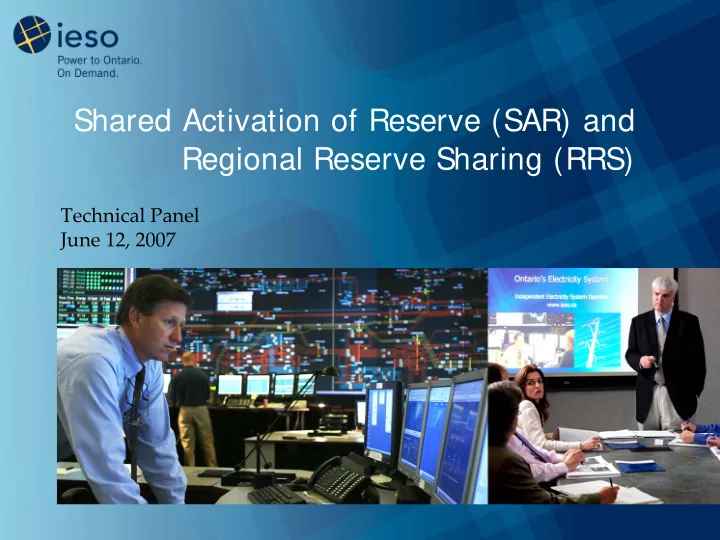
Shared Activation of Reserve (SAR) and Regional Reserve Sharing (RRS)

Technical Panel June 12, 2007

slide-2
SLIDE 2

2

Agenda

  • Shared Activation of Reserve (SAR)

– Purpose – Activation details – Summary statistics

  • Regional Reserve Sharing (RRS)

– Activation details – Process timelines – 2006 Experience

  • Pre‐ and post‐contingency OR requirements
slide-3
SLIDE 3

3

Purpose of SAR

  • To more quickly relieve stress on the

interconnected transmission system following a contingency event

  • To effect an improvement in reliability achieved

by the faster recovery

  • To assist in achieving compliance with the

NERC Disturbance Control Standard

Source: NPCC Document C‐12 Procedures for Shared Activation

  • f Ten Minute Reserve
slide-4
SLIDE 4

4

Activation of SAR

  • Available for contingencies ≥ 500 MW
  • Area requiring assistance may request SAR for up

to 50% of the total contingency loss

  • SAR request allocated proportionately amongst

assisting areas, provided no transmission constraints

– Allocations determined by NYISO

  • Assistance from SAR can be maintained for up to

30 minutes

  • Activation of SAR causes inadvertent interchange
slide-5
SLIDE 5

5

Example – SAR Activation

100 200 300 400 500

Time (minutes) MW

T=0

500 MW generation loss in Area A

10 20 30 40 50 60 70 80 90 100

250 MW picked up by Areas B, C, D 250 MW picked up by Area A SAR At T=30:

  • Area A activates 250 MW with 10-min ramp
  • Areas B,C,D ramp out 250 MW over 10-min
slide-6
SLIDE 6

6

SAR Statistics:

January 1, 2005 – December 31, 2006

SAR Events IESO ISO‐NE 15 17 Average duration (minutes) 19 9 9 13 11 Number of SAR events lasting the full 30 minutes 4 1 318 582 420 470 3 NBSO NYISO PJM Number of Requests for SAR 1 12 4 Average MW 160 418 493 Maximum MW 160 525 563 Number of times SAR energy converted to RRS energy after 30 minutes

slide-7
SLIDE 7

7

Activation of RRS

  • RRS energy only delivered after SAR has been

utilized

  • After 30 minutes, 100 MW of SAR is converted

to RRS energy which can be maintained for up to 60 minutes following the termination of SAR

  • RRS energy is only available as discrete 100 MW

block, partial activation is not permitted

  • RRS activation creates inadvertent interchange
slide-8
SLIDE 8

8

Example – SAR with RRS

100 200 300 400 500

Time (minutes) MW

T=0

500 MW generation loss in Area A

10 20 30 40 50 60 70 80 90 100

250 MW picked up by Areas B, C, D 250 MW picked up by Area A SAR RRS

slide-9
SLIDE 9

9

RRS – Process Timelines

  • Availability and deliverability of RRS energy is

determined weeks in advance of real‐time

– OR requirement is reduced by 100 MW, if RRS energy is available and deliverable

  • If circumstances change and RRS energy is no

longer available due to capacity or tx constraints, 100 MW added back to OR req’t

– Issue SSR with new OR requirement

  • RRS reduction is applied uniformly in both the

unconstrained and constrained schedules

slide-10
SLIDE 10

10

Experience with RRS

January 4 – December 31, 2006

  • NPCC Balancing Areas have not experienced any

negative reliability impacts resulting from RRS

  • Three requests for delivery of RRS energy

– All three requests by IESO – 100 MW of SAR energy converted to RRS Date Contingency Event Duration

  • f RRS

May 30 SPS rejected 700 MW of generation due to loss of 500 kV transmission line in northeastern Ontario 47 minutes Nov 23 Nuclear unit turbine trip: 800 MW generation loss 60 minutes Dec 19 Nuclear unit turbine trip: 940 MW generation loss 38 minutes

slide-11
SLIDE 11

11

OR Requirements

Pre‐contingency

  • OR requirements not affected by SAR
  • RRS allows participating areas to reduce 10‐min OR

requirement by 100 MW, subject to energy being available in the event of a contingency

– Existing market rules allow the reduction in non‐sync req’t only – MR‐00332 proposes to allow reduction in either sync or non‐sync

Post‐contingency

  • Following a contingency requiring the activation of OR,

total 10‐min OR requirement reduced by the full amount

  • f the contingency