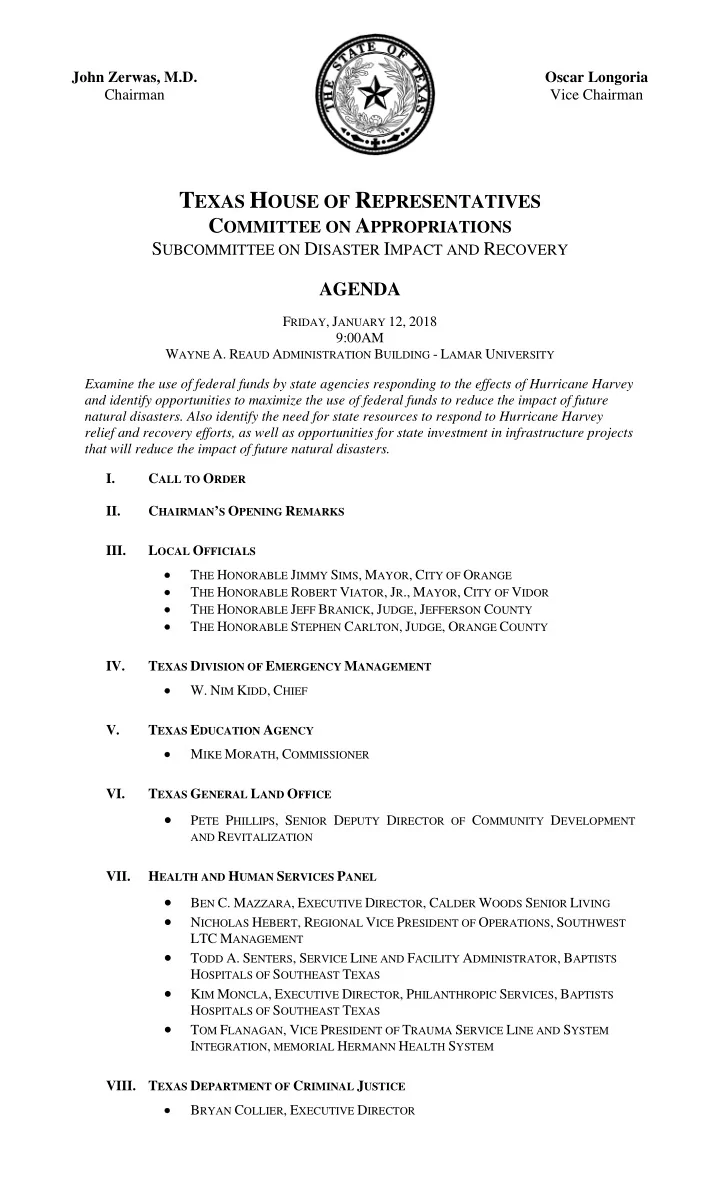
rnmihecaZYXWVUTSRPONMLKJIHGFEDCBA John Zerwas, M.D. Oscar Longoria - - PDF document

rnmihecazyxwvutsrponmlkjihgfedcba
SMART_READER_LITE
LIVE PREVIEW

rnmihecaZYXWVUTSRPONMLKJIHGFEDCBA John Zerwas, M.D. Oscar Longoria - - PDF document

rnmihecaZYXWVUTSRPONMLKJIHGFEDCBA John Zerwas, M.D. Oscar Longoria Chairman Vice Chairman T EXAS H OUSE OF R EPRESENTATIVES C OMMITTEE ON A PPROPRIATIONS S UBCOMMITTEE ON D ISASTER I MPACT AND R ECOVERY AGENDA F RIDAY , J ANUARY 12, 2018


slide-1
SLIDE 1

rnmihecaZYXWVUTSRPONMLKJIHGFEDCBA

John Zerwas, M.D. Oscar Longoria Chairman Vice Chairman

TEXAS HOUSE OF REPRESENTATIVES

COMMITTEE ON APPROPRIATIONS

SUBCOMMITTEE ON DISASTER IMPACT AND RECOVERY AGENDA

FRIDAY, JANUARY 12, 2018 9:00AM WAYNE A. REAUD ADMINISTRATION BUILDING - LAMAR UNIVERSITY Examine the use of federal funds by state agencies responding to the effects of Hurricane Harvey and identify opportunities to maximize the use of federal funds to reduce the impact of future natural disasters. Also identify the need for state resources to respond to Hurricane Harvey relief and recovery efforts, as well as opportunities for state investment in infrastructure projects that will reduce the impact of future natural disasters. I. CALL TO ORDER II. CHAIRMAN’S OPENING REMARKS III. LOCAL OFFICIALS  THE HONORABLE JIMMY SIMS, MAYOR, CITY OF ORANGE  THE HONORABLE ROBERT VIATOR, JR., MAYOR, CITY OF VIDOR  THE HONORABLE JEFF BRANICK, JUDGE, JEFFERSON COUNTY  THE HONORABLE STEPHEN CARLTON, JUDGE, ORANGE COUNTY IV. TEXAS DIVISION OF EMERGENCY MANAGEMENT 

  • W. NIM KIDD, CHIEF

V. TEXAS EDUCATION AGENCY  MIKE MORATH, COMMISSIONER VI. TEXAS GENERAL LAND OFFICE

 PETE PHILLIPS, SENIOR DEPUTY DIRECTOR OF COMMUNITY DEVELOPMENT

AND REVITALIZATION

VII. HEALTH AND HUMAN SERVICES PANEL

BEN C. MAZZARA, EXECUTIVE DIRECTOR, CALDER WOODS SENIOR LIVING

NICHOLAS HEBERT, REGIONAL VICE PRESIDENT OF OPERATIONS, SOUTHWEST LTC MANAGEMENT

TODD A. SENTERS, SERVICE LINE AND FACILITY ADMINISTRATOR, BAPTISTS HOSPITALS OF SOUTHEAST TEXAS

KIM MONCLA, EXECUTIVE DIRECTOR, PHILANTHROPIC SERVICES, BAPTISTS HOSPITALS OF SOUTHEAST TEXAS

TOM FLANAGAN, VICE PRESIDENT OF TRAUMA SERVICE LINE AND SYSTEM INTEGRATION, MEMORIAL HERMANN HEALTH SYSTEM

  • VIII. TEXAS DEPARTMENT OF CRIMINAL JUSTICE

 BRYAN COLLIER, EXECUTIVE DIRECTOR

slide-2
SLIDE 2

wsronihgecaZYXVUTSRQPONMLKJIHGFEDCA rnmihecaZYXWVUTSRPONMLKJIHGFEDCBA IX. TEXAS COMMISSION ON ENVIRONMENTAL QUALITY  BRYAN W. SHAW, CHAIRMAN X. CLOSING REMARKS AND ADJOURNMENT

slide-3
SLIDE 3

SUMMARY OF AGENCY ACTIONS AND DISASTER SUPPORT

HOUSE APPROPRIATIONS COMMITTEE, JANUARY 12, 2018

Hurricane Harvey Response

C.E. King HS, Houston TX

slide-4
SLIDE 4

19

Hurricane Harvey Impact

16

Districts With Delayed Reopenings

17 09 08 10

  • 1

week delayed 14 11 07

61 Districts

12

  • 2

weeks delayed 18 15 13 06 5

62 Districts

4

  • 3

weeks delayed 20 3

11 Districts

  • 4+ weeks delayed

1 2

9 Districts

*Approximation based on available data

Education Service Center Regions with Delayed School Openings

1/8/18 2 Texas Education Agency

slide-5
SLIDE 5

Assessment and Accountability

Testing dates Student Accountability District Accountability

Academic & Financial

1/8/18 3 Texas Education Agency

slide-6
SLIDE 6

STAAR Testing Dates

1/8/18 4

  • 1.9

million students attend school within the surveyed counties, 1.5 million in surveyed districts

  • 59% of

districts responded to survey on potential delay of STAAR administration windows

  • 40

counties represented in the survey

  • 182 districts represented

in the survey

STAAR Administration Survey Results

Texas Education Agency

All districts opted to maintain current schedule Majority of districts opted to maintain current schedule Majority of enrollment represented

  • pted to

change current schedule Majority of LEAs and enrollment represented opted to change schedule All districts opted to change current schedule

slide-7
SLIDE 7

District Response By Delay Time

77% of districts representing 65% of students enrolled in affected area want to maintain current testing schedule. 59% of Districts Reporting.

A week or less delay 2 weeks delay 3+ weeks delay Total

District Student District Student District Student District Student Count Count Count Count Count Count Count Count

Maintain current testing windows Delay testing for two weeks for both windows 92 285,074 40 660,704 8 25,901 140 971,679 21 97,966 17 402,979 4 32,565 42 533,510

Total 113 383,040 57 1,063,683 12 58,466 182 1,505,189

Given the feedback received from districts, the agency is maintain the existing testing schedule.

1/8/18 5 Texas Education Agency

slide-8
SLIDE 8

Student Accountability

End-of-Course (EOC) 5th and 8th Grade

  • Students must pass STAAR in reading and
  • math. If they don’t, they must

participate in a grade placement committee process and potentially have to repeat grade First administration – April 10-13 Second administration – May 14-18 Third administration*

*

– June 26-29

*

The third administration is not used for campus accountability

  • High school students must pass at least 3

EOCs to graduate

  • No Commissioner authority to waive EOC

requirements

1/8/18 6 Texas Education Agency

slide-9
SLIDE 9
  • On December 14, 2017, TEA removed the

requirement for grade placement committees for districts within the Presidential Disaster Declaration and,

  • TEA also

removed the requirement for the June 2018 STAAR retests in fifth and eighth-grades for districts within the Presidential Disaster Declaration.

Student Success Initiative: Elimination of Certain Requirements

  • If a student in a district or charter within the

Presidential Disaster Declaration fails the second test administration, districts will not be required to administer a third test and will have local discretion on whether that student should advance to the next grade.

Action Taken Action Taken What This Means

1/8/18 7

slide-10
SLIDE 10

District Accountability: Elimination of Certain Requirements Action Taken Action Taken What This Means

  • Asked U.S. Department of Ed for a waiver
  • Subject to thresholds to be defined, certain
  • Communicated to districts that exceptions will

campuses and districts may not receive be outlined in forthcoming rules ratings and/or may be given exemptions for

  • Collected data on student displacement,

displaced students facilities disruptions and we will be gathering data on staff displacements

1/8/18 8

slide-11
SLIDE 11

Harvey’s Impact on Accountability TEA’s Data Collection Efforts – Crisis Codes

TEA has issued two To the Administrator Addressed (TAA) letters adding “crisis codes” to more accurately monitor displaced students. On October 5th, TEA informed LEAs of the new, more detailed crisis codes (5A, 5B, and 5C). There are still 123 students coded with the original 05 crisis code as LEAs are still working on recoding these students.

5A

15,909

students

Student was enrolled in an LEA impacted by Harvey, and the student enrolled in a different LEA during the 2017-2018 school year.

5B

2,008

students

Student was enrolled in an LEA impacted by Harvey, and the student enrolled in another campus in the same LEA during the 2017-2018 school year

5C

22,649

students

Student identified as homeless because

  • f Harvey but remained enrolled in

home campus during the 2017-2018 school year

*Numbers current as of Jan. 1,

2018

1/8/18 9 Texas Education Agency

slide-12
SLIDE 12

Use of Crisis Codes Throughout Recovery Period

45000.00 40000.00 25000.00 30000.00 35000.00

8,526 40,689

Jan 1st, 2018

20000.00

Sep 27th, 2017

15000.00 10000.00 5000.00 0.00 9/27/17 10/4/17 10/11/17 10/18/17 10/25/17 11/1/17 11/8/17 11/15/17 11/22/17 11/29/17 12/6/17 12/13/17 '

1/8/18 10

slide-13
SLIDE 13

Harvey Impact on Accountability HB 1842 Interventions

The following districts have at least one campus that has been Improvement Required for four or more years. Highlighted districts are in counties within the Governor’s disaster declaration.

Hou Houston

  • n

IS ISD (1 (10 IR4 Campuses) San San Antonio io ISD SD (6 IR4 Campuses) Ar Arlington ISD (1 IR4 Campus) Au Austin ISD (1 IR4 Campus)

Accountability

Da Dallas ISD (4 IR4 Campuses) Bu Buckholts ISD (1 IR4 Campus) Wa Waco ISD (5 IR4 Campuses) Cr Crystal Ci City ISD (1 IR4 Campus) Be Beaumont ISD (3 IR4 Campuses) Ha Hart IS ISD (1 IR4 Campus) Fo Fort Worth ISD (3 IR4 Campuses) Lu Luling ISD (1 IR4 Campus) Ec Ector County ISD (3 IR4 Campuses) Ma Marshall ISD (1 IR4 Campus) Bi Big Spring ISD (2 IR4 Campuses) Re Reagan County ISD (1 IR4 Campus) Hea Hearne IS e ISD (2 IR4 Campuses) Lu Lubbock ISD (2 IR4 Campuses) Sie Sierra a Blan lanca a ISD SD (1 IR4 Campus) Mi Midland ISD (2 IR4 Campuses) Ty Tyler ISD (1 IR4 Campus) Na Nacogdoches ISD (2 IR4 Campuses) Wi Winfield ISD (1 IR4 Campus) Ru Runge IS ISD (1 IR4 Campus) Vi Victoria ISD (2 IR4 Campuses)

1/8/18 11 Texas Education Agency

slide-14
SLIDE 14

Harvey’s Impact on Accountability

School Financial Integrity Rating System of Texas (FIRST)

FIRST ensures that Texas public schools are held accountable for the quality of their financial management practices.

This is the first time a FIRST adjustment for Harvey may be necessary* Texas Education Agency release 2016-2017 School districts and charter schools submit School Districts and charter schools TEA releases 2018-2019 FIRST First Ratings for fiscal year 2015-2016 data the audited Annual Financial and Compliance close-out books on fiscal year 2017-2018 Ratings for fiscal 2017-2018 data (Aug 8, 2017) report for fiscal year 2016-2017 (Aug 31, 2018) (Aug 08, 2019)* (Jan 30, 2018) Hurricane Harvey made land fall School districts and charter schools TEA releases 2017-2018 FIRST School districts and charter schools (Aug 25, 2017) close-out books on fiscal year 2016-2017 Ratings for fiscal 2016-2017 data submit the audited Annual Financial and (Aug 31, 2017) (Aug 8, 2018) Compliance report for fiscal year 2017-2018 (Jan 28, 2019)

1/8/18 12

slide-15
SLIDE 15

School Finance Implications

Texas Education Agency

slide-16
SLIDE 16

Students Who Changed Districts Due To Harvey (ADA Hold Harmless)

16000 18000 14000 12000

15,909

10000

Jan 1st, 2018

8000 2000 4000 6000

6,827

Oct 16th, 2017

10/16/17 10/23/17 10/30/17 11/6/17 11/13/17 11/20/17 11/27/17 12/4/17 12/11/17 12/18/17

Initial financial estimates were based on enrollment losses representing an ADA of over 46,000 for an entire year.

1/8/18 14

slide-17
SLIDE 17

How Property Value Declines Could Impact School Finance

1/8/18 15

The following graph is based upon a district with a baseline M&O budget of $100.

2017-2018: In this example,

the district’s total M&O budget before the storm was $100,

  • f which half was supplied by local

property taxes and half by state aid.

2018-2019: The example assumes significant

declines in property values, so that total collections are only $25. This reduced value doesn’t affect this year’s state share since state share is based upon the values for the prior year. As a result, the district will see a reduction in it’s total budget.

2019-2020: The significant

decline in property values from the prior year are finally recognized with corresponding increases in state share during this year. Property values should begin swinging back up as well as storm recovery is in full swing. The result will be a positive side-effect of the lag in FSP formulas, with the district’s overall budget up to $110.

slide-18
SLIDE 18

Looking Back - Hurricane Ike

Changes Over Time in Property Values and ADA from School Districts Impacted by Hurricane Ike

Bridge City ISD Galveston ISD

Values reflect collections that year, state aid lags by 1 year Values reflect collections that year, state aid lags by 1 year

Millions

$950 2,600 $900 2,550

Millions

$5,500 8,000 7,500 $5,000 $850 2,500 $800 7,000 2,450 $4,500 $750 2,400 6,500 $700 $650 2,350 $4,000 6,000 $600 2,300 $3,500 5,500 $550 2,250 $500 2006-07 2007-08 2008-09 2009-10 2010-11 2011-12 2012-13 2,200 $3,000 2006-07 2007-08 2008-09 2009-10 2010-11 2011-12 2012-13 5,000

Values ADA Values ADA

1/8/18 16

slide-19
SLIDE 19

Looking Back - Hurricane Ike

Changes Over Time in Property Values and ADA from School Districts Impacted by Hurricane Ike

High Island ISD Hitchcock ISD

Values reflect collections that year, state aid lags by 1 year Values reflect collections that year, state aid lags by 1 year

$140 225 $540 1,150

Millions Millions

$520 $120 1,125 200 $500 $100 1,100 $480 $80 175 1,075 $460 $60 1,050 150 $440 $40 $420 1,025 $20 2006-07 2007-08 2008-09 2009-10 2010-11 2011-12 2012-13 125 $400 2006-07 2007-08 2008-09 2009-10 2010-11 2011-12 2012-13 1,000

Values ADA Values ADA

1/8/18 17

slide-20
SLIDE 20

Property Value Decline Impact on M&O and I&S

Fiscal Year & Academic Year FY2018 2017-2018 FY2019 2018-2019 FY2020 2019-2020 Reduction in ISD Property Tax Collections: M& M&O Collections $ 71

$385

– $1,520

$411

  • $1,626

I&S Collections $ 18

$85

– $341 NA Total Property Tax Collection Reductions+ $ 89

$470

– $1,861

$411 - $1,626

Increases in State Costs: FSP State Aid Increases (Decreases) ($ 5)

($31)

– ($123)

$241 - $978

Ch 41 Recapture Revenue Decreases $ 5

$39

– $140

$159 - $561

Total State Costs $ 0

$8

– $17

$400 - $1,539

Total ISD Budget Reductions $ 89

$462

  • $1,844

$11 - $87

Ranges = Mid-ranges estimates (most likely) – Worse Case Scenario. Numbers In Millions

1/8/18 18

slide-21
SLIDE 21

Additional Resources For Districts

Texas Education Agency

slide-22
SLIDE 22

E-Rate Flexibility For Harvey Impacted Districts

TEA requested from the FCC E-Rate flexibility to help repair and restore fiber optic infrastructure in affected districts. FCC approved the following:

  • A

separate E-rate filing window for the directly impacted LEAs.

  • This filing window applies to Category

1 (90% discount rate) & Category 2 (85% discount rate)

  • Reset 5-year funding budget for Category 2

12 Districts and Charters took advantage of the window, representing $1.7 million in

  • projects. 3 additional applicants are awaiting certification, representing another $0.2

million in projects.

*Unaffected: $25M E-Rate State Matching funds (85th Legislature) is for new fiber projects only, and is available for the FY18 cycle

1/8/18 20

slide-23
SLIDE 23

Community Development Block Grants

Community Development Block Grants – Disaster Recovery (CDBG-DR) funds can be used for the most impacted and distressed areas for:

Disaster Relief Long Term Recovery Restoration of Housing Economic Infrastructure Revitalization CDBG funds are coordinated and prioritized through local Council of Governments (COGs). TEA has encouraged impacted districts to begin talking with their local COG to make them aware of any damage or needs.

1/8/18 21

slide-24
SLIDE 24

SERV and ESSA Rollover

ESSA

The U.S. Department of Education awarded TEA a $2.0 million Project School Emergency Response to Violence (SERV) grant for the purposes of supporting districts impacted by Hurricane Harvey. The Agency allocated $6.4 million of unused federal funds from prior years from the Every Student Succeeds Act (ESSA), formerly No Child Left Behind (NCLB), to districts impacted by Hurricane Harvey.

1/8/18 22

slide-25
SLIDE 25

Coordination To Maximize FEMA Dollars

Policy Procurement Coordination Coordination

  • Transportation
  • Additional service center staff
  • Shelters
  • Rebuild Texas staff
  • Service Center Costs

1/8/18 23

slide-26
SLIDE 26

PreKindergarten Partnership

In the wake of the devastation of Hurricane Harvey, parents in affected counties face significant challenges finding child care options for their children. 352 Child Care Centers 39,800 School Children

Have reported damage, permanent Are estimated to have been closure, or voluntary temporary impacted across 27 counties suspension of their licenses. and 68 school districts. In December, TEA reached out to districts in Harvey-affected areas that include damaged child care centers to

  • ffer assistance in establishing these public

private partnerships. Strategic partnerships between local education agencies (LEAs) and child care centers have the potential to create more spaces for children and options for parents.

1/8/18 24

slide-27
SLIDE 27

Instructional Materials Donations

Districts use Instructional Materials Allotment (IMA) funds to purchase replacement instructional materials, with insurance and FEMA providing

  • reimbursement. TEA has also set up a process to allow impacted districts to

post instructional materials needs that were not immediate so that

  • ther

schools from around the country can help. Instructional Materials

Requested Fulfilled

Number of Districts Number of Districts Requesting Lists: 18 Partially/Comp Fulfilled: 16 Total Amount of Requested Total Amount of Items Items: $1,557,526 Fulfilled: $739,467

On November 21, 2017, TEA sent a follow-up survey to determine any remaining

  • utstanding

needs for replacement instructional materials. TEA and Regional Education Service Center staff have followed up individually with six districts who still expressed some need.

1/8/18 25 Texas Education Agency

slide-28
SLIDE 28

Statutory Issues

Impact of Current Statutory Authorizations and Limitations

  • 1. Operations (Maintenance & Operations)
  • ADA

hold harmless adjustments

  • Property value adjustments
  • Funds available
  • vs. appropriations vs. excess FSP
  • Cash

flow

  • 2. Debt

(Interest & Sinking)

  • Possible tax increases
  • Funds available
  • vs. appropriations
  • 3. Disaster Remediation
  • Chapter 41s abate recapture
  • Chapter 42s require available funds
  • Instructional

facilities limitation

  • 4. Other Statutory Issues
  • Open meeting constraints
  • Certification

deadlines (SBEC)

  • Transportation & busing

1/8/18 26 Texas Education Agency

slide-29
SLIDE 29

TEA HURRICANE HARVEY SCHOOL FINANCE ISSUES See Items #3-6 – Property Value Decline Impact on M&O and I&S in 2017-18 and 2018-19 Hurricane Harvey will cause a decline in property values for a number of districts in Texas. This will reduce both M&O and I&S collections in those districts, once properties are appraised again after the storm. These appraisals will happen starting in January 2018 for all districts, as part of the normal, annual cycle of appraisals. This can be accelerated if a district orders reappraisal, applying to the last four months of 2017. Given the school finance system, a reduction in local property values entitles districts to additional state aid to make up for the decline (solely for M&O), but this increased state aid always lags one year, so the districts will experience a significant one-time hole in their budgets the year the decline occurs. For I&S collections, all but the most property poor districts are entirely dependent on local property taxes. The agency modeled a Mid-Range Estimate (MRE) and Worst-Case Scenario (WCS) based on property tax decline data from districts affected by Hurricane Ike, applied to 130 districts most impacted by Hurricane Harvey. The following chart shows the impact. Fiscal Year & Academic Year FY2018 2017-2018 FY2019 2018-2019 FY2020 2019-2020 Reduction in ISD Property Tax Collections: M&O Collections $ 71 $385 – $1,520 $411 - $1,626 I&S Collections $ 18 $85 – $341 NA* Total Property Tax Collection Reductions+ $ 89 $470 – $1,861 $411 - $1,626 Increases in State Costs: FSP State Aid Increases (Decreases) ($ 5) ($31) – ($123) $241 - $978 Ch 41 Recapture Revenue Decreases $ 5 $39 – $140 $159 - $561 Total State Costs $ 0 $8 – $17 $400 - $1,539 Total ISD Budget Reductions $ 89 $462 - $1,844 $11 - $87

In Millions. Ranges are MRE – WCS.

NA* – By FY2020, we assume districts will have adjusted I&S tax rates, so there would be no reduction in tax collections to support debt payments going forward. This will occur for many in FY2019. + - This model assumes a 1% decline in collections for taxes paid by Jan 2018. This isn’t property tax relief, as tax bills don’t decline, but rather taxpayers who are unable to pay their property tax bill and go delinquent because of the storm.

slide-30
SLIDE 30

TEA HURRICANE HARVEY SCHOOL FINANCE ISSUES An Illustration The following graph provides an illustration of this effect, based upon a district with a baseline M&O budget of $100. 2017-2018: In this example, the district’s total M&O budget before the storm was $100, of which half was supplied by local property taxes and half by state aid. Absent reappraisals

  • rdered by the ISD, there isn’t any decline in values from the storm. (In reality, there will be a

slight decline in collections given the likelihood of taxpayer delinquency, signified by the asterisk). The state aid portion of their budget is based on 2016-2017 values, which in this case are assumed to be the same as 2017-2018. 2018-2019: Property will be re-valued this year because property’s market value is determined every year. The example assumes significant declines in values, so that total collections are

  • nly $25. But this reduced current year value doesn’t affect this year’s state share. Instead,

state share is based upon the values for the prior year. As a result, the district will see a noticeable reduction in its total budget. 2019-2020: The significant decline in property values from the prior year are finally recognized with corresponding increases in state share during this year. Plus, property values will begin swinging back up at this point, as storm recovery is in full swing. The result will be a positive side-effect of the lag in FSP formulas, with the district’s overall budget up to $110.

slide-31
SLIDE 31

utsroniedc yutsrponmlihgedcaTLA

1 | P a g e

Hurricane Harvey School Finance Issues

November 1, 2017

A B C D E F Issue/Response Current Action/Next Steps FY 2018 Estimated Costs** FY 2019 Estimated Costs** Biennial Total

  • Est. Cost**

Legal Authority

Enrollment Related Adjustments

1 2

Increased enrollment due to student displacement in the 2017–2018 school year. Is this currently a legally required cost to the state? Yes. Issue: Many districts have newly enrolled students displaced from their home districts because of Hurricane

  • Harvey. TEA does not normally increase Foundation

School Program (FSP formula) funding to districts during the school year when there are increases in student

  • enrollment. Instead, FSP formula increases due to

enrollment changes are made during the FSP settle-up process occurring in September of 2018 (FY 2019) following the school year. Solution: Districts can receive an increase in their state aid during the 2017–2018 school year if they have increased average daily attendance (ADA) and apply to

  • TEA. To date, six districts have applied for adjustments,

with a total of 1,039 ADA. These districts include Calallen ISD, College Station ISD, Cuero ISD, Gregory Portland ISD, Splendora ISD, and Victoria ISD. Loss of funding due to student enrollment decline during the 2017–2018 school year. Is this currently a legally required cost to the state? No. Issue: School districts and charter schools with enrollment losses during the 2017–2018 school year will have lower average daily attendance. ADA is a major component in determining FSP formula funds as Texas provides funding

  • n a per ADA basis. As a result, a loss of ADA in the 2017–

2018 school year would normally result in the following: TEA issued guidance to school

  • districts. Beginning with the

October 2017 FSP formula payment, TEA will increase the amount of state aid to districts that have (1) additional ADA and (2) apply to TEA. Consistent with current practice, TEA will continue to make full FSP formula payments to all school districts (and requesting charter schools), regardless of a student enrollment decline. This prevents any immediate loss of state funding during the 2017– 2018 school year. On Oct. 9, 2018, TEA issued a To the Administrator Addressed Letter providing an ADA hold $380 million Costs will be shifted from FY 2019 to FY 2018. This shifting is cost neutral for the biennium because the state is legally obligated to fund the FSP formulas for students at the districts they actually

  • attend. TEA is just shifting the

costs from FY 2019 (September 2018 settle-up) to FY 2018. $0 (-$380 million) cost reduction These existing costs will be shifted from FY 2019 to FY 2018. Note: There may be additional costs to the state for increased students in FY 2019. $400 million (based on a mid-range best estimate, composed of: $150 million forgone recapture collections to State Treasury (this is not state aid payment or currently anticipated in state budget). $250 million state aid to school districts during TEC §42.005(d). Average Daily Attendance. $0 $400 million TEC §42.005(d). Average Daily Attendance. **Amounts are estimates based on TEA’s current knowledge and are subject to significant change. Some costs may be eligible for Federal Emergency Management Agency (FEMA) reimbursements. For FY 2019, TEA will request a supplemental appropriation during the 86th Texas Legislature for the difference between the amount necessary to fully fund the formulas in FY 2019 and the amount appropriated in the General Appropriations Act.

slide-32
SLIDE 32

2 | P a g e

A Issue/Response B Current Action/Next Steps C FY 2018 Estimated Costs** D FY 2019 Estimated Costs** E Biennial Total

  • Est. Cost**

F Legal Authority

  • 1. For Chapter 42 districts, a loss of FSP funds in

harmless for 157 initially September 2018 (FY 2019) September 2018 (FY 2019) during FSP settle-up. identified school districts and FSP settle-up.

  • 2. For Chapter 41 districts, an increase in recapture. The

timing of recapture payments depends on when ADA data is received by TEA. In anticipation of this loss of FSP funding during settle-up, school districts might reduce costs through personnel charter schools that (1) had damage to at least one facility,

  • r (2) had instructional facilities

that were closed for 9 or 10 hurricane-related waiver days. The school district or charter TEA would have to request a supplemental appropriation for the state aid portion during the 86th Texas Legislature. reductions during the 2017–2018 school year. school must complete the Solution: TEA will hold school districts and charter schools meeting certain qualifications harmless for their Governor’s Commission to Rebuild Texas Worksheet. loss of ADA. This will encourage districts to avoid reducing TEA will continue to monitor to school personnel throughout the 2017–2018 school year. ensure qualifying districts are The commissioner will hold affected districts and charter held harmless for ADA losses. schools harmless to a projected ADA number calculated using a three-year average trend from the 2014–2015 through 2016–2017 school years, unless this projection is both 15 percent higher and 100 ADA higher than the 2017–2018 legislative projections. In the latter case, 2017– 2018 legislative projections will be used. This is a one- time adjustment for the 2017–2018 school year. **Amounts are estimates based on TEA’s current knowledge and are subject to significant change. Some costs may be eligible for Federal Emergency Management Agency (FEMA) reimbursements. For FY 2019, TEA will request a supplemental appropriation during the 86th Texas Legislature for the difference between the amount necessary to fully fund the formulas in FY 2019 and the amount appropriated in the General Appropriations Act.

slide-33
SLIDE 33

3 | P a g e

A B C D E F Issue/Response Current Action/Next Steps FY 2018 Estimated Costs** FY 2019 Estimated Costs** Biennial Total

  • Est. Cost**

Legal Authority

2017–2018 School Year Tax Issues

3

Loss of maintenance and operations (M&O) property tax revenue during the 2017–2018 school year. Is this currently a legally required cost to the state? No. Issue: M&O local property tax revenue helps school districts pay for their maintenance and operations. School districts may experience losses in M&O local property tax revenue during the 2017–2018 school year due to (1) 2017 tax year property reappraisals, which would decrease property values/tax revenue, and (2) delayed/uncollected tax collections. TEA currently estimates the local M&O tax revenue could potentially decline by approximately $71 million due to delinquencies. TEA is aware of five school districts that have voted to reappraise their 2017 taxable property values; they are Conroe ISD, Katy ISD, La Porte ISD, Montgomery ISD, and Spring Branch ISD. TEA would not normally increase the 2017–2018 school year FSP formula state aid to make up for any decrease in 2017 tax year local property tax collections. TEA proposal: Collect information from school districts about 2017 tax year collection losses and potentially borrow money from FY 2019 to provide state aid to school districts during the 2017–2018 school year to make up for lost local property tax revenue. Note: Charter schools do not levy taxes. Loss of interest and sinking (I&S) property tax revenue during the 2017–2018 school year. Is this currently a legally required cost to the state?

  • No. However, if a district defaults on a bond payment that

is guaranteed by the Texas Permanent School Fund (TPSF), the TPSF must make the payment. The school district is then required to repay the TPSF. TEA issued guidance to school districts. TEA will collect data from districts to develop a projection

  • f lost property tax revenue

during the 2017–2018 school year and reappraisal efforts. TEA would then provide analysis to the legislature in February 2018. Thereafter, TEA could provide additional state aid to replace lost local property tax revenue. This action would potentially require TEA to borrow funds from FY 2019 and bring them to FY 2018. TEA is unaware of any district that is in jeopardy of not making its I&S payments. To mitigate any loss in I&S tax revenue, school districts can (1) use their available fund balance

  • r other available revenue such

State cost: $0 TEA will provide an analysis by February of 2018. TEA could potentially borrow money from FY 2019 to provide state aid to school districts during the 2017– 2018 school year for the loss

  • f local property tax revenue.

If done, TEA would request a supplemental appropriation during the 86th legislative session. School district local tax revenue loss: TEA currently estimates the local M&O tax revenue could potentially decline by approximately $71 million. State costs: $0 TEA is unaware of any district that is in jeopardy of not making its I&S payments. If a school district has insufficient I&S tax revenue to pay its bonds, TPSF will N/A. This is covered in the 2018–2019 school year tax issues (below). N/A. This is covered in the 2018–2019 school year tax issues (below). $0 The legislature could consider

  • ptions to

help mitigate the anticipated tax increase. $0 TEC §42.2523. Adjustment for Property Value Affected by State of Disaster. TEC §45.003 Bonds and Tax Elections. TEC §45.052 Guaranteed Bonds.

4

**Amounts are estimates based on TEA’s current knowledge and are subject to significant change. Some costs may be eligible for Federal Emergency Management Agency (FEMA) reimbursements. For FY 2019, TEA will request a supplemental appropriation during the 86th Texas Legislature for the difference between the amount necessary to fully fund the formulas in FY 2019 and the amount appropriated in the General Appropriations Act.

slide-34
SLIDE 34

4 | P a g e

A Issue/Response B Current Action/Next Steps C FY 2018 Estimated Costs** D FY 2019 Estimated Costs** E Biennial Total

  • Est. Cost**

F Legal Authority Issue: The local I&S property tax revenue provides funds for the payment of the debt that districts issue to finance facilities and other capital expenditures. During the 2017– 2018 school year, there are 130 school districts that were estimated to collect $1.9 billion in I&S local property tax revenue. as M&O revenue, and/or (2) seek refinancing options. make the payment. The school district is then required to repay the TPSF. School district local property tax revenue loss: TEA currently estimates the School districts may experience losses in local property tax revenue during the 2017–2018 school year due to (1) 2017 tax year property reappraisals, which would decrease property values/tax revenue, and (2) delayed/uncollected tax collections. TEA currently estimates the local I&S tax revenue could potentially decline by approximately $18 million due to delinquencies. TEA is aware of five school districts that have voted to reappraise their 2017 taxable property values; they are Conroe ISD, Katy ISD, La Porte ISD, Montgomery ISD, and Spring Branch ISD. TEA would not normally increase the 2017–2018 school year FSP formula state aid to make up for any decrease in 2017 tax year local property tax collections. To mitigate this loss in revenue, school districts can (1) use their available fund balance or other available revenue, such as M&O, and/or (2) seek refinancing options. TEA is unaware of any district that is in jeopardy of not making its I&S payments. Note: Charter schools do not levy taxes. local I&S tax revenue could potentially decline by approximately $18 million due to delinquencies. **Amounts are estimates based on TEA’s current knowledge and are subject to significant change. Some costs may be eligible for Federal Emergency Management Agency (FEMA) reimbursements. For FY 2019, TEA will request a supplemental appropriation during the 86th Texas Legislature for the difference between the amount necessary to fully fund the formulas in FY 2019 and the amount appropriated in the General Appropriations Act.

slide-35
SLIDE 35

5 | P a g e

A B C D E F Issue/Response Current Action/Next Steps FY 2018 Estimated Costs** FY 2019 Estimated Costs** Biennial Total

  • Est. Cost**

Legal Authority

2018–2019 School Year Tax Issues

Loss of maintenance and operations (M&O) property TEA will collect data from N/A. This is covered in the State costs: $8 (a mid-range $8 million TEC §42.2523. tax revenue) during the 2018–2019 school year. Is this currently a legally required cost to the state?

  • 1. Reappraised property: Yes. If 2017 tax year property

is reappraised, TEA is required by the FSP formulas to provide FSP formula state aid to make up for local property tax revenue losses in the 2018–2019 school districts to develop a projection

  • f lost property tax revenue

during the 2017–2018 school year and reappraisal efforts. TEA would then provide analysis to the legislature in February 2018. 2017–2018 school year tax issues (above). estimate, which could increase depending on the number of FY 2017 reappraisals). Reappraised property: If 2017 tax year property is re- Potential state cost for intervention: up to $385 million (a mid- range Adjustment for Property Value Affected by State of Disaster. year. appraised, TEA is legally estimate).

  • 2. Un-reappraised property: No. If 2017 tax year

required to provide FSP property is not reappraised, then there is no state formula state aid to make up

  • bligation to make up for declines in local property tax

for local property tax revenue revenue during the 2018–2019 school year. However, losses in 2018–2019 school the state could consider additional funding for local year. property value loss in a supplemental appropriation. TEA is aware of five school Issue: districts that have voted to Reappraised property: Beginning with the 2018–2019 reappraise their 2017 taxable school year, the state is legally obligated to “make-up” property values: they are state aid (state share) for any reported loss of local Conroe ISD, Katy ISD, La property tax revenue on reappraised 2017 tax year Porte ISD, Montgomery ISD, property. and Spring Branch ISD. TEA is aware of five school districts that have voted to reappraise their 2017 taxable property values; they are Others are considering this

  • ption.

Conroe ISD, Katy ISD, La Porte ISD, Montgomery ISD, Un-reappraised property: and Spring Branch ISD. There is no current state Others are considering this option.

  • bligation. The legislature

could provide additional Un-reappraised property: There is no current state

  • bligation to make up for lost property tax revenue during

the 2018–2019 school year. The legislature could provide funding to mitigate property tax revenue loss in a supplemental appropriation. additional funding to mitigate property tax revenue loss in a supplemental appropriation. School district local property tax revenue loss: TEA anticipates that school districts will lose $385 million (a mid-range estimate) in previously anticipated local property tax revenue due to a decline in property values caused by the Hurricane during the 2018 tax year. TEA anticipates that school districts will lose $385 million (a mid-range estimate) in previously anticipated local property tax revenue due to a decline in property values

5

**Amounts are estimates based on TEA’s current knowledge and are subject to significant change. Some costs may be eligible for Federal Emergency Management Agency (FEMA) reimbursements. For FY 2019, TEA will request a supplemental appropriation during the 86th Texas Legislature for the difference between the amount necessary to fully fund the formulas in FY 2019 and the amount appropriated in the General Appropriations Act.

slide-36
SLIDE 36

6 | P a g e

A Issue/Response B Current Action/Next Steps C FY 2018 Estimated Costs** D FY 2019 Estimated Costs** E Biennial Total

  • Est. Cost**

F Legal Authority caused by the hurricane during the 2018 tax year.

6

Local tax increases to interest & sinking (I&S) to cover School districts may have to N/A. This is covered in the $0 $0 TEC §45.003 debt service during the 2018–2019 school year. Is this currently a legally required cost to the state? No. Issue: The I&S tax revenue provides funds for payment of the debt that districts issue to finance facilities and other capital expenditures. School districts may experience losses in I&S local property tax revenue during the 2018– 2019 school year due to (1) 2017 tax year property reappraisals, which would decrease property values/tax revenue, and (2) delayed/uncollected tax collections. increase their I&S tax rates in the 2018–2019 school year to ensure they have adequate funds to make bond payments. Depending on the type of bond, some school districts may not be able to raise I&S taxes and will have to (1) use their available fund balance or other available revenue such as M&O, and/or (2) seek refinancing options. 2017–2018 school year tax issues (above) The legislature could consider options to help mitigate the anticipated tax

  • increase. However, most I&S

tax rates are required to be adopted in the summer of 2018. The legislature could consider

  • ptions to

help mitigate the tax increase. However, I&S rates are adopted in the summer of Bonds and Tax Elections. TEC §45.052 Guaranteed Bonds. TAX §26.08a Election to Ratify School Taxes TEA currently estimates the local I&S tax revenue could potentially decline by approximately $85 million (a mid- range estimate). Many school districts may be required to raise local I&S taxes during the 2018–2019 school year to cover any loss

  • f local property tax revenue caused by reappraisals.

Taxes can be increased without a role back election in the year after a disaster. Depending on the type of bond, some school districts may not be able to raise I&S taxes and will have to (1) use their available fund balance or other available revenue such as M&O, and/or (2) seek refinancing options. Note: Charter schools do not levy taxes. TEA will collect data from districts to develop a projection

  • f lost property tax revenue

during the 2017–2018 school year and reappraisal efforts. TEA would then provide analysis to the legislature in February of 2018. 2018. **Amounts are estimates based on TEA’s current knowledge and are subject to significant change. Some costs may be eligible for Federal Emergency Management Agency (FEMA) reimbursements. For FY 2019, TEA will request a supplemental appropriation during the 86th Texas Legislature for the difference between the amount necessary to fully fund the formulas in FY 2019 and the amount appropriated in the General Appropriations Act.

slide-37
SLIDE 37

7 | P a g e

A Issue/Response B Current Action/Next Steps C FY 2018 Estimated Costs** D FY 2019 Estimated Costs** E Biennial Total

  • Est. Cost**

F Legal Authority

7

Impact to state facilities funding costs. Consistent with current practice, $0 Less than $10 million (a Less than TEC §46.003 IFA Is this currently a legally required cost to the state? Yes Issue: Approximately, 39 of the 130 impacted school TEA will continue to make full FSP formula payments to all school districts (and requesting charter schools), regardless of a Cost is included in $400 million ADA hold harmless in row 2 (above). mid-range estimate) $10 million (a mid-range estimate) TEC §46.032 EDA districts receive approximately $47 million in state FSP aid for the Instructional Facilities Allotment (IFA) or Existing Debt Allotment (EDA). These programs help districts pay for the debt they incur for facilities and other capital expenditures. School districts with enrollment losses during the 2017– 2018 school year will have lower average daily

  • attendance. As ADA is a major component in determining

EDA and IFA FSP formula state aid, the decrease in ADA student enrollment decline. This prevents any immediate loss of state funding during the 2017– 2018 school year. 2017–2018 school year. TEA will hold school districts meeting certain qualifications harmless for their loss of ADA. This is anticipated to largely stabilize TEA will hold school districts meeting certain qualifications harmless for their loss of

  • ADA. This is anticipated to

largely stabilize their IFA and EDA amounts. See row 2 (above). This is a one-time adjustment for the 2017– 2018 school year. would normally result in a decrease in EDA and IFA during the 2017–2018 school year settle-up occurring in September 2018 (FY 2019). Solution: 2017–2018 school year. TEA will hold school districts meeting certain qualifications harmless for their loss of

  • ADA. This is anticipated to largely stabilize their IFA and

EDA state aid amounts. See row 2 above. This is a one- time adjustment for the 2017–2018 school year. 2018–2019 school year. EDA and IFA changes in state aid will depend on whether the school district reappraises its property (see 6 above) and ADA. Note: Charter schools are not eligible for IFA or EDA funding. their IFA and EDA state aid

  • amounts. See row 2 above. This

is a one-time adjustment for the 2017–2018 school year. **Amounts are estimates based on TEA’s current knowledge and are subject to significant change. Some costs may be eligible for Federal Emergency Management Agency (FEMA) reimbursements. For FY 2019, TEA will request a supplemental appropriation during the 86th Texas Legislature for the difference between the amount necessary to fully fund the formulas in FY 2019 and the amount appropriated in the General Appropriations Act.

slide-38
SLIDE 38

8 | P a g e

A Issue/Response B Current Action/Next Steps C FY 2018 Estimated Costs** D FY 2019 Estimated Costs** E Biennial Total

  • Est. Cost**

F Legal Authority

Facilities Issues

8

Facilities damage at Chapter 41 districts. Is this currently a legally required cost to the state? Yes, in forgone recapture funding to the State Treasury. Issue: Chapter 41 school districts have significant property

  • damage. These districts can already apply for a

reduction/elimination in their recapture costs for the 2017– 2018 and 2018–2019 school years for any facility damage costs not covered by insurance or FEMA. Importantly, however, districts cannot recover more than their recapture payments (see row 9 below). Solution: Chapter 41 districts with eligible remediation costs can offset recapture payments by applying to TEA in the 2017–2018 and 2018–2019 school years. Chapter 41 districts can apply to TEA for disaster aid assistance to reduce their recapture payments for the 2017–2018 and 2018–2019 school years. The application is available on the TEA website. TBD $474 million is the maximum cost Loss of budgeted recapture to State Treasury. Note: Based on preliminary information, TEA has learned that FEMA may cover up to 90 percent of uninsured loss, leaving districts with at least a 10 percent uninsured and uncovered loss. TBD $500 million is the maximum cost Loss of budgeted recapture to State Treasury. Note: Based on preliminary information, TEA has learned that FEMA may cover up to 90 percent of uninsured loss, leaving districts with at least a 10 percent uninsured and uncovered loss. TBD TEC §41.0931 Disaster Remediation Costs.

9

Facilities damage related to Chapter 42 districts and TEA is encouraging districts to TBD TBD TBD TEC §42.2524 Chapter 41 districts beyond recapture. Is this a legally required cost to the state? No. Issue: The Texas Education Code provides that (1) Chapter 42 districts can receive facilities assistance, and (2) Chapter 41 districts can receive facilities assistance beyond their recapture payment amounts (see row 8 above), only if there is an FSP surplus in the fiscal year. work with their insurance providers and FEMA to determine unreimbursed damage amounts. $0 unless TEA borrows money from FY 2019 to create an FSP surplus in FY

  • 2018. This has never been

done before. If done, TEA would request a supplemental appropriation in the 86th Texas Legislature. $0 unless there is an FSP formula surplus in FY 2019. The legislature could provide additional funding as part of a supplemental appropriation bill during the 86th Texas Legislature. Reimbursement for Disaster Remediation Costs. Even if there is an FSP surplus, TEA must first use the surplus to finance special education camera needs. Note: Based on preliminary information, TEA has learned that FEMA may cover up to 90 percent of uninsured loss, leaving districts with at least a 10 percent uninsured and uncovered loss. TEA proposal: The only potential legal mechanism for TEA to assist districts is to borrow money from FY 2019 and declare an FSP surplus in FY 2018. This has never been done before. Further, the surplus would first be used for special education camera needs. **Amounts are estimates based on TEA’s current knowledge and are subject to significant change. Some costs may be eligible for Federal Emergency Management Agency (FEMA) reimbursements. For FY 2019, TEA will request a supplemental appropriation during the 86th Texas Legislature for the difference between the amount necessary to fully fund the formulas in FY 2019 and the amount appropriated in the General Appropriations Act.

slide-39
SLIDE 39

9 | P a g e

A Issue/Response B Current Action/Next Steps C FY 2018 Estimated Costs** D FY 2019 Estimated Costs** E Biennial Total

  • Est. Cost**

F Legal Authority Additionally, the legislature could provide additional funding as part of a supplemental appropriations during the 86th Texas Legislature. **Amounts are estimates based on TEA’s current knowledge and are subject to significant change. Some costs may be eligible for Federal Emergency Management Agency (FEMA) reimbursements. For FY 2019, TEA will request a supplemental appropriation during the 86th Texas Legislature for the difference between the amount necessary to fully fund the formulas in FY 2019 and the amount appropriated in the General Appropriations Act.

slide-40
SLIDE 40

10 | P a g e

A B C D E F Issue/Response Current Action/Next Steps FY 2018 Estimated Costs** FY 2019 Estimated Costs** Biennial Total

  • Est. Cost**

Legal Authority

Other Funding Issues

10 11

Students newly eligible to generate State Compensatory Education (SCE) FSP formula funds. Is this currently a legally required cost to the state? Yes. Issue: Data from the Texas Department of Agriculture (TDA) National School Lunch Program (free/reduced price lunch) indicates that districts will have more students qualifying for the FSP formula SCE weight during the 2017–2018 and 2018–2019 school years. Solution: For the 2017–2018 school year, TEA estimates 162,000 additional students will qualify for the SCE weight in the school finance system. Consistent with current practice, TEA will update its SCE FSP related formulas in February of 2018. As a result, impacted districts will recognize increases to state aid for SCE identified students beginning with their March 2018 FSP payment. Students newly eligible for pre-K. Is this currently a legally required cost to the state? Yes. Issue: Three- and four-year-old children may be newly eligible for free prekindergarten if they are deemed educationally disadvantaged and/or homeless for the 2017–2018 school year and beyond. Solution: Districts will be provided additional prekindergarten FSP funding during the September 2018 (FY 2019) FSP settle-up process for newly qualifying students. TDA collects and provides National School Lunch Program student eligibility data to TEA. Per customary practice, TEA is scheduled to incorporate TDA data into the FSP system for the 2017–2018 school year during February of 2018. As a result, impacted districts will recognize increases to state aid for SCE identified students beginning with their March 2018 FSP payment. TEA will review PEIMS data provided by districts and flow funding for these students during the September 2018 (FY 2019) FSP settle-up for the 2017–2018 school year. $186 million $0 Additional funding for these students would not flow until the September 2018 (FY 2019) FSP settle-up for the 2017–2018 school year. $80 million $266 million TEC §42.152. Compensatory Costs will vary depending on Education the number of additional Allotment. students eligible for free/reduced lunch. TBD TBD TEC §29.153. **Amounts are estimates based on TEA’s current knowledge and are subject to significant change. Some costs may be eligible for Federal Emergency Management Agency (FEMA) reimbursements. For FY 2019, TEA will request a supplemental appropriation during the 86th Texas Legislature for the difference between the amount necessary to fully fund the formulas in FY 2019 and the amount appropriated in the General Appropriations Act.

slide-41
SLIDE 41

11 | P a g e

A B C D E F Issue/Response Current Action/Next Steps FY 2018 Estimated Costs** FY 2019 Estimated Costs** Biennial Total

  • Est. Cost**

Legal Authority

12

Storm recovery costs. TEA is working to obtain $0 to state $0 to state $0 Is this currently a legally required cost to the state? No. approvals from FEMA so that some of these costs can be

  • reimbursed. TEA is also working

All additional costs are borne by school systems. All additional costs are borne by school systems. Issue: Affected districts may face storm recovery to identify additional federal The legislature could provide expenditures for transportation, additional counselors, funding sources and coordinate additional funding as part of a student mental health needs, and overtime for auxiliary private resources. supplemental appropriations and maintenance staff. bill during the 86th Texas The legislature could provide additional funding as part of a Legislature. supplemental appropriations during the 86th Texas Legislature.

13

Education service center (ESC) costs. Is this currently a legally required cost to the state? No, but TEA has pledged assistance. Issue: ESCs are incurring substantial costs to help with hurricane-related remediation. TEA will continue to collect hurricane-related costs from the ESCs and report to the legislature. $1 million $1 million $2 million Solution: TEA has pledged to help the ESCs, possibly by utilizing its FSP transfer authority in Rider 25 of the 2018– 2019 General Appropriations Act. **Amounts are estimates based on TEA’s current knowledge and are subject to significant change. Some costs may be eligible for Federal Emergency Management Agency (FEMA) reimbursements. For FY 2019, TEA will request a supplemental appropriation during the 86th Texas Legislature for the difference between the amount necessary to fully fund the formulas in FY 2019 and the amount appropriated in the General Appropriations Act.

slide-42
SLIDE 42

Partial Repair & Essential Power for Sheltering (PREPS) Examples of Temporary Repairs

ABOUT THE

PROGRAM

Under the PREPS program, the state provides partial repair to survivors’ homes, who are displaced because of Hurricane

  • Harvey. This will allow them to

return to their own home and shelter in place for an extended period of time until permanent repairs can be completed. This could mean no longer having to stay at shelters, hotels, or rentals.

If you decide to participate in the program, you will need to sign a Legal Right of Entry and Indemnifjcation Form as well as an Agreement to Participate form.

WHO IS ELIGIBLE?

Single-family owner-occupied properties are eligible for basic, temporary damage repairs to prepare your home for permanent work and to make the home safe, sanitary and secure. Repair work will be performed by contractors hired by the Texas General Land Offjce. The PREPS program allows residents to quickly and safely shelter in their own home and come back to their communities. Only properties that are determined that they can be brought up to a safe and habitable standard will be eligible to participate in the program. A damage assessor provided by the program will examine your home to determine if it can be made safe and habitable within the funding limitations, for example: if the structural integrity of the dwelling is in good condition and excessive fmood waters were not experienced, it is likely the property will be eligible. All areas of the home are observed to identify eligible scope of work items.

HOW DOES IT WORK?

The program evaluates each interested applicant’s home to determine a scope of work in the home to create a safe, secure, and habitable place for the family to live while they continue their permanent home rebuilding. Construction work will include items such as gutting out and cleaning the house, treating but not remediating for mold, electrical restoration, installing a water heater, removing wet wall insulation, installing limited drywall, insulation, heat and air conditioning, and provide up to $500 in basic cooking or refrigeration appliances. This work will be provided to eligible homeowners at no out-of-pocket cost. Assistance under the PREPS program is designed to be an emergency protective measure to support efforts to save lives and promote public health and safety. As a result, PREPS emergency protective measures do not affect a FEMA Individuals and Households Program (“IHP”) applicant’s eligibility for repair, replacement, or permanent or semi-permanent housing construction under the Stafford Act. However, once emergency work is completed and the residence is cleared for occupancy, the homeowner will no longer be eligible for temporary housing assistance or further Transitional Shelter Assistance (TSA) or any other FEMA sheltering assistance. This essential emergency cleanup and partial repair work will help families live in at least a portion of their home, while they continue to fjnish making permanent repairs to their home.

TEXAS GENERAL LAND OFFICE

Many residents are desperately ready to go home and get back into their communities. This may not be possible because their home is not safe and sanitary yet. If you are ready to leave the shelter, rental apartment or hotel room; if you are ready to go home, this program is for you and could be what you have been waiting for. Keep in mind that this program provides partial repairs necessary to prepare your home for more permanent repairs but it does allow you to get back into your home and community so that you can begin the tasks of rebuilding.

SHOULD I PARTICIPATE IN THIS PROGRAM?

For more information:

Email: info@prepstexasrebuilds.com Phone: 1-888-610-1622

slide-43
SLIDE 43

EXAMPLE EXTERIOR REPAIRS

(Homeowner may not receive all listed repairs) (Homeowner may not receive all listed repairs)

  • Work necessary to provide essential

electric power supply, HVAC, and hot

  • Work necessary to provide a potable

water supply – this may include well

  • Work necessary to restore natural gas

decontamination if it’s the only source of supply if required for HVAC, hot water, potable water and/or food preparation

  • Removal of disaster-related debris
  • Securing broken windows and repair or

within the home to a curbside location to replacement of functioning exterior and/ ensure safety in entering, assessing, and

  • r interior necessary doors

performing eligible work within the home

  • Removing fmood-damaged water-absorbing
  • Taking temporary actions to

fmooring material including carpet, carpet weatherproof the home and prevent padding, vinyl and other fmoor covering water intrusion; repairs could be materials temporary patches to roof or siding

  • Minor interior and/or exterior work to

provide safe access to the home and

  • Repairing damaged front stairs or

ensure a safe living environment porches to allow safe entrance and exit

  • Drywall and insulation replacement for the

purpose of safely covering any exposed electrical work or to ensure the home is

To be eligible for PREPS, individuals

properly insulated

and households must reside in a county that has been designated for Individual

  • Ensure one useable bathroom with vanity

cabinet and countertop, sink and faucet,

  • Assistance. Your damage must be to

toilet (with tank), tub or shower, drywall

a primary residence, you must be the

around bathroom for privacy

homeowner, and damage must be a

  • Ensure functional kitchen facilities with

result of Hurricane Harvey.

minimal base cabinets, countertops, sink and faucet to include minimal cooking

NOTE: You must have registered with

and refrigeration appliances necessary to

FEMA prior to the closing date to take

shelter in place (not to exceed $500)

advantage of this program.

  • Ensure safe and adequate sleeping

accommodations for all household members

  • Post-jobsite cleanup of exposed fmoor

and wall surfaces where fmooring or wall coverings were removed

  • Replacing/installing smoke and carbon

monoxide detectors

  • Items and work necessary to ensure

safe shelter and accessibility for

This document was prepared under an agreement with the United States Department of Homeland Security’s Federal Emergency Management

individuals with access and

  • Agency. Points of view or opinions expressed in this document are those of the authors and

functional needs

do not necessarily represent the offjcial position or policies of the

  • U. S. Department of Homeland Security’s Federal Emergency Management Agency.

EXAMPLE INTERIOR REPAIRS

water

Drywall on exterior facing walls

slide-44
SLIDE 44

For more information:

This document was prepared under an agreement with the United States Department of Homeland Security’s

for Sheltering (PREPS)

TEXAS GENERAL LAND OFFICE

Partial Repair & Essential Power

STEP 1

APPLICATION: A program representative will contact FEMA-determined eligible individuals by phone to determine if you are interested in the PREPS program. If you say “yes”, you will be contacted by a damage assessor to schedule an INITIAL SITE VISIT at your home.

STEP 2

INITIAL SITE VISIT: This is the fjrst in-person meeting between you, the damage assessor, and a representative from one of the licensed construction contractors who have been hired to perform the construction work at your home. At this meeting, the damage assessor will provide you with an overview of the program and answer any questions that you might have. You will then be asked to sign a Right of Entry Form, allowing the damage assessor and construction contractor to enter your home. The damage assessor and contractor will then observe specifjc areas of your home to determine whether temporary repairs can be made to your house to make it safe and habitable within the established program funding. If it is determined that your residence qualifjes, then the damage assessor and contractor will develop a scope of work and take photos. You will then be asked to sign the Agreement to Participate Form. Once REPAIRS ARE SCHEDULED for your residence you will be notifjed.

STEP 3

REPAIRS ARE SCHEDULED: You will be contacted by the construction contractor to schedule a time for workers to perform the agreed upon temporary CONSTRUCTION repairs to your home.

STEP 4

CONSTRUCTION: During this step, construction contractors and subcontractors will be performing repairs to your home. Different construction specialists, such as plumbers or electricians, will likely be working in your home at different times and even different days. During this period, your home is a work-in-progress. You should consider work ongoing until a FINAL SITE VISIT is requested by the contractor to be performed by the program to approve the completed work.

STEP 5

FINAL SITE VISIT: The fjnal step! You will meet with the damage assessor and contractor to review the repairs to your home. The damage assessor will ensure that all the work has been completed as agreed upon and meets all standards. Photos will be taken to record the completed work as well. After this, the process is complete.

PREPS IN 5 STEPS

Federal Emergency Management Agency. Points of view or opinions expressed in this document are those

Email: info@prepstexasrebuilds.com

  • f the authors and do not necessarily represent the offjcial position or policies of the U. S. Department of

Phone: 1-888-610-1622

Homeland Security’s Federal Emergency Management Agency.

slide-45
SLIDE 45

General Land Ofice and Veterans' Land BoardShort-term Housing Program Cash Flow Analysis As of December 20, 2017

R evenue E xpenditures Cash Balance T emporary Liquid/S hort-term F unding Week E nding S tate F unds F ederal F unds Total R evenues F E MA P ayroll F E MA Operating Indirect Admin - 43.9% F E MA P rograms C OG S - 2% *3 T otal E xpenditures Borrow S tate F unds Advance *1 R eimbursement *2 2019 G R Appropriations Other *4 Balance 8/25/2017 9/1/2017 9/8/2017 9/15/2017 9/22/2017 9/29/2017 10/6/2017 10/13/2017 10/20/2017 10/27/2017 11/3/2017 11/10/2017 11/17/2017 11/24/2017 12/1/2017 12/8/2017 12/15/2017 12/22/2017 12/29/2017 1/5/2018 1/12/2018 1/19/2018 1/26/2018 2/2/2018 2/9/2018 2/16/2018 2/23/2018 3/2/2018 3/9/2018 3/16/2018 3/23/2018 3/30/2018 4/6/2018 4/13/2018 4/20/2018 4/27/2018 5/4/2018 5/11/2018 5/18/2018 5/25/2018 6/1/2018 6/8/2018

  • $
  • $
  • $

229,784

  • 1,733,147

1,890,590 40,610

  • 40,610
  • 311,534

591,979 240,610 13,546,220 2,385,763 7,880,789 1,218,436 32,630,789 240,610 58,891,300 240,610 8,245,789 1,933,147 7,880,789 612,336 7,880,789 240,610 28,586,300 240,610 8,245,789 617,998 7,880,789 7,603,659 8,462,267 28,826,910 8,858,125 8,121,399 9,473,068 29,167,778 8,493,125 8,121,399 9,473,068 27,146,528 8,452,700

  • $
  • 229,784
  • 3,623,737

40,610 40,610 903,513 13,786,830 10,266,552 33,849,225 59,131,910 8,486,399 9,813,936 8,493,125 28,826,910 8,486,399 8,498,787 7,603,659 8,462,267 28,826,910 8,858,125 8,121,399 9,473,068 29,167,778 8,493,125 8,121,399 9,473,068 27,146,528 8,452,700

  • $
  • $
  • $
  • $

(1,890,590)

  • (27,958)

(159,683) (70,101)

  • (201,621)
  • (939,311)

(381,478) (412,358)

  • (40,610)
  • (40,610)

(362,400) (40,610) (13,546,220) (40,610) (7,880,789) (939,311) (381,478) (412,358) (32,630,789) (40,610) (58,891,300) (40,610) (8,245,789) (40,610) (7,880,789) (939,311) (381,478) (412,358) (7,880,789) (40,610) (28,586,300) (40,610) (8,245,789) (40,610) (7,880,789) (939,311) (381,478) (412,358) (7,880,789) (40,610) (7,880,789) (40,610) (28,586,300) (40,610) (8,245,789) (40,610) (7,880,789) (939,311) (381,478) (412,358) (7,880,789) (40,610) (28,586,300) (40,610) (7,880,789) (40,610) (7,880,789) (939,311) (381,478) (412,358) (7,880,789) (40,610) (26,565,050) (40,610) (7,880,789) (40,610) (7,880,789)

  • $
  • (270,924)

(200,000) (652,616) (1,177,826) (200,000) (200,000) (200,000) (571,726) (200,000) (200,000) (200,000) (200,000) (571,726) (200,000) (200,000) (200,000) (571,726) (200,000) (200,000) (200,000) (531,301) (200,000) (200,000)

  • $
  • (1,890,590)
  • (27,958)

(229,784)

  • (201,621)
  • (1,733,147)

(40,610) (403,010) (13,857,754) (8,121,399) (35,016,552) (60,109,736) (8,486,399) (8,121,399) (9,813,936) (29,198,636) (8,486,399) (8,121,399) (9,813,936) (8,121,399) (29,198,636) (8,486,399) (8,121,399) (9,813,936) (29,198,636) (8,121,399) (8,121,399) (9,813,936) (27,136,961) (8,121,399) (8,121,399)

  • $
  • (1,890,590)

(1,890,590) (1,890,590) (1,890,590) (1,918,548) (1,918,548) (1,918,548) (2,120,169) (2,120,169) (229,579) (229,579) (591,979) (13,546,220) (7,880,789)

  • $
  • $

4,000,000 8,000,000 10,000,000

  • $
  • 4,000,000

2,109,410 10,109,410 10,109,410 20,109,410 20,081,452 20,081,452 20,081,452 19,879,831 19,879,831 21,770,421 21,770,421 21,408,021 8,453,780 14,119,211 (10,630,789) (36,891,300) 13,754,211 14,119,211 14,119,211 (6,586,300) 13,754,211 14,119,211 12,804,062 12,286,322 (8,450,047) 11,890,464 12,627,190 10,934,653 (8,790,915) 12,255,464 12,627,190 10,934,653 (6,729,240) 12,295,889 12,627,190 (32,630,789) (58,891,300) (8,245,789) (7,880,789) (7,880,789) (28,586,300) (8,245,789) (7,880,789) (9,195,938) (9,713,678) (30,450,047) (10,109,536) (9,372,810) (11,065,347) (30,790,915) (9,744,536) (9,372,810) (11,065,347) (28,729,240) (9,704,111) (9,372,810) P age 1 of 8

slide-46
SLIDE 46

General Land Ofice and Veterans' Land BoardShort-term Housing Program Cash Flow Analysis As of December 20, 2017

R evenue E xpenditures Cash Balance 2019 G R Appropriations Other *4 Borrow S tate F unds T emporary Liquid/S hort-term F unding Balance Week E nding S tate F unds F ederal F unds Total R evenues F E MA P ayroll F E MA Operating Indirect Admin - 43.9% F E MA P rograms C OG S - 2% *3 T otal E xpenditures Advance *1 R eimbursement *2 6/15/2018 6/22/2018 6/29/2018 7/6/2018 7/13/2018 7/20/2018 7/27/2018 8/3/2018 8/10/2018 8/17/2018 8/24/2018 8/31/2018 T otal 8,121,399 8,121,399 9,813,936 17,276,910 8,262,125 8,121,399 9,473,068 17,617,778 8,262,125 8,121,399 8,121,399 9,813,936 8,121,399 8,121,399 9,813,936 17,276,910 8,262,125 8,121,399 9,473,068 17,617,778 8,262,125 8,121,399 8,121,399 9,813,936 (939,311) (939,311) (939,311) (381,478) (40,610) (40,610) (40,610) (40,610) (381,478) (40,610) (40,610) (40,610) (381,478) (40,610) (40,610) (412,358) (7,880,789) (7,880,789) (17,036,300) (7,880,789) (7,880,789) (412,358) (7,880,789) (17,036,300) (7,880,789) (7,880,789) (412,358) (7,880,789) (7,880,789) (17,036,291) (200,000) (200,000) (340,726) (200,000) (200,000) (200,000) (340,726) (200,000) (200,000) (200,000) (200,000) (340,726) (9,813,936) (8,121,399) (17,417,636) (8,121,399) (8,121,399) (9,813,936) (17,417,636) (8,121,399) (8,121,399) (9,813,936) (8,121,399) (17,417,627) (11,065,347) (11,065,347) (18,669,047) (9,513,536) (9,372,810) (11,065,347) (19,009,915) (9,513,536) (9,372,810) (11,065,347) (11,065,347) (18,669,038) (12,000,000)

  • $

10,000,000 $ 10,934,653 10,934,653 3,330,953 12,486,464 12,627,190 10,934,653 2,990,085 12,486,464 12,627,190 10,934,653 (1,065,347) (8,669,038)

  • $

10,326,415 $ 467,478,811 $ 477,805,226 $ (8,613,482) $ (4,610,992) $ (3,781,323) $ (469,098,444) $ (10,370,023) $ (496,474,264) $ P age 2 of 8

slide-47
SLIDE 47

General Land Ofice and Veterans' Land BoardShort-term Housing Program Cash Flow Analysis As of December 20, 2017

R evenue Obligations/E xpenditures Cash Balance 2019 G R Appropriations Other *4 Temporary Liquid/S hort-term Funding Borrow S tate Funds Balance Week E nding S tate Funds Federal Funds Total R evenues F E MA P ayroll F E MA Operating Indirect Admin - 43.9% F E MA P rograms C OG S - 2% *3 Total E xpenditures Advance *

1

R eimbursement *

2

C arryfwd

  • $

10,326,415 $ 467,478,811 $ 477,805,226 $ (8,613,482) $ (4,610,992) $ (3,781,323) $ (469,098,444) $ (10,370,023) $ (496,474,264) $ (18,669,038) $

  • $

10,000,000 $ (8,669,038) $ 9/7/2018 17,276,901 17,276,901 (40,610) (560,589) (200,000) (801,199) (2,193,336) 7,806,664 9/14/2018 941,925 941,925 (939,311) (381,478) (412,358) (560,589) (200,000) (2,493,736) (3,745,147) 6,254,853 9/21/2018 801,199 801,199 (40,610) (560,589) (200,000) (801,199) (3,745,147) 6,254,853 9/28/2018 2,493,736 2,493,736 (40,610) (9,716,100) (200,000) (9,956,710) (11,208,121) (1,208,121) 10/5/2018 9,956,710 9,956,710 (40,610) (560,589) (200,000) (801,199) (2,052,610) 7,947,390 10/12/2018 801,199 801,199 (40,610) (560,589) (200,000) (801,199) (2,052,610) 7,947,390 10/19/2018 801,199 801,199 (939,311) (381,478) (412,358) (560,589) (200,000) (2,493,736) (3,745,147) 6,254,853 10/26/2018 2,152,868 2,152,868 (40,610) (9,716,100) (200,000) (9,956,710) (11,548,989) (1,548,989) 11/2/2018 10,297,578 10,297,578 (40,610) (560,589) (200,000) (801,199) (2,052,610) 7,947,390 11/9/2018 801,199 801,199 (40,610) (560,589) (200,000) (801,199) (2,052,610) 7,947,390 11/16/2018 801,199 801,199 (939,311) (381,478) (412,358) (560,589) (200,000) (2,493,736) (3,745,147) 6,254,853 11/23/2018 801,199 801,199 (40,610) (560,589) (200,000) (801,199) (3,745,147) 6,254,853 11/30/2018 2,152,868 2,152,868 (40,610) (9,716,078) (200,000) (9,956,688) (11,548,967) (1,548,967) 12/7/2018 9,956,688 9,956,688 (40,610)

  • (40,610)

(1,632,889) 8,367,111 12/14/2018 240,610 240,610 (939,311) (381,478) (412,358)

  • (1,733,147)

(3,125,426) 6,874,574 12/21/2018 40,610 40,610 (40,610)

  • (40,610)

(3,125,426) 6,874,574 12/28/2018 1,733,147 1,733,147 (40,610) (5,228,028) (200,000) (5,468,638) (6,860,917) 3,139,083 1/4/2019 5,268,638 5,268,638 (40,610)

  • (40,610)

(1,632,889) (5,000,000) 3,367,111 1/11/2019 240,610 240,610 (40,610)

  • (40,610)

(1,432,889) 3,567,111 1/18/2019 40,610 40,610 (939,311) (381,478) (412,358)

  • (1,733,147)

(3,125,426) 1,874,574 1/25/2019 1,392,279 1,392,279 (40,610)

  • (40,610)

(1,773,757) 3,226,243 2/1/2019 381,478 381,478 (40,610)

  • (40,610)

(1,432,889) 3,567,111 2/8/2019 40,610 40,610 (40,610)

  • (40,610)

(1,432,889) 3,567,111 2/15/2019 40,610 40,610 (939,304) (381,472) (412,347)

  • (1,733,123)

(3,125,402) 1,874,598 2/22/2019 1,392,279 1,392,279

  • (1,733,123)

3,266,877 3/1/2019 381,472 381,472

  • (1,351,651)

3,648,349 3/8/2019

  • (1,351,651)

3,648,349 3/15/2019

  • (1,351,651)

3,648,349 3/22/2019

  • (1,351,651)

3,648,349 3/29/2019 1,351,651 1,351,651

  • 5,000,000

4/5/2019

  • (5,000,000)
  • 4/12/2019
  • 4/19/2019
  • 4/26/2019
  • 5/3/2019
  • 5/10/2019
  • 5/17/2019
  • 5/24/2019
  • 5/31/2019
  • 6/7/2019
  • 6/14/2019
  • 6/21/2019
  • 6/28/2019
  • P age 3 of 8
slide-48
SLIDE 48

General Land Ofice and Veterans' Land BoardShort-term Housing Program Cash Flow Analysis As of December 20, 2017

R evenue Obligations/E xpenditures Cash Balance 2019 G R Appropriations Other *4 Temporary Liquid/S hort-term Funding Borrow S tate Funds Balance Week E nding S tate Funds Federal Funds Total R evenues F E MA P ayroll F E MA Operating Indirect Admin - 43.9% F E MA P rograms C OG S - 2% *3 Total E xpenditures Advance *

1

R eimbursement *

2

7/5/2019 7/12/2019 7/19/2019 7/26/2019 8/2/2019 8/9/2019 8/16/2019 8/23/2019 8/30/2019 Total

  • $
  • $
  • $

10,326,415 $ 540,059,883 $ 550,386,298 $ (14,249,341) $ (7,630,834) $ (6,255,460) $ (509,080,640) $ (13,170,023) $ (550,386,298) $ Advance: received 10/23/17 adjustment to new projection Adjusted Advance $ $ 15,271,020 (4,944,605) 10,326,415 Check: P ayroll 12 mos. P ayroll 3.17 mos. 8,506,964 2,247,256 3,734,557 986,545 $

  • 509,080,640

41,305,658 G LO C osts Admin - 6% ($688M-G LO C osts $509M plus FE MA P rovided $179M) Agy P yrll C ontribution 12 mos. Agy P yrll C ontribution 3.17 mos. F ringe 12 mos. 127,604 33,709 2,637,159 56,018 14,798 1,157,713 $ $ 550,386,298 179,347,000 729,733,298 G LO P rogram/Admin C osts F E MA P rovided MHUs/Trailers/R Vs Total F E MA P rogram F ringe 3.17 mos. Non-P ayroll 12 mos. Non-P ayroll 3.17 mos. Outsourcing Multi-Fam Lease R epairs 696,649 1,991,685 526,133 5,113,016 305,829 10,901,520 $ $ 58,891,300

  • 58,891,300

Largest cash flow deficit Zero balance ($ needed if -0- not acceptable) Total cash flow need Direct Leasing P HC - R epairs MHU R V/Trailers C OG S - 2% Difference $ 14,249,341

  • $

7,630,834

  • $

6,255,460

  • $

23,502,960 67,964,400 289,420,960 117,290,800 509,080,640

  • $

13,170,023 13,170,023

  • $

550,386,298 P age 4 of 8

slide-49
SLIDE 49

General Land Ofice and Veterans' Land BoardShort-term Housing Program Cash Flow Analysis As of December 20, 2017

R evenue Obligations/E xpenditures Cash Balance Temporary Liquid/S hort-term Funding Week E nding S tate Funds Federal Funds Total R evenues F E MA P ayroll F E MA Operating Indirect Admin - 43.9% F E MA P rograms C OG S - 2% *3 Total E xpenditures Borrow S tate Funds Advance *

1

R eimbursement *

2

2019 G R Appropriations Other *4 Balance Assumptions: *1 Advance of federal funds assumes advance given once and remainder of program on a reimbursement basis based on historical complications in obtaining advanced funding. FE MA advanced funds of $15,271,020 on 10/23/17 to the G LO. Advance funds may only be used for 6% Administration costs; not FE MA P rogram costs. *2 R eimbursement of federal funds assumes reimbursement received by following timelines:

  • a. FE MA P ayroll - end of the month of payment date to employees. Actual payrolls pay against cash in the Uniform S tatewide Accounting S ystem (US AS ) mid-month. S ufficient cash

required in US AS accounts to pay all P ayroll expenses or the entire P ayroll for the agency will not process for payment.

  • b. FE MA Operating C osts - assumes spent evenly per week through the end of the program, 2/25/2019 and two weeks for reimbursement from FE MA. Assumes outsourcing

personnel (Accounting, Audit, and G eneral S ervices) costs spent evenly per month beginning mid-Nov 2017.

  • c. Indirect Admin 43.9% - same assumptions as FE MA P ayroll as indirect is drawn based on direct FE MA payroll expenses
  • d. FE MA P rograms - the aim of the G LO is to work with FE MA to reimburse expenses on proper invoice, however, assumes a one week delay as 4 week turnaround is a tight timeline

for proper review of invoice at the G LO and allowing FE MA 10-14 business days to process payment.

  • e. C OG S 2% - assumes spent evenly per week through the end of the program, 2/25/2019 and two weeks for reimbursement from FE MA

*3 C OG contract amounts were based on the original FE MA estimate and total $20,361,360 (2% or a minimum of $200,000). For cash flow analysis, the C OG S cost is kept at 2% of the new estimate. *4 Borrow S tate Funds, Other - includes $10 million of E conomic S tabilization Fund (E S F) grant funds as of 10/30/17 from the Office of the G overnor (OOG ). G rant funds will be used for cash flow purposes, and barring any FE MA disallowed costs outside of the G eneral Land Office' control, will be transferred back to the OOG at the end of the S hort-term Housing P rogram. P age 5 of 8

slide-50
SLIDE 50

General Land Ofice and Veterans' Land BoardShort-term Housing Program Direct Project Costs for Cash Flow Analysis as of December 20, 2017

E xpenditures Week E nding Multi-F amily Lease and R epair Direct Leasing P ermanent Housing C onstruction (P HC ) - R epairs Manufactured Housing Units (MHU) R ecreation Vehicles (R V)/T railers Total E xpenditures 8/25/2017

  • $
  • $
  • $
  • $
  • $

9/1/2017

  • 9/8/2017
  • 9/15/2017
  • 9/22/2017
  • 9/29/2017
  • 10/6/2017
  • 10/13/2017

(1,890,590) (1,890,590) 10/20/2017

  • 10/27/2017
  • 11/3/2017
  • 11/10/2017

(27,958) (27,958) 11/17/2017

  • 11/24/2017
  • 12/1/2017

(201,621) (201,621) 12/8/2017

  • 12/15/2017
  • 12/22/2017
  • 12/29/2017

(362,400) (362,400) 1/5/2018 (5,228,031) (7,757,600) (560,589) (13,546,220) 1/12/2018 (7,320,200) (560,589) (7,880,789) 1/19/2018 (32,070,200) (560,589) (32,630,789) 1/26/2018 (991,047) (2,136,633) (5,228,031) (7,757,600) (42,777,989) (58,891,300) 2/2/2018 (7,685,200) (560,589) (8,245,789) 2/9/2018 (7,320,200) (560,589) (7,880,789) 2/16/2018 (7,320,200) (560,589) (7,880,789) 2/23/2018 (991,047) (2,136,633) (5,228,031) (7,757,600) (12,472,989) (28,586,300) 3/2/2018 (7,685,200) (560,589) (8,245,789) 3/9/2018 (7,320,200) (560,589) (7,880,789) 3/16/2018 (7,320,200) (560,589) (7,880,789) 3/23/2018 (7,320,200) (560,589) (7,880,789) 3/30/2018 (991,047) (2,136,633) (5,228,031) (7,757,600) (12,472,989) (28,586,300) 4/6/2018 (7,685,200) (560,589) (8,245,789) 4/13/2018 (7,320,200) (560,589) (7,880,789) 4/20/2018 (7,320,200) (560,589) (7,880,789) 4/27/2018 (991,047) (2,136,633) (5,228,031) (7,757,600) (12,472,989) (28,586,300) 5/4/2018 (7,320,200) (560,589) (7,880,789) 5/11/2018 (7,320,200) (560,589) (7,880,789) 5/18/2018 (7,320,200) (560,589) (7,880,789) 5/25/2018 (991,047) (2,136,633) (5,228,031) (7,757,600) (10,451,739) (26,565,050) 6/1/2018 (7,320,200) (560,589) (7,880,789) 6/8/2018 (7,320,200) (560,589) (7,880,789) 6/15/2018 (7,320,200) (560,589) (7,880,789) E xpenditures Week E nding Multi-F amily Lease and R epair Direct Leasing P ermanent Housing C onstruction (P HC ) - R epairs Manufactured Housing Units (MHU) R ecreation Vehicles (R V)/T railers Total E xpenditures C arryfwd 9/7/2018 9/14/2018 9/21/2018 9/28/2018 10/5/2018 10/12/2018 10/19/2018 10/26/2018 11/2/2018 11/9/2018 11/16/2018 11/23/2018 11/30/2018 12/7/2018 12/14/2018 12/21/2018 12/28/2018 1/4/2019 1/11/2019 1/18/2019 1/25/2019 2/1/2019 2/8/2019 2/15/2019 2/22/2019 3/1/2019 3/8/2019 3/15/2019 3/22/2019 3/29/2019 4/5/2019 4/12/2019 4/19/2019 4/26/2019 5/3/2019 5/10/2019 5/17/2019 5/24/2019 5/31/2019 6/7/2019 6/14/2019 (7,928,376) $ (991,047) (991,047) (991,050) (17,093,064) $ (2,136,633) (2,136,633) (2,136,630) (47,052,279) $ (5,228,031) (5,228,031) (5,228,031) (5,228,028) (288,108,760) $ (437,400) (437,400) (437,400) (108,915,965) $ (560,589) (560,589) (560,589) (922,989) (560,589) (560,589) (560,589) (922,989) (560,589) (560,589) (560,589) (560,589) (922,967) (469,098,444) $

  • (560,589)

(560,589) (560,589) (9,716,100) (560,589) (560,589) (560,589) (9,716,100) (560,589) (560,589) (560,589) (560,589) (9,716,078)

  • (5,228,028)
  • P age 6 of 8
slide-51
SLIDE 51
  • General Land Ofice and Veterans' Land BoardShort-term Housing Program

Direct Project Costs for Cash Flow Analysis as of December 20, 2017

E xpenditures P ermanent Multi-F amily Housing Manufactured Lease and C onstruction Housing Units R ecreation Vehicles Week E nding R epair Direct Leasing (P HC ) - R epairs (MHU) (R V)/Trailers 6/22/2018 (7,320,200) (560,589) 6/29/2018 (991,047) (2,136,633) (5,228,031) (7,757,600) (922,989) 7/6/2018 (7,320,200) (560,589) 7/13/2018 (7,320,200) (560,589) 7/20/2018 (7,320,200) (560,589) 7/27/2018 (991,047) (2,136,633) (5,228,031) (7,757,600) (922,989) 8/3/2018 (7,320,200) (560,589) 8/10/2018 (7,320,200) (560,589) 8/17/2018 (7,320,200) (560,589) 8/24/2018 (7,320,200) (560,589) 8/31/2018 (991,047) (2,136,633) (5,228,031) (7,757,591) (922,989) Total $ (7,928,376) $ (17,093,064) $ (47,052,279) $ (288,108,760) $ (108,915,965) Assumptions: Based on Direct Housing Need of 8,292 as of 12/9/2017 (per S hort-term Housing P rogram) Multi-F amily Lease and R epair: 412 applicants Total E xpenditures Week E nding (7,880,789) 6/21/2019 (17,036,300) 6/28/2019 (7,880,789) 7/5/2019 (7,880,789) 7/12/2019 (7,880,789) 7/19/2019 (17,036,300) 7/26/2019 (7,880,789) 8/2/2019 (7,880,789) 8/9/2019 (7,880,789) 8/16/2019 (7,880,789) 8/23/2019 (17,036,291) 8/30/2019 $ (469,098,444) Total C heck - GLO C osts Direct Leasing: $ $ 11 start in F eb 2018; 11 months; paid before 1st of next month in equal monthly payments 37 rents due per month 10,901,520 Total per new projection 11 start in F eb 2018; 11 months 991,047 P er month cost (paid before 1st of next month in equal monthly payments) P HC R epair (DHLR ): $ $ 899 units 13 start in Dec 2017 (payment starting in J an 2018); 13 months 69 units repaired per month 67,964,400 Total per new projection 13 start in Dec 2017; 13 months 5,228,031 P er month cost (R epairs take ave of 3 months with 1/3 equal builder draw per month at month end (work 1/3 complete every month)) E xpenditures P ermanent Housing Manufactured R ecreation Multi-F amily C onstruction Housing Units Vehicles Lease and R epair Direct Leasing (P HC ) - R epairs (MHU) (R V)/T railers $ (10,901,520) $ (23,502,960) $ (67,964,400) $ (289,420,960) $ (117,290,800) 10,901,520 23,502,960 67,964,400 289,420,960 117,290,800 F E MA P rovided GLO and F E MA P rogram C osts Admin 6% Total F E MA P rogram 837 applicants Total E xpenditures

  • $

(509,080,640) 509,080,640 179,347,000 688,427,640 41,305,658 729,733,298 11 start in F eb 2018; 11 months; paid before 1st of next month in equal monthly payments 76 rents due per month $ 23,502,960 Total per new projection 11 start in F eb 2018; 11 months $ 2,136,633 P er month cost (paid before 1st of next month in equal monthly payments) P age 7 of 8

slide-52
SLIDE 52

General Land Ofice and Veterans' Land BoardShort-term Housing Program Direct Project Costs for Cash Flow Analysis as of December 20, 2017

E xpenditures P ermanent Week E nding Multi-F amily Lease and R epair Direct Leasing Housing C onstruction (P HC ) - R epairs Manufactured Housing Units (MHU) R ecreation Vehicles (R V)/T railers MHUs: 3,438 applicants (1,186) P rovided by F E MA 2,252 (1,802 at $55,000 each, 450 at $68,750 each for accessibility upgrades) (450) Dec 2017 1,802 Balance Total E xpenditures 35 start in J an 2018; 30 weeks; paid at end of each week upon delivery and installation 51 units per week; approximately 10 units per day $ 392,189,160 Total per new projection (109,112,000) P rovided by F E MA, 1,186 at $92,000 each 283,077,160 Balance (2,120,169) Oct -Dec 2017, purchase 29 MHUs and associated costs (24,750,000) J an 2018 (purchased Dec 2017) $ 256,206,991 Balance 35 start in J an 2018; 35 weeks $ 7,320,200 P er week cost (paid weekly in equal payments) $ 5,248,800 C ommercial S ite P ad Leases: 729 MHUs at $600/mo 12 start in J an 2018; 12 months $ 437,400 P er month cost $ 1,095,000 C ommercial S ite Improvements: 146 group sites at $7,500/site 3 start in J an 2018; 3 months P er month cost (R epairs take ave of 3 months with 1/3 equal builder draw per month at month $ 365,000 end (work 1/3 complete every month)) Week E nding R Vs/Trailers: E xpenditures P ermanent Housing Manufactured R ecreation Multi-F amily C onstruction Housing Units Vehicles Lease and R epair Direct Leasing (P HC ) - R epairs (MHU) (R V)/Trailers Total E xpenditures 2,706 applicants (1,277) P rovided by F E MA 1,429 (888 at $55,000 each, 541 at $68,750 each for accessibility upgrades) (664) Dec 2017 (200) J an 2018 (200) F eb 2018 (200) Mar 2018 (165) Apr 2018

  • $

183,177,000 Total per new projection (70,235,000) P rovided by F E MA, 1,277 at $55,000 each 112,942,000 Balance (41,855,000) Dec 2017; paid J an 2018 (11,550,000) J an 2018; paid F eb 2018 (11,550,000) F eb 2018; paid Mar 2018 (11,550,000) Mar 2018; paid Apr 2018 (9,528,750) Apr 2018: paid May 2018 $ 26,908,250 Balance 48 start in J an 2018; 48 weeks $ 560,589 P er week cost (paid weekly in equal payments) $ 4,348,800 C ommercial S ite P ad Leases: 604 R Vs at $600/mo 12 start in J an 2018; 12 months $ 362,400 P er month cost P age 8 of 8

slide-53
SLIDE 53

House Committee on Appropriations

January 12, 2018 Hearing

TEXAS DEPARTMENT OF CRIMINAL JUSTICE

TDCJ Hurricane Harvey Update

slide-54
SLIDE 54

TDCJ Hurricane Harvey Update

Preparation / Response

  • Preparations began in advance of the storm by staging offender buses and staff in the

Beeville area for possible evacuations. Additional food, water, fuel for generators, and

  • ther necessities were delivered to the potentially impacted units.
  • A total of 5,842 offenders and 1,098 parolees and probationers were evacuated primarily

from facilities located in Rosharon, Richmond, Houston, and Beaumont. These offenders were transported to other TDCJ correctional facilities in south and east Texas.

1

slide-55
SLIDE 55

TDCJ Hurricane Harvey Update

  • After landfall, 30 units were without electrical power (between August 26 and August 30,

2017) and the city of Beaumont’s water system was temporarily disabled.

  • Most impacted facilities were able to shelter in place. In areas where electricity or water

service were temporarily interrupted, back-up generators, water tankers, and deliveries of bottled water were employed.

2

slide-56
SLIDE 56

TDCJ Hurricane Harvey Update

  • The agency also responded to requests from the Texas Division of Emergency

Management (TDEM) to assist with operations for the public and first responders. TDCJ facilities and staff supported a staging location for DPS and military responders in Beeville. Offender work crews produced sandbags for use in response activities. In addition, TDCJ’s Office of Inspector General assisted local police departments with law enforcement duties.

3

slide-57
SLIDE 57

TDCJ Hurricane Harvey Update

Recovery

  • All evacuated units have since been repopulated. Minimal infrastructure damage

was sustained, primarily damages to perimeter roads and fencing and minor flood damage of a few support buildings near affected units. Equipment damage is also minimal, consisting mainly of transformers, water heaters, and transportation and agriculture equipment. In addition, Hurricane Harvey caused the loss of approximately 2,600 acres of crops, to include cotton and corn.

4

slide-58
SLIDE 58

TDCJ Hurricane Harvey Update

Expenditures

  • The majority of TDCJ expenditures have been labor costs associated with the

evacuation and repopulation of facilities.

  • Expenditures reported as of January 5, 2018 total $8.2 million. This amount includes

labor costs (overtime only), as well as equipment used, supplies, fuel, rentals, and

  • ther related expenses. Of the current expenditures, approximately $4.3 million is

expected to be covered by FEMA (mostly expenditures for overtime).

5

slide-59
SLIDE 59

House Appropriations Committee Subcommittee on Disaster Impact & Recovery Hearing - January 12, 2018 Thank you Chairman Zerwas, Vice-Chair Longoria, and members of the Appropriations Subcommittee on Disaster Impact and Recovery. For the record, my name is Bryan Shaw. I am the Chairman of the Texas Commission on Environmental Quality (TCEQ), and I am here to discuss the use of federal funds and the need for state resources in response to natural disasters. TCEQ executive support staff is in the audience to help with questions. Opportunity to Maximize the Use of Federal Funds by State Agencies Receiving funds from the federal government is extremely important in the wake of a natural disaster like Hurricane Harvey. One of the most important ways for state agencies to maximize the use of federal funds is through pre-planning to ensure a quick response to disasters. When a major Presidential Disaster Declaration is issued, it is common for the Federal Emergency Management Agency (FEMA) to reimburse 100% of response activity costs incurred during the first 30 days, or use a lower percentage of cost share under the Robert T. Stafford Disaster Relief and Emergency Assistance Act. For state agencies, this means that all eligible and properly documented disaster response activities related to Category B “Emergency Protective Measures” may be 100% reimbursable to the state during the first 30 days. Other eligible reimbursement activities for state agencies like Category A “Debris Removal” are covered at up to 90% reimbursement from the onset. These activities can be conducted under the FEMA public assistance program or through a request for a Mission Assignment (MA) for Direct Federal Assistance. Under the FEMA public assistance program, the state pays upfront and then seeks reimbursement. When an MA is requested, the federal agency is assigned to conduct activities for the state, meaning there are no upfront costs. For the Category B “Emergency Protective Measures,” once the first 30-day period passes, FEMA generally will set the reimbursement rate between 90% and 75%, meaning the state will be responsible for 10% to 25% cost share for activities. Therefore, to maximize the use of federal funds, it is important that state agencies be prepared to act quickly to begin response activities during the first 30 days of a major disaster.

slide-60
SLIDE 60

zyxvutsrponmlihgfedcbaUTSRQONMJIHFEDCA House Appropriations Committee Subcommittee on Disaster Impact & Recovery Hearing - January 12, 2018 The Use of Federal Funds by the TCEQ Because of the TCEQ’s pre-planning and disaster preparedness coordination with other state and federal partners, FEMA quickly issued the TCEQ an MA on August 28, 2017. Through this early MA and subsequent amendments, FEMA authorized the TCEQ to receive over $15 million in Direct Federal Assistance from the U.S. Environmental Protection Agency (EPA), most of which was covered at 90% to 100% reimbursement. Also, through the FEMA public assistance program, the TCEQ anticipates that most of our direct response costs, which may reach up to $700,000 for overtime, travel, and materials, will be reimbursable at 90% to 100% for eligible costs. The Need for State Resources In addition to federal funds and resources, state resources are also crucial in natural disaster response and recovery efforts. As I discussed earlier, for debris removal, there is potential for reimbursement from FEMA. Just like with state agencies, the local governments are also potentially eligible for FEMA reimbursement for approved and properly documented debris removal operations. In this case, the local governments are responsible for 10% of the cost share. In response to Hurricane Harvey, TCEQ staff worked with local governments to ensure the proper steps were followed to qualify for reimbursement of debris removal operations. Also, to help those governments with the federal cost share, the TCEQ worked with Governor Abbott and the Texas Division of Emergency Management (TDEM) to alleviate these costs. By working together, our agencies facilitated the transfer of $90 million from the TCEQ’s Solid Waste Disposal Account to TDEM, and that money will ultimately go to local governments to cover that 10% local cost share.

slide-61
SLIDE 61

zyxvutsrponmlihgfedcbaUTSRQONMJIHFEDCA House Appropriations Committee Subcommittee on Disaster Impact & Recovery Hearing - January 12, 2018 To lessen the need for state resources for future natural disasters the following actions are recommended to help maximize the use of federal funds and reduce the impact on state resources:

  • 1. To streamline the process of debris removal it would be very beneficial for local

governments to have current debris management plans in place that include provisions for working with the TCEQ (the approving authority) to pre-identify an adequate number of Temporary Debris Management Sites prior to the next disaster. This single measure would allow local governments to begin debris removal operations sooner and more efficiently;

  • 2. To conserve landfill space and reduce transportation costs, local governments may

consider the use of Air Curtain Incinerators for burning vegetative debris; and

  • 3. To reduce the tremendous volume of construction and demolition debris, and to reduce

transportation costs to landfills, local governments should consider recycling as much material as practical. Also, the use of industrial shredders, grinders, or compactors may provide a means of reducing volume and potentially lowering transportation costs. Conclusion The TCEQ has a vast amount of regulatory guidance, support material, and useful information posted under the Hurricane Harvey Response link on our main web page.1 The agency also put together a website with information related to Hurricane Harvey financial assistance and

2

resources. I do want to thank you for the opportunity to visit with you today. I am available to answer questions you may have.

1 https://www.tceq.texas.gov/ 2 https://www.tceq.texas.gov/assistance/funding/funding