AARHUS UNIVERSITY DEPARTMENT OF POLITICAL SCIENCE
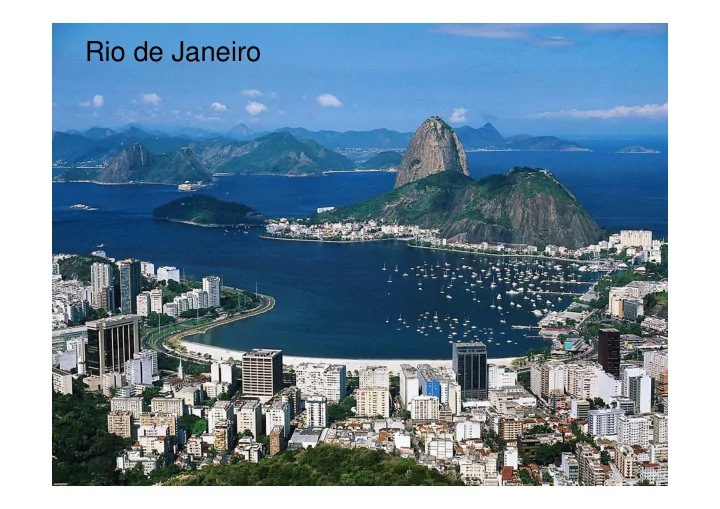
Rio de Janeiro AARHUS UNIVERSITY DEPARTMENT OF POLITICAL SCIENCE - - PowerPoint PPT Presentation
Rio de Janeiro AARHUS UNIVERSITY DEPARTMENT OF POLITICAL SCIENCE AARHUS UNIVERSITY A GLOBAL CO 2 TAX FOR SUSTAINABLE DEVELOPMENT? CARBON LEAKAGE, RENEWABLE ENERGY AND COALITIONS Urs Steiner Brandt & Gert Tinggaard Svendsen (accepted,
AARHUS UNIVERSITY DEPARTMENT OF POLITICAL SCIENCE
A GLOBAL CO2 TAX FOR SUSTAINABLE DEVELOPMENT?
CARBON LEAKAGE, RENEWABLE ENERGY AND COALITIONS
Urs Steiner Brandt & Gert Tinggaard Svendsen (accepted, Journal of Sustainable Development)
2
AARHUS UNIVERSITY DEPARTMENT OF POLITICAL SCIENCE
Outline:
- 1. Introduction
- 2. Tax and renewable energy
- 3. Lobbying
- 4. The socio-economic impact
- 5. Conclusion
AARHUS UNIVERSITY DEPARTMENT OF POLITICAL SCIENCE
- 1. Introduction
1.1 Rio+20 (2012) Twin goal: i) Facilitate growth of green industries ii) Enhance quality of institutions
AARHUS UNIVERSITY DEPARTMENT OF POLITICAL SCIENCE
1.2 Research question Non-productive negotiations…simple solution? “Can a CO2 tax secure the Rio+20 twin goal at the global level?” Gap: Cost-effective and politically feasible!
AARHUS UNIVERSITY DEPARTMENT OF POLITICAL SCIENCE
- 2. Tax and Renewable Energy
2.1 Tax Economists: Green taxation (Pigou 1920) Figure 1, global CO2 tax
AARHUS UNIVERSITY DEPARTMENT OF POLITICAL SCIENCE
t* q* MC CO2 reduction €/unit A B
CO2 Taxation
AARHUS UNIVERSITY DEPARTMENT OF POLITICAL SCIENCE
2.2 Renewable energy How does a global CO2 tax affect the potential shift from non-renewable to renewable energy (green economy)? Figure 2: Switch point.
AARHUS UNIVERSITY DEPARTMENT OF POLITICAL SCIENCE
From fossil fuels to renewable energy when taxing CO2
MCfossil + tax t* MCfossil Time €/MW MCrenewable t0 P CO2 tax
AARHUS UNIVERSITY DEPARTMENT OF POLITICAL SCIENCE
- 3. Lobbying
3.1 Winners/Losers Economic part: ”green light” for the global use
- f CO2 taxation.
What about the political feasibility?
AARHUS UNIVERSITY DEPARTMENT OF POLITICAL SCIENCE
Consumers: Potential winners (tax revenue can be used to lower distortive taxes). Producers: Losers (reduction costs and tax payments). Asymmetry.
AARHUS UNIVERSITY DEPARTMENT OF POLITICAL SCIENCE
3.2 Negotiations So far not possible to introduce a common CO2 tax in the EU or the US! Main argument: loss of jobs.
AARHUS UNIVERSITY DEPARTMENT OF POLITICAL SCIENCE
”Carbon leakage” China/India! Competitiveness, however, not ruined when all countries are taxed the same (uniform)!
AARHUS UNIVERSITY DEPARTMENT OF POLITICAL SCIENCE
3.3 New coalitions “Brown” industry vs. environmental groups. Brandt and Svendsen (2002): How wind turbine producers joined forces with environmental organizations in promoting ambitious target levels for renewable energy.
AARHUS UNIVERSITY DEPARTMENT OF POLITICAL SCIENCE
3.4 Administration simple Possible to implement global CO2 taxation even when national institutions are “bad”. CO2 tax basically a ‘painted’ energy tax according to CO2 content in fossil fuels.
AARHUS UNIVERSITY DEPARTMENT OF POLITICAL SCIENCE
Developing countries may find CO2 taxation highly attractive as a tool to collect taxes. Tax revenue may be invested in better institutions, for example by fighting corruption efficiently.
AARHUS UNIVERSITY DEPARTMENT OF POLITICAL SCIENCE
- 4. The socio-economic impact
2009 Copenhagen meeting (COP15): Limit the increase in global mean temperature below 2 degrees Celsius (compared to 2000). Carbon tax in the 2 degrees scenario? How this tax will affect various countries and how are the incentives to reduce emissions?
AARHUS UNIVERSITY DEPARTMENT OF POLITICAL SCIENCE
Carbon price Carbon price in the 2 degrees scenario (Nordhaus, 2010) (2010 prices, $/ton CO2)
18
Year 2015 2025 2035 2045 2055 2105 CO2 tax ($/ton) 24.24 43.63 69.32 107.04 160.04 277.18
AARHUS UNIVERSITY DEPARTMENT OF POLITICAL SCIENCE
IPAT – measure We illustrate the consequences of a tax for different countries by use of the IPAT identity. This identity is given by
19
AARHUS UNIVERSITY DEPARTMENT OF POLITICAL SCIENCE
For CO2 emissions, we plug in:
- 20
AARHUS UNIVERSITY DEPARTMENT OF POLITICAL SCIENCE
Given emission in country i
- , and uniform
tax rate , total tax payment (revenue) in country i (
- is given by:
- Inserting:
- 21
AARHUS UNIVERSITY DEPARTMENT OF POLITICAL SCIENCE
IPAT measures for four countries 10$/ton CO2 tax (2009 numbers).
22
Countries GDP CO2 pop GDP/pop CO2/GDP t*CO2/GDP taxpayment/pop ($) (ton) ($) Ton/$ USA 1.39E+13 5.3E+09 3.07E+08 45305.1 3.81E-04 3.81E-03 172.7 China 9.05E+12 7.69E+09 1.33E+09 6797.8 8.49E-04 8.49E-03 57.7 India 3.73E+12 1.98E+09 1.19E+09 3132.9 5.31E-04 5.31E-03 16.6 Denmark 2.11E+11 4.57E+07 5.52E+06 38268.0 2.16E-04 2.16E-03 82.7
AARHUS UNIVERSITY DEPARTMENT OF POLITICAL SCIENCE
The main effect of a CO2 tax
›Red arrow indicates how a tax moves countries towards a lower CO2/GDP path
23
AARHUS UNIVERSITY DEPARTMENT OF POLITICAL SCIENCE
Reasons We consider that the (main) reason for this is that the tax-system punishes inefficient use of fossil fuels (column 8, taxpayment/pop). While the US does not have any significant price on carbon, there are several price mechanisms in place for Denmark such as CO2 taxes and other energy taxes combined with the European Emission Trading System.
24
AARHUS UNIVERSITY DEPARTMENT OF POLITICAL SCIENCE
Further consequences i) Punish inefficient energy usage: The CO2/GDP in the US and China will decrease following the CO2 tax because the tax system punishes inefficient usage of fossil fuels. ii) Eliminating leakage: Some of the Danish reduction in CO2 might be caused by leakage effects. Such effects will be eliminated in the global uniform tax system.
25
AARHUS UNIVERSITY DEPARTMENT OF POLITICAL SCIENCE
- 5. Conclusion
Bold conjecture: A global CO2 tax should be considered to meet the two main challenges of green economy and better institutions from Rio+20.
26
AARHUS UNIVERSITY DEPARTMENT OF POLITICAL SCIENCE
Economically: double dividend Politically: carbon leakage and new coalitions Administratively: simple, even bad institutions.
27
AARHUS UNIVERSITY DEPARTMENT OF POLITICAL SCIENCE
Policy recommendations Future climate negotiations: Define specific and binding global CO2 target levels and tax at the right level. If somebody cheats, supranational authority such as WTO (potential trade sanctions)…
28