
SLIDE 1
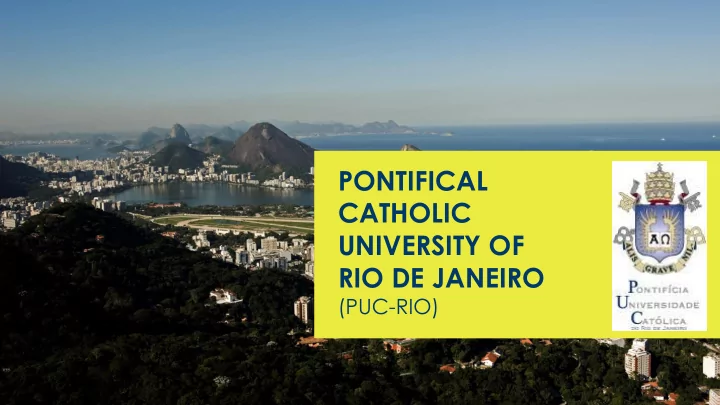
PONTIFICAL CATHOLIC UNIVERSITY OF RIO DE JANEIRO
(PUC-RIO)
CATHOLIC UNIVERSITY OF RIO DE JANEIRO (PUC-RIO) WELCOME TO - - PowerPoint PPT Presentation
PONTIFICAL CATHOLIC UNIVERSITY OF RIO DE JANEIRO (PUC-RIO) WELCOME TO PUC-RIO HISTORY AND PUC-Rio was the first private higher education MISSION institution in the country, created by the Catholic Church. It was founded in 1940 by
(PUC-RIO)
PUC-Rio was the first private higher education institution in the country, created by the Catholic
Sebastião Leme and Father Leonel Franca, S.J., and in 1946 it acquired the status of university. The title of Pontifical was conferred in 1947 — a rare honor conceded by the Vatican establishing a special link between this university and the Pope. In 1955, the institution moved to the present campus.
Beyond providing education, PUC-Rio undertook the task of assisting the community, based on Christian ethical values, solidarity and human respect. It represents a space for achievement,
challenges and development of its students. The university operates under the supervision of the Society of Jesus and under the supreme authority of the Archbishop
Rio de Janeiro as its Grand Chancellor. PUC-Rio is a non-profit philanthropic institution, a communitarian university. It is thus a Catholic university based on Christian humanistic principles.
It welcomes students, staff members, teachers, researchers and administrators
all religions, nationalities, ethnic groups and social classes. The referential starting-point
PUC-Rio is the complete development of the human being in two main perspectives: the philosophical and the
institution that focuses primarily in the development of academic and scientific knowledge. PUC-Rio is, above all, a community
people, professors, students and staff members united by a common interest in seeking the truth and acting in accordance with the needs of the society and with the ever changing world around us.
International Cooperation (CCCI).
2014, PUC-Rio granted the status of a public non-state institution — a communitarian university.
departments, except for Biology.
university — the Rio Datacentro (RDC) — was created in 1972.
Main Campus Marquês de São Vicente, St. (Gávea) Other Facilities
(Downtown)
(Barra da Tijuca)
Chancellor Dom Orani João Tempesta, O. Cist., Archbishop of Rio de Janeiro President
Vice-president
Vice-president for Academic Affairs
Vice-president for Administrative Affairs
Vice-president for Community Affairs
Vice-president for Development Affairs
Total number of students 2018 Undergraduate students*-----------10.501 Graduate students -------------------- 2.223 Academic Master: 1.148 Professional Master: 215 Doctorate: 1.190 Continuing Education students --- 10.015 *Including exchange and
international students. Students with full or partial waiver of fees --- 5.816 Total number of faculty members 2017 Full time ------------------------------------------------- 486 Part time ------------------------------------------------ 872 With Master degree --------- 352 With PhD degree ------------- 844
Times Higher Education/BRICS & Emerging Economies, 3rd position in Latin American: https://www.timeshighereducation.com/world- university-rankings/2019/emerging-economies- university- rankings#!/page/0/length/25/sort_by/rank/sort_order /asc/cols/stats and https://www.timeshighereducation.com/world- university-rankings/2019/emerging-economies- university QS World University Rankings, 2nd position, Academic Reputation: www.topuniversities.com https://www.topuniversities.com/university- rankings/latin-american-university-rankings/2018
Gênesis Institute is elected 11th Best Incubator in the world Brics Policy Center is among the ten best Think Tanks https://www.timeshighereducation.com/world- university-rankings/pontifical-catholic-university-rio-de- janeiro-puc-rio https://guiadoestudante.abril.com.br/universidades/ melhores-universidades-puc-rio-e-a-melhor- instituicao-privada/ PUC-Rio is third Brazilian university and first in Rio de Janeiro at THE World University Rankings 2020
Undergraduate Central Coordination Office http://www.puc-rio.br/ensinopesq/ccg Associate vice-president for academic affairs Daniela Vargas, PhD Graduate Courses Central Coordination Office http://www.puc-rio.br/ensinopesq/ccpg Associate vice-president for academic affairs Paulo Cesar Duque Estrada, PhD
Center for Theology and Human Sciences (CTCH) Architecture and Urbanism, Arts and Design (Product Development, Visual Communication, Digital Media and Fashion), Education, Philosophy, Letters (Modern Languages, Literature, Linguistics, Translation, Creative Writing, Performing Arts), Psychology and Theology. Center for Science and Technology (CTC) Center
Telecommunication Studies (CETUC), Chemical Engineering, Civil Engineering, Control and Automation Engineering, Electrical Engineering, Environmental Engineering, Industrial Engineering, Materials and Nanotechnology Engineering, Mechanical Engineering, Petrol Engineering, Production Engineering, Chemistry, Physics, Informatics, Mathematics, Institute of PUC-Rio (ITUC) and Institute of Energy (IEPUC).
Center for Social Sciences (CCS) Business and Administration, Economics, Law, Social Communication (Cinema, Journalism, Publicity), Geography and Environment, History, International Relations, Social Work and Social Sciences. Center for Biology and Healthy Sciences (CCBS) Biological Sciences (undergraduate level). Medicine and Dentistry (specialization courses – graduate certificate programs – held off-campus).
http://www.ctch.puc-rio.br Dean Júlio Cesar Valladão Diniz, PhD
Departments Architecture and Urbanism, Arts and Design (Product Development, Visual Communication, Digital Media and Fashion), Education, Philosophy, Letters (Modern Languages, Literature, Linguistics, Translation, Creative Writing, Performing Arts), Psychology and Theology. All departments have PhD Programs and Research Programs, except Architecture and Urbanism.
http://www.ctc.puc-rio.br Dean Luiz Alencar Reis da Silva Mello, PhD
Departments Chemical Engineering, Civil Engineering, Control and Automation Engineering, Electrical Engineering, Environmental Engineering, Industrial Engineering, Materials and Nanotechnology Engineering, Mechanical Engineering, Petrol Engineering, Production Engineering, Chemistry, Physics, Informatics, Mathematics. All departments have PhD Programs and Research Programs.
http://www.puc-rio.br/sobrepuc/admin/ccs Dean Luiz Roberto Azevedo Cunha
Departments Business and Administration, Economics, Law, Social Communication (Cinema, Journalism, Publicity), Geography and Environment , History, International Relations, Social Work and Social Sciences. All departments have PhD Programs and Research Programs.
http://www.ccbs.puc-rio.br Dean Hilton Augusto Koch, M.D.
Institute of Dentistry (IOPUC) – Lato sensu Department of Biology (BIOPUC) – Undergraduate level Department of Medicine – Lato sensu Nucleus for Technological Innovation in Health (NITES)
The Brics Policy Center produces academic research in the form of articles, policy briefs, monitors, books and indicators, all of which are available online through our website (<www.bricspolicycenter.org>). Among
main themes and lines of research are:
www.bricspolicycenter.org General Supervisor Paulo Luiz Moreaux Lavigne Esteves Administrative Coordinator Lia Lopes
http://www.ccead.puc-rio.br Coordinator Gilda Helena Bernardino de Campos, PhD
and produces didactic material in various media for subjects in the different modalities such as videos, podcasts and other resources present in the online learning environment;
and basic orientation for the elaboration of projects
different modalities;
innovative practices in education.
Research Group CNPq: Cooperation and Assessment in Distance Education Research Topics
and Learning Design for Web-based Distance Education Courses
Learning Assessment Methods in Web Environments
with Teachers in Training Programs of the Federal
Lato Sensu Technologies in Education (2006-2013) Course
http://www.cce.puc-rio.br Associate Vice-president for Academic Affairs Alfredo Jefferson de Oliveira
Since 1971, Extension Central Coordination Office (CCE) plans, promotes and offers free extension courses, seminars, workshops, certificate level professional specialization and training courses, and technical Master courses. CCE offers approximately 400 options
besides the advantage of studying in a well-recognized university with excellent academic achievement and facilities, such as the privileged location. CCE also provides specialized training to private companies or government-owned enterprises, which may be held at the campus or at other arranged locations. The courses fulfill all the academic requirements of the Ministry of Education and Culture.
http://www.ccesp.puc-rio.br Associate Vice-president for Academic Affairs André Lacombe Penna da Rocha, PhD
PUC-Rio encourages the integration of students in the labor market, in the best possible condition. CCESP is the unit in charge of disseminating internship offers, trainee programs and jobs, as well as promoting activities to connect undergraduates with companies. Annually, the PUC Exhibition (Mostra PUC) ̶ that is part of the calendar of events of the city of Rio de Janeiro ̶ brings dozens of large companies to the university to present their work in speeches, workshops, and stands set up in the ground floor area, during four days. It is an excellent
Currently, about 6.000 companies maintain agreements with PUC-Rio.
http://www.dbd.puc-rio.br Temporary Director Mônica de Oliveira
The library network of PUC-Rio holds quite a varied collection with 206.758 titles, corresponding to 467.557 volumes of books, monographs, theses, dissertations and periodicals and about 380.000 e-books and a great number of international e-theses and dissertations. Online access is available. The DBD´s structure is composed of five sectional libraries specialized in the field of each of the university's four major centers. Other services provided by the DBD site are the links to important information resources and to the CAPES Portal, a group of databases with over 37.000 titles of scientific periodicals collections, created to assist research universities. PUC-Rio is
the private institutions allowed to use this service from CAPES. The DBD is part of an integrated library system, the Pergamum Network, which comprises important Brazilian institutions, being most of them universities and research centers.
http://www.rdc.puc-rio.br Director José Raimundo Oliveira
RDC manages the computing resources for public use at PUC-Rio. It performs the following services for the benefit
administrative units of the university:
corporate network (optical fiber, wire and wi-fi) that interconnects all departmental data networks and provides internet access for them.
academic and administrative systems, the corporate database and internet services. This environment is highly available, reliable and secure from harm, thanks to the protection of anti-intrusion, high temperature and smoke detection systems, equipment redundancy and uninterruptible power supply.
network.
microcomputers in broadband connection to the internet.
RioBotz is the Robotic Competition team from PUC-Rio
focused on combat robots, but now competing as well in other categories such as Humanoid Robots and Robot Sumo. The team is formed by control, mechanical and electrical engineering undergraduate students from PUC-Rio. The objective of the team is to allow the students to learn in practice about several areas involved in an engineering project, such as mechanic and electronic design, materials science, programming, team work and marketing. They have the opportunity to apply in practice the concepts learned in the classroom. They get the know-how to complement the know-why. The technology involved in building combat robots can be applied in several areas, such as in wheel chairs, inspection robots for the oil and nuclear industries, and even rescue or anti-bomb robots.
http://riobotz.com Coordinator Marco Antônio Meggiolaro
The Gênesis Institute of PUC-Rio (IG) is a complementary unit of the Vice-Rectory for Development Affairs, which permeates all the centers and departments of the
mission
the Gênesis Institute is to prepare entrepreneurs and businesses for success by fostering a culture of innovation and creating innovative environments and workspaces that contribute to the economic, social, cultural and environmental development of areas. The Gênesis Institute transforms students into entrepreneurs, entrepreneurs into businesses, and technologies into products, helping students strengthen their relationships with the market and guaranteeing that their academic research effectively and positively impacts society.
http://www.genesis.puc-rio.br Director João Gabriel Hargreaves Ribeiro
http://www.genesis.puc-rio.br Director João Gabriel Hargreaves Ribeiro
Over the course of the last 19 years, the Gênesis Institute has generated through its Department for Business Support over 145 active businesses that together form revenue of over U$ 1,10 billion. The Gênesis Institute currently possesses in its portfolio 12 germinated enterprises, 13 incubated enterprises, 61 graduated enterprises and 58 satellites. In 2016, 55 of the 87 germinated, incubated and graduated enterprises together generated a total income of R$ 208 million and directly employed 2,660 professionals. Finally, the Department
Local Development is responsible for the application of knowledge generated by the Gênesis Institute for the promotion
entrepreneurship and innovation in neighborhoods, cities and regions. In 2016, the Gênesis Institute launched three local development projects that impacted the municipalities
Itaguai and Mangaratiba (RJ), Parauapebas (PA), São Luís (MA), Ouro Preto and Mariana (MG).
http://www.puc-rio.br/english/specialprojects/gtep.html Director Sergio A. B. da Fontoura, PhD
Since 1991, the Group of Technology and Petroleum Engineering works with the oil industry in research and development projects. The Group's mission is to develop, adapt and implement technology with the support of Geomechanics and Computational Mechanics in order to optimize Brazil's oil and gas resources. Areas of Research Studies in Carbonates and Evaporites Drilling Geomechanics Computational Geomechanics Fluid-Rock Interaction Studies High Performance Computing Reservoir Geomechanics
http://www.puc- rio.br/english/specialprojects/iepuc.html Director Sergio Leal Braga, PhD
Areas of Activity The IEPUC conducts interdisciplinary research and projects in energy. Among the topics
interest it is included: petroleum, natural gas applications, gas turbines, internal combustion engines, refrigeration, environment, electricity generation and distribution, solar energy and many others. In the development of these projects, IEPUC cooperates with
the rational use of energy-related issues, meeting the new demands of the society and the market. VEHICULAR ENGINEERING LABORATORY (LEV) The LEV is a laboratory
PUC-Rio focused
the development of new fuels and engines, in order to reduce atmospheric emissions and to improve the quality of life in the cities. The research, involving new fuels, hybrid and electric vehicles, automation and testing of vehicles and parts are made in partnership with major companies and international research centers.
http://www.tecgraf.puc-rio.br/pt/index.html Director Marcelo Gattass, PhD
Areas of Activity The Tecgraf Institute
Technical-Scientific Software Development of PUC-Rio (Tecgraf/PUC-Rio) stands out in the national and international scenario by developing innovative computer systems applied mainly to the oil and gas industry. Founded in 1987 as a laboratory of the Department of Informatics of PUC-Rio, it became an Institute of PUC-Rio in 2012. Tecgraf has created more than 60 software products in the areas of Geophysics, Geology, Reservoir, Environment, Engineering, Logistics and Entertainment, which are widely used in different research, project and production sectors of the industry. The Institute holds partnerships with Petrobras, the Brazilian Navy, BG Group, and Rede Globo.
Areas of Activity Tecgraf is an accredited EMBRAPII (Brazilian Agency for Industrial Research and Innovation) unit. The institute’s line of action is Computing Solutions for Engineering, which aims to develop complex technical-scientific computer systems that require advanced research and state of the art solutions to meet the technological challenges of the industry. The institute is an accredited unit of The Brazilian National Agency of Petroleum, Natural Gas and Biofuels (ANP) and is authorized to develop projects with funds from the Investment Clause in R,D&I. Finally, Tecgraf is also an accredited unit of the Information Technology Committee (CATI) of the Ministry
Science, Technology, Innovation and Communication, which allows access to projects funded by the Informatics Act (Act nº 8.248/91). The Institute supports academic research by working in cooperation with PUC-Rio’s Departments of Informatics, Civil Engineering, Mechanical Engineering and Industrial
418 researchers and collaborators, including professors, PhDs, doctors, masters and graduate and undergraduate students.
http://www.tecgraf.puc-rio.br/pt/index.html Director Marcelo Gattass, PhD
http://www.nirema.puc-rio.br/ Coordinator Sérgio Hamilton da Silva Barra
Nirema is a complementary unit of PUC-Rio linked to the History, Social Work, Sociology and Politics departments. It is a research and documentation center of the African Brazilian culture. It develops activities and interdisciplinary initiatives that involve representatives from PUC-Rio´s faculty and staff. Nirema activities involve not only professors from PUC-Rio but also have a body of associate researches belonging to other educational institutions in Brazil and abroad.
Environment Interdisciplinary Center (NIMA) is located within PUC’s Ecological Park, an area with plenty of vegetation and with a diversity of rare species. An Atlantic Forest place where the Rainha River passes by, the sabiá-laranjeira sings and where one builds with bamboo, with words and with transforming actions. Founded by the current rector, father Josafá Carlos de Siqueira, S.J., in 1999, NIMA received the task to become the integration place for the interdisciplinary exchange
close the relationship among the different departments, seeking to build up cooperation to face the social- environmental questions.
http://www.nima.puc-rio.br Coordinator Luiz Felipe Guanaes Rego, PhD
The environmental crisis is a global and local reality that must be faced by all of us who inhabit the planet earth. The university must collaborate in the production of knowledge, through teaching and research, looking for sustainable solutions and promoting creative actions that might help society with adaptive processes derived from the climate changes and with the search of minimizing resolutions for current and future socioenvironment impacts. Due to this challenge, we have to put our efforts toward the construction of systems and alternatives ecologically correct and socially fair and solidary. The power and testimony of local actions are extremely important to illuminate and enrich global proposals of planetary sustainability, contributing to changes
habits and construction process of new habits (ethos). Only this way we will realize the utopia of a world where environmental and social relations are really more balanced to current generations and to those who in the future will succeed us.
In this local action perspective, we believe in the proposal strength of PUC-Rio Environmental Agenda. The Agenda is a result
a long discussion and reflexion process
a competent group composed by teachers and students, from different centers and departments, coordinated by PUC-Rio Environment Interdisciplinary Center (NIMA). We are aware of academic difficulties in summarizing and synthetizing convergent and divergent aspects from the various scientific knowledges. On the other hand, we believe that due to the union of different efforts we will put in practice actions that contribute to the future construction of a truly sustainable university. The socioenvironment issue is a reference capable of gathering diverse ideas and to suggest practical and reasonable solutions in order to improve patterns that control the fundamental principles of social and academic excellence institution, such as PUC-Rio. The Environmental Agenda is, above all, a symbolic expression of the institution collective effort of looking for sustainable alternatives in short and long terms. Its symbolic force is a clear demonstration that the local testimony is fundamental to mirror the global wish of a planet more ecologically well balanced and socially fairer and greater in solidarity.
President of PUC-Rio
http://www.nima.puc-rio.br Coordinator Luiz Felipe Guanaes Rego, PhD
The social action promoted by PUC-Rio is seen by communities as the only source of hope to improve its member's quality of life. All efforts are educational, for the citizens that benefit from them and for the students involved with the work. It creates new understanding
Scholarship Aid Programs Implemented more than 20 years ago, beneficiaries of the program are students, employees and their dependents, interns, athletes, seminarians, religious personnel and members of the choir of PUC-
The UNICOM UNICOM emerged in 1978 with the purpose of strengthening the participation
PUC-Rio in the daily lives
marginalized communities in the city of Rio de Janeiro. The objective is to use the student's knowledge for the benefit of the population, generating better life conditions. The Group for Psycho-pedagogical Guidance and Counseling (NOAP) It carries out work in public schools related to triage, evolution and monitoring of children and adolescents with learning difficulties. The project includes teachers and psychopedagogues who work with children under the supervision of a former professor from the Department of Education.
The PUC-Rio Solidarity Emergency Fund (FESP) The students that benefit from this fund come from low- income families. At university, they can take community courses to prepare themselves for the university entrance exam and apply for scholarships. However, they may still encounter difficulties attending classes due to expenses for food and transportation. Currently, the resources
the FESP finance the purchase of transport and meal tickets for 520 students.
http://aaapucrio.com.br/ President Ricardo Lagares Henriques
Alumni Association (AAA) aims to maintain the university's alumni in touch with PUC-Rio, whenever it is necessary. At present, for an annual symbolic contribution, more than 38,000 registered alumni can keep themselves permanently contacted to the university by receiving the monthly newsletter Jornal da PUC, by having free access to the university library network, to Rio Data Centro (RDC) internet connection facilities and to the university Registrar (DAR) services. These contributions also allow the AAA, a non-profit
such as the scholarship program to a number
undergraduate students in need for their maintenance at PUC-Rio. AAA realizes lectures in partnership with different departments; as well as courses , events, tours, cinema.
http://www.puc-rio.br/ccci Associate Vice-president for Academic Affairs Angela Randolpho Paiva, PhD Deputy Associate Vice-president for Academic Affairs Ricardo Borges Alencar, PhD
The Central Coordination for International Cooperation (CCCI) has a broad actuation area including:
mathematics and business students.
PUC-Rio students.
international institutions.
Summer Program.
regarding the development of research.
cooperation with overseas institutions, celebrating and following the execution of agreements.
Outgoing Students – PUC-Rio Students
exchange with partner universities regarding recruitment, scholarships and
necessary documents for the application.
students to meet the requirements of each university.
for PUC-Rio students applying for international programs.
Incoming Students – International Students
PUC-Rio welcomes students from all over the world in exchange programs. Activities and services offered:
contact with consulates).
staff.
and Add & Drop of disciplines.
24/7.
Portuguese as a Second Language Course Pre-term Intensive Portuguese Program (90 hours) for international students – Winter and Summer sessions (Jan./Feb. and July), lasting 18 business days. Study in English at PUC-Rio International students have the
to take courses taught in English at PUC-Rio in several departments.
Double Degree Programs
(France) – Engineering
Strasbourg, Rouen, Toulouse and Rennes) (France) – Engineering
Etiene (France) – Engineering
Nationale Supérieure des Télécommunications (TELECOM) (Paris) – Engineering
Nationale Supérieure des Télécommunications (TELECOM) (Bretagne) – Engineering
Business
Short-term (Summer/Winter) Programs
PUC-Rio understands that these programs are a great
period of time, and during academic vacation periods (January, February or July). Many partners offer Summer/Winter short-term options and
Faculty-led/Customized Programs
Programs developed on demand to attend the specific needs of international institutions. Classes, seminars and lectures can be offered in English. They can be tailored to any necessary length and may combine class activities on a diverse range of themes, with cultural/technical visits and service learning. The Central Coordination for International Cooperation has been developing it successfully for more than 10 years and have hosted about 2,000 participants from all over the world.
Brazilian Seminars
A fantastic opportunity for people interested in Brazil and Rio de Janeiro to receive academic credits while traveling abroad. The Brazilian Seminars is an interdisciplinary Summer Program offered every July, for the duration of 12 business days (48 hours). Through a combination of lectures on different areas of interest and
activities, the program provides students, young scholars and international administrators the opportunity to deepen their knowledge about Brazil and discuss the current issues that are in the global scenario. Optional
participants may combine the Brazilian Seminars with a 20 hours intensive course of Portuguese language.
Exchange Students
PUC-Rio Students Abroad Program 1996 2000 2005 2010 2011 2012 2013 2014 2015 2016 2017 2018 Regular Courses 23 52 143 243 233 223 166 191 267 244 269 289 Science without Borders 67 127 98 184 95 Double Degree Programs 36 44 48 39 46 21 39 44 35 47 Short Term Programs 20 80 141 105 89 67 47 28 35 36 Total per Year 23 52 199 367 422 434 428 377 537 411 339 372 Main Destinations United States, Spain, Portugal and France
PUC-Rio International Students Program 1996 2000 2005 2010 2011 2012 2013 2014 2015 2016 2017 2018 Regular Courses 57 123 244 623 553 627 779 917 734 780 678 534 Double Degree Programs 12 8 7 12 19 23 18 24 26 33 Intensive Courses 8 42 172 274 305 341 344 288 234 104 136 125 Customized Programs 38 66 247 171 324 164 303 185 231 164 Internships 6 29 13 20 15 12 13 22 Brazilian Seminars 8 12 11 Total per Year 65 165 466 971 1118 1151 1479 1412 1304 1113 1096 889 Main Nationalities United States, France, Portugal, Spain, Germany and Norway Total Exchanged Students per Year (PUC-Rio and Internationals) 88 217 665 1338 1540 1614 1907 1789 1841 1524 1435 1261
http://www.puc-rio.br/ccci Associate Vice-president for Academic Affairs Angela Randolpho Paiva, PhD Deputy Associate Vice-president for Academic Affairs Ricardo Borges Alencar, PhD
Contacts
Incoming students Linda Cristina Sousa - incoming@puc-rio.br Outgoing students Nancy Guimarães - mobility@puc-rio.br Short-term students Daniel Castro - curtaccci@puc-rio.br Partnerships Christine Duarte - partnership@puc-rio.br
The Campus Area
PUC-RIO is located near the forest and the beach. Its campus is a pleasant green area with a stream running through it; small monkeys and squirrels can be seen jumping up in the trees.
The Campus Area
Basic Health Assistance Bookstore Bus Stop/Taxi Stop Bike Parking Church Sports Gymnasium Psychological Assistance Program to Students (SPA) Campus Ministry University Museum - Solar Grandjean de Montigny Coffee shops Restaurants ATM Machines Photocopy services Parking lot