Review Review Consider the following sequence of lock requests: l - - PDF document

review review
SMART_READER_LITE
LIVE PREVIEW

Review Review Consider the following sequence of lock requests: l - - PDF document

Review Review Consider the following sequence of lock requests: l 1 (B); l 2 (A); l 3 (C); l 1 (C); l 2 (B); l 3 (A) l 1 (B); l 2 (A); l 3 (C); l 1 (C); l 2 (B); l 3 (A) Assume that upon start, transactions T 1 , T 2 , T 3 wait-die


slide-1
SLIDE 1

1 Review

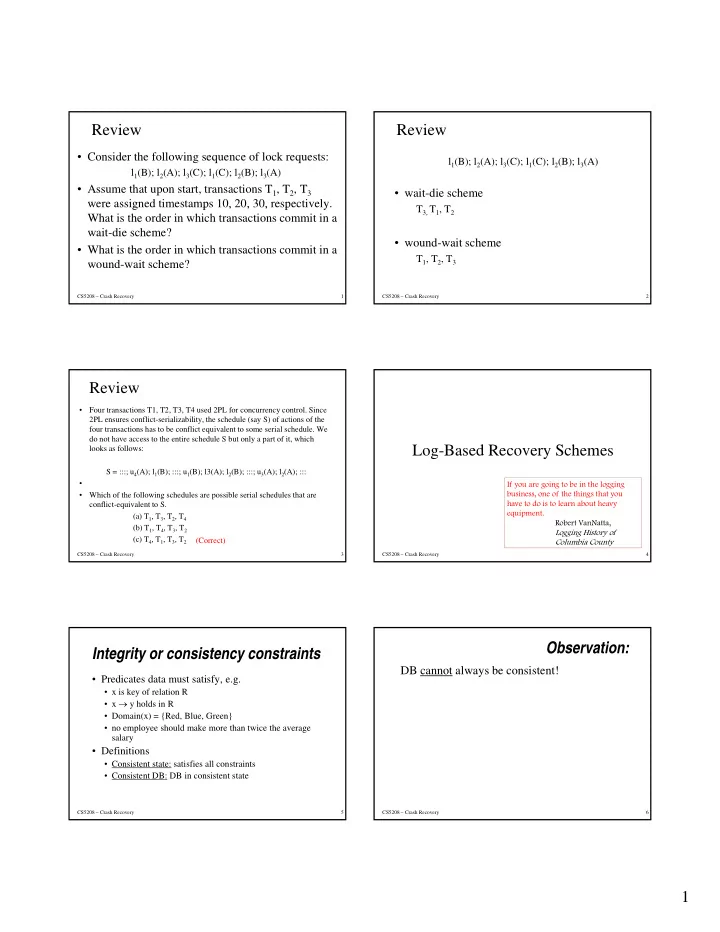
  • Consider the following sequence of lock requests:

l1(B); l2(A); l3(C); l1(C); l2(B); l3(A)

  • Assume that upon start, transactions T1, T2, T3

were assigned timestamps 10, 20, 30, respectively. g p , , , p y What is the order in which transactions commit in a wait-die scheme?

  • What is the order in which transactions commit in a

wound-wait scheme?

CS5208 – Crash Recovery 1

Review

l1(B); l2(A); l3(C); l1(C); l2(B); l3(A)

  • wait-die scheme

T T T T3, T1, T2

  • wound-wait scheme

T1, T2, T3

CS5208 – Crash Recovery 2

Review

  • Four transactions T1, T2, T3, T4 used 2PL for concurrency control. Since

2PL ensures conflict-serializability, the schedule (say S) of actions of the four transactions has to be conflict equivalent to some serial schedule. We do not have access to the entire schedule S but only a part of it, which looks as follows: S = :::; u4(A); l1(B); :::; u1(B); l3(A); l2(B); :::; u3(A); l2(A); :::

  • Which of the following schedules are possible serial schedules that are

conflict-equivalent to S. (a) T1, T3, T2, T4 (b) T1, T4, T3, T2 (c) T4, T1, T3, T2

CS5208 – Crash Recovery 3

(Correct)

Log-Based Recovery Schemes

CS5208 – Crash Recovery 4

If you are going to be in the logging business, one of the things that you have to do is to learn about heavy equipment. Robert VanNatta, Logging History of Columbia County

Integrity or consistency constraints

  • Predicates data must satisfy, e.g.
  • x is key of relation R
  • x  y holds in R
  • Domain(x) = {Red, Blue, Green}

CS5208 – Crash Recovery 5

  • no employee should make more than twice the average

salary

  • Definitions
  • Consistent state: satisfies all constraints
  • Consistent DB: DB in consistent state

DB cannot always be consistent!

Observation:

CS5208 – Crash Recovery 6

slide-2
SLIDE 2

2

DB cannot always be consistent!

Observation:

Example: Transfer 100 from a2 to a10 a2  a2 - 100 a10  a10 + 100

CS5208 – Crash Recovery 7

. . 500 . . 1000 . . 400 . . 1000 a10  a10 + 100 a2 a10

DB cannot always be consistent!

Observation:

Example: Transfer 100 from a2 to a10 a2  a2 - 100 a10  a10 + 100

CS5208 – Crash Recovery 8

. . 500 . . 1000 . . 400 . . 1000 . . 400 . . 1100 a10  a10 + 100 a2 a10

Transaction: collection of actions that preserve consistency

Consistent DB Consistent DB’ T

CS5208 – Crash Recovery 9

If T starts with consistent state + T executes in isolation (and absence of errors)  T leaves consistent state

Reasons for crashes

  • Transaction failures
  • Logical errors, deadlocks
  • System crash
  • Power failures operating system bugs etc

CS5208 – Crash Recovery 10

  • Power failures, operating system bugs etc
  • Disk failure
  • Head crashes
  • STABLE STORAGE: Data never lost. Can

approximate by using RAID and maintaining geographically distant copies of the data

  • Atomicity – All actions in a transaction are carried out, or

none are, i.e., no incomplete transactions

  • Consistency – Each transaction preserves DB consistency
  • User’s responsibility, e.g., Funds transfer between bank accounts
  • Isolation – A transaction isolated or protected from the

effects of other transactions

Review: The ACID properties

CS5208 – Crash Recovery 11

effects of other transactions

  • Durability – When a transaction commits, its effects persist
  • Atomicity – All actions in a transaction are carried out, or

none are, i.e., no incomplete transactions

  • Consistency – Each transaction preserves DB consistency
  • User’s responsibility, e.g., Funds transfer between bank accounts
  • Isolation – A transaction isolated or protected from the

effects of other transactions

Review: The ACID properties

CS5208 – Crash Recovery 12

effects of other transactions

  • Durability – When a transaction commits, its effects persist
  • Question: which ones do the Recovery Manager

help with?

Atomicity & Durability

slide-3
SLIDE 3

3 Actions of Transaction:

  • Read
  • Write
  • Commit

CS5208 – Crash Recovery 13

  • Abort

Key problem: Unfinished transaction

Example Transfer fund from A to B T1: A  A - 100 B  B + 100

CS5208 – Crash Recovery 14

B  B + 100 T1: Read (A); A  A-100 Write (A); Read (B); B  B+100 Write (B);

CS5208 – Crash Recovery 15

Write (B);

A: 800 B: 800 A: 800 B: 800

memory disk

T1: Read (A); A  A-100 Write (A); Read (B); B  B+100 Write (B);

CS5208 – Crash Recovery 16

Write (B);

A: 800 B: 800 A: 800 B: 800

memory disk

700

T1: Read (A); A  A-100 Write (A); Read (B); B  B+100 Write (B);

Updated A value is written to disk. Thi b t i d “ANYTIME”

CS5208 – Crash Recovery 17

Write (B);

A: 800 B: 800 A: 800 B: 800

memory disk

700 700

This may be triggered “ANYTIME” by explicit command or DBMS or OS.

T1: Read (A); A  A-100 Write (A); Read (B); B  B+100 Write (B);

CS5208 – Crash Recovery 18

Write (B);

A: 800 B: 800 A: 800 B: 800

memory disk

700 900 700

slide-4
SLIDE 4

4

T1: Read (A); A  A-100 Write (A); Read (B); B  B+100 Write (B);

CS5208 – Crash Recovery 19

Write (B);

A: 800 B: 800 A: 800 B: 800

memory disk

700 900 700 failure!

T1: Read (A); A  A-100 Write (A); Read (B); B  B+100 Write (B);

Need atomicity: execute all actions of a transaction or none at all

CS5208 – Crash Recovery 20

Write (B);

A: 800 B: 800 A: 800 B: 800

memory disk

700 900 700 failure!

T1: Read (A); A  A-100 Write (A); Read (B); B  B+100 Write (B);

One Solution: Undo logging (Immediate modification)

CS5208 – Crash Recovery 21

A:800 B:800 A:800 B:800

memory disk Log (Stable)

T1: Read (A); A  A-100 Write (A); Read (B); B  B+100 Write (B);

One Solution: Undo logging (Immediate modification)

CS5208 – Crash Recovery 22

A:800 B:800 A:800 B:800

memory disk log < T1, start>

T1: Read (A); A  A-100 Write (A); Read (B); B  B+100 Write (B);

One Solution: Undo logging (Immediate modification)

CS5208 – Crash Recovery 23

A:800 B:800 A:800 B:800

memory disk log

700 900

< T1, start>

T1: Read (A); A  A-100 Write (A); Read (B); B  B+100 Write (B);

One Solution: Undo logging (Immediate modification)

CS5208 – Crash Recovery 24

A:800 B:800 A:800 B:800

memory disk log

700 900

< T1, start> < T1, A, 800>

slide-5
SLIDE 5

5

T1: Read (A); A  A-100 Write (A); Read (B); B  B+100 Write (B);

One Solution: Undo logging (Immediate modification)

CS5208 – Crash Recovery 25

A:800 B:800 A:800 B:800

memory disk log

700 900

< T1, start> < T1, A, 800>

700 T1: Read (A); A  A-100 Write (A); Read (B); B  B+100 Write (B);

One Solution: Undo logging (Immediate modification)

CS5208 – Crash Recovery 26

A:800 B:800 A:800 B:800

memory disk log

700 900

< T1, start> < T1, A, 800>

700

< T1, B, 800>

T1: Read (A); A  A-100 Write (A); Read (B); B  B+100 Write (B);

One Solution: Undo logging (Immediate modification)

CS5208 – Crash Recovery 27

A:800 B:800 A:800 B:800

memory disk log

700 900

< T1, start> < T1, A, 800>

700

< T1, B, 800>

900 T1: Read (A); A  A-100 Write (A); Read (B); B  B+100 Write (B);

One Solution: Undo logging (Immediate modification)

CS5208 – Crash Recovery 28

A:800 B:800 A:800 B:800

memory disk log

700 900

< T1, start> < T1, A, 800> < T1, commit>

700

< T1, B, 800>

900

Complication

  • Log is first written in memory

memory DB

A 800 700 A: 800 B: 800

CS5208 – Crash Recovery 29

DB Log

A: 800 700 B: 800 900 Log: < T1,start> < T1, A, 800> < T1, B, 800>

Complication

  • Log is first written in memory

memory DB

A 800 700 A: 800 B: 800 700

BAD STATE

CS5208 – Crash Recovery 30

DB Log

A: 800 700 B: 800 900 Log: < T1,start> < T1, A, 800> < T1, B, 800>

S # 1

Failure occurs after partial updates on disk but before log is written to disk

slide-6
SLIDE 6

6 Complication

  • Log is first written in memory

memory DB

A 800 700 A: 800 B: 800 700

BAD STATE

CS5208 – Crash Recovery 31

DB Log

A: 800 700 B: 800 900 Log: < T1,start> < T1, A, 800> < T1, B, 800>

S # 1

Failure occurs after partial updates on disk but before log is written to disk This means log record for A must be on log disk before A can be updated on data disk (DB)

Complication

  • Log is first written in memory
  • Updates are not written to disk on every action

memory DB

A 800 700 A: 800 B: 800

CS5208 – Crash Recovery 32

Log

A: 800 700 B: 800 900 Log: < T1,start> < T1, A, 800> < T1, B, 800>

< T1, B, 800> < T1, commit>

Complication

  • Log is first written in memory
  • Updates are not written to disk on every action

memory DB

A 800 700 A: 800 B: 800 700

BAD STATE

CS5208 – Crash Recovery 33

Log

A: 800 700 B: 800 900 Log: < T1,start> < T1, A, 800> < T1, B, 800> < T1,commit>

# 2

< T1, B, 800> < T1, commit> All logs are on disk (including commit log) but

  • nly partial updates
  • n disk.

Complication

  • Log is first written in memory
  • Updates are not written to disk on every action

memory DB

A 800 700 A: 800 B: 800 700

BAD STATE

CS5208 – Crash Recovery 34

Log

A: 800 700 B: 800 900 Log: < T1,start> < T1, A, 800> < T1, B, 800>

# 2

< T1, B, 800> < T1, commit> All logs are on disk (including commit log) but

  • nly partial updates
  • n disk.

Before commit log is written to Log, all updates must be on disk (DB)

Undo logging rules

(1) For every action generate undo log record (containing old value) (2) Before x is modified on disk, log records

CS5208 – Crash Recovery 35

pertaining to x must be on disk (write ahead logging: WAL) (3) Before commit is flushed to log, all writes of transaction must be reflected on disk

Undo Logging

T1: Read (A); A  A-100 Write (A); Read (B); B  B+100 Write (B);

CS5208 – Crash Recovery 36

A: 800 700 B: 800 900 Log: < T1,start> < T1, A, 800> < T1, B, 800> A: 800 B: 800 log

slide-7
SLIDE 7

7 Undo Logging

T1: Read (A); A  A-100 Write (A); Read (B); B  B+100 Write (B);

CS5208 – Crash Recovery 37

A: 800 700 B: 800 900 Log: < T1,start> < T1, A, 800> < T1, B, 800> A: 800 B: 800 log

<T1, Start> <T1, A, 800> <T1, B, 800>

Undo Logging

T1: Read (A); A  A-100 Write (A); Read (B); B  B+100 Write (B);

CS5208 – Crash Recovery 38

A: 800 700 B: 800 900 Log: < T1,start> < T1, A, 800> < T1, B, 800> A: 800 B: 800 log 700

<T1, Start> <T1, A, 800> <T1, B, 800>

Undo Logging

T1: Read (A); A  A-100 Write (A); Read (B); B  B+100 Write (B);

CS5208 – Crash Recovery 39

A: 800 700 B: 800 900 Log: < T1,start> < T1, A, 800> < T1, B, 800> A: 800 B: 800 log

<T1, Start> <T1, A, 800> <T1, B, 800>

700 900

Undo Logging

A 800 700

T1: Read (A); A  A-100 Write (A); Read (B); B  B+100 Write (B);

CS5208 – Crash Recovery 40

A: 800 700 B: 800 900 Log: < T1,start> < T1, A, 800> < T1, B, 800> < T1, commit> A: 800 B: 800 log

<T1, Start> <T1, A, 800> <T1, B, 800> <T1, Commit>

700 900

Recovery rules: Undo logging

(1) Let S = set of transactions with <Ti, start> in log, but no <Ti, commit> (or <Ti, abort>) record in log (2) For each <Ti, X, v> in log, i d (l li ) d

CS5208 – Crash Recovery 41

in reverse order (latest  earliest) do:

  • if Ti  S then - X  v
  • Update disk

(3) For each Ti  S do

  • write <Ti, abort> to log

What if failure during recovery? No problem! Undo is idempotent

CS5208 – Crash Recovery 42

slide-8
SLIDE 8

8 Redo logging (deferred modification)

  • In UNDO logging, we remember the “old”

values.

  • How about remembering the “new” (updated)

values instead?

CS5208 – Crash Recovery 43

values instead?

  • What does this mean?

Redo logging (deferred modification)

  • In UNDO logging, we remember the “old”

value.

  • How about remembering the “new” (updated)

values instead?

CS5208 – Crash Recovery 44

values instead?

  • What does this mean?
  • NO updates must be written to disk until a

transaction commits! So?

Redo logging (deferred modification)

  • In UNDO logging, we remember the “old”

value.

  • How about remembering the “new” (updated)

values instead?

CS5208 – Crash Recovery 45

values instead?

  • What does this mean?
  • NO updates must be written to disk until a

transaction commits!

  • All updates have to be buffered in memory!

Redo logging (deferred modification)

T1: Read(A); A  A-100; write (A); Read(B); B  B+100; write (B);

CS5208 – Crash Recovery 46

A: 800 B: 800 A: 800 B: 800

memory DB LOG

Redo logging (deferred modification)

T1: Read(A); A  A-100; write (A); Read(B); B  B+100; write (B);

CS5208 – Crash Recovery 47

A: 800 B: 800 A: 800 B: 800

memory DB LOG

700 900

Redo logging (deferred modification)

T1: Read(A); A  A-100; write (A); Read(B); B  B+100; write (B);

CS5208 – Crash Recovery 48

A: 800 B: 800 A: 800 B: 800

memory DB LOG

700 900

< T1, start> < T1, A, 700> < T1, B, 900> < T1, commit>

slide-9
SLIDE 9

9 Redo logging (deferred modification)

T1: Read(A); A  A-100; write (A); Read(B); B  B+100; write (B);

CS5208 – Crash Recovery 49

A: 800 B: 800 A: 800 B: 800

memory DB LOG

700 900

< T1, start> < T1, A, 700> < T1, B, 900> < T1, commit>

  • utput

700

Redo logging rules

(1) For every action, generate redo log record (containing new value) (2) Before X is modified on disk (DB), all log

CS5208 – Crash Recovery 50

( ) ( ), g records for transaction that modified X (including commit) must be on disk (1) Let S = set of transactions with <Ti, commit> in log (2) For each <Ti, X, v> in log, in forward

Recovery rules: Redo logging

CS5208 – Crash Recovery 51

  • rder (earliest  latest) do:
  • if Ti  S then X  v

Update X on disk

Recovery is very, very SLOW !

Redo log:

... ... ...

CS5208 – Crash Recovery 52

First T1 wrote A,B Last Record Committed a year ago Record (1 year ago)

  • -> STILL, Need to redo after crash!!

Crash

What about UNDO scheme?

Solution: Checkpoint (simple version)

Periodically: (1) Do not accept new transactions (2) Wait until all transactions finish (3) Fl h ll l d t di k (l )

CS5208 – Crash Recovery 53

(3) Flush all log records to disk (log) (4) Flush all buffers to disk (DB) (5) Write “checkpoint” record on disk (log) (6) Resume transaction processing

Example: what to do at recovery?

Redo log (disk):

A,16>

  • mmit>

kpoint B,17>

  • mmit>

C,21>

Crash

CS5208 – Crash Recovery 54

< T1,A < T1,co Check < T2, < T2,co < T3,C

Crash ... ... ... ... ... ... No need to examine log records before the most recent Checkpoint

slide-10
SLIDE 10

10 Key drawbacks:

  • Undo logging: increase the number of disk I/Os
  • Redo logging: need to keep all modified

blocks in memory

CS5208 – Crash Recovery 55

until commit

Solution: undo/redo logging!

Update  <Ti, Xid, New X val, Old X val> page X Rules:

CS5208 – Crash Recovery 56

1) Page X can be flushed before or after Ti commit 2) Log record flushed before corresponding updated page (WAL) 3) Flush at commit (log only)

This is adopted in IBM DB2 – known as the Aries Recovery Manager

Non-quiesce checkpoint (for Undo/Redo logging)

L O G

Start-ckpt active TR: Ti,T2,...

end ckpt ... ... ... ..

CS5208 – Crash Recovery 57

for undo dirty buffer pool pages flushed

..

Examples: what to do at recovery time?

no T1 commit

L O G

T1,- a ... Ckpt T1 ... Ckpt end ... T1- b ...

CS5208 – Crash Recovery 58

G

 Undo T1 (undo a,b)

Example

L O G

... T1 a ... ... T1 b ... ... T1 c ... T1 cmt ... ckpt- end

ckpt-s

T1

CS5208 – Crash Recovery 59

 Redo T1: (redo b,c)

Recovery process:

  • Backwards pass (end of log  latest checkpoint start)
  • construct set S of committed transactions
  • undo actions of transactions not in S
  • Undo transactions that are in checkpoint active list

CS5208 – Crash Recovery 60

  • Forward pass (latest checkpoint start  end of log)
  • redo actions of S transactions

backward pass forward pass

start check- point

slide-11
SLIDE 11

11 Undo/Redo Log (Example)

<START S> <S, A, 60, 61> <COMMIT S> <START T> <T, A, 61, 62> <START U> <U, B, 20, 21> <T C 30 31>

Suppose we begin a nonquiescent checkpoint immediately after <T, A, 61, 62>, where could the <END CKPT> record be potentially written in the log?

CS5208 – Crash Recovery 61

<T, C, 30, 31> <START V> <U, D, 40, 41> <V, F, 70, 71> <COMMIT U> <T, E, 50, 51> <COMMIT T> <V, B, 21, 22> <COMMIT V>

Undo/Redo Log (Example)

<START S> <S, A, 60, 61> <COMMIT S> <START T> <T, A, 61, 62> <START U> <U, B, 20, 21> <T C 30 31>

Suppose we begin a nonquiescent checkpoint immediately after <T, A, 61, 62>, where could the <END CKPT> record be potentially written in the log?

CS5208 – Crash Recovery 62

<T, C, 30, 31> <START V> <U, D, 40, 41> <V, F, 70, 71> <COMMIT U> <T, E, 50, 51> <COMMIT T> <V, B, 21, 22> <COMMIT V>

ANYWHERE after <T, A, 61, 62> since the writing

  • f dirty blocks can be performed independent of

whatever actions the transactions are performing in the interim

Undo/Redo Log (Example)

<START S> <S, A, 60, 61> <COMMIT S> <START T> <T, A, 61, 62> <START U> <U, B, 20, 21> <T C 30 31>

Suppose we begin a nonquiescent checkpoint immediately after <T, A, 61, 62>. Suppose further there is a crash at any possible point after <T, A, 61, 62>, how far back in the log we must look to find all possible incomplete transactions if

  • <END CKPT> was written prior to the crash

CS5208 – Crash Recovery 63

<T, C, 30, 31> <START V> <U, D, 40, 41> <V, F, 70, 71> <COMMIT U> <T, E, 50, 51> <COMMIT T> <V, B, 21, 22> <COMMIT V>

<END CKPT> was written prior to the crash

  • <END CKPT> was not written

Undo/Redo Log (Example)

<START S> <S, A, 60, 61> <COMMIT S> <START T> <T, A, 61, 62> <START U> <U, B, 20, 21> <T C 30 31>

The only active transaction when the checkpoint began was T.

  • <END CKPT> was written prior to the crash
  • We need only go back as far as the start of T.

CS5208 – Crash Recovery 64

<T, C, 30, 31> <START V> <U, D, 40, 41> <V, F, 70, 71> <COMMIT U> <T, E, 50, 51> <COMMIT T> <V, B, 21, 22> <COMMIT V>

Start CKPT End CKPT Crash

Undo/Redo Log (Example)

<START S> <S, A, 60, 61> <COMMIT S> <START T> <T, A, 61, 62> <START U> <U, B, 20, 21> <T C 30 31>

The only active transaction when the checkpoint began was T.

  • <END CKPT> was written prior to the crash
  • We need only go back as far as the start of T.
  • <END CKPT> was not written

CS5208 – Crash Recovery 65

<T, C, 30, 31> <START V> <U, D, 40, 41> <V, F, 70, 71> <COMMIT U> <T, E, 50, 51> <COMMIT T> <V, B, 21, 22> <COMMIT V>

  • Any transaction that was active when the

previous checkpoint ended may have written some but not all of its data to disk.

  • So, go to the previous checkpoint
  • In this case, the only other transaction that could

qualify is S, so we must look back to the beginning

  • f S, i.e., to the beginning of the log in this simple

example.

Summary

  • Consistency of data
  • One source of

problems: failures

  • Logging
  • Redundancy

CS5208 – Crash Recovery 66

  • Redundancy
  • Another source of

problems: data sharing

  • Concurrency Control