Podcast: Ch05-03 Title : Identifying Attributes and Operations - - PDF document

podcast ch05 03
SMART_READER_LITE
LIVE PREVIEW

Podcast: Ch05-03 Title : Identifying Attributes and Operations - - PDF document

Podcast: Ch05-03 Title : Identifying Attributes and Operations Description : finding attributes & operations; Abbots method Participants : Barry Kurtz (instructor) and Cheng Vue, Sara Hyde, Brandon Winters (students)


slide-1
SLIDE 1

1

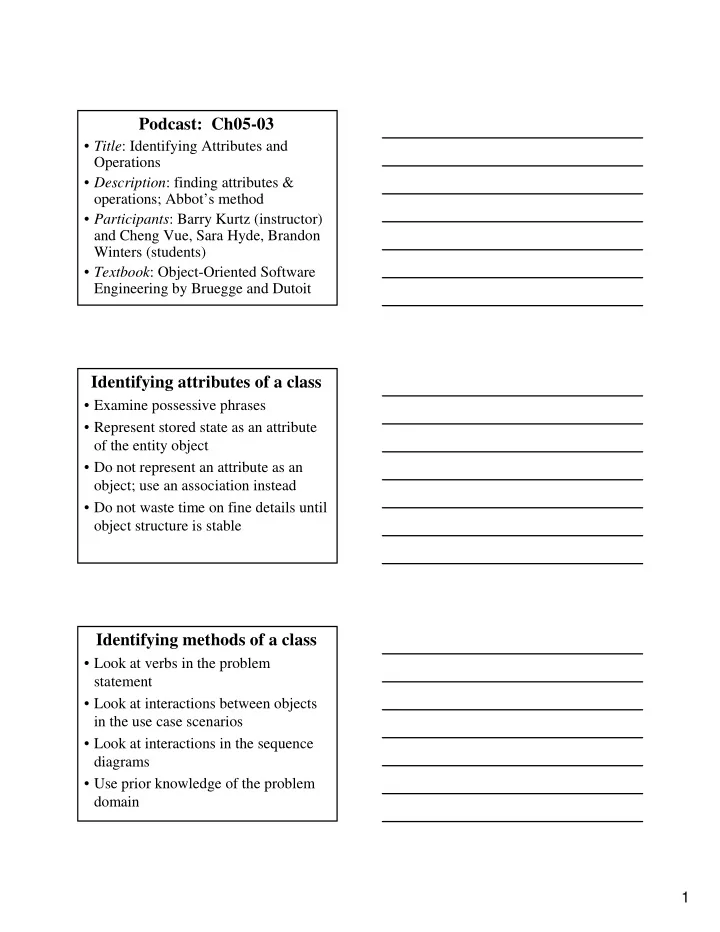
Podcast: Ch05-03

  • Title: Identifying Attributes and

Operations

  • Description: finding attributes &
  • perations; Abbot’s method
  • Participants: Barry Kurtz (instructor)

and Cheng Vue, Sara Hyde, Brandon Winters (students)

  • Textbook: Object-Oriented Software

Engineering by Bruegge and Dutoit

Identifying attributes of a class

  • Examine possessive phrases
  • Represent stored state as an attribute
  • f the entity object
  • Do not represent an attribute as an
  • bject; use an association instead
  • Do not waste time on fine details until
  • bject structure is stable

Identifying methods of a class

  • Look at verbs in the problem

statement

  • Look at interactions between objects

in the use case scenarios

  • Look at interactions in the sequence

diagrams

  • Use prior knowledge of the problem

domain

slide-2
SLIDE 2

2 Identifying associations between classes

  • Inheritance is the strongest form of

association; it is based on a “kind of” relationship

  • Aggregation is the next strongest form
  • f association; it is based on a “part of”

relationship

  • A strong form of aggregation is

composition where the “part” uniquely belongs to the “whole”

Identifying associations between classes

  • Examine verb phases
  • Name associations and roles precisely
  • Use qualifiers as often as possible
  • Eliminate any association that can be

derived from other associations

  • Do not worry about multiplicity until the

set of associations is stable

  • Too many associations make a model

unreadable

Example: Flow of events

  • The customer enters a store with the

intention of buying a toy for his child with the age of n.

  • Help must be available within less

than one minute.

  • The store owner gives advice to the
  • customer. The advice depends on the

age range of the child and the attributes

  • f the toy.
slide-3
SLIDE 3

3

Example: Flow of events

  • The customer selects a dangerous toy

which is kind of unsuitable for the child.

  • The store owner recommends a yellow

doll.

Mapping parts of speech to object model components [Abbott, 1983]

Part of speech Model component Example Proper noun

  • bject

Jim Smith Improper noun class Toy, doll Doing verb method Buy, recommend being verb inheritance is-a (kind-of) having verb aggregation has an modal verb constraint must be adjective attribute 3 years old transitive verb method enter intransitive verb method (event) depends on

Another Example

  • The customer enters the store to buy a toy.
  • It has to be a toy that his daughter likes and it

must cost less than 50 Euro.

  • He tries a videogame, which uses a data glove

and a head-mounted display. He likes it.

  • An assistant helps him.
  • The suitability of the game depends on the age of

the child.

  • His daughter is only 3 years old.
  • The assistant recommends another type of toy,

namely the cardgame “Go Fish".

slide-4
SLIDE 4

4

Grammatical construct UML Component Concrete Person, Thing Object noun class verb Operation Classifying verb Inheritance Possessive Verb Aggregation modal Verb Constraint Adjective Attribute Intransitive verb Operation (Event)

Textual Analysis

Example “Monopoly" “toy" “enters" “is a" ,“either..or", “kind of…" "Has a ", “consists of" “must be", “less than" "3 years old" “depends on…."