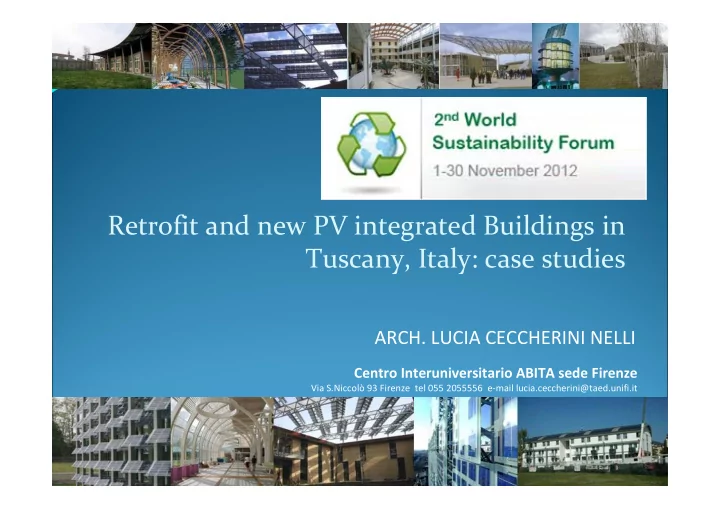
SLIDE 1
- ARCH. LUCIA CECCHERINI NELLI
Centro Interuniversitario ABITA sede Firenze
Via S.Niccolò 93 Firenze tel 055 2055556 e‐mail lucia.ceccherini@taed.unifi.it
Retrofit and new PV integrated Buildings in Tuscany, Italy: case studies
SLIDE 2 The solar system includes solar panels with cells spaced integrated in the architecture and construction of the greenhouse. The greenhouse is in fact an innovative atrium for the control of air conditioning, light and color are articulated in a language of materials: pillars, transformed into symbolic trees, are an expression of the technology of laminated wood on which is anchored the photovoltaic system that also acts as a shading device of the glass surface. The heat input due to overheating of the cells contributes to the heating of the air in winter; while, in summer the ascensional convective motions improve the natural ventilation, and assist the natural cooling through openings located
- n the top of the greenhouse.
MEYER HOSPITAL FLORENCE ITALY 30 kWp
SLIDE 3 PV-laminates (size 220 x 100 cm) are arranged in parallel rows, supported by the main structure and along the vertical axis. Horizontally connected by means
the structure, however, placed in the intrados of the greenhouse, to ensure a continuity of composition and structural of the glass surface in the outer part.
SLIDE 4
SLIDE 5 TYPOLOGY The system created is composed by 181 photovoltaic modules made with glass of different sizes, the total energy power is about 32 kWp. The modules have been integrated into the facade of the greenhouse and photovoltaic most have size 220x93, 8 cm with a power of 201 Wp, others are smaller. The group of conversion can convert the direct current into alternating current was laid on the roof of the greenhouse, the control panel and interface with the network is located in the center
- f the greenhouse inside a
wooden structure.
SLIDE 6
SLIDE 7 SIZING The system created is made up of three fields fotovoltaiici, lot east, lot and batch central west, each field feeds each of the three phases of the electricity network of the hospital. In order to optimize the conversion efficiency of the modules connected to each inverter have all the same inclination (tolerance allowed up to 6 °). The modules
- ccupy at most two adjacent rows so that the plant can be
fairly homogeneous.
55 modules of 201 Wp (B1) 12 modules of 88 Wp (B1 / 2) 5 inverters SMA SB2500
35 modules of 188 Wp (B2) 12 modules of 88 Wp (B2 / 2) 1 inverter SMA SB3000 inverters SMA SB3300 + 1
55 modules of 201 Wp (B1) 12 modules from 88Wp (B1 / 2) 5 inverters SMA SB2500
SLIDE 8
SLIDE 9
SLIDE 10
SLIDE 11 Photovoltaic modules The different types of modules are 4 (B1, B2, B1 / 2, B2 / 2) and can be grouped essentially in two types, modules 2 meters long with a power of 200W and modules 1 meter long with 88W power. The SE project has realized electrically compatible modules in order to avoid mismatching of current in the strings. The modules are certified and both sides are tempered glass HST (guaranteed 20 years). Wiring The cable resistance DC side is minimized by the size of the cables:
- 1. in each string the conductor is 6 mm2
- 2. the inverter interface board the conductor is 16 mm2
- 3. from the interface board to the overview section of the conductor is 25 mm2.
The connections are made with terminals compression and sometimes by means
- f soft soldering. In such conditions, the decrease in efficiency due to the parasitic
resistances is less than 2 percentage points and the voltage drop are considered negligible.
SLIDE 12 Inverter They were chosen from outside of the SMA inverter, the average yield is about 94%, the input voltage reaches 550 VDC class protection against atmospheric agents is IP65.Gli inverter are located on the roof of the greenhouse. components inverter 10 inverters SMA Sunny Boy SB 2500 1 inverter SMA Sunny Boy SB3000 1 inverter SMA Sunny Boy SB 3300 Double glazing and photovoltaic cells 110 modules of 201 Wp type B1 (2200x938) mm SE Project
- n. 35 modules of 188 Wp type B2 (2076x938) mm SE Project
- n. 24 modules of 88 Wp B1 / 2 (1089x938) mm SE Project
- n. 12 modules of 88 Wp type B2 / 2 (1026x938) mm SE Project
20 years warranty
SLIDE 13
SLIDE 14
SLIDE 15
Side wiring of the Civil Code Wiring the AC side Connection cables D.C. FG7-OR with Sections 6 mm2. Baldassari Spiral sheath Matufless Ducting of insulating material wall IBOCO Interface protection 3 pictures of the field for the cutting of DC and AC co fuse disconnectors and circuit breakers bipolar bipolar. Units from ext to 24, 36 Mod.din 1 interface board 1 device network security Gavazzi DPC 02 1 ABB contactor 53 A AC1 and network analyzer. 20A circuit breaker ABB S204 32A circuit breaker ABB S204 Sezionatoru with fuse 10 ° ABB Pairs of traps DEHN 600V Dehn (D).
SLIDE 16
SLIDE 17 THERMAL INSULATION The building must ensure the
- ptimal conditions for thermal
comfort in relation to the activities that are carried out inside.
- To optimize the thermal behavior
is necessary to pay attention to the reduction of heat loss.
- A solution to overcome the
problem is to try to achieve a high value of thermal resistance by means of a high level of insulation. The local hospital type is characterized by a vertical element with a layer of insulating material with a thickness of 6 cm. The wall reaches a thermal transmittance value equal to 0.37 W/m2K, contributes significantly to the reduction
- f the annual energy consumption for heating, with a percentage of energy saving
- f 12%.
SLIDE 18 GREEN ROOF The use of a green roof allows to reduce leakage through the cover and also reduces the visual impact on the surrounding environment of the building. The green roof realized Hospital Meyer is characterized by a thermal transmittance value equal to 0.79 W/m2K against 1 .16 W/m2K of the traditional type
adopted for the entire building envelope will reduce the annual energy requirement of 36% for each hospital room.
SLIDE 19 WINDOWS AND SCREENING The windows used are characterized by wooden profiles. The patient rooms are sheltered from direct solar radiation through a structure projecting with the upper cladding copper pre-oxidized, green color, and with the bottom covered with
- wood. In this way you get a
perfect integration in the context
- f the surrounding park and a
reduction of the visual impact. The shading system adopted in the greenhouse is constituted by internal blinds white whose movement is controlled through an automated control system. The tents reproduce a system of sails.
SLIDE 20 LIGHT PIPES AND SOLAR CHIMNEY Light pipes and solar chimneys have been used to increase the amount of natural lighting within the corridors in front of the patient rooms. These devices will allow a higher level
- f natural lighting but also will have a
positive impact on the psychological well-being of patients will feel a more comfortable environment than just a traditional hospital. The use of these devices allows to estimate a saving on energy consumption for lighting by approximately 60%, however variable value in relation to the efficiency of the activity carried out by the Head of Energy and the behavior of individual users (more or less sensitive issues of energy savings). All lamps are high-efficiency, low energy consumption, with an annual demand for electricity equal to 12.3 kWh/m2, resulting in energy savings of 35%.
SLIDE 21 VENTILAZIONE La ventilazione nell’Ospedale è garantita da aperture posizionate nelle parti alte e basse dell’edificio, prive di un controllo automatizzato. Una combinazione tra i dispositivi di oscuramento ed i sistemi di ventilazione permette che la temperatura interna non superi più di 10°C quella esterna. Per
- ttenere una diminuzione dei
consumi energetici per raffrescamento sono state adottate tecniche per favorire la ventilazione naturale in modo tale da utilizzare il meno possibile, e solo se necessario, l’impianto di raffrescamento. La serra svolge la funzione di spazio cuscinetto per l’intero edificio. L’aria riscaldata viene utilizzata per creare un flusso d’aria naturale che attraversa l’edificio. .
SLIDE 22
SLIDE 23 The main objective of the project was to: reduce the energy consumption of the building ensure optimal indoor comfort conditions. Construction of a new building experimental ZERO ENERGY NEW CENTER IN ENVIRONMENTS AND ICT VIRTULALI LUCCA
Client: Cham ber of com m erce I m plem enting agency: Province of Lucca Project: Province of Lucca and Studio Marco Sala Associati – Centro Abita UNI FI
SLIDE 24
Energy savings strategies
SLIDE 25
SLIDE 26
SLIDE 27
In particular, all four buildings are characterized by solutions of facade with INSULATION AND WALL FORCED, so as to ensure very high transmittance values.
SLIDE 28
The tamponade of the south and east front is constituted by a double skin DYNAMIC, that during the winter months, thanks to the possibility to close the external transparent surface, allows to increase the thermal insulation of the inner wall, and avoid the phenomenon of cold wall typical of many offices delimited transparent surfaces monolayer.
SLIDE 29 Photovoltaic facade. The photovoltaic system in question is composed of 84
- modules. In each of the front
panel (2.92 x 1.48 m) will be made 3 PV modules placed horizontally. The photovoltaic facade is classified as an "integrated system", has a power of 15.96 kW and an estimated production
- f 12 840.59 kWh of energy per
year, resulting from 84 modules
- ccupying an area of 120.71
m². The PV array is divided into six sub-two strings, each string will have a painting of field with an isolating and possible blocking diode. Data sheet. general data Classification integrated architectural Generator Fixed support structure Number of surfaces available 28 Total extent available 120.71 m² Total extension used 120.71 m² Total area 120.71 m² modules Module inclination (tilt) 90 ° Orientation of the modules (Azimut) 7 ° Annual solar radiation at the level of modules 1 074,01 kWh / m² technical Data Total power 15.96 kW Total 84 modules Total number inverter 6 energy performance Total annual energy 12 840.59 kWh form Brand - Model SANYO HIP inverter Brand - Model ITALY SMA SB 3300TL HC Modules strings x 2 x 7
SLIDE 30
The building is characterized by the presence of a PHOTOVOLTAIC SYSTEM integrated into the facade and roof, whose power is 78 kWp, with an estimated production of 78,500 kWh of energy annually.
SLIDE 31 Photovoltaic cover glass (greenhouse). The photovoltaic cover glass (greenhouse) is an "integrated system", has a power of 5.76 kW and an estimated production of 6615.98 kWh of energy per year, resulting in 24 transparent glass- glass photovoltaic panels (system glass camara), of dimensions 3.020 x 1.620 m, arranged in parallel rows of 12 panels each,
- ccupying an area of 117.5 m².
Each panel has a peak power of 240 W, produced for 96 cells. The PV array is divided into six subfields as one string, each connected to an inverter. For the system design were considered two different angles of the panels: 16 ° and 13 °. Panels at an angle of 16 °. general data integrated generator Fixed support structure Number of surfaces available 1 Total extent available 58.70 m² Total extension used 58.70 m² Total area 58.70 m² modules Module inclination (tilt) 16 ° Orientation of the modules (Azimut) 7 ° Annual solar radiation on the surface of the modules 1 541.21 kWh / m² technical Data Total power 2.88 kW Total number of modules 12 Total number inverter 3 energy performance 3327.69 kWh total annual energy form Module module with 96 solar cells with a power of 240 W inverter Brand - Model SMA ITALY - SB 1100-IT Modules strings x 1 x 4
SLIDE 32
Data sheet of the panels section with an angle of 13 °. general data Classification integrated architectural Generator Fixed support structure Number of surfaces available 1 Total extent available 58.70 m² Total extension used 58.70 m² Total area 58.70 m² modules Module inclination (tilt) 13 ° Orientation of the modules (Azimut) 7 ° Annual solar radiation at the level of modules 1 522.96 kWh / m² technical Data Total power 2.88 kW Total number of modules 12 Total number inverter 3 energy performance 3 288.29 kWh total annual energy form Brand - Model module with 96 solar cells for power 240 W inverter Brand - Model SMA ITALY - SB 1100-IT Modules strings x 1 x 4
SLIDE 33
SLIDE 34
Laminated glass tempered glass-glass (6 +6)
SLIDE 35
KEY FEATURES OF 3 PV SYSTEM Three-phase connection in BT, interface protection (IP) only and external converters DC / AC Generator system G1 South Facade POWER Wp tot = 15.96 kW MODULES (make, model, power) SANYO HIP - 190BE11, 190 W INVERTER (make, model, power) SMA ITALY, SB 3300TL HC, 3000W Composition subsystem (2 strings x 7 Modules) (x3) Power subsystem Wp tot = 2.66 kW (x3) Generator G2 system cover Serra (13 ° - 16 °) POWER Wp tot = 2.88 kW MODULES (make, model, power) module with 96 solar cells with a power of 240 W INVERTER (make, model, power) SMA ITALY, SB 1100-IT, 1000 W Composition subsystem (1 x 4 Strings Modules) (x3) Power subsystem Wp tot = 0.96 kW (x3) Generator G3 plant cover POWER Wp tot = 5.77 kW thin Film
SLIDE 36
Air conditioning of the building is provided by a radiant ceiling system in all rooms used as offices, while in the laboratories is installed a radiant floor system.
SLIDE 37 Was created an hydraulic system that uses GROUNDWATER UNTREATED for flushing the toilet building and irrigation of the roof garden and the relevant areas
- utside. All baths, moreover, are equipped with taps equipped with flow reducers
and WC with flushing cistern with jet differentiated.
SLIDE 38
The thermal energy required to whole heat of the architectural complex is ensured by the installation of a geothermal system consists of 18 probes from 90.00 m in length and a water-water heat pump monobloc indoor.
SLIDE 39
SLIDE 40
Library and classrooms building . University of Florence
SLIDE 41 The project involved the construction of a photovoltaic system integrated power of 20 kWp installed in the courtyard
used for classrooms and the library
Centre of Sesto Fiorentino by Bernardini 6. Funded by the Ministry of the Environment program "Roofs PV" European project "PV Enlargement"
SLIDE 42
Description of the system The photovoltaic system has an installed capacity of 20 kWp and is composed of n ° 160 photovoltaic modules glass / Tedlar transparent with a peak power of 125 W average / each, divided into five subsystems of 4000 Wp each.
SLIDE 43 The photovoltaic system consists of the following elements: 1 Main structure - 4 trusses of about 22 m each positioned on the short side of the courtyard 2 Secondary structure - 25 beams produced with 2 IPE beams resting
3 Structure of support modules - the modules are arranged on the long side in the direction of the support beams. The modules glass / transparent Tedlar are provided with profile frame made of perforated aluminum on the back on both sides. The modules are then anchored (with screw) to
- mega profiles welded stands consist of three
L profiles in galvanized steel. 4 Passerelle - to ensure the maintenance of the photovoltaic system have been realized in grating type (Orsogril) of footbridges placed: on the main and secondary beams to form a trench in the first case 1 m wide and 60 cm in the second. 5 On trenches were mounted 4 "lines of life" to be used with safety belts to allow maintenance of the system in conditions of safety.
SLIDE 44 The photovoltaic modules are tilted at 35 ° in the horizontal plane and facing south. The electrical energy into direct current produced by the photovoltaic modules, converted into electrical energy into alternating current at 220 V, 50Hz is fed into the Enel distribution. The system has a fully automatic and does not require an aid to regular exercise. During the early hours of the day, when it reached a minimum threshold of radiation on the surface of the modules, the system automatically begins to chase the maximum power point of the photovoltaic field, changing the voltage (current) side continues to extract the maximum power from the field .
SLIDE 45 System Features The system consists of five sub- systems for a total installed capacity
Each subsystem (4000 Wp) is connected in series. The data for each string are: Rated power Wp-4000
- Open circuit voltage Voc 516.8 V
- Short circuit current Isc 10 A
- Maximum power voltage Vm 414.4 V
- Maximum power current Im 9,6 A
- Panel field with traps and switches
the DC and AC. The choice of the division of the system into subsystems belonging each to a dedicated inverter was made in such a way as to guarantee the operation of the plant even in the presence of a malfunction of one of the subsystems.
SLIDE 46
Photovoltaic modules The modules forming the photovoltaic generator are of the type glass / Tedlar transparent polycrystalline silicon, the cells are connected together in series and encapsulated in a sandwich glass with high transmittance front, EVA encapsulant and Tedlar rear, with the following main features: · Minimum power (guaranteed): 125 Wp · Dimensions: 1237 x 822 x 38 mm · Voltage Voc: 25.7 V · Short circuit current Isc: 5A · Voltage at max power Vm 32 V · Current at max power Im: 5.64 A · Weight: 12.5 kg · Frame: anodized aluminum · Temperature B = - 118 mV / ° C · Power 1000W / m²: 25 ° C, AM 1.5 · Maximum 600V DC
SLIDE 47 strings Each string is composed of 16 modules connected in series with the following characteristics: Number of modules 16 String power 2.000 Wp Open circuit voltage 516.8 V Short circuit current 5 A Maximum power 414.4 V Maximum current 4.8 A The interface section of strings, each of the delivery is made by the blocking diode.
SLIDE 48
Connections string Were made 5 connections string to put the strings in parallel in groups of 2. Power 4.000 Wp Open circuit voltage (V) 516.8 V Open circuit voltage 9.6 A Maximum power 414.4 V Maximum current 10 A
SLIDE 49 Conversion assembly and delivery of the electrical energy This group consists of five inverters each devoted to a subsystem, complete with junction box, for the conversion
- f energy into direct current
produced by the solar generator in energy into alternating current for the grid. it is 5 inverters produced by the company Sun Power Solartechnik GmbH, SP 3100-600, 3.3 kW single-phase inverter DC side (ie 4.2 kWp photovoltaic side). The conversion system, control, processing and delivery of the energy produced is made from 5 single-phase inverter connected to the PV generator by means of the section of arrival and to the mains BT ca through the delivery section.
SLIDE 50 System Control and Monitoring For diagnostics and real-time monitoring of the PV system the Scientific Pole university Sesto Fiorentino was installed a sophisticated monitoring system: the system will be fully
- perational in late summer 2004 and the
estimated costs for the construction will be largely offset from increased efficiency in power generation and a more uniform overall performance of the PV system. The objectives of monitoring are summarized in the following points: · Ensure that the overall system is working properly · Evaluate the performance of the various components · Identify the defective equipment or components that work below their nominal capacities · Allow the calibration of the PV system for greater production efficiency · Suggest guidelines for possible improvements and optimizations · The experience obtained during the monitoring activities will be an important wealth of experience to the construction of photovoltaic plants of the same size.
SLIDE 51
SLIDE 52
SLIDE 53
Physics laboratory building in Sesto Fiorentino University of Florence
SLIDE 54
The Pv integrated system is a 50 kWp divided in two systems, one in the façade and the second in the roof as shading devices. The 3 subsystems are realised by 60, 54 e 74 photovoltaic modules divided in variable strings from 9 to 12 modules. The total panel numbers is 1 Subsystem: 54 modules 290Wp - 15,66 kWp 2 Subsystem: 60 modules 290Wp - 17,40 kWp 3 Subsystem: 74 modules 225Wp - 16,65 kWp Total peack power: 49,71 kWp, for a total production: 51.766 kWh The PV modules area The photovoltaic modules used are of the type with high peak power composed of 60 multicrystalline solar cells 156x156 mm. The integration of the photovoltaic shading devices in the facade can improve the thermal comfort conditions in summer, the facade The photovoltaic modules are placed in the field with the following values of the tilt and azimuth: Subfields 1/2/3: 30.0 ° TILT - Azimut 32 °. The total installed peak power is equal to 49.71 kWp.
SLIDE 55
SLIDE 56
subfield 1 54 modules of 290Wp - 15.66 kWp subfield 2 60 modules of 290Wp - 17.40 kWp subfield 3 74 modules of 225Wp - 16.65 kWp
SLIDE 57
SLIDE 58
SLIDE 59
The project was funded under the Notice of the Ministry of Environment and Protection of the Sea Call "measure3" Properties: University of Florence Project integration of photovoltaics: Arch lucia Ceccherini Nelli - Interuniversity Centre Realization: Company FEDI SYSTEMS Srl - Checks System - Studio Fredducci Project manager: Studio tables S.r.l. Society of Environmental Engineering
SLIDE 60 The system is integrated into the roof of the building of the university residences in Mezzetta Street in Florence. The plant type is grid-connected and the connection mode is "in-phase low voltage." The power plant is equal to 19.92 kWp, and the estimated production of 21 320 kWh of energy per year (minimum value to ensure), derives from 94 amorphous silicon modules occupying an area of approximately 220 m2 and 34 silicon modules monocrystalline occupying an area of 44 m2 approx., power, respectively: - 12.784 kWp - 7.14 kWp. University residential student building in
- Florence. University of Florence 20kWp
SLIDE 61
Modules in amorphous Si thin film The photovoltaic panels are made from a sheet of aluminum 10/10, high corrosion resistance, having dimensions of 5700 mm x 467 mm, which supports the laminates described above by gluing, to be mounted parallel to the slabs of the building roof.
SLIDE 62 IMonocrystalline modules At the bottom in the roof is arranged a row of photovoltaic modules in hybrid technology (monocrystalline silicon surrounded by ultra-thin amorphous silicon film) parallel to the roof covering. The modules are placed side by side with each
- ther and fixed to the cover by means of special
aluminum profiles and in adherence of the roof covering existing exploiting the existing inclination (about 35 ° above the horizon). This plant (consisting of No. 34 modules) of the rated power of 7.14 kWp, will complement the
- ther plant resulting in a system "mixed" 19.92
kWp total.
SLIDE 63
Generator (G1 + G2) description The generator has a power of 19.92 kWp and an estimated production of 21,320 kWh of energy per year (value minimum guarantee), resulting from 128 modules occupying an area of 264 m². Classification integrated architectural Generator Fixed support structure Number of surfaces available 1 Total extent available 427 m² Total extension used 427 m² Total surface area 264 m² modules Module inclination (tilt) 15 ° (average value) Orientation of the modules (Azimut) 24 ° Annual solar radiation at the level of modules 1 591.70 kWh / m² technical Data 19.92 kWp total power Total number of modules 128 Total energy inverter 4Prestazioni Energy total annual 21,320 kWh (minimum value guarantee) Form
SLIDE 64 Electrical checks cables Analysis of DC cables upstream of the inverter (string
Insulation type EPR - SOLAR CABLE 359.00 Vm V Number ducts loaded 2 Im A 5.17 Number of circuits grouped 1 Voltage dips 1.38% Ambient temperature 80 ° C Length 28.8 m 4 mm2 Generator 1 (G1) Peak power 136 Wp Voc 46.2 V Vmp 33 V Isc 5.1 A Imp 4.1 A Inverter No. 1.2 (Power One PVI 6000 OUTD-IT) Number two inverters installed Max Power Inverter 6000W Strings x Modules (Inverter 1) 3x8 + 3x8 (MPPT in parallel) Strings x Modules (Inverter 2) 3x8 + 2x11 (MMPT independent) Form Generator 2 (G2) Peak power 210 Wp Voc 50.9 V Vmp 41.3 V Isc 5.57 A Imp 5.09 A Inverter No. 3.4 (Power One PVI 3600 OUTD-IT) Number two inverters installed Max Power Inverter 6000W Strings x Modules (Inverter 1) 1x8 + 1x9 (independent MPPT) Strings x Modules (Inverter 2) 1x8 + 1x9 (MMPT independent)
SLIDE 65
The project was funded under the Ministry of Environment and Protection of the Sea Call "measure3" Properties: University of Florence Project integration of photovoltaics: Arch Lucia Ceccherini Nelli - ABITA Interuniversity Centre Realization: Company SAEET S.p.A. Project manager: Studio tables S.r.l. Society of Environmental Engineering