Results of County Managers Review Sept. 23, 2014 Performance and - - PowerPoint PPT Presentation

results of county manager s review
SMART_READER_LITE
LIVE PREVIEW

Results of County Managers Review Sept. 23, 2014 Performance and - - PowerPoint PPT Presentation

Super Stop Prototype Results of County Managers Review Sept. 23, 2014 Performance and Financial Review CliftonLarsonAllen LLP conducted the review Selected through a competitive process Work completed at the direction of the


slide-1
SLIDE 1

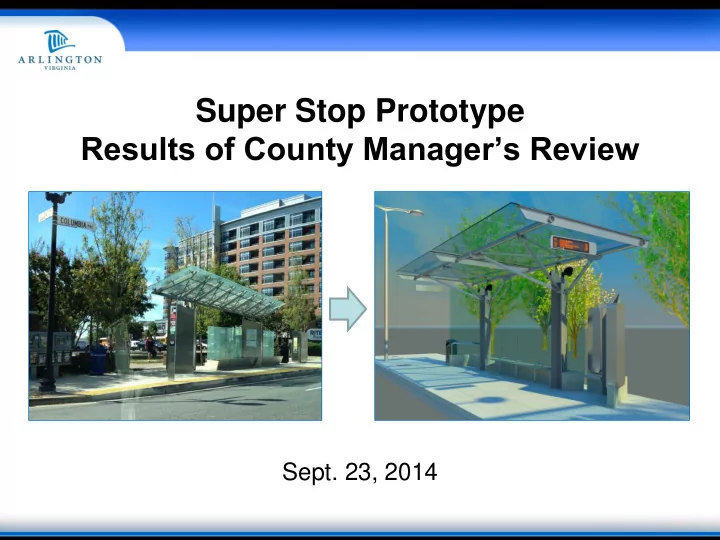
Super Stop Prototype Results of County Manager’s Review

  • Sept. 23, 2014
slide-2
SLIDE 2

CliftonLarsonAllen LLP conducted the review

  • Selected through a competitive process
  • Work completed at the direction of the Department of Management

and Finance

  • Scope of work

– Performance review on the project development and delivery – Financial review of costs associated with the project

2

Performance and Financial Review

slide-3
SLIDE 3

Performance review findings

  • Lack of clear communication between County and WMATA staff
  • Unforeseen external delays, specifically VDOT approval
  • Poor execution of construction performance

Financial review findings

  • Documentation provided to WMATA from Potomac Construction

lacked proper detail to support additional payments from the County

  • Change orders were not agreed to in writing per the Agreement,

resulting in those costs being borne solely by WMATA

  • Original budget of $2,150,000 for three prototypes was not amended

when scope changed from three prototypes to one

3

Performance and Financial Review

slide-4
SLIDE 4

4

Performance and Financial Review

Prototype costs Amount

Construction costs supported by County funds $1,020,211 County project management costs $319,604 Total costs $1,338,815

Walter Reed prototype = $881,933 Fabrication of parts for two other prototypes = $456,882

slide-5
SLIDE 5

CliftonLarsonAllen recommended that the County take several steps:

  • Develop a formal process to establish criteria for escalating difficulties with

contractors, partners or other third parties to the next level.

  • Consider revising agreements with partners to include consequences for

failure to achieve project benchmarks.

  • Ensure the County has outlined all project tasks and the expected timeline

prior to the project starting, especially when working with third parties.

  • Ensure an individual is assigned to monitor the budget throughout a project.
  • Ensure agreement language clearly identifies roles and responsibilities of all

parties involved.

For future Columbia Pike transit stations, the County will:

  • Directly oversee construction – All consultants and contractors will

work directly for the County.

  • Control costs throughout design and construction – This includes

identifying risks early in project development, and enhanced monitoring and management of costs.

5

Performance and Financial Review

slide-6
SLIDE 6

 We heard the community  We developed a better design  We substantially reduced costs  We will take over management of the project from WMATA and deliver it effectively and efficiently  We will continue to leverage federal and state funding

6

Columbia Pike Transit Stations

slide-7
SLIDE 7
  • Create an improved, walkable “Main Street”
  • Neighborhoods linked by enhanced transit and a street that

balances all modes of travel (complete street)

Transform the corridor from an “aging auto-oriented, suburban, commercial strip”

Vibrant, pedestrian-friendly, “Main Street” destination

into a

Vision for the Pike

slide-8
SLIDE 8

8

Serving More Transit Riders

Nearly all transit station locations along Columbia Pike have more than 100 daily boardings – with ridership expected to more than double by 2035.

Basic stop includes:

  • Sign
  • Information/schedule
  • Paved boarding area

Typical ridership: <40 boardings daily Sheltered stop adds:

  • Small shelter, seating
  • Bus bay or curb

extension Typical ridership: 40-100+ boardings daily Transit station adds:

  • Larger shelter, seating
  • Raised platform (near-level boarding)
  • Real-time information display
  • Lighting
  • Off-board fare payment

Typical ridership: 250-1000+ boardings daily

slide-9
SLIDE 9

What we improved:

 Better canopy coverage (larger and lower with reduced angle)

‒ Doubled covered standing capacity for standard size station

 Better pedestrian circulation  Improved ADA accessibility  Better seating

‒ Increased amount of covered seating

 “Kit of parts” design (modular)

What we kept:

 Passenger amenities  Real-time information  Lighting  Design aesthetics

9

Results of Design Review

slide-10
SLIDE 10

Simplified the design

– Modular, flexible – can be scaled up or down – Standardized components – Less structure, less steel – Eliminated ice melt system – Scaled program to ridership

10

How We Cut Costs

Cheaper to build Cheaper to maintain

slide-11
SLIDE 11

Construction Cost Breakdown

11

Structure: $192,000 Supporting infrastructure: $169,000

Estimated Construction Cost (Standard size): $361,000

Structure includes:

  • Steel beams, bracing and columns
  • Glass roof panels
  • Glass windscreens
  • Benches and lean bars
  • Display cases and electronic real-

time transit information display Supporting infrastructure includes:

  • Station platform - 10”-high curb, 90-feet long

to accommodate two transit vehicles

  • Foundations and footings
  • Power
  • Site preparation
  • Landscaping/site restoration
slide-12
SLIDE 12

Eugene, Oregon – BRT

12

Alexandria, VA – BRT Charlotte, NC – LRT Grand Rapids, MI – BRT

Transit Stations in Other Cities

slide-13
SLIDE 13

13

Program Funding

Federal = 38% $8 million State = 24% $5.1 million Local - TCF= 33% $6.8 million Local - G.O. Bond = 5% $1 million Local - G.O. Bond = 6% $800,000 Federal = 52% $6.4 million State = 14% $1.7 million Local - TCF= 28% $3.5 million

Note: Local - TCF is commercial real estate tax revenues that can

  • nly be spent for new transportation projects.

2013 CIP = $20.9 million

(24 stations)

2015 CIP = $12.4 million

(23 stations)

Program cost reduced 40 percent

slide-14
SLIDE 14

We have:

 Cut standard-size station cost significantly  Reduced program costs by 40%  Developed a better design that shelters more people  Taken over project management  Incorporated lessons learned  Stayed true to the goal of providing great transit for the Pike

14

Summary

slide-15
SLIDE 15
  • Begin design this fall for new

station sizes and next eight stations

‒ Consulting the community: We will seek targeted input on specific elements of the updated design

  • Plan to build remaining 23

stations in phases

‒ Construction of the next eight stations expected to begin in late 2015/early 2016

15

Project information: http://projects.arlingtonva.us/projects/columbia-pike-transit-stations/

Moving Forward