
SLIDE 1
A Counsellors’ Enhanced Response
to Mult ltip iply ly Excluded Homeless People’
John Conolly, January 2015
Slide Design, Paul Ashton 1
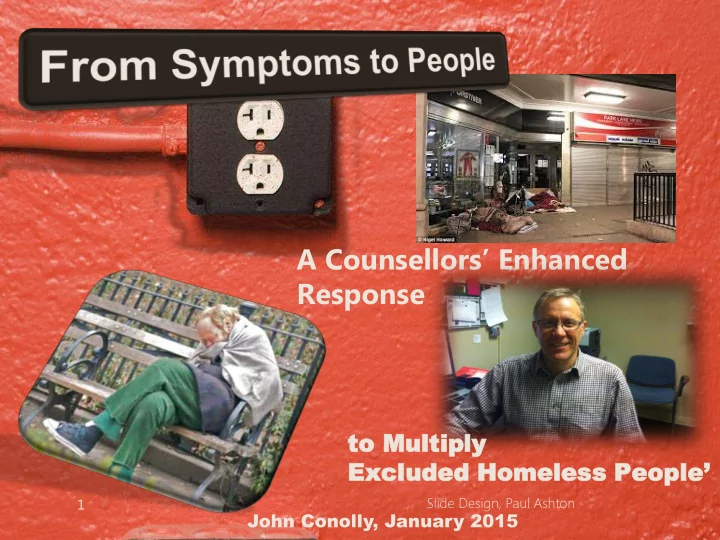
Response to Mult ltip iply ly Excluded Homeless People Slide - - PowerPoint PPT Presentation
A Counsellors Enhanced Response to Mult ltip iply ly Excluded Homeless People Slide Design, Paul Ashton 1 John Conolly, January 2015 In her report of the multiple exclusion homelessness research programme, McDonagh (2011), described
to Mult ltip iply ly Excluded Homeless People’
John Conolly, January 2015
Slide Design, Paul Ashton 1
Finds a night shelter Needs to drink to avoid DTS is told to leave Gets placed in hostel Arrested for fighting with another resident Out of prison back on the street
John Conolly, January 2015
Finds a night shelter Needs to drink to avoid DTS is told to leave Gets placed in hostel Arrested for fighting with another resident Out of prison back
street John Conolly, January 2015
( Maguire et al, 2009).
73% Prison Population, (Ministry Justice,2007). 77%
( DOH, 2009).
67% Mental Hospital Populations, (NIMHE 2003). Have PD as opposed to : 4% of General Population (Coid et al, 2006).
John Conolly, January 2015
Slide Design, Paul Ashton 4
John n Conolly
, January uary 2015
One particularl ticularly dangerous rous aspect t of PD is that in their ir search h to meet their ir emotion tional al and psychol
gical al needs, s, PD patie ient nts wil ill continu inual ally up the ante until il the destructio ruction n wroug ught ht upon themselv selves es or others rs is so great t that it can be no longe ger r ignored red, , and usually ally culm lmina inates tes in emergency gency admi missio sions (Burn rns, s, 2006). ).
John Conolly, January 2015
Historically homeless people, due to their unsettled circumstances and state of mind, have been perceived as unable to make use of mh and psychological services. In my own Psychology and Psychotherapy trainings the following were very much stressed as patient pre-requirements:
John Conolly, January 2015
Be Crisis and addiction free ( as impedes the above) Stable situation (housed) Be able to develop and maintain a ‘therapeutic’ alliance Regular attendance This to withstand the emotional rigours and challenges of treatment aimed at replacing destructive defences with constructive ones.
John Conolly, January 2015
John Conolly, January 2015
I found that I would:
– Validate idate and empathi thize ze with people a lot more – Be more transpa nsparent rent regarding my thoughts, feelings, decision making processes, requirements – I would explain things a lot more – I found the need to ‘suspend judgment’, to keep an ‘open mind’ to be that much greater
which lay beyond not just my own experiences but even beyond my own conception of what might be possible
John Conolly, January 2015
I don’t think
box I think of what I can do for the person living in that box John Conolly, January 2015
All the while however, I would be aware that I was not following my original training, that I was going beyond it. Something Colleagues and myself came to label: ‘ THE PROFESSIONAL SUPEREGO’ (Greenway, 2014,) There was a constant concern NOT to confuse ‘Boundary crossing with ‘Boundary violation’ ( Gutheil, 2005):
Boundary crossing - temporary, non –exploitative deviations from ‘classical/general practice that do no harm and actually help Boundary violation, - harmful deviation from the norm
One major distinguishing factor being whether these deviations can be discussed in the public domain, in Supervision, with other colleagues. John Conolly, January 2015
Slide Design, Paul Ashton 12
‘ an approach that enhances safety while promoting transition to housing, and/or treatment alternatives through patient centred supportive interventions that develop goals and motivation to create positive change’ (levy 2013)
John Conolly, January 2015
New ways of conceptualising the nature of an enhanced psychological approach to multiply excluded homeless people are emerging such as:
Slide Design, Paul Ashton 13
John Conolly, January 2015
person’s world by learning meaning of his/her gestures, words, and actions – promoting mutual understanding and jointly defined goals
promoting manner while developing goals ( Motivational Interviewing techniques, Person centred listening skills)
te Safety ety – crisis intervention, use opportunity for further work
Slide Design, Paul Ashton 14
lita tate e and Support Change – point out discrepan pancie cies, s, explore e ambivalen alence ce, , reinforce e healthy hy behaviou iours s and develo lopin ping g skills, ls, as well as needed d supports ts – use Ch Change e Model & Motivational tional Interviewi viewing ng Princi ciples ples. . ( M Miller ler & Rollnick, , 2013). 5. . Cultural al and Ecologic gical al Consider eratio tions ns - Prepar are and support t homeless ess person
ssful l transiti ition
tion
tionsh
ips, ideas, s, service ices, s, resources, es, treatmen ent, t, accommoda
tion etc.
John Conolly, January 2015
Slide Design, Paul Ashton 15
1.Indi ndividu idual al practitioner actitioner Enhanced anced Clinical nical Practic ctice, e, Super ervis ision ion, , Exper erts By Experien erience ce 2.Ser ervice ice level el Psychol hologicall
Infor
med Envir ironm
ents – PIES 3.Ins nstitution titutional al Level el
culty Guidelines idelines
riculum Developm elopment ent ( Unis of Brighto ghton, n, Westm tmins inster) ter)
earch 4.Government Level
Understanding Framework for Personality Disorder - KUF PD.
Understanding Framework for Homeless/Exclusio n Health???
John Conolly, January 2015
16 Slide Design, Paul Ashton
1.
Donagh gh, , T. (2011) 011), , Tackling kling Homele elessnes ness and Exclus lusion: ion: Under ersta tanding nding Comple mplex x Lives es, , The Joseph eph Rownt ntree ee Founda undation, tion, York. k. John n Conoll
, Slide de Design ign, Paul l Ashto hton 17
re-offending: prisoner Cohort Study’, 2007, Ministry of Justice, London
review of the literature’, 2009, Southampton, UK, University
Commissioning guidance for personality disorder services’, 2009.
Personality disorder no longer a diagnosis of exclusion’, 2003.
. ‘ An Introduction to Community Mental Health Teams (CHMTs): How Do They Relate to Patients with Personality Disorders?’, Chaptr 9, pps179 – 1998, in ‘ Personality Disorder and Community Mental Health Teams – A Practitioner’s Guide’,2006, Sampson, McCubbin and Tyrer, John Wiley & Sons, Ltd.
correlates of personality disorder in Great Britain, British Journal of Psychiatry, 188, 423-431. John Conolly, Slide Design, Paul Ashton 18
communication.
. G.,’ Boundary issues and personality disorders’, Journal of Psychiatric Practice, 2005, 11, 421-429
10. . Levy, J.S. ‘ Pretreatment Guide’,
2013, Loving Healing Press Inc.
‘Motivational Interviewing, Helping People Change’, (2013), 3rd Ed, The Guildford Press.
John Conolly, Slide Design, Paul Ashton 19