Researching alternative, sustainable agricultural systems A - - PowerPoint PPT Presentation

researching alternative sustainable agricultural systems
SMART_READER_LITE
LIVE PREVIEW

Researching alternative, sustainable agricultural systems A - - PowerPoint PPT Presentation

Researching alternative, sustainable agricultural systems A modelling aproach by examples from Denmark Hugo Fjelsted Alre and Erik Steen Kristensen Danish Research Centre for Organic Farming email: hugo.alroe AT agrsci.dk Outline of


slide-1
SLIDE 1

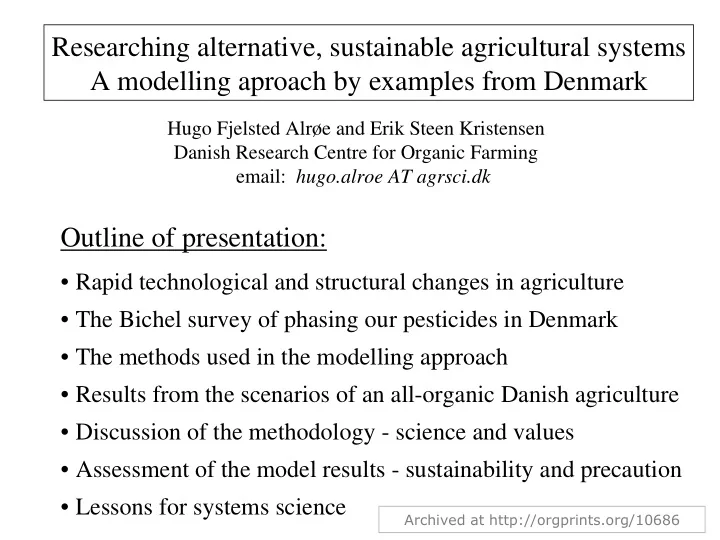
Researching alternative, sustainable agricultural systems A modelling aproach by examples from Denmark

Hugo Fjelsted Alrøe and Erik Steen Kristensen Danish Research Centre for Organic Farming email: hugo.alroe AT agrsci.dk

Outline of presentation:

  • Rapid technological and structural changes in agriculture
  • The Bichel survey of phasing our pesticides in Denmark
  • The methods used in the modelling approach
  • Results from the scenarios of an all-organic Danish agriculture
  • Discussion of the methodology - science and values
  • Assessment of the model results - sustainability and precaution
  • Lessons for systems science

Archived at http://orgprints.org/10686

slide-2
SLIDE 2

The Bichel survey

The main committee with expert members representing vested interests in society Four sub-committees with specialist research members An inter-disciplinary group

  • n total organic conversion

More than 60 reports from specialist consultants in different disciplines and sciences Five specialist reports Final report from the main committee

slide-3
SLIDE 3

Systems science and systems values

  • Neither experiments nor environmental monitoring can prevent

all systemic consequences - due to the time lag between the act and the measurable consequence and - due to ignorance of possible consequences

  • Decisions based on risk assessments and economical decision

theory will not prevent the systemic consequences of rapidly changing new technologies

  • Acknowleding the human dependency, and growing influence,
  • n the environment leads to a principle of precautionary acting
  • The development of scientific strategies for handling

uncertainty and ignorance involves value inquiry and ethics

  • Sustainability as functional integrity and the principle of

precaution are key examples of elements in a systemic ethics

slide-4
SLIDE 4

Lessons for systems science

  • Inquiry into values and basic perceptions involved is decisive in

the modelling of alternative agricultural systems

  • The presumptions of the model are related to the vision of a

future state and the values related to this vision

  • Value inquiry forms the basis for determining and critically

evaluating the necessery presumptions

  • And conversely, the scenario results make the value inquiry

more precise and substantiated

  • The involvement of experts in the value inquiry is crucial, in
  • rder to gain an informed critique of the presumptions
  • Values are also important in the assessment of the model results
  • Value inquiry constitutes a key element of situated systems

science