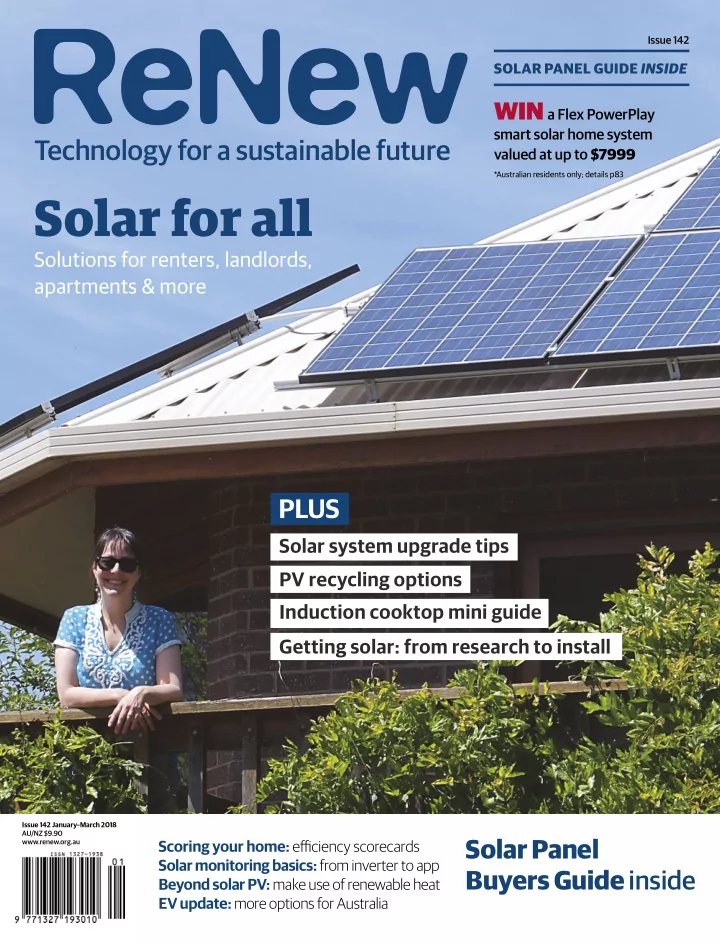
ReNew Issue 142 SOLAR PANEL GUIDE INSIDE WIN a Flex PowerPlay smart - - PDF document

renew
SMART_READER_LITE
LIVE PREVIEW

ReNew Issue 142 SOLAR PANEL GUIDE INSIDE WIN a Flex PowerPlay smart - - PDF document

ReNew Issue 142 SOLAR PANEL GUIDE INSIDE WIN a Flex PowerPlay smart solar home system Technology for a sustainable future valued at up to $7999 * Australian residents only; details p83 Solar for all Solutions for renters, landlords,


slide-1
SLIDE 1 Issue 125 October–November 2013 AU $7.95 NZ $8.95 www.renew.org.au Issue 142 January–March 2018 AU/NZ $9.90 www.renew.org.au

ReNew

Scoring your home: effjciency scorecards Solar monitoring basics: from inverter to app Beyond solar PV: make use of renewable heat EV update: more options for Australia

Issue 142

Solar Panel Buyers Guide inside

Technology for a sustainable future

WIN a Flex PowerPlay

smart solar home system valued at up to $7999

* Australian residents only; details p83

Solar for all

PLUS

PV recycling options Induction cooktop mini guide Solar system upgrade tips Getting solar: from research to install

SOLAR PANEL GUIDE INSIDE

Solutions for renters, landlords, apartments & more

slide-2
SLIDE 2 56 ReNew Issue 142 renew.org.au

Park your solar Australia’s largest solar car park

A solar car park just makes sense, particularly at a university campus where it can be used for research and education. A recent ATA branch meeting heard about the largest one in Australia, recently installed at USQ. Branch convenor Mark Tranter and USQ’s Andreas Helwig and Alicia Logan explain.

IT’S inspiring to see renewable energy projects springing up in Queensland even in areas of signifjcant fossil fuel production. One such example is Australia’s largest integrated solar car park, which is now operating at the University of Southern Queensland (USQ) in Toowoomba in the Darling Downs. This is a rich agricultural region that is also home to coal mining, coal seam gas production and two of the country’s youngest coal-fuelled power stations, alongside large solar (2 GW) and wind farm (500 MW) proposals—a region with very diverse business interests. The solar car park is part of a bigger project at USQ, the Sustainable Energy Solution, which involves installation of signifjcant PV arrays around the university: a 1 MW car park solar array at the Toowoomba campus, 196 kW
  • f rooftop PV at Ipswich, 205 kW of rooftop PV
in Springfjeld and another 506 kW of rooftop PV in Toowoomba. Quite a feast of solar! The solar project is intended as a feast for research as well. Andreas Helwig, a sustainable energy researcher from the school
  • f mechanical and electrical engineering, is
undertaking several research projects using the resulting “100 km virtual aperture” (i.e. modelled like 100 km of solar panels!) to investigate the “secret life” of solar panels. With PV across three locations, the research will investigate how solar cell performance is afgected by transient clouds, varying levels
  • f relative humidity and difgerent types of
airborne dust (including coal dust). All of these can degrade the PV output, reduce the cooling benefjt of inverter heat sinks and exacerbate PV manufacturing faults. Andreas notes, “A big question—and an expensive one—is when is it necessary to clean
  • Making good use of a car park space: the largest solar car park in Australia—3842 panels and over 1 MW!—is
now operating at USQ’s Toowoomba campus, providing energy and shading. and maintain the surfaces of the arrays and the inverter heat sinks?” Research projects are also using infrared photometry to identify PV faults, whether from manufacturing or degradation over time. Solar car park design Using the 1.45 hectare car park at the Toowoomba campus (equivalent to the size of a football fjeld) yielded some benefjts—large PV capacity and sheltered parking for cars— and some challenges, such as the need for a structure to support the PV panels. The panels are mounted on specially designed stands, engineered to withstand the rated wind zone for this part of Toowoomba, and orientated 30° west of north and tilted at 23° ofg the horizontal. The orientation for parking bays is now aligned both for better solar generation and to provide maximum shade and protection to cars. After tenders were analysed, Autonomous Energy was chosen as principal contractor. Table 1 shows all three stages of the project and variations in panel wattage/technology as the project progresses. The guaranteed minimum annual generation from the car park array is 1.826 GWh—enough to power about 250
  • homes. Since commissioning in June 2017,
the output has averaged 4 MWh per day in winter, currently climbing in spring to around 6 MWh per day. There is zero export of energy allowed from the car park array, but partial
slide-3
SLIDE 3 ReNew Issue 142 57 renew.org.au and full export capability is available for the Ipswich and Springfjeld projects. The cost of all three stages over the three campuses for solar PV, with a total rated capacity of 2 MW, is $6.1 m. With an expected payback of nine years, the projection is for additional savings of $3.51 m (net present value) over the 25 year life of the system. Research opportunities As all three stages of installation are commissioned, there will be excellent
  • pportunities for both research and student
  • education. The intention is to develop models
to understand, predict, compare and test long-term energy production and maintenance costs for each array. This is of particular relevance to eastern Australia as renewable energy penetration increases, as well as for isolated island communities depending heavily on solar energy. PV MANUFACTURING FAULTS Early detection of faults in large arrays allows for planned maintenance to replace faulty panels or repair connections during non daylight hours to maintain peak performance
  • f the array throughout its lifetime.
Possible manufacturing faults include minor leaks in a panel’s hermetic seals which can lead to internal corrosion; minor fractures in the outer edges of individual cells which can develop into cracks with daily thermal cycling; incomplete metal current collectors
  • n the front of cells; and poor panel junction
box and inter-panel connections. Several projects are looking at how infrared photometry can be used to detect changing
  • r abnormal characteristics of PV panels
and inverters (see Figure 1). With the solar car park array, infrared images can be taken from underneath the array—both easier and cheaper than using a drone or climbing onto a roof to take the images. USQ is also planning to compare the use of output monitoring versus infrared indicators to detect PV faults. DUST, MOISTURE AND HEAT IMPACTS All solar panels and their cells will sufger reduced output due to the impacts of heat, water vapour from humidity, and airborne dust and pollution. As humidity increases, solar irradiance decreases (Figure 2); studies will compare output from the difgerent array locations which experience difgerent humidity levels. Dust is a double whammy: it can downgrade the PV output both due to shading of the cells and increased cell temperature (see Figure 3). USQ will be looking at the impacts of a range of airborne particles on difgerent solar cell types. For example, Toowoomba’s red soil absorbs the shorter blue spectrum wavelengths and refmects and transmits the longer red
  • wavelengths. A broad spectrum PV array
such as one made from Ga-As cells would experience an energy production drop due to both shading and a loss of the spectrum used for energy production. However, the same red soil dust on a conventional monocrystalline cell will sufger the shading loss, but, as the spectrum it uses is towards the lower end of the red range (they don’t absorb blue light, which is why these cells look blue), the impact is less. Black soil or soot, however, would afgect the generation for both types of solar cell. This leads onto the issue of cleaning USQ’s commitment to sustainable energy wins awards USQ’s 2MW solar array project—the Sustainable Energy Solution—actively demonstrates the university’s commitment to its social responsibilities and to improving environmental
  • performance. Over the years the
university has successfully implemented projects to reduce its energy, waste and water consumption. In 2011, the university began to implement a carbon- reduction strategy including both energy effjciency upgrades and the campus-wide Sustainable Energy Solution. The project represents a signifjcant investment into the three communities USQ is part
  • f, providing a ‘real-world experience’
that delivers a measurable reduction in long-term energy-related emissions and costs, as well as an enhanced platform for research, learning and teaching. And this commitment is winning
  • awards. The Sustainable Energy Solution
was recently recognised at the Clean Energy Council Solar Design and Installation awards, with Autonomous Energy taking out the ‘Over 240kW’ category for the solar car park project. The university also won the Continuous Improvement—Institutional Change category at the 2017 Green Gown Australasia awards, which recognise sustainability best-practice in the tertiary education sector. USQ will now progress to the international Green Gown Awards, representing Australasia in Europe next
  • year. Well done, USQ!
Stage Project array Specs Stage 1: Toowoomba campus solar car park
  • nline 26 June 2017
1.09 MW PV, zero export 3842 x 285 W Jinko panels 19 x 60 kW SMA inverters Min energy guarantee 1.83 GWh/year Stage 1: Toowoomba engineering block, roof-mounted array, small system to emulate a domestic installation for research 5 kW PV with 10 kWh battery 17 x 285 W Jinko panels 5 kW SMA inverter 10 kWh LG Chem battery Stage 2: Ipswich campus, roof-mounted array, heritage permission required, online 28 November 2017 197 kW PV, partial export up to 51 kW 678 x 290 W Jinko panels 7 x 25 kW SMA inverters Min energy guarantee 287 MWh/year Stage 2: Springfjeld campus, roof-mounted array, higher effjciency panels for smaller roof, online 11 December 2017 205 kW PV, full export capability 520 x 395 W LG Neon panels 4 x 25 kW, 5 x 20 kW SMA inverters Min energy guarantee 300 MWh/year Stage 3: Toowoomba campus, roof-mounted array over multiple buildings, online from December 2017 to January 2018 506 kW PV, zero export 1430 x 290 W Jinko, 232 x 395 W LG Neon panels 18 x 25 kW, 2 x 20 kW SMA inverters Min energy guarantee 739 MWh/year
  • Table 1: USQ’s sustainable energy solution is being implemented in three stages to provide a total capacity of
around 2 MW. Technology improvements are included as the project rolls out.
slide-4
SLIDE 4 58 ReNew Issue 142 renew.org.au PV arrays. Cleaning arrays is expensive and involves electrical safety issues, so it’s important to get the balance right between cost, cleaning without degrading the PV’s glass surface and maintaining the array for
  • ptimal energy output.
Inverters are also afgected by heat, with many inverters now having thermal rollback protection—they reduce output to keep their electronic components below 45 °C to 50 °C. The efgectiveness of cooling heat sinks is also degraded by dust accumulation. The installations enable research into how ambient temperatures and dust afgect the performance and life of the inverters under difgerent conditions. DUAL LAND USE The project also lends itself to consideration
  • f agriculture under large PV arrays. The
microclimate that occurs under large PV arrays ofgers potential for dual land use for ‘protected’ agriculture using dew and rainfall run-ofg. If USQ research is successful, this could be used to enhance agriculture in semi- arid landscapes. A model campus These projects across the university’s three campuses have many benefjts. One is as a model for other projects; for example, the USQ solar car park provides a template that can be applied across shopping centres, hospitals and
  • ther places with large open parking areas.
As well as shade for the cars, with appropriate design a solar car park can pay for itself, providing payback within a decade or so. This payback period could potentially be reduced in the future if electric vehicles become more prevalent, with a solar car park able to get a return from a fee for EV charging. The projects also support the university’s future energy needs and stand as a model
  • f practical and cost-efgective action to
contribute to Australia’s emission reduction
  • goals. Further, the projects enhance regional
resilience, both producing energy and developing new jobs in areas as diverse as solar energy forecasting, reliability engineering and high-value sustainable agricultural practices. You’d have to say that’s a good place to park your car. S This article is based on a talk at ATA’s Toowoomba branch in September given by Alicia Logan (USQ’s Environment Manager) and Andreas Helwig (USQ Lecturer in Electro-mechanical Engineering). For further information, see www.usq.edu.au/toowoomba/ sustainable-energy
  • Figure 3: Typical efgects of rising temperature and dust accumulation
  • n PV panel output capacity relative to the panel’s rating.
  • Figure 2: Typical impact of atmospheric humidity on irradiance reaching ground
level in the tropics.
  • Figure 1: USQ is experimenting with using infrared thermal images to detect PV faults. This image from a USQ
student’s research shows how hot spots can be detected; this is made simpler in the USQ solar car park as they can be detected from underneath the structure. “The microclimate that occurs under large PV arrays ofgers potential for dual land use for ‘protected’ agriculture using dew and rainfall run-ofg.” Irradiance reaching ground level (W/m2 1000 950 900 850 800 750 700 650 600 550 500 450 400 350 16 18 20 22 24 26 Relative humidity (%) 100 90 80 70 60 50 40 30 20 10 PV rating output (%) 25 35 45 55 65 75 Temperature (°C) Without dust With dust