Reliability In case of a crash, recover to a consistent (or correct - - PowerPoint PPT Presentation

reliability
SMART_READER_LITE
LIVE PREVIEW

Reliability In case of a crash, recover to a consistent (or correct - - PowerPoint PPT Presentation

Reliability In case of a crash, recover to a consistent (or correct state) and continue processing. Types of Failures Node failure 1. Communication line of failure 2. Loss of a message (or transaction) 3. Network partition 4. Any


slide-1
SLIDE 1

Distributed DBMS Reliability and Partition. 1
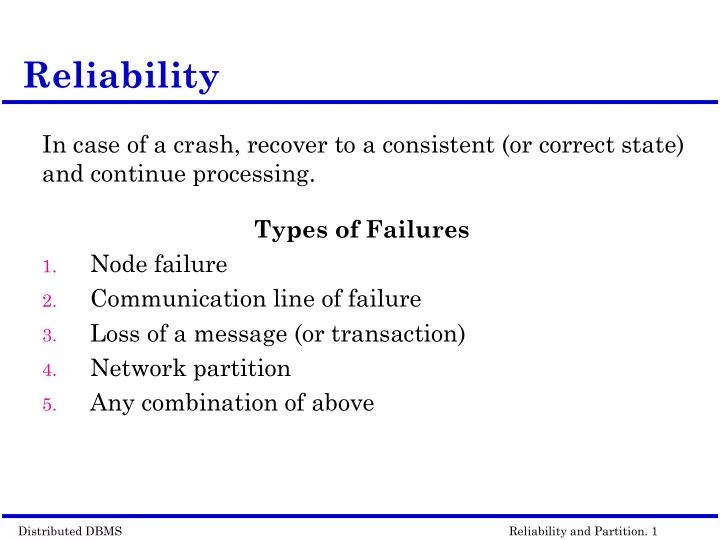
Reliability

Types of Failures

1.

Node failure

2.

Communication line of failure

3.

Loss of a message (or transaction)

4.

Network partition

5.

Any combination of above In case of a crash, recover to a consistent (or correct state) and continue processing.

slide-2
SLIDE 2

Distributed DBMS Reliability and Partition. 2

Approaches to Reliability

1.

Audit trails (or logs)

2.

Two phase commit protocol

3.

Retry based on timing mechanism

4.

Reconfigure

5.

Allow enough concurrency which permits definite recovery (avoid certain types of conflicting parallelism)

6.

Crash resistance design

slide-3
SLIDE 3

Distributed DBMS Reliability and Partition. 3

Recovery Controller Types of failures:

transaction failure site failure (local or remote) communication system failure

Transaction failure

UNDO/REDO Logs (Gray) transparent transaction (effects of execution in private workspace)  Failure does not affect the rest of the system

Site failure

volatile storage lost stable storage lost processing capability lost (no new transactions accepted)

slide-4
SLIDE 4

Distributed DBMS Reliability and Partition. 4

System Restart

Types of transactions: 1. In commitment phase 2. Committed actions reflected in real/stable 3. Have not yet begun 4. In prelude (have done only undoable actions)

We need:

stable undo log; stable redo log (at commit); perform redo log (after commit)

Problem:

entry into undo log; performing the action

Solution:

undo actions

  • < T, A, E >

must be restartable (or idempotent) DO – UNDO  UNDO  DO – UNDO – UNDO – UNDO --- UNDO

slide-5
SLIDE 5

Distributed DBMS Reliability and Partition. 5

Local site failure

Transaction committed  do nothing Transaction semi-committed  abort Transaction computing/validating  abort

AVOIDS BLOCKING Remote site failure

Assume failed site will accept transaction Send abort/commit messages to failed site via spoolers

Initialization of failed site

Update for globally committed transaction before validating other transactions If spooler crashed, request other sites to send list of committed transactions

slide-6
SLIDE 6

Distributed DBMS Reliability and Partition. 6

Communication system failure

Network partition Lost message Message order messed up

Network partition

Semi-commit in all partitions and commit on reconnection (updates available to user with warning) Commit transactions if primary copy taken for all entities within the partition Consider commutative actions Compensating transactions

slide-7
SLIDE 7

Distributed DBMS Reliability and Partition. 7

Compensating transactions

  • Commit transactions in all partitions
  • Break cycle by removing semi-committed transactions
  • Otherwise abort transactions that are invisible to the

environment (no incident edges)

  • Pay the price of committing such transactions and issue

compensating transactions

Recomputing cost

  • Size of readset/writeset
  • Computation complexity
slide-8
SLIDE 8

Distributed DBMS Reliability and Partition. 8

time site of

  • rigin

site B site C (coordinator) UNKNOWN active UNKNOWN active UNKNOWN active initiate commit READY prepare READY prepare COMMITTING commit COMMITTING commit ack UNKNOWN inactive UNKNOWN inactive ack UNKNOWN inactive

Figure 5.3: Linear Commit Protocol

slide-9
SLIDE 9

Distributed DBMS Reliability and Partition. 9

Local Site Failure System’s Decision at Local Site After Committing/Aborting a local transaction Do nothing (Assume: Message has been sent to remote sites) After Semi-Committing a local transaction Abort transaction when local site recovers Send abort messages to other sites During computing/validating a local transaction Abort transaction when local site recovers Send abort message to other sites

TABLE 1: Local Site Failure

slide-10
SLIDE 10

Distributed DBMS Reliability and Partition. 10

Ripple Edges: Ti reads a value produced by Tj in same partition Precedence Edges: Ti reads a value but has now been changed by Tj in same partition Interference Edges: Ti reads a data-item in one partition and Tj writes in another partition then Ti → Tj Finding minimal number of nodes to break all cycles in a precedence graph consisting of only two-cycle of ripple edges has a polynomial solver.

slide-11
SLIDE 11

Distributed DBMS Reliability and Partition. 11

Communications

  • Design

– Sockets, ports, calls (sendto,

recvfrom)

– Oracle – Server cache – Addressing in RAID – LUDP

  • High level calls

– Setup – RegisterSelf – ServActive – ServAddr – SendPacket – RecvMsg

Software guide (where is the code and how is it compiled?) Testing RAID

  • RAID installation
  • RAIDTOol
  • Example test session

Recommended reading How to incorporate a new server (RC) How to run an experiment (John-Comm)

slide-12
SLIDE 12

Distributed DBMS Reliability and Partition. 12

Storage of backup copies of database

  • Reduce storage
  • Maintain number of versions
  • Access time

Move servers at Kernel level

  • Buffer pool, scheduler, lightweight processes
  • Shared memory
slide-13
SLIDE 13

Distributed DBMS Reliability and Partition. 13

New protocols and algorithms Replicated copy control

  • Survivability
  • Availability
  • Reconfigurability
  • Consistency and dependability
  • Performance
slide-14
SLIDE 14

Distributed DBMS Reliability and Partition. 14

Site is up All data items are available Site is down None of the data items are available Site is up (all fail locks for this site released) Continued recovery, copies on failed site marked and fail-locks are released Partial recovery, unmarked data-objects are available Control transaction 1 running

Figure : States in site recovery and availability of data-items for transaction processing

slide-15
SLIDE 15

Distributed DBMS Reliability and Partition. 15

ABCDEFGH ABCDE ABC DE GH F FGH AB C D E B A

slide-16
SLIDE 16

Distributed DBMS Reliability and Partition. 16

Data Structures

  • Connection vector at each site:

Vector of boolean values

  • Partition graph

ABCDE ABC B DE C AC A ADE

slide-17
SLIDE 17

Distributed DBMS Reliability and Partition. 17

Site name vector of file f (n is the number of copies) S = < s1, s2 ,…, sn > Linear order vector of file f L = < l1, l2 ,…, ln > Version number X of a copy of file f Number of times network partitioned while the copy is in majority

slide-18
SLIDE 18

Distributed DBMS Reliability and Partition. 18

Version vector of a copy at site Si V = < v1, v2 ,…, vn > Marked vector of a copy of file f M = < M1, m2 ,…, mn > mi = T if marked = F if unmarked

slide-19
SLIDE 19

Distributed DBMS Reliability and Partition. 19

ABCDE ABC B DE C AC A ADE

slide-20
SLIDE 20

Distributed DBMS Reliability and Partition. 20

{1,2,3,4,5,6,7} undefined {1,2,5,6} undefined {1,2} undefined {1} {1,2,3,4,5,6,7} undefined {3,4,7}} undefined {3}

P_treeS1: P_treeS3:

Figure 9. Partition trees maintained at S1 and S3 before any merge

  • f partition occurs

(a) (b)

Examples of Partition Trees

slide-21
SLIDE 21

Distributed DBMS Reliability and Partition. 21

Partition Tree after Merge

P_treeS1,3:

Figure 10. Partition tree maintained at S1 and/or S3 after S3 merge

{1,2,3,4,5,6,7} {1,2,5,6} undefined {1,2} undefined {1} {3,4,7} undefined {3}