Register Names lecture 9 MIPS assembly language 2 - register - - PowerPoint PPT Presentation

register names lecture 9 mips assembly language 2
SMART_READER_LITE
LIVE PREVIEW

Register Names lecture 9 MIPS assembly language 2 - register - - PowerPoint PPT Presentation

Register Names lecture 9 MIPS assembly language 2 - register names - pseudo instructions - immediate versions - signed and unsigned - shifting February 8, 2016 We will learn other register names later. Conditional Branch

slide-1
SLIDE 1

lecture 9 MIPS assembly language 2

  • register names
  • pseudo instructions
  • immediate versions
  • signed and unsigned
  • shifting

February 8, 2016

Register Names

We will learn other register names later.

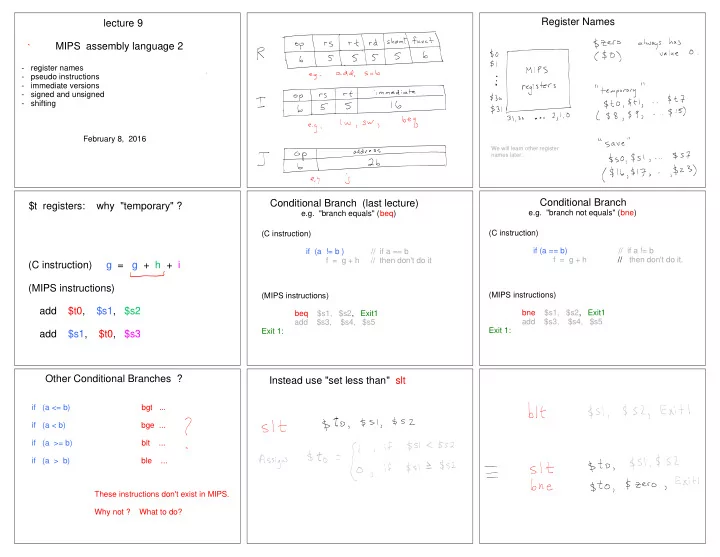
(C instruction) g = g + h + i (MIPS instructions) add $t0, $s1, $s2 add $s1, $t0, $s3 $t registers: why "temporary" ? Conditional Branch (last lecture)

e.g. "branch equals" (beq) (C instruction) if (a != b ) // if a == b f = g + h // then don't do it (MIPS instructions) beq $s1, $s2, Exit1 add $s3, $s4, $s5 Exit 1:

Conditional Branch

e.g. "branch not equals" (bne) (C instruction) if (a == b) // if a != b f = g + h // then don't do it. (MIPS instructions) bne $s1, $s2, Exit1 add $s3, $s4, $s5 Exit 1: These instructions don't exist in MIPS. Why not ? What to do?

Other Conditional Branches ?

if (a <= b) bgt ... if (a < b) bge ... if (a >= b) blt ... if (a > b) ble ...

Instead use "set less than" slt

slide-2
SLIDE 2

How to express inequalities using only "<" and "not" ?

Exercise

To avoid headaches, MIPS assemblers allow you to use pseudoinstructions such as blt, ble. Assemblers (e.g. MARS) convert these to real MIPS instructions. assembler

Why was MIPS designed this way ?

The benefits of having fewer instructions available outweighs the cost of having more instructions in each program. (recall: RISC - reduced instruction set computer)

lecture 9 MIPS assembly language 2

  • register names
  • pseudo instructions
  • immediate versions
  • signed and unsigned
  • shifting

Q: What is the difference here ? A: The "overflow" conditions (recall Exercises 2 Q 12) e.g. 01...... signed -> overflow + 01...... unsigned -> no overflow 1 .......

Signed versus Unsigned instructions

slide-3
SLIDE 3

Exercise:

MIPS doesn't have these two. Why not?

Signed Unsigned Sign Extension Data path.... (coming soon...) Manipulating Bits

How to put some 32 bit pattern e.g. 0x37b1 fa93 into a register? Q: What happens if you switch the order of those two instructions?

Shifting Bits

(You might have thought this was "I" format, but in fact it is "R" format. Why ?)

Announcements

  • A1 due Wednesday night
  • A2 will be posted Wednesday (MIPS programming)
  • no office hours today for me