Regional Stormwater Management Presented by: Mark Gutshall Lancast - - PowerPoint PPT Presentation

regional stormwater management
SMART_READER_LITE
LIVE PREVIEW

Regional Stormwater Management Presented by: Mark Gutshall Lancast - - PowerPoint PPT Presentation

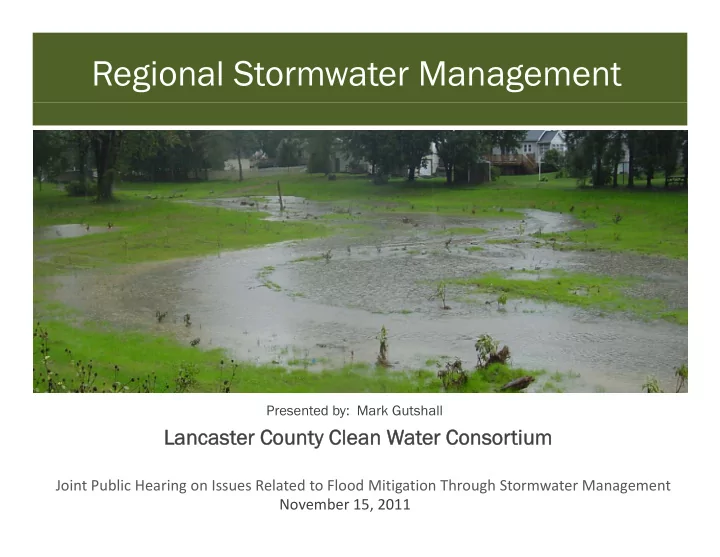
Regional Stormwater Management Presented by: Mark Gutshall Lancast Lancaster County Clean W County Clean Water Consor r Consortium tium Joint Public Hearing on Issues Related to Flood Mitigation Through Stormwater Management November 15, 2011


slide-1
SLIDE 1

Regional Stormwater Management

Lancast Lancaster County Clean W County Clean Water Consor r Consortium tium

Presented by: Mark Gutshall

November 15, 2011 Joint Public Hearing on Issues Related to Flood Mitigation Through Stormwater Management

slide-2
SLIDE 2

Introduction:

Impact of Legacy Sediment

slide-3
SLIDE 3

Introduction:

Benefit Stacking

Single Function Multiple Function Conventional Stormwater Basin Restored Floodplain

slide-4
SLIDE 4

Introduction:

Regulatory Compliance

slide-5
SLIDE 5

Why many of our Floodplains do not function……

Existing Conditions Restored Floodplain

slide-6
SLIDE 6

Historical Impacts

slide-7
SLIDE 7

Sediment trapped behind mill dams

slide-8
SLIDE 8

DEP BMP l 6 7 4

Where we’re going…

Impact of Mill Dams and Deforestation

Bridgen’s 1864 Atlas | Lancaster County, Warwick Township

DEP BMP manual 6.7.4 s

slide-9
SLIDE 9

1840 US CENSUS OF WATER POWERED MILLS FOR EASTERN USA

~ 60,000 mills in 1840

Mill Dams per US Census in Eastern US

NUMBER OF MILLS PER COUNTY

Mills Per County

0 - 5 6 - 20 21 - 50

Lancaster County, PA

0 ‐ 5 6 ‐ 20 21 ‐ 50

51 - 90 91 - 150 151 - 225 227 999

Piedmont

51 ‐ 90 91 ‐ 150 151 ‐ 225

Chesapeake Bay Watershed

227 - 999

  • D. Merritts, R. Walter, A. Ross, and S. Siddiqui

Physiographic Province

Mill Dam Heights, Lancaster County, P

8 0 1 0 0

Mean Dam Height= 2 .4 m

Average dam ht 2.4 m 225 ‐ 999 Total = >60,000

Figure credit: Franklin & Marshall College, Lancaster, PA.

Franklin & Marshall College

2 0 4 0 6 0 0 .0 0 .6 1 .2 1 .8 2 .4 3 .0 3 .7 4 .3 4 .9 5 .5 6 .1 6 .7 7 .3 7 .9

Dam Height, m g
slide-10
SLIDE 10

Natural Streams and the Legacy of Water-Powered Mills

Robert C. Walter and Dorothy J. Merritts

slide-11
SLIDE 11

Post-Settlement Sedimentation Post‐Settlement Sedimentation

Current Floodplain

Source for Sediments & Nutrient Loads

NWBranch2003-07-08 145021

slide-12
SLIDE 12
slide-13
SLIDE 13

Floodplain Restoration

What it is and why it is important

Issue: Legacy Sediment

Material that eroded during the 18th through early 20th century due to large-scale forest clearing and poor farming practices dumping millions of tons of soil into streams, valleys and floodplains

Solution: Floodplain Restoration

R t i fl d l i t th i hi t i l ti Returning floodplains to their historic elevations including the size and quantity of bed/sediment load, downstream base-level controls, and streambank materials

slide-14
SLIDE 14

Floodplain Restoration Design Approach Effects of Legacy Sediment

  • Unstable stream banks (source of sediment, nutrients)

d h d f fl d l d d

  • Streams detached from floodplain and groundwater
  • Reduced flood storage
  • Impaired aquatic and riparian habitat
slide-15
SLIDE 15

Floodplain Restoration as a Stormwater Management Tool Stormwater Management Functions Management Functions

  • Peak Rates
  • Runoff Volume
  • Water Quality

Applications and pp Benefits

  • Land Development
  • Karst
  • Karst
  • TMDLs
  • Others
slide-16
SLIDE 16

Floodplain Restoration Stormwater Management Functions g

Peak Discharge Rate Attenuation

  • Removal of legacy sediment results in increased flood storage
  • Removal of legacy sediment results in increased flood storage
  • Increased flood storage results in reduced flood peak rates

Runoff Volume Runoff Volume

  • Improved soil conditions (Clay → Organic)
  • Retentive riparian wetland pockets
  • Re‐attach floodplain to channel (Allow the floodplain to flood)
  • Improved root structure (native, deep rooted plants)
  • Increased evapotranspiration due to increased vegetative cover (trees/ shrubs)

Water Quality

  • Plant and soil filtration of suspended solids and uptake of nutrients (Riparian Buffer)
  • SW outfalls discharge to floodplain rather than directly to stream
  • Re‐attach floodplain to groundwater (interaction with root zone)

d f f fl d fl fl d l (f l f ff)

  • Increased frequency of flood flows accessing floodplain (filtration of upstream runoff)
  • Eliminates unstable banks as a source of sediment and nutrients
slide-17
SLIDE 17

Existing Floodplain Restored Vegetated Floodplain

slide-18
SLIDE 18

Detention Basin

  • Peak Rate Requirement: Post Development Peak Flows must be ≤

Pre‐Development Peak Flows p

  • Volume Requirement: Manage 2‐yr/ 24‐hr volume difference
  • Water Quality Requirement: Provide Water Quality BMPs
slide-19
SLIDE 19
  • Peak Rate Requirement: Post Development Peak Flows must be ≤

Pre‐Development Peak Flows Restored Floodplain p

  • Volume Requirement: Manage 2‐yr/ 24‐hr volume difference
  • Water Quality Requirement: Provide Water Quality BMPs
slide-20
SLIDE 20

Floodplain Restoration as a Tool to Meet TMDLs

Value added as part of Stormwater Management Plan for new d l

  • r re‐development
  • Public/ private partnership opportunities

Part of TMDL Plan to meet MS‐4 requirements

  • Can be more cost effective than Urban/ Suburban Retrofits
  • Provides increased recreation opportunities, flood reduction, and reduced

maintenance costs on public land maintenance costs on public land

Part of a Nutrient Trading Strategy

  • Delay or eliminate need for hard infrastructure upgrades at WWTP

Delay or eliminate need for hard infrastructure upgrades at WWTP

  • Options for other point discharges
slide-21
SLIDE 21

Floodplain Restoration Additional Benefits

Local and Regional Flood Management

  • Protect infrastructure
  • Reduce local flood elevations
  • Reduce peak discharge rates
  • Reduce peak discharge rates

Opportunities For Wetland Mitigation/ Banking

  • Potential to offset project costs
  • Potential to meet local development needs
  • Potential to meet local development needs

with quality wetland replacement

Wildlife Habitat

  • Aquatic
  • Terrestrial

Recreation

  • Opportunities for trails
  • Wildlife observation
  • Hunting/ fishing

Long‐Term Stream Stability Aesthetics

slide-22
SLIDE 22
slide-23
SLIDE 23

After Before

slide-24
SLIDE 24

Before

Bedford Springs Resort | Floodplain Restoration

slide-25
SLIDE 25

After

Bedford Springs Resort | Floodplain Restoration

slide-26
SLIDE 26

Stormwater BMP Examples

Bucks County Restoration | Floodplain Restoration

slide-27
SLIDE 27

Before & During

Nutrient Trading Pilot Project | New Street Park, Lititz, PA

slide-28
SLIDE 28

After

Nutrient Trading Pilot Project | New Street Park, Lititz, PA

slide-29
SLIDE 29

After

Nutrient Trading Pilot Project | New Street Park, Lititz, PA

slide-30
SLIDE 30

After

Bedford Springs Resort

Bedford, Pennsylvania

After

Bedford Springs Resort | Bedford, Pennsylvania

Part of $100 million restoration

  • f Bedford Springs

R t Resort

slide-31
SLIDE 31

After

Bedford Springs Resort

Bedford, Pennsylvania

After

Bedford Springs Resort | Bedford, Pennsylvania

e

slide-32
SLIDE 32

After

Bedford Springs Resort

Bedford, Pennsylvania

After

Bedford Springs Resort | Bedford, Pennsylvania

e

slide-33
SLIDE 33

Stormwater BMP’s

Santo Doming Regional Water Quality Facility, Lancaster County, PA

slide-34
SLIDE 34

Conclusions

“…Re‐establishing natural stream corridors and floodplains through local stormwater management requirements could offer more g q ff environmentally friendly flood control options than concrete structures.” “…Innovative stormwater management should be considered and g incorporated as an important component of the overall flood mitigation plan.” “Shifting from traditional stormwater management methods to designs and practices that also address channel alterations and degradation, runoff quality, dry‐weather flow protection, and aquifer recharge l h h f l requires an underlying change in how water resource professionals do business”

PA State Water Plan Principles S a e a e a c p es