SLIDE 1
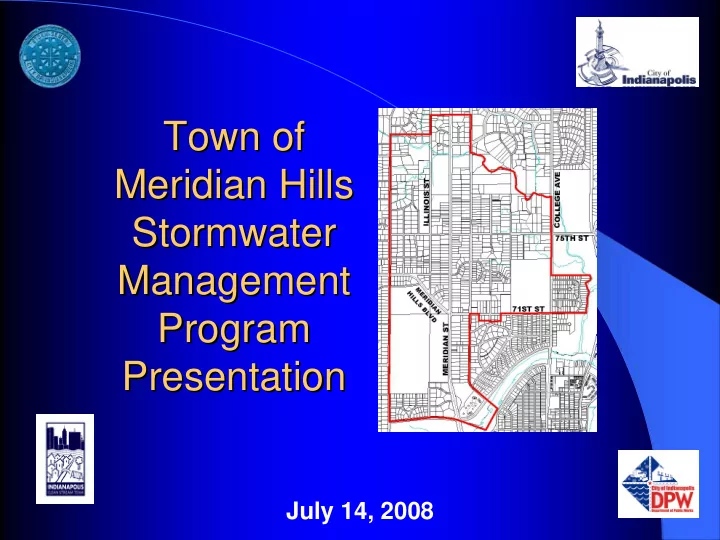
Town of Town of Meridian Hills Meridian Hills Stormwater Stormwater Management Management Program Program Presentation Presentation
July 14, 2008
SLIDE 2 Presentation Topics Presentation Topics
- Stormwater Program Background/General Information
- Importance/Purpose of the Stormwater Program
- Stormwater Program Issues and Questions
- Indianapolis Clean Stream Team Web Site
- Questions / Discussion
SLIDE 3 Stormwater Program Stormwater Program
Background/General Information Background/General Information
- Watershed Masterplan - 1994
The first coordinated look at stormwater control for Marion County
- NPDES Permit Number INS000001 – February 1, 1998
Federal water quality permit issued through and regulated by IDEM
- Preliminary Stormwater Masterplan - 1998
Compilation of known drainage problems county-wide and the estimated cost to correct them.
- Marion County Stormwater Management District & the Stormwater
Utility - September 6, 2001, establishing:
- 1. County-wide Stormwater Management District (excluding
Speedway and Cumberland)
- 2. County-Wide Stormwater Masterplan
- 3. Stormwater Management District Billing and Collection
SLIDE 4
- The Marion County Stormwater Management District (MCSMD) was
created to provide for the collection and disposal of stormwater in a manner that protects the public health, safety, and welfare.
- The Board of Public Works has exclusive jurisdiction over the
collection and disposal of stormwater within the Marion County Stormwater Management District.
- The Department of Public Works manages the stormwater system
within the MCSMD.
- The Marion County Stormwater Management Technical Advisory
Committee (TAC) advises the Board of Public Works.
Stormwater Program Stormwater Program
Background/General Information Background/General Information
Stormwater Management District Stormwater Management District
SLIDE 5 Stormwater Program Stormwater Program
Background/General Information Background/General Information
Countywide Stormwater Countywide Stormwater Masterplan Masterplan
- The Department of Public Works is responsible for providing the Board of
Public Works and the City-County Council with a Countywide Stormwater Masterplan
- The Masterplan includes:
- Stormwater infrastructure inventory
- Stormwater conveyance system analyses
- Responding to neighborhood and citizen input
- Establishment of priorities for capital improvements
- Integration of information into the Geographic Information System
- Education and Public Outreach
SLIDE 6 Stormwater Program Stormwater Program
Background/General Information Background/General Information
Summary Summary
- District Created in 2001
- Public Works established as the department responsible for
managing the stormwater system
- TAC established as entity to advise/provide recommendations to the
Board
- Program Team members outside of DPW determined:
- The Indianapolis Clean Stream Team
- Masterplan developed to identify project needs
- Stormwater utility billing and collection established as a means to
fund projects - Initial fee - $1.25/ERU, Current fee - $2.25/ERU
SLIDE 7 Importance/Purpose Importance/Purpose
- f the Stormwater Program
- f the Stormwater Program
SLIDE 8 Importance/Purpose of the Program Importance/Purpose of the Program
Increase Public Safety Increase Public Safety
Flooded neighborhoods:
conditions
welfare
infrastructure
septic systems
SLIDE 9
Importance/Purpose of the Program Importance/Purpose of the Program
Improve Water Quality Improve Water Quality
Erosion from construction sites/general runoff impact water quality
SLIDE 10 Importance/Purpose of the Program Importance/Purpose of the Program
Avoidance of Economic Disruption and Losses Avoidance of Economic Disruption and Losses
Flooded areas:
residents and emergency services
property
SLIDE 11
Importance/Purpose of the Program Importance/Purpose of the Program
Reduction of Human Suffering Reduction of Human Suffering
Flooded neighborhoods impact the quality of life for residents
SLIDE 12 Providing for the safe and efficient capture and
conveyance of stormwater runoff :
- Increases public safety
- Improves water quality
- Reduces damage to property and public infrastructure
- Avoidance of economic disruption and losses
Importance/Purpose of the Program Importance/Purpose of the Program
Summary Summary
SLIDE 13 Meridian Hills Meridian Hills Questions and Issues Questions and Issues
- Identification of responsibilities - Public & Private Facilities
- System maintenance vs. Capital Improvement Program (CIP) Projects
- CIP project rating process
- Recommended maintenance of drainage systems & how to avoid problems
- What residents should do if they identify a problem
- Easements and Right-Of-Way
- DPW/Meridian Hills process to address drainage issues
- When and how residents apply for a drainage permit
- DPW points-of-contact
- Drainage Permits - When required/How to obtain
- Potential additional methods to fund stormwater improvements
SLIDE 14 Identification of Responsibilities Identification of Responsibilities
MCSMD/DPW Organizational Structure & Functions
Policy & Planning Division - DPW Customer Service
performs initial investigation of citizen complaints. The Customer Service representative initiates the Service Request (SR) to United Water for corrective action.
Operations Division - Water Services (WSR) is
responsible for the operation and maintenance of MCSMD stormwater conveyance systems. WSR/United Water (UW) review the SR, determine scope of correction, estimated cost and priority. WSR issues any required Work Order(s)
Engineering Division - Plans, develops and implements
the Capital Improvement Program. Serves as the Technical Staff for the Technical Advisory Committee.
SLIDE 15 Identification of Responsibilities Identification of Responsibilities
MCSMD/DPW is responsible for:
Storm water systems integral with public streets, roads and highways and contained within the public right-of-way, excluding driveway culverts and privately enclosed roadside ditches. Class I storm drain systems contained with in easements required by City of Indianapolis standards and specifications. All other stormwater and flood control facilities under the direct ownership and/or control of the District.
SLIDE 16
Identification of Responsibilities Identification of Responsibilities
Stormwater facilities on private property including drainage systems that receive and carry runoff from publicly owned/operated stormwater conveyance systems, Driveway culverts, pipes where ditches were enclosed by property owners, and Ordinary maintenance of roadside ditches, such as removing vegetation, debris and built-up sediment to ensure the system functions properly.
Property Owners are responsible for:
SLIDE 17
Examples of Maintenance Responsibilities Examples of Maintenance Responsibilities
Public Responsibility
SLIDE 18
Examples of Maintenance Responsibilities Examples of Maintenance Responsibilities
Public Responsibility
SLIDE 19
Examples of Maintenance Responsibilities Examples of Maintenance Responsibilities
Property Owner Responsibility
SLIDE 20 Examples of Maintenance Responsibilities Examples of Maintenance Responsibilities
Property Owner Responsibility
Obstructed Obstructed Drivew ay Pipe Drivew ay Pipe
SLIDE 21 Stormwater System Stormwater System Maintenance Operations Maintenance Operations
The cost of the project cannot exceed $75,000, Maintenance solution cannot be beyond DPW Operations/United Water’s capability to perform, Funds are allocated by the City County Council through the annual budget and cannot be augmented unless by Fiscal Ordinance, and Funding sufficient only to address Priority 1 and most Priority 2 work.
DPW Operations performs:
Minor capital maintenance (MCM) work, such as ditch reconstruction and culvert pipe replacement, Minor capital improvement (MCI) work such as the installation of storm inlets and short runs of storm pipe, and Maintenance of flood control gates and pipe closures.
MCM, MCI & other maintenance work limitations:
SLIDE 22 Capital Improvement Program (CIP) Capital Improvement Program (CIP) Stormwater Projects Stormwater Projects
Must primarily benefit Public Infrastructure, Health, and or Safety. Any derived private benefit must be incidental to the public benefit, Exceed the cost cap and/or capability of DPW Operations/United Water to perform, Are planned as a progressive 5-year program, Are developed through a comprehensive planning and study process, based primarily on the Initial Stormwater Masterplan and the determined Initial Priority Rating (IPR), Must be publicly bid, and Must provide a cost effective and maintainable solution to address the project need.
CIP Stormwater Projects:
SLIDE 23 Capital Improvement Program Capital Improvement Program
Initial Priority Rating (IPR) Initial Priority Rating (IPR)
Provides a systematic, uniform approach to evaluate all problem areas/potential projects equally, Potential projects are ranked from highest to lowest priority for implementation - a higher IPR number represents a higher priority within the Stormwater Capital Improvement
- Program. Projects with higher IPRs will more than likely be
accomplished first. Aids in identifying multiple-problem locations within an area.
Importance of the IPR:
SLIDE 24 Capital Improvement Program Capital Improvement Program
Initial Priority Rating (IPR) Initial Priority Rating (IPR)
- The street/area classification and the level of hazard to the public
- Frequency of the flooding & extent of potential street
deterioration
- The use/type of the affected properties
- The number of properties affected
- Extent of flooding or erosion
- Water quality impacts/improvements
- Potential improvement in quality of life
- Cost-sharing willingness of property owners in the affected area
The IPR addresses the following areas:
SLIDE 25 Capital Improvement Program Capital Improvement Program
Initial Priority Rating (IPR) Initial Priority Rating (IPR)
IPR 71st & Williams Creek Drive IPR 78th & College
SLIDE 26 Recommended Maintenance of Ditches, Recommended Maintenance of Ditches, Swales and Drainage Facilities Swales and Drainage Facilities
Remove leaves and debris from ditches, culvert pipe openings and storm inlets before drainage is
- blocked. Periodically removing small amounts of
debris is a more manageable process.
SLIDE 27
Avoiding Creating Drainage Problem Avoiding Creating Drainage Problem
Design & construct systems per current standards Ensure site improvements do not block or restrict existing drainage ways Ensure drainage ways and pipes are maintained and functioning properly
SLIDE 28
What Residents Should Do If They What Residents Should Do If They Identify a Problem Identify a Problem
Requests for service may be made by calling:
327-4622 (327-4MAC)
Or on the Web at:
www.indygov.org/mac Stormwater system and drainage problems should be reported to the Mayor’s Action Center (MAC)
Always remember to ask for and receive your Tracking Number !
SLIDE 29 Public Right Public Right-
Way & Easements
SLIDE 30 Public Right Public Right-
Way
Public Right-of-Way:
Generally contains public roads & streets and related stormwater conveyance systems, Owned/operated by the municipality, May be established by subdivision platting, Acquired through dedication by property owner as part of development, or Acquired as part of a Capital Improvement Project.
As noted previously, the District maintains municipally owned and
- perated stormwater systems within
the public right-of-way.
SLIDE 31 Easements Easements
Easements:
Establish locations within a development or building site for the location and construction of drainage facilities. Allow the municipality to the reconstruct or maintain drainage systems if necessary to protect public infrastructure. Like public right-of-way, may be acquired through platting, dedication or capital project land acquisition process. Should not be obstructed by buildings, fences or
SLIDE 32
Easements Easements
Easements:
Allow property owner to retain ownership of land, Do not relieve the property owner of the responsibility to maintain the property’s drainage facilities, and Do not create a duty for the municipality to maintain drainage facilities within the easement area, but only a right to do so if necessary.
SLIDE 33 Preferred Process to Address Preferred Process to Address Drainage Issues Drainage Issues
Initial citizen requests for service:
Request is made to the MAC either by phone or
Existing Service Requests and/or Work Orders:
Meridian Hills Town Engineer communicates and coordinates with DPW Water Services staff by phone, email and/or personal meeting as necessary.
CIP Project planning and development:
Meridian Hills Town Engineer communicates and coordinates with DPW Engineering staff by phone, email and/or personal meeting as necessary.
SLIDE 34 When and How Residents Apply for When and How Residents Apply for Drainage Permits Drainage Permits
A drainage permit is required when on-site or
- ff-site land altering activities:
Change the land contours, or Increase the runoff rate or volume, or Change elevation, or Decrease the rate at which water is absorbed, or Change a drainage pattern, or Create or change a stormwater facility, or Involve the construction, enlargement, or location of any building/structure on a permanent foundation, or Increase the delivery of point or non-point source pollution to streams, or Create an impoundment.
SLIDE 35 When and How Residents Apply for When and How Residents Apply for Drainage Permits Drainage Permits
Application for a Drainage Permit may be made at:
Division of Compliance Department of Metropolitan Development 1200 Madison Avenue, Suite 100 Indianapolis, IN 46225 327-8700 Lobby Hours of Operation Monday, Tuesday, Thursday - 8:00 AM to 5:00PM Wednesday - Noon to 5:00 PM Friday - 9:00 AM to 5:00 PM
SLIDE 36 DPW/DMD Points DPW/DMD Points-
Contact
Complaints regarding drainage problems, sewer backups, missed trash pick-up, traffic signals, chuckholes, curbs/sidewalks and other municipal facilities:
The Mayor’s Action Center By phone: 327-4622 (327-4MAC) By email: www.indygov.org/mac General information and DPW Public Affairs 327-4000 M - F, 8:00 AM to 5:00 PM Neighborhood/Community Issues Catherine A. Moore Mayor’s Neighborhood Liaison 327-5380 or cmoore2@indygov.org
SLIDE 37 Special Assessment Districts for Special Assessment Districts for Stormwater Funding Stormwater Funding
However:
By statute, the Marion County Stormwater Management District is prohibited from establishing secondary special funding districts for stormwater improvements. Preliminary analyses by the Department of Public Works and the City of Indianapolis Office of Corporation Counsel, indicates that as legally constituted municipalities, incorporated towns may be able to establish a stormwater assessment district within the town’s municipal boundaries. NOTE: Further statutory study is required on this topic. The MCSMD recommends that the Town of Meridian Hills investigate this concept further.
SLIDE 38 Clean Stream Team Clean Stream Team Website Website
http://www.indygov.org/eGov/City/DPW/Environment/CleanStream/hom http://www.indygov.org/eGov/City/DPW/Environment/CleanStream/home.htm e.htm
SLIDE 39
Questions & Further Questions & Further Discussion Discussion