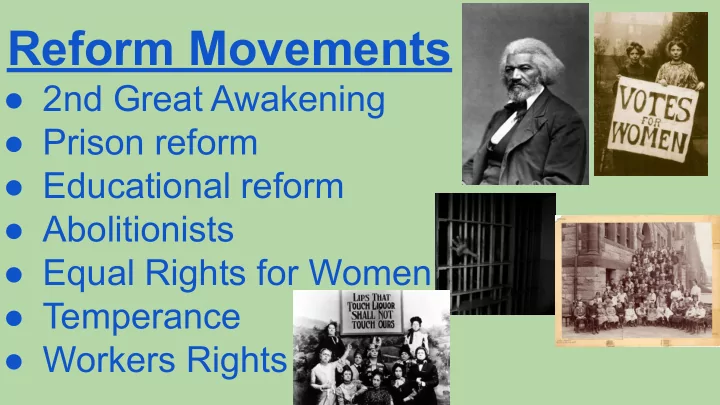
Reform Movements 2nd Great Awakening Prison reform Educational - - PowerPoint PPT Presentation

reform movements
SMART_READER_LITE
LIVE PREVIEW

Reform Movements 2nd Great Awakening Prison reform Educational - - PowerPoint PPT Presentation

Reform Movements 2nd Great Awakening Prison reform Educational reform Abolitionists Equal Rights for Women Temperance Workers Rights Second Great Awakening a revival of religious feeling and beliefs a


slide-1
SLIDE 1

Reform Movements

  • 2nd Great Awakening
  • Prison reform
  • Educational reform
  • Abolitionists
  • Equal Rights for Women
  • Temperance
  • Workers Rights
slide-2
SLIDE 2

Second Great Awakening

  • a revival of religious feeling and beliefs
  • a message of hope
  • doing good works can help people go to

heaven

  • Gave a reason to work for improvement of

society

slide-3
SLIDE 3

Prison Reform

  • Dorothea Dix
  • Treatment of mentally ill, children &

debtors in prison

  • Solution: humane treatment,

separate prisons, asylums for mentally ill, stopped jailing debtors

  • Successful: Yes, but work is still

being done to help mentally ill.

slide-4
SLIDE 4

Education Reform

  • Horace Mann
  • Children stealing, destroying property, not

regular attendance, teachers not trained, no schools

  • Solution: help children escape poverty &

become good citizens, wanted all children to have an education

  • Successful: Yes but public education still

needs improvements in many areas of the U.S.

slide-5
SLIDE 5

Abolitionist

  • Frederick Douglass, William Lloyd Garrison,

Sojourner Truth

  • Slavery for millions of African-Americans in

the Southern U.S.

  • Solution: end/abolish slavery; and give

equal rights to African Americans

  • Successful: Yes with the 13th amendment

(1865)

slide-6
SLIDE 6

Women’s Rights

  • Elizabeth Cady Stanton, Lucretia Mott
  • Can’t vote or hold office, husbands control

money and property, can be disciplined by husbands

  • Solution: equal rights and ability to vote
  • Successful: Yes; Seneca Falls Convention

started the women’s rights movement; ended with the 19th Amendment (1920) and women given the right to vote

slide-7
SLIDE 7

Temperance Movement

  • Susan B. Anthony, Lyman Beecher
  • Alcohol abuse, poverty, domestic

violence

  • Solution: ban the sale, production

and consumption of alcohol

  • Successful: Yes with the 18th

Amendment (1919); repealed by the 21st Amendment (1933)

slide-8
SLIDE 8

Workers Rights

  • Sarah Bagley- First Pres. of the

Lowell Female Labor Reform Association

  • 13 hour work days, harsh

conditions, child labor

  • Solution: shorter work days, safer

conditions

  • Successful: Yes, in 1938 with the

Fair Labor Standards Act

slide-9
SLIDE 9

Reform Movements Vocabulary

  • Reform - to make changes in order to bring about improvements,

end abuses, or correct injustices

  • Second Great Awakening - a revival of religious feeling and belief

from the 1800s to the 1840s

  • Transcendentalism - a philosophy emphasizing that people should

transcend, or go beyond, logical thinking to reach true understanding, with the help of emotions and intuition

  • Abolitionists - a person who supported ending slavery
  • Seneca Falls Convention - the gathering of supporters of women’s

rights in July 1848 that launched the movement for women’s rights to vote

  • Declaration of Sentiments - a formal statement of injustices

suffered by women, written by the organizers of the Seneca Falls Convention (Sentiments means beliefs or convictions)