RED LAKE RIVER FARM TO RED LAKE RIVER FARM TO STREAM TILE DRAINAGE - - PDF document

red lake river farm to red lake river farm to stream tile
SMART_READER_LITE
LIVE PREVIEW

RED LAKE RIVER FARM TO RED LAKE RIVER FARM TO STREAM TILE DRAINAGE - - PDF document

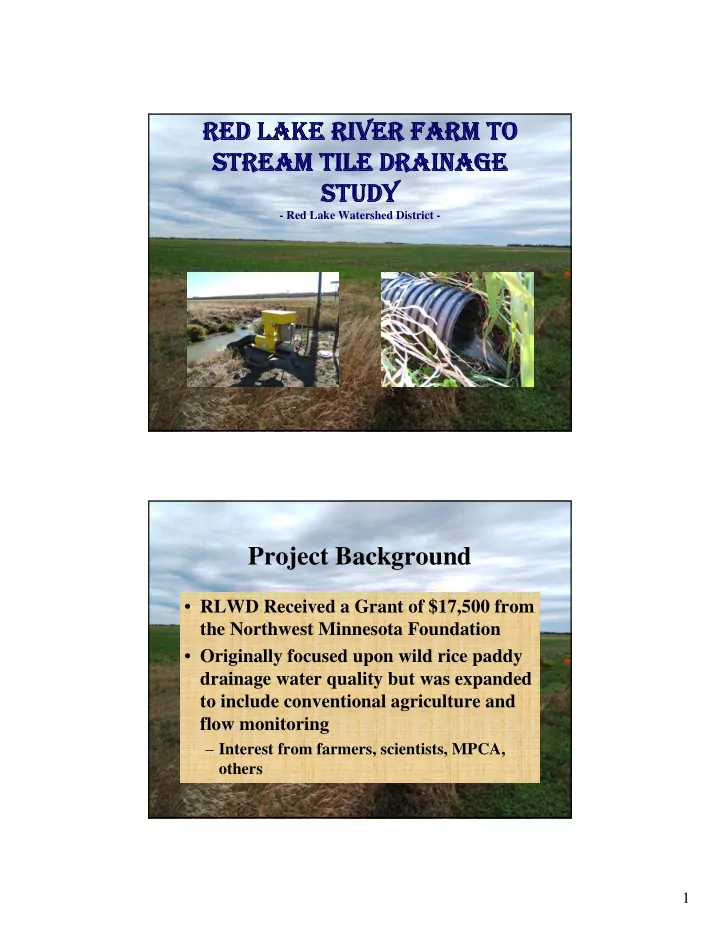
RED LAKE RIVER FARM TO RED LAKE RIVER FARM TO STREAM TILE DRAINAGE STREAM TILE DRAINAGE STUDY STUDY - Red Lake Watershed District - Project Background RLWD Received a Grant of $17,500 from the Northwest Minnesota Foundation


slide-1
SLIDE 1

1

RED LAKE RIVER FARM TO RED LAKE RIVER FARM TO STREAM TILE DRAINAGE STREAM TILE DRAINAGE STUDY STUDY

  • Red Lake Watershed District -

Project Background

  • RLWD Received a Grant of $17,500 from

the Northwest Minnesota Foundation

  • Originally focused upon wild rice paddy

drainage water quality but was expanded to include conventional agriculture and flow monitoring

– Interest from farmers, scientists, MPCA,

  • thers
slide-2
SLIDE 2

2

Project Background

  • Red River Watershed Management Board

– Took interest in the project – Wanted flow measurement – Provided funding for accurate flow monitoring

  • The Marshall/Beltrami SWCD received a grant

for tile drainage sampling

– Paid for sampling and analysis in Beltrami County – We were able to include more sites in the study

RLWD Project Partners

  • Northwest Minnesota Foundation
  • Red River Watershed Management Board
  • Red Lake Nation DNR
  • Marshall/Beltrami County SWCD
  • Red Lake County SWCD
  • Stanley Farms
  • Sparby Farms
  • Bachand Farms
  • Red Lake Nation Wild Rice Paddies
  • HDR Engineering
slide-3
SLIDE 3

3

Data Collected

  • Water quality samples and field

measurements

  • Flow measurement
  • Rainfall, baro, and temp
  • Crop and fertilizer usage
  • Land use, drainage area, soils, and other

spatial data about the project sites

Water Quality Comparisons

  • Conventional Agriculture

– Different types of tile outlets – Different areas within the Red Lake River Watershed – Tile Drainage vs. Surface Drainage vs. Natural Background WQ

  • Wild Rice Paddy Drainage

– Different types of drainage systems

slide-4
SLIDE 4

4

Water Quality Sites

  • Marshall County (near Grygla)

– Gravity tile, pumped tile, surface drainage, “reference” natural background site

  • Red Lake County near Brooks

– Tile and surface drainage from tiled field – Surface drained field

  • Clearwater County Hangaard Township

– Red Lake Nation wild rice paddies

  • Completely surface drained
  • Combination of tile and surface drainage
  • Completely tile drained (pattern to main line, out of the

paddy to a grassed waterway)

Marshall County Sites

slide-5
SLIDE 5

5

Red Lake County Sites Clearwater County (Wild Rice) Sites

slide-6
SLIDE 6

6

Water Quality Sampling

  • Parameters

– Total Phosphorus – Orthophosphorus – Nitrates – Total Nitrogen – Total Suspended Solids

  • Frequency

– At least bi-weekly, more frequent during high flow events – Sampling during runoff events is essential – Wild rice paddies sampled intensively during drawdown in late July, early August

Tile Water Quality Findings So Far – Dry Land Ag

  • Very low turbidity

– <1 NTU – Often similar to distilled water

  • Minimal Phosphorus and Total Suspended

Solids

– TP interferences

  • Nitrates range from mid-teens to over 40 mg/L

– Drinking Water Standard is 10 mg/L – Mud River – 0.43 mg/L avg., 3.16 mg/L max – Hill River – 0.61 mg/L avg., 1.84 mg/L max – RRV ecoregion - .20 mg/L

  • Good DO levels, but high conductivity
slide-7
SLIDE 7

7

Surface Drainage Water Quality

  • Not many samples in 2005
  • Significantly higher turbidity levels vs.

tile drainage – sometimes extreme

  • Higher orthophosphorus
  • Higher total Kjeldahl nitrogen
  • Lower nitrate concentration

Wild Rice Paddy Water Quality Results

slide-8
SLIDE 8

8

Wild Rice Paddy Water Quality Results

  • Main line tile had much cleaner water

than the surface drained paddy and the tile & sfc drained paddy

Wild Rice Paddy Water Quality Results

  • Simply having tile within a paddy is not enough

to achieve WQ benefits

– Need main line tile – Eliminate internal surface drainage

  • Wild rice paddy sites had low nitrate levels

– Saturated/ponded conditions? – Plant Uptake?

  • Main line tile nearly meets drinking water
  • standards. Occasional measured suspended

solids could be due to mineral buildup on inside

  • f outlet/pipe
slide-9
SLIDE 9

9

Wild Rice Paddy Water Quality Results

  • Incentives for the installation of main line tile

in wild rice paddies would drastically improve water quality within the Clearwater River during the discharge months of Jul-Sept.

  • Benefits to Farmer

– More even quality, maturity – Less ditch maintenance – Fewer ruts during harvest – More control over drainage – No topsoil loss

Flow Comparisons

Accurate, continuous measurement of flow

– Tile Drained Field – Surface Drained Field – Onset HOBO Level Loggers

  • Need to quantify both surface and tile

flow from the tile drained field.

slide-10
SLIDE 10

10

Flow Comparisons

  • Needed to find a field or part of a field in

which all drainage can be measured, preferably at a single point

  • Site selection was a longer and more

difficult than anticipated at the start of the project

  • Compare peak flow & total flow between

the two types of drainage

How will surface flow be measured?

  • H flumes

– Yaggie 2 Surface Drained Field – Sfc Drainage from Bachand Tiled Field

slide-11
SLIDE 11

11

How will tile flow be measured?

  • Water control structure w/ v-notch weir

Flow Monitoring Results

  • Late start in 2005 – will get a more

complete record in 2006

  • Surface drainage is “flashy”
  • Tile drained field

– Very little surface runoff

  • Tile drainage – storage in soil
  • Field was plowed perpendicular to flow

– Delayed drainage during a storm

  • Flow from tile continues long after a storm
slide-12
SLIDE 12

12

Flow Monitoring Results Future Monitoring Plans

  • Late start in 2005, but we now have a really

good set of sites

– start ASAP during spring runoff in 2006

  • Begin recording the amount of sfc. and tile

drainage from the flow monitoring sites.

  • Repeat RLN wild rice paddy sampling

– quantify flow from main line tile site

  • Involve the Red Lake County SWCD
  • Official report of findings this Fall
  • Possible continuation of some monitoring

– especially flow

slide-13
SLIDE 13

13

Questions?