Background Metta has been actively engaging with eco- friendly - - PowerPoint PPT Presentation

background
SMART_READER_LITE
LIVE PREVIEW

Background Metta has been actively engaging with eco- friendly - - PowerPoint PPT Presentation

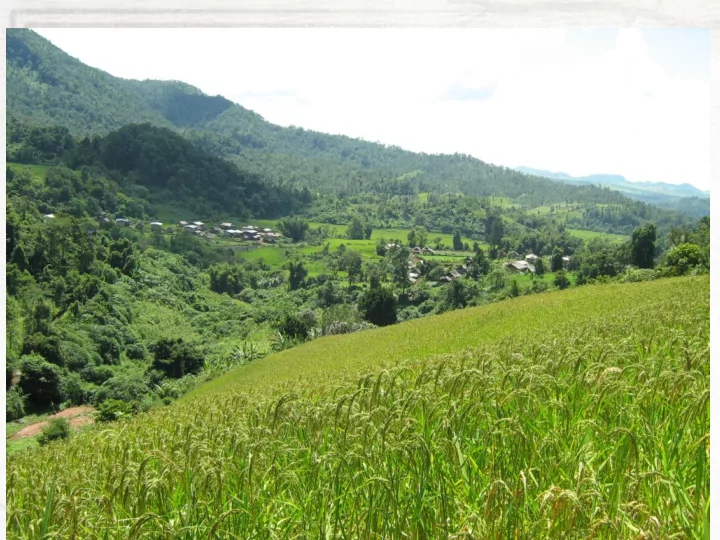
Background Metta has been actively engaging with eco- friendly techniques for growing crops since 1998 Initially Farmer Field Schools (FFS) began in 2001 in Kachin State, and now have been conducted in Kachin, Northern and Southern


slide-1
SLIDE 1
slide-2
SLIDE 2

Background

  • Metta has been actively engaging with eco-

friendly techniques for growing crops since 1998

  • Initially Farmer Field Schools (FFS) began in

2001 in Kachin State, and now have been conducted in Kachin, Northern and Southern Shan, Kayar States and Ayeyawady Region

slide-3
SLIDE 3

FFS to LIFT the food security of small and marginal land holder (2010-2013)

arwåm

slide-4
SLIDE 4

Specific Objective

  • To raise the food security and livelihoods

status of the small and marginal farm holding households

  • To develop core groups of farmers skilled in

upland rice farming

  • To develop a set of new practices effective to

sustainably increase the productivity of rain- fed upland rice fields

slide-5
SLIDE 5

Farmers, in groups, are learning from the actual situation, which builds their confidence

A typical field school consists of 20-25 farmer participants. Season long field study. Adult and non-formal

  • education. Experiential

learning, discovery based and learning by doing.

slide-6
SLIDE 6

System of rice intensification (upland rice)

  • Used of quality seed
  • Sowing in line with small number of seed rate
  • Used of modify drum seeder
  • Used of modify weeder for regular weeding
  • Used of organic manure and compost
  • Timely harvest
slide-7
SLIDE 7

Project Target

Project Site Township Target Villages Target House hold Southern Shan State Hsi-hseng, Hopone, Taunggyi and Pinlaung 150 3750 Kachin State Putao, Machanbaw, Sumparabum, NganYaung 50 1250 Total 8 200 5000

slide-8
SLIDE 8

(TOT- 2011) 48 Graduated M(27) +F(21)

slide-9
SLIDE 9

FFS Process

  • Village Leaders’

workshop

  • FFS planning
  • Establishment of

FFS’s committee

  • Establishment of

study plot and meeting place

  • FFS’s regular

session

  • Agro-ecosystem

anlysis

  • Farmer level seed

production

  • Action research
  • Farmer field visit and

regular motoring

  • Cross visit and field days
  • Cost and return analysis
  • Participatory

monitoring and evaluation

slide-10
SLIDE 10
slide-11
SLIDE 11

FFS Planning

slide-12
SLIDE 12

Meeting Place Establishment

slide-13
SLIDE 13

Each FFS Established One Acre Study Plot

slide-14
SLIDE 14

FFS’s regular sessions

slide-15
SLIDE 15

Action Research

slide-16
SLIDE 16

Cross Visit by FFS Participants

slide-17
SLIDE 17

FFS’s Field day

slide-18
SLIDE 18

Farmer Adaptation

slide-19
SLIDE 19

Farmer Adaptation

  • No of Farmer
  • 3,762
  • Total Acres
  • 4,774
  • Average Yield
  • 35 Baskets/acre
  • Baseline Yield
  • 15-25 baskets/acre
  • Net Increased Yield
  • 10 – 20 baskets/acre
  • 4,774 acre X 10 basket

= 47,740 baskets (2,387 mt)

  • 47,740 baskets X 5 USD

= 2,38,700 USD

slide-20
SLIDE 20

Some Achievement

  • Enhance farmer decision making skill in

upland rice farming

  • Reduce weeding time and labour cost
  • Increase women participation in different level
  • Men involvement in weeding
  • Enhance capacity of FFS committee
  • Reduce significant used of chemical
  • Increase food security period by 2 to 4 months
slide-21
SLIDE 21

Challenges

  • Limited technology for rice in steep slope

area

  • Access to remote and mountainous area

during rainy season

  • Paying attention to cash crop rather than rice
  • Use of organic manure in large scale
  • Prominent use of herbicide in some area
slide-22
SLIDE 22

Farmers’ innovation

slide-23
SLIDE 23
slide-24
SLIDE 24