Recruiting and Motivating Community Health Workers in Zambia - - PowerPoint PPT Presentation

recruiting and motivating community health workers in
SMART_READER_LITE
LIVE PREVIEW

Recruiting and Motivating Community Health Workers in Zambia - - PowerPoint PPT Presentation

Recruiting and Motivating Community Health Workers in Zambia Primary investigators: Nava Ashraf, Oriana Bandiera, and Nampaka Nkumbula Policy Associate Scott Lee nnkumbula@poverty-action.org Summary To recruit qualified community


slide-1
SLIDE 1

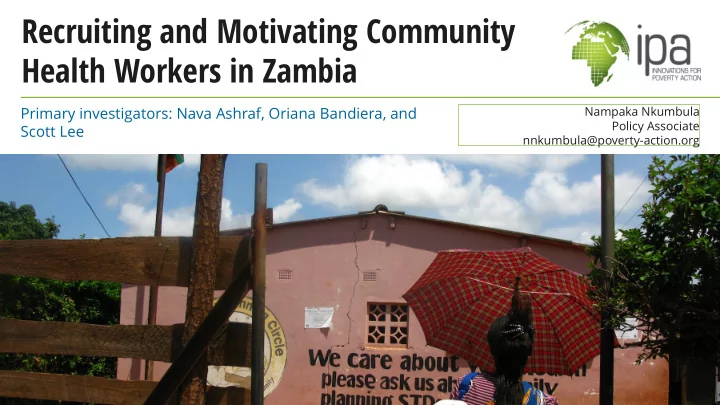
Recruiting and Motivating Community Health Workers in Zambia

Nampaka Nkumbula ​Policy Associate ​nnkumbula@poverty-action.org

Primary investigators: Nava Ashraf, Oriana Bandiera, and Scott Lee
slide-2
SLIDE 2

To recruit qualified community health assistants (CHAs), researchers and the Ministry of Health compared two strategies:

  • Emphasizing social benefits (intrinsic motivation)
  • Emphasizing career benefits

They found that CHAs motivated by career benefits had better qualifications, performed better on the job, and resulted in improved health outcomes for the communities they served than those motivated by social benefits.

Summary

slide-3
SLIDE 3
  • Community health workers can help to address shortage of healthcare

providers.

  • New civil service position created in 2010: the Community Health Assistant

(CHA) in an effort by the Ministry of Health to standardize CHW training and qualifications in communities.

  • CHAs undergo a year of formal training, and then return to their

communities to work.

  • They are the first line of healthcare for Zambians living in the most remote

regions of the country.

Policy Context

slide-4
SLIDE 4
  • Ministry of Health partnered with researchers and IPA to evaluate strategies for recruiting

and motivating CHAs.

  • The success of public services like the CHA program depends on the effort of the workers

who provide them.

  • How do different incentives affect who self-selects into community health assistant jobs?
  • Effort can be increased in two ways:
  • Incentives that directly reward effort
  • Selection of workers predisposed towards exerting effort (high intrinsic motivation)
  • Which strategy attracts more qualified, higher-performing workers?

Research Question

slide-5
SLIDE 5

Ministry of Health posted advertisements for CHA position in 48 districts in rural Zambia 48 districts randomly divided into two groups:

  • Recruitment posters emphasizing social benefits of becoming a CHA
  • Serving one’s community and becoming a leader
  • Recruitment posters emphasizing career benefits of becoming a CHA
  • Opportunities for promotion and further professional development

Program Design

slide-6
SLIDE 6
slide-7
SLIDE 7
  • Aside from emphasis on benefits, recruitment materials and selection

processes were otherwise identical

  • Applicants needed to be Zambian nationals, age 18-45
  • High school diploma and passing grades for at least 2 subjects on secondary school exams
  • Government received over 2,400 applications
  • 314 applicants accepted and trained, 307 began work as CHAs

Program Design

slide-8
SLIDE 8
  • 2010-2014
  • Researchers:
  • Nava Ashraf (London School of Economics and Political Science)
  • Oriana Bandiera (London School of Economics and Political Science)
  • Scott Lee (Harvard University)
  • Researchers used several data sources to determine which CHAs

were more effective :

  • Data from mobile platform
  • Administrative records
  • Household surveys

Evaluation

slide-9
SLIDE 9

Background on IPA involvement

​Timeline

  • CHA recruitment: 2010
  • CHA training: 2011-2012
  • CHA midline survey: 2013
  • Household endline survey 1: 2014
  • Household endline survey 2: 2016-17
slide-10
SLIDE 10

Workers drawn by career benefits were more effective CHAs than those drawn by social benefits.

  • Performed 29 percent more household visits
  • Attended twice as many community meetings
  • More likely to use health facilities for childbirth (30%), health checks (24%),

child weighings (22%), and immunizations (20%)

  • Significant increases in healthy practices among households they served
  • Breastfeeding, proper stool disposal, deworming treatment, immunization schedules
  • Children under 5 years old who had these CHAs were 5 percentage points

less likely to be underweight

Results

* As compared to “community” recruited CHAs

slide-11
SLIDE 11
  • 1. The ways in which workers self-select for public service jobs have

significant effects on service provision.

  • 2. Offering civil service positions with career opportunities attracts

workers who deliver services with remarkable health impacts in their communities.

Policy Lessons

slide-12
SLIDE 12
  • The Ministry of Health and

The Clinton Health Access Initiative (CHAI) have used the career incentives posters to recruit, train, and deploy 1,400 CHAs nationwide.

  • Given the Ministries current

targets this could reach 3, 400 in 2020.

Impact

slide-13
SLIDE 13

Further Research

​Full-sample endline evaluation:

  • Visit all 307 CHAs from initial 2011-2012 cohort
  • 47 districts
  • 162 health posts
  • Conduct interviews with:
  • Households (16 per HP)
  • CHAs (1-2 per HP)
  • Health facility In-charge (1 per HP)
  • Collect administrative data from HMIS and ECZ

2016-17 Endline

slide-14
SLIDE 14

Thank you

poverty-action.org

This study was made possible by the generous support of, among others, the International Growth Centre (IGC) and the American people through the United States Agency for International Development (USAID). The contents are the responsibility of IPA and do not necessarily reflect the views of USAID or the United States Government.