
SLIDE 1
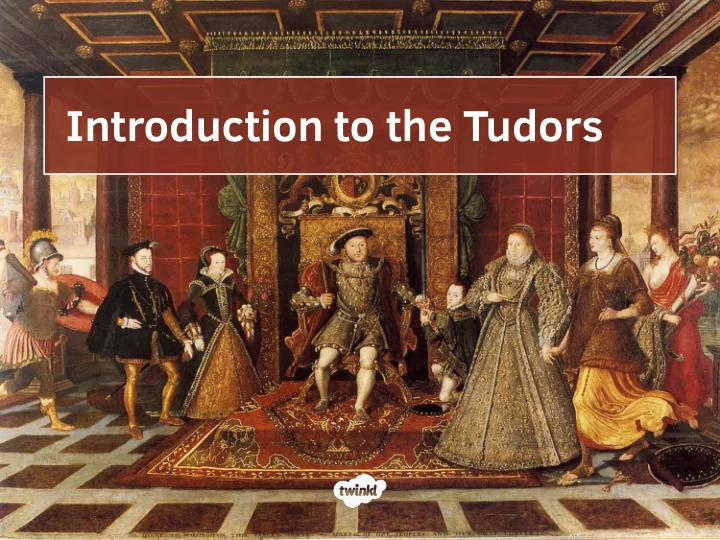
Introduction to the Tudors The Tudors Henry VII (Henry Tudor) Henry - - PowerPoint PPT Presentation
Introduction to the Tudors The Tudors Henry VII (Henry Tudor) Henry VIII Edward VI Lady Jane Grey Mary I Elizabeth I The Tudors The Tudors were the royal family who ruled England from 1485 to 1603 . During this period there were three Kings
Henry VII (Henry Tudor) Henry VIII Edward VI Lady Jane Grey Mary I Elizabeth I
The Tudors were the royal family who ruled England from 1485 to 1603. During this period there were three Kings and two Queens. The best known of the Tudor Monarchs are Henry VIII and Elizabeth I.
Key Theme:
Continuity and Change
1400 1500 1600
Henry VII 1485 - 1509 Edward VI 1547 - 1553 Mary I 1553 - 1558 Henry VIII 1509 - 1547
Lady Jane Grey July 1553 (disputed)
Elizabeth I 1558 - 1603
In Britain, the rule of primogeniture meant that the first born son of the ruling King or Queen would become the King upon the monarch’s death. (If the King has inherited the throne, then his wife is the ‘Queen’ but she only has this position while they are married and/or the King is alive.) This was fine if the King or Queen had a first born son. Until Mary I, no Queen had acceded to the throne and ruled in her own right, largely because it was believed that they were not
there was one. However, this left the throne open to greater threat and did in effect, mean giving up the throne to the family of the husband of the Queen. But sometimes they died without any children. In this instance, they would name an heir to the throne. Some Kings ran the country so badly that other powerful nobles fought them and took the title of King for themselves and their family. The War of the Roses took place between the Houses of Lancaster (red rose) and York (white rose), over claims to the throne between 1455 and 1485.
1400 Henry VI 1422 - 1461 Richard III 1483 - 1485 Elizabeth I 1558 - 1603 Henry IV 1399 - 1413 Edward III 1327 - 1377 Henry V 1413 - 1422 Richard II 1377 - 1399
Edward V 1483 (never crowned)
1300 Edward IV 1461 - 1483 Henry VII 1485 - 1509
Henry VII
Henry Tudor’s claim to the throne was tenuous, he was the great, great, great grandson of Edward III. Edward III had 6 sons altogether, all of whose descendants could make a claim to be the rightful heir (some of them would have had a stronger link to the old King). However, the death of Henry VI resulted in Henry Tudor becoming the head of the Lancaster
Henry had attempted to join a revolt against Richard III in 1483, but this failed. Instead he waited until 1485 and defeated Richard III at the Battle of Bosworth. He married Elizabeth of York (daughter of Edward IV and niece
and ending the War of the Roses.
Henry VIII
Henry became the heir to the throne when his older brother, Arthur, died from an illness. He was crowned King at the age of 18, after his father Henry VII died.
Edward VI
Edward was only 10 when Henry VIII died. A ‘Regency Council’ was set up to rule until he became an adult.
Lady Jane Grey
When Edward VI became terminally (incurably) ill, he and the Council drew up a ‘Devise for the Succession’, to prevent Mary from becoming Queen, as she was a Catholic. He also passed over his sister Elizabeth, as he believed in primogeniture and didn’t think women should be heirs to the throne. Edward, with the support of Lord Dudley, settled on the granddaughter
Yet why, when Edward VI opposed Elizabeth’s claim to the throne, would he pass it to another woman? Well the answer is, he didn’t at first. He actually left the throne to her male heirs, failing that, male heirs of her sisters. Grey was young and recently married to Lord Dudley’s son, so the hope had been that she would give birth to a male child in time.
Henry VII King of England
1457-1509
Elizabeth of York
1466-1503
Margaret
1489-1541
Mary
1496-1533
Henry VIII King of England
1491-1547
James V King of Scots
1512-1542
Frances Brandon
1517-1559
Mary I Queen of Scots
1542-1587
Lady Jane Grey
1537-1554
Elizabeth I Queen of England
1533-1603
Mary I Queen of England
1516-1558
Edward VI King of England
1537-1553
However, as he approached death, Edward VI altered the wording of the document to make Lady Jane Grey his successor. He considered this an exception to the rule of primogeniture, necessitated by the reality of his situation, not an example to be followed. Lady Jane Grey became Queen at the age of 15, when Edward VI
shortest reign of any monarch – just nine days! What have you learned? Have a go at the 'Devise for the Succession’ activity sheet.
Mary I
Mary had been summoned to Edward VI’s deathbed but was warned that it was a pretext to have her captured. This would make it easier for Lady Jane Grey to accede to the
Council, with orders to proclaim her Edward’s successor, as well as sending proclamations throughout the country announcing she was now Queen. She had gathered a force together and went to Framlingham Castle in Suffolk. Meanwhile, the Privy Council realised that they were wrong to go along with Dudley. They declared Mary the true Queen of England. Mary rode into London with her supporters and was crowned Queen Mary I.
Dudley was executed immediately. However, plots to overthrow Mary in favour of a Protestant monarch, including one involving Lady Jane Grey’s brother, resulted in the execution of Grey and her husband. Elizabeth, her sister, was temporarily imprisoned in the Tower of London due to the plots in her name, but was released. Mary I was the first undisputed Queen regent (ruler, as opposed to wife of the King) in
not independent of his marriage to Mary I. That is, if she died, he would lose those titles.
Elizabeth I
Mary I had no children with her husband Phillip II of Spain. While Mary was unhappy about Elizabeth, who was Protestant, succeeding her, she did name her as the heir to the throne in her last days. While her regency was shaky, with more than one plot to overthrow her, Elizabeth I reigned until her death, and she was the last of the Tudor Monarchs.
Christianity was introduced to England by the Romans. There was a short period of Insular Christianity after which the Anglo-Saxons linked with the Church in Rome during the period AD 500 - AD 600. There have been several schisms (divisions) of the Christian Church. The two main ones were the Great Schism in 1054 and the Protestant Reformation which was started in 1517 when Martin Luther nailed 95 (many critical of the Roman Catholic Church) to the door of the Castle Church in Wittenburg, Germany. The English Reformation followed a different path to that of reformation movements in other European countries as its inception lay in Henry VIII's need for a male heir rather than the criticisms made by Martin Luther or other Protestants.
Restorationism Anabaptism Protestanism Anglicanism (“Via Media”) “Union”
(Eastern Rites) (Western Rites)
Roman Catholicism Eastern Orthodoxy Oriental Orthodox (Miaphysites) Assyrian Church
Martin Luther posts 95 Theses. Protestant Reformation begins. (1517)
Great Schism
(1054)
Early Christianity Council of Ephesus (431) Council of Chalcedon (451)
Church of England (1534)
Crusades
(1095-1291)
Test Yourself! Have a go at the 'Christianity During the Tudor Period’ reading comprehension.
Monarch
This was the ruling King of England (until Mary I).
Privy Council
13-20 officials that gave advice to and implemented the decisions of the monarch. They drew up legislation. They could act as a court of law.
Parliament
House of Commons made up
from each county and borough, which some villages and towns had acquired the right to vote for. The House of Commons and House of Lords did not have the ultimate power to create the law. The monarch could veto it.
Prerogative Powers
These were a number of powers that only the monarch had including declaring war and pardoning criminals.
Civil Service
Law, finances and communicating royal policy was the main purpose of the civil servants.
Sheriffs and Commission
Local government who maintained law and order and enforcing royal policies.
During Tudor times, Church (religion) and State (politics) were more closely aligned and influenced each other. Monarchs used the clergy to ensure that the King’s message got through to ordinary people across England. In turn, everyone had to pay for the local clergy, and church courts were allowed to punish people. Some punishments, such as burning, were carried out by local government on behalf
While Henry VII won the dynastic War of the Roses, it was still the case that there were many who had a claim to the throne, equal to or more so than he did. The descendants of Edward III’s children, especially the males, could have made a claim to the throne, had Henry VII died without an heir. Henry VII declared Edward IV’s marriage invalid so that his sons could not make a claim to the throne (only children of a valid marriage could accede to the throne). He had to defend his crown from 6 rebellions aimed at overthrowing him in favour of rival contenders for the throne, in 1486 and 1496. In 1499, he had Edward, (who was Richard of York’s grandson, George’s son and Richard III’s nephew), executed. Henry VII’s reign therefore was one where his right to rule was threatened. The entitlement of the Tudors to rule was not secure, which led to paranoia about plots. Henry VII was able to pass the crown onto his son when he died. But the need to secure the throne for future generations of the Tudors rested on the ability to produce a legitimate male heir. This consideration was to afflict the reign
Henry VIII Catherine
1509 -1533
Anne Boleyn
1533 -1535
Jane Seymour
1536 -1537
Anne of Cleves
1540 -1540
Catherine Howard
1540 -1541
Catherine Parr
1543 -1547
The English Reformation occurred due to Henry VIII’s need to produce a male heir to the throne. He had married his brother Arthur’s widow, Catherine of Aragon and they had one daughter – Mary. Henry’s need for a male heir, Catherine’s inability to have more children and his interest in Anne Boleyn, led him to seek an annulment of his first marriage. Mary was not considered to be a suitable heir because there had never been a ruling Queen of England (only those married to the King, who was the ruler) and her accession was thought to be more open to challenge. Catherine of Aragon came from the powerful Spanish Royal Family and her nephew was the Holy Roman Emperor. When she found
able to appeal to the Pope directly.
Catherine refused to accept her marriage was not legitimate, not only because it affected her but also because if an annulment took place, Mary’s status would change to that of an illegitimate child of the King and she would therefore lose her right to be the heir to the throne. The Roman Catholic Church believed in marriage for life and did not recognise divorce. One could remarry if one’s spouse died but if divorced, then the remarriage would not be seen as legitimate. This applied to all Catholics, including the King. After 6 years of requests, the Pope refused the annulment due to the disapproval of Catherine’s nephew Charles, the Holy Roman Emperor. Henry married Anne Boleyn in secret in 1532 and in a public ceremony in January 1533. Henry VIII turned to the Archbishop of Canterbury, Thomas Cranmer who was loyal to him. He granted Henry the divorce by declaring his marriage to Catherine invalid.
Anne Boleyn, bore Henry one child, Elizabeth. She miscarried twice. When Henry found out the second had been a boy, he became convinced the marriage was cursed and blamed Anne for the lack of a male heir. She was investigated, accused of and found guilty of adultery and witchcraft. She became the first English queen to be beheaded. Henry had the marriage declared invalid and as a result both Mary and Elizabeth were no longer heirs to the throne. Henry VIII’s third marriage to Jane Seymour, resulted in the much longed for male heir, Edward. Jane was portrayed as a Protestant after her death, due to the reforms introduced by her son, Edward VI. However, she had been brought up Catholic and did not renounce this. She also ended the rift between Henry and his daughter, Mary, so that the Catholic princess could be reinstated as heir to the throne. Jane was able to achieve the former but not the latter. However, her influence on religious matters was not as great as Anne Boleyn’s, as Henry did not wish to be challenged. She tried to intervene during the time of the rebellion led by Robert Aske (known as The Pilgrimage of Grace) and asked him to restore the monasteries. Henry exploded at her, he did not want another queen who tried to influence him in political
Jane’s death, the result of falling ill from puerperal fever (a common cause of death for women after childbirth in Tudor times), was an unexpected and tragic turn. Despite Edward, Henry knew that one male heir alone was not the security he required to ensure the succession of the Tudors. Infant and child mortality rates were high. Also, Henry knew all to well that an heir and a ‘spare’ were needed, given the death of his older brother, Arthur. His marriage to Anne of Cleves, was both to produce more heirs and also an opportunity to build an alliance with Protestant German princes. This would give him political advantages against Charles V, nephew of Catherine of Aragon. Some hoped that Anne would advance Protestantism in England. However, Henry was not attracted to Anne and their short six month marriage was annulled with her consent. She was given the title of the ‘King’s Sister’ and was given estates, manors and a yearly income. Far from influencing the King to move towards Protestantism, Anne’s friendship with the King’s daughter, Mary, led her to convert to Catholicism!
Still in need of male heirs, Henry VIII’s married a fifth time, to the 17 year old Catherine
matters but only lasted 18 months as queen. Thomas Cranmer (Archbishop of Canterbury), who wanted greater religious reform, was unhappy with the King’s marriage to the Catholic Howard. It was Cranmer who brought the news and evidence of Catherine’s affair before her marriage to the King, which in turn led to an investigation where her affair with Thomas Culpepper, while Queen, came to light. Henry VIII was genuinely upset about her betrayal. The charge of adultery against the King was treason and so Catherine, like Anne Boleyn, was beheaded.
When Henry married Catherine Parr, he did so for companionship, rather than to produce more heirs. She was a pious widow, whose history was known to the King. She was to be his queen until he died. She was an intelligent woman, who had Protestant leanings. She helped to secure the release of imprisoned reformers and placed leading Protestant thinkers in the household of Prince Edward, which affected his views on religion greatly. Henry approved of this to the extent that he did not want his son to reverse the changes he had made to the Church of
However, Catherine brought the whole family together, including Mary and Elizabeth. In 1543, Henry VIII created a new Act of Succession, which restored both daughters to the line of succession after their brother, Edward and any of his potential children, as well any potential children of his by his wife Catherine Parr. In the 1547 Treason Act, interrupting the line of succession to the throne was made an act of high treason. This was to provide greater security for any contenders who might rise up against Edward. Henry VIII died in 1547 and his ten year old son acceded to the throne, as Edward VI.
Monarch was the Supreme Head of the Church of England
introduced Henry to Tyndale’s ideas, including the belief that the King not the Pope should be the Head of the Church.
church after the Pope excommunicated him.
treason.
was wrong to charge for ceremonies and felt it was getting rich at their expense. Henry VIII took advantage of this sentiment in making changes to the Church.
Dissolution of the Monasteries
While it is true that some monks were living a far from holy life, some of the incidents were exaggerated or trick questions were used to catch out the monks.
anything else that remained, which made Henry VIII popular.
monasteries left alone. He went to London with thousands
Thomas Cromwell
Church Services
Bible
ladies-in-waiting to read.
printed and distributed. Ultimately, the changes that Henry VIII made were due to the need to gain political power and control. Anything that got in the way of his being able to produce a male heir was a threat, including the Pope. However, Henry did not have any particular issue with the practices or doctrines of the Catholic Church (except that of divorce!). He had little to no interest in changing the way that ordinary people practised Christianity in their daily lives. He wanted them to practise Catholicism and Anne Boleyn, while an influence on the King, did not convince him of the need to make the drastic changes seen in other European countries.
Due to his age, Edward VI was considered too young to exercise power as the King. Instead a Regency Council was set up to rule until he was 18. The Regency Council had been chosen by Henry VIII before his death and was to rule collectively. However, shortly after his death, Edward’s uncle Edward Seymour, Duke of Somerset, was made Lord Protector, which meant he ruled as if he were the King. While Henry VIII had denied the authority of the Pope, he had not renounced Catholic doctrine or religious ceremonies. Edward Seymour, however, was more radical in his views and made a number of reforms. Key Reforms:
This reform of Church services led to a serious revolt, called the Prayer Book Rebellion. Edward Seymour was held responsible for this and other rebellions, by the Regency Council, who replaced him with John Dudley, Earl of Northumberland. While Seymour remained on the council, he was later tried and executed for plotting against Dudley.
The extent to which Edward VI was to influence laws while growing up has been contentious. Certainly, Dudley encouraged his interest and Edward VI worked closely with members of the Privy Council. However, Dudley was the one to exercise real power during this time, unlike Seymour, he did so by ensuring he had a majority of the Privy Council on side while supporting Edward VI as
In terms of religious reforms, Dudley too was Protestant and therefore the reforms started by Seymour continued, supported by Edward, who believed it to be the ‘true’ religion which should be imposed in England. Reforms included:
and clarified how Christianity was to be practiced. Effectively, he abolished Mass, by rejecting the idea of transubstantiation (the belief that the bread and wine served during Holy Communion became the actual body and blood of Jesus Christ).
The religious picture in England was complex at this time. Some wanted radical Protestant reforms, others wanted only minor changes, while others hoped that the English Church would once again join the Roman Catholic Church. Cranmer’s influence was great but not all of the changes he believed were necessary were implement, due to the illness and death of Edward VI in 1553.
Thomas Cranmer
Mary was hailed when she became Queen. Yet her determination to restore Catholicism in England (known as the Counter-Reformation) and execution of Protestants, led to her eventual epithet of ‘Bloody Mary’.
1553: Mary issued a proclamation stating that she would not force anyone to follow her
religion, yet she had imprisoned leading Protestant Churchmen, including Thomas Cranmer. She abolished Religious Laws passed by Edward VI and restored Church Doctrine. She also reversed the decision to allow clergymen to marry and married priests were forced out of their positions.
1554: Mary reversed Henry VIII’s religious laws and restored the Pope’s
authority over the English Church. Heresy Acts were reinstituted. These made it illegal to follow any Christianity other than the Catholic faith.
1555: In total, 283 Protestants were executed and 800 rich Protestants
moved abroad. Thomas Cranmer was forced to watch Bishops Latimer and Ridley being burnt at the stake. He renounced Protestantism and re-joined the Catholic faith. Yet he was still burned at the stake!
Elizabeth, like Edward VI, was raised a Protestant, yet she was said to have kept Catholic symbols such as the crucifix and downplayed the role of sermons, which was a key Protestant belief. According to the Catholic Church, she could never be considered legitimate so there was never any real chance of her embracing the Catholic faith, even if she was not as staunchly Protestant as Edward VI had been. She instead legislated for a church based on the reforms
such as priestly vestments. The Heresy Laws were repealed to avoid individuals being persecuted as they had been during the reign of Mary I. Attendance at Church was compulsory once a week and a Book of Common Prayer was compulsory. During her early reign, Elizabeth I did manage to end the turmoil and period of mass persecutions and executions that had marred. However, during the later parts of Elizabeth’s reign, both Catholics and Puritans (who were Protestant) were held in suspicion and punished, though only Catholics were executed. What have you learned? Have a go at ‘The Tudors and Religion’ activity sheet.
Henry VII
Henry VII’s policy to was to maintain peace at home and create economic prosperity. He had no interest in trying to regain French territories that had once belonged to England. Instead he focused on creating alliances and increasing trade between England and other countries.
Henry VIII
Henry VIII took a different approach to his father. He had shifting alliances with France and Spain (the two main European powers at that time) and chose to go to battle to restore pride in England.
Henry VIII - Military Victories
(It was Catharine of Aragon who oversaw this victory, as Henry VIII was fighting in France when James IV of Scotland invaded at the behest of the French King).
Kildare led to the declaration of Henry VIII as the King of Ireland.
joint war against the French, with the Spanish. The Spanish however made peace with the French, as did the British 2 years later.
Edward VI
Edward Seymour was a veteran soldier of both Scottish and French campaigns under Henry VIII.
in parts of Scotland but the cost of this and the need to defend Boulogne forced him to withdraw from Scotland. John Dudley, on the other hand was seen as weak militarily.
However, his position was a pragmatic one, as England’s finances were dire and could not support the cost of wars against Scotland and France.
Mary I
conquest of Ireland under Henry VIII.
While her husband Philip of Spain wanted England to join Spain’s war against France, the truth was that England’s finances were still poor and therefore militarily it was weak during Mary’s reign.
Elizabeth I
While Elizabeth is famous for the defeat of the Spanish Armada, her reign was marked by mixed fortunes militarily.
exchange it for Calais.
the Dutch. This was the beginning of the Anglo-Spanish War.
sail to invade the South East of England. A combination of bad weather, superior manoeuvrability of the English fleet and miscalculations from the Spanish, led to the defeat of the Spanish Armada.
its goals.
against the Spanish but they withdrew in disarray.
after Queen Elizabeth’s death.
due to poor weather. Undoubtedly, Elizabeth I was able to see off the worst of the military threats to England but her record was remarkably mixed. Much of her reputation militarily is due to the nostalgic revival in the 1620s when her reign was seen as a golden age, compared to that of her successor, King James. During the Napoleonic Wars, her memory was revived as the nation found itself again on the brink of
World War.
Problems
France, Spain, Scotland and Ireland.
the amount of commons land reduced and a rise in poverty.
in the number of vagrants and beggars.
countryside.
mixed with other metals, this made the costs of making the coins cheaper but lowered their value too.
Successes
especially in the trade for wool.
amount of precious metals.
loans from England rather than abroad, and enabled London to take over from Antwerp as the financial capital of Europe.
to collect taxes so that the ‘lame, impotent,
At the beginning of the Tudor period, England produced few books. Ideas and literature were imported from Europe.
Henry VIII
Elizabeth I
and Christopher Marlow.
and Macbeth.
However, unlike mainland Europe, the idea of an English Renaissance is seen as a modern invention which has little to do with the achievements of mainland Europe in general and Italy in particular.