Traditional Health Workers: Oregons model Community Health - - PowerPoint PPT Presentation

traditional health workers
SMART_READER_LITE
LIVE PREVIEW

Traditional Health Workers: Oregons model Community Health - - PowerPoint PPT Presentation

Traditional Health Workers: Oregons model Community Health Workers, Peer Support Specialists, Peer Wellness Specialists, Personal Health Navigators, and Doulas Traditional Health Worker Types Community Health Worker : a trusted,


slide-1
SLIDE 1

Community Health Workers, Peer Support Specialists, Peer Wellness Specialists, Personal Health Navigators, and Doulas
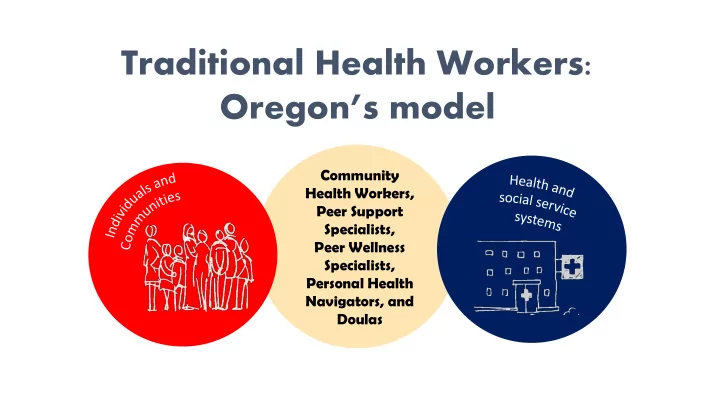
Traditional Health Workers: Oregon’s model

slide-2
SLIDE 2

Traditional Health Worker Types

  • Community Health Worker: a trusted, trained community member who

promote, advocate and organize for improved health in their communities.

  • Peer Wellness Specialist: an individual who has lived experience with a

psychiatric condition(s) plus intensive training, who works as part of a person- driven, health home team, integrating behavioral health and primary care to assist and advocate for individuals in achieving well-being.

  • Peer Support Specialist: an individual who provide supportive services to a

current or former consumer of mental health or addiction treatment.

  • Doula: a birth companion who provides personal, nonmedical support to

women and families throughout a woman's pregnancy, childbirth, and post- partum experience.

  • Personal Health Navigator: an individual who provides information,

assistance, tools and support to enable a patient to make the best health care decisions.

slide-3
SLIDE 3

Oregon’s Traditional Health Workers

Community Health Workers, Peer Wellness and Peer Support Specialists, Personal Health Navigators, Doulas

slide-4
SLIDE 4

Traditional Health Workers …

  • Reduce costs associated with health care
  • Understand and address the social determinants of health
  • Address health disparities in culturally-appropriate ways
  • Support integration and whole person care

An effective THW workforce consists of individuals

  • from the community served
  • who have shared “lived experiences”
  • who are representative of the population served
slide-5
SLIDE 5
  • HB 3650 (2011) Requires State to establish

criteria, descriptions, and education/training requirements for community health workers, peers, personal health navigators, and other providers not regulated by the State

  • SB 1580 (2012) Requires utilization of these

workers in Health Systems Transformation

  • HB 3407 (2013) Establishes the THW
  • Commission. The Commission advises the

Oregon Health Authority on THW policy and program issues.

Oregon THW Legislation

slide-6
SLIDE 6
  • HB2024 (2015) Adds oral health training

requirement for certification of all THWs

  • HB 2304 (2017) Adds Peer Support Specialists

and sub-worker types (Family and Youth Support Specialists) to THW Commission

More Oregon THW Legislation

slide-7
SLIDE 7

Traditional Health Worker Commission and Subcommittees

Commission Systems Integration Subcommittee Payment Models workgroup Training Evaluation Metrics Program & Scoring (TEMPS) Subcommittee

slide-8
SLIDE 8

EMPLOYMENT

Care providers CCOs Other care providers

CERTIFICATION

OHA-approved training program Certification Assessment Core curriculum

REGISTRY

OHA Registry Enrollment On Site Training Continuing Education

CONTINUED LEARNING

Introduction to the training, certification, and hiring process of THWs

slide-9
SLIDE 9

EMPLOYMENT

Care providers CCOs Other care providers

CERTIFICATION

OHA-approved training program Certification Assessment Core curriculum

THW Training

  • Training programs must submit

application to Oregon Health Authority for approval

  • Applications reviewed by TEMPS

Sub-committee

  • Must meet requirements

established in rules

  • Requirements specific to worker

type

  • Approved training programs

listed on THW program website

REGISTRY

OHA Registry Enrollment On Site Training Continuing Education

CONTINUED LEARNING

slide-10
SLIDE 10

EMPLOYMENT

Care providers CCOs Other care providers

THW Certification

  • Must be 18 Years of age
  • Must meet training requirements

through OHA approved process

  • Must submit a completed application

for registry

  • Must pass a criminal background

check

REGISTRY

OHA Registry Enrollment On Site Training Continuing Education

CONTINUED LEARNING

CERTIFICATION

OHA-approved training program Certification Assessment Core curriculum

slide-11
SLIDE 11

EMPLOYMENT

Care providers CCOs Other care providers

THW Registry

  • Once certified, THWs are enrolled on the

THW Registry

  • Registry available through Office of Equity &

Inclusion website

  • Names and contact information of certified

THWs available to CCOs and other healthcare providers

REGISTRY

OHA Registry Enrollment

CONTINUED LEARNING

CERTIFICATION

OHA-approved training program Certification Assessment Core curriculum Continuing Education

slide-12
SLIDE 12

THW Employment

  • Definitions and scope of practice of THW

worker types on OEI website

  • Roles need to be clearly defined and

understood by all team members

  • Supervision should be specific to the

worker type

  • Additional on-site training/continuing

education should be provided or verified through employer (20 hours every 3 years to maintain certification)

REGISTRY

OHA Registry Enrollment

EMPLOYMENT

Care providers CCOs Other care providers On Site Training

CONTINUED LEARNING

Continuing Education

CERTIFICATION

OHA-approved training program Certification Assessment Core curriculum

slide-13
SLIDE 13

Examples for Integrating THWs

  • Partners with CBOs to

conduct Community Assessment

  • Identifies diabetes

disparity and related high utilization rates in demographic-specific community

  • Subcontracts with CBO

serving specific community

  • Finances outreach, disease

self-management, and service coordination

CCO

  • CBO trains CHWs in Chronic Disease

Self-Management

  • CBO deploys CHWs in this

community

  • CHWs enroll community members

in plan and teaches Chronic Disease Self Management

  • CHW provides ongoing support and

system navigation

Community Health Workers

  • Connects to a PCPCH
  • Receives Diabetes Self

Management information

  • Receives culturally

and linguistically appropriate services

  • Receives regular

check-ins by CHW

  • Engages in more

appropriate utilization

Community Member

Public Health

slide-14
SLIDE 14

Intensive Case Management

  • Enrolls person with

disabling condition in Plan.

  • Connects person with

Plan employed Personal Health Navigator (PHNav)

  • Intensive case

management services funded through capitated portion of global budget

CCO

  • Works with new member to

understand the Plan

  • Connects member with a PHPCH
  • Provides coordination between

PCPCH and specialty care

  • Provides support to member to

assure smooth transition and

  • ngoing care

Personal Health Navigator

  • Is enrolled in Plan
  • Connects to PCPCH
  • Experiences well-

coordinated care

  • Has a direct connection

to Plan for potential future challenges

  • Experiences increased

satisfaction

Community Member

Examples for Integrating THWs

slide-15
SLIDE 15
  • Identifies a woman who

entered the country as a refugee, who is 4 months pregnant and has experienced refugee- related trauma

  • Enrolls woman in Plan
  • Connects woman to

culturally specific behavioral health services

CCO/PCPCH

  • Serve on health care team
  • Referral for THW services

made by licensed provider

  • Doula provides support

before, during and after pregnancy

  • Refers woman for services

addressing refugee related trauma issues

Doula

  • Is enrolled in Plan
  • Connects to PCPCH
  • Receives culturally and

linguistically appropriate care

  • Receives behavioral

health and doula services

  • Poor birth outcomes

averted

Community Member

Examples for Integrating THWs

Clinical Services

slide-16
SLIDE 16

Examples for Integrating THWs

  • Partners with CBOs to

conduct Community Assessment

  • Identifies peer support

disparity and related high utilization rates in demographic-specific community

  • Subcontracts with CBO

serving specific community

  • Finances outreach, support

activities, utilization within

  • ther systems (jail, child

welfare, hospital, etc.)

CCO/County

  • CBO trains Peers to provide support

and navigation of systems

  • Deploys Peers in this community
  • Peer meets individuals where they’re

at and supports them in exploring new wellness and recovery goals

  • Peer provides ongoing support and

system navigation

Peer Support Specialists

  • Connects to other

services if the individual requests this type of support

  • Receives culturally and

linguistically appropriate services

  • Receives regular check-

ins by the peer

  • Engages in more

appropriate utilization

Community Member

Mental Health &/or Addictions

slide-17
SLIDE 17

Some ways THWs can be paid through Medicaid

Health Plans CBOs Hospitals

OREGON

Coordinated Care Organizations

Traditional Health Workers

slide-18
SLIDE 18

Examples of other payment models for THWs

Peer Support Specialists

Oregon providers can purchase peer services through funding sources such as:

  • Federal (SAMHSA, TANF, Medicaid)
  • State and Local Funding, Private

funding

  • Drug Courts (federal, state and

local funding)

  • DOJ funding

Community Health Workers

Oregon providers currently purchase CHW Services with:

  • Federal or state grants (public

health; prevention & education)

  • Foundation Grants
  • Community Benefit funding
  • Community Health Centers

(Alternative Payment Model)

  • Pathways
slide-19
SLIDE 19

“I can do things you cannot, you can do things I cannot. Together we can do great things.”

  • Mother Teresa
slide-20
SLIDE 20

END

slide-21
SLIDE 21

Resources

Office of Equity and Inclusion http://www.oregon.gov/oha/oei/Pages/index.aspx Traditional Health Worker Program http://www.oregon.gov/oha/oei/Pages/Traditional- Health-Worker-Program.aspx Tip Sheets for Working with THWs http://www.oregon.gov/oha/OEI/Documents/Tradition al-Health-Worker-Tip-Sheet-9-2016.pdf

slide-22
SLIDE 22

Additional Resources

  • “The Role of Traditional Health Workers in Oregon’s Health Care System” -

http://www.oregon.gov/oha/oei/docs/THW-report-120106.pdf

  • “Utilizing Doulas to Improve Birth Outcomes for Underserved Women in Oregon” -

http://www.oregon.gov/oha/legactivity/2012/hb3311report-doulas.pdf

  • “Paving a Path to Advance the CHW Workforce in New York State: A New Summary Report and Recommendations” -

http://nyshealthfoundation.org/uploads/resources/paving-path-advance-community-health-worker-october-2011.pdf

  • “CHWs Then and Now: An Overview of National Studies Aimed at Defining the Field” -

http://159.36.1.66/phs/healthdisparities/pdf/wklyUpdate/110720/Attachment3_CHWsThenAndNowJACM.pdf

  • “CHWs: A Front Line for Primary Care?” - http://www.nhpf.org/library/issue-briefs/IB846_CHW_09-17-12.pdf
  • “CHW Insights on Their Training and Certification” - http://www.ncbi.nlm.nih.gov/pubmed/20208223
  • CDC course: “Promoting Policy and Systems Change to Expand Employment of CHWs” -

http://www.cdc.gov/dhdsp/pubs/chw_elearning.htm

  • Toolkit for Developing a CHW program - http://www.raconline.org/communityhealth/chw
  • Substance Abuse and Mental Health Services Administration. Consumer-Operated Services: The Evidence. HHS Pub. No. SMA-11-

4633, Rockville, MD: Center for Mental Health Services, Substance Abuse and Mental Health Services Administration, U.S. Department of Health and Human Services, 2011.

  • The SAMHA-HRSA Center for Integrated Health Solutions new peer support curriculum, Whole Health Action Management

(WHAM), guidance to promote whole health self-management and strengthen the peer workforce’s role in integrated healthcare

  • delivery. www.integration.samhsa.gov/health-wellness/wham
  • The National Empowerment Center - http://www.power2u.org/
  • Engaging Women in Trauma-Informed Peer Support: A Guidebook - http://www.nasmhpd.org/EngagingWomen.cfm
  • Pillars of Peer Support - http://www.pillarsofpeersupport.org/
  • Chinman MJ, Rosenheck R, Lam JA, Davidson L “Comparing Consumer and Nonconsumer Provided Case Management Services for

Homeless Persons with Serious Mental Illness” Journal of Nervous and Mental Disease 2000; 188(7): 446-453

  • Chinman MJ, Young AS, Hassell J, Davidson L “Toward the Implementation of Mental Health Consumer Provider Services” Journal
  • f Behavioral Health Services & Research 2006; 33(2): 176-195
slide-23
SLIDE 23

Contact Us:

Abdiasis Mohamed THW Program Coordinator Office of Equity and Inclusion 971-673-3389 Shawn Clark Peer Delivered Services Coordinator Addictions and Mental Health Division 503-945-9720 shawn.clark@state.or.us Medicaid payments for THWs: Don Ross Manager DMAP Policy and Planning Section 503-945-6084 donald.ross@state.or.us

THW Committee Website: www.oregon.gov/oha/oei/Pages/non-traditional-health-worker-committee.aspx Subscribe to mailing list through website for updates. THW Rules: http://www.dhs.state.or.us/policy/healthplan/rules/notices.html (N)THW Report: www.oregon.gov/OHA/oei/docs/nthw-report-120106.pdf HB3311 Report: www.oregon.gov/oha/legactivity/2012/hb3311report-doulas.pdf

slide-24
SLIDE 24

EXAMPLE: Community Health Worker Pilot Project in Oregon

Trillium CCO and South Lane Mental Health

Measure: Reduction in ER Visits

Averaged 20 ER Visits per year prior to 2012 costing $40,000 per year.

2011: 20 Visits 2012: 15 Visits 2013: 0 Visits

slide-25
SLIDE 25

References

Doula Rules http://www.oregon.gov/oha/healthplan/Policies/130-0015- 010114.pdf Medical Services Rule Book http://www.dhs.state.or.us/policy/healthplan/guides/medsurg/1 30rb080111.pdf THW Rules http://www.oregon.gov/oha/amh/peer/Proposed%20NonTraditi

  • nal%20Health%20Workers%20NTHWs%20Rule.pdf

Background Check Rules http://www.oregon.gov/oha/healthplan/Policies/Nprm-180- 121813.pdf

slide-26
SLIDE 26

Food for Thought

Why might a Native American patient be hesitant to speak

  • penly about

symptoms of her diabetes?

slide-27
SLIDE 27

Questions?

Office of Equity and Inclusion Website:

http://www.oregon.gov/OHA/oei http://www.oregon.gov/oha/oei/Pag es/health-equity-webinars.aspx

Your CCO Point

  • f Contact
slide-28
SLIDE 28

Type of Worker Type of Service Payment Options Reporting Community Health Worker/ Peer Wellness Specialist/ Personal Health Navigator Direct Care*:

Care Coordination, Health Promotion

PCPCH Payment

  • r CCO – Intensive Case

Management Capitation Documentation in Medical Record Community Health Worker/ Peer Wellness Specialist/ Personal Health Navigator Population-Based:

Prevention, Outreach, Health Promotion

CCO-ICM Capitation

  • r CCO Sub-Contracted

Entity CCO reports Expenditures

  • n Financial Report **

Peer Support Specialist Direct Care*:

Care Coordination, Health Promotion

OHA Certified MH/A&D Providers Managed Care Encounter Only, using HCPCS code H0038 *** Doula Direct Care*:

Care Coordination, Health Promotion

Payment to Provider, Hospital or Birthing Center is enhanced when Doula is utilized FFS Claim for Delivery is billed with modifier CCO reimbursement is dependent on the business practice of the plan

*Direct Care services are provided under the supervision of a Licensed Healthcare Professional **(Identify the specific report and line item) ***FFS reimbursable for individuals approved for MH 1915(i) Home and Community Based State Plan Option, Discussion currently underway to amend the State Medicaid Plan, Rehabilitative Services Option which will authorize FFS OHP for this HCPCS code.