
SLIDE 1
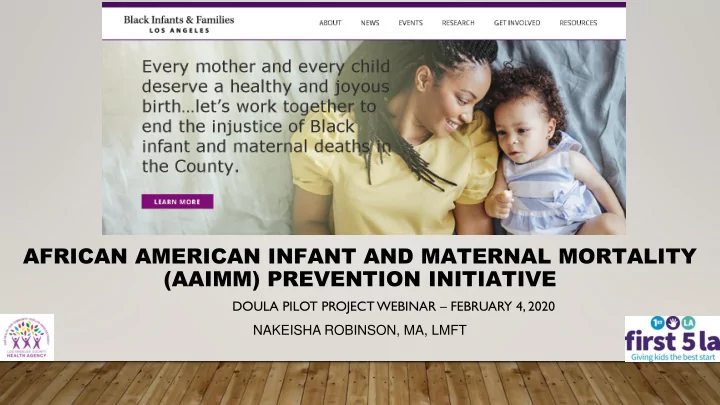
AFRICAN AMERICAN INFANT AND MATERNAL MORTALITY (AAIMM) PREVENTION - - PowerPoint PPT Presentation
AFRICAN AMERICAN INFANT AND MATERNAL MORTALITY (AAIMM) PREVENTION INITIATIVE DOULA PILOT PROJECT WEBINAR FEBRUARY 4, 2020 NAKEISHA ROBINSON, MA, LMFT Initiative and Project Overviews Doulas and Services Provided DPH Support TODAYS
Initiative and Project Overviews Doulas and Services Provided DPH Support Training Opportunities Client Eligibility & How to Make Referrals Q&A Who to contact
% Preterm 2003 – 2005 (95% CI) % Preterm 2006 – 2008 (95% CI) % Preterm 2009 – 2011 (95% CI) % Preterm 2012 – 2014 (95% CI) % Preterm 2015-2017 (95% CI) White 9.8 (9.6 – 10.0) 9.9 (9.7 – 10.1) 8.6 (8.4 – 8.8) 7.9 (7.7 – 8.1) 7.9 (7.7 – 8.0) Hispanic 10.8 (10.7 – 10.9) 10.5 (10.4 – 10.7) 8.4 (8.3 – 8.5) 8.6 (8.5 – 8.7) 9.2 (9.0 – 9.3) African American 15.0 (14.6 – 15.4) 15.1 (14.7 – 15.4) 12.6 (12.2 – 12.9) 12.1 (11.7 – 12.5) 12.2 (11.8 – 12.6) Asian 9.7 (9.4 – 9.9) 9.4 (9.1 – 9.6) 8.1 (7.9 – 8.3) 7.2 (7.0 – 7.4) 7.6 (7.3 – 7.8) Los Angeles County 10.8 (10.7 – 10.9) 10.7 (10.6 – 10.8) 8.8 (8.7 – 8.8) 8.6 (8.5 – 8.6) 8.9 (8.8 – 9.0)
Notes: Preterm births are defined as births occurring from 17-36 weeks gestation. Gestational age calculated based on first date of last menstrual period for 2002-2007 and based on
fluctuations. Data Source: 2003-2017 California Department of Public Health, Birth Statistical Master File
Perform clinical tasks such as vaginal exams or fetal heart monitoring Give medical advice or diagnose conditions Make decisions for the client (medical or
Pressure the birthing person into certain choices just because that’s what they prefer Take over the role of the partner, support person,
Catch the baby Change shifts (although some doulas may call in their back-up after several, several hours of continuous labor)
Felicia Francis-Edwards Maryam Abdul Karim Monique Cowan Bethany Benson Mercedez Johnson Jordan Smith Keisha Smith-Spears Syreeta Staples Latrice Matthews Tamara Robertson T
Carla Clark
Prenatal visits (3)
Preparing for birth Signs of labor Navigating the medical system/staff Infant feeding
Available to clients througout pregnancy
Questions; Information Provide support outside of scheduled visits
Continuous labor and delivery support
On-Call 24/7 Golden hour
Postpartum visits (3)
Infant feeding/breastfeeding Infant daily care & safety Bonding activities Connecting to local resources/peer support Maternal mental health (screening, referral
Stipends Doula kits Print materials Client incentives Media campaign Peer-mentor support and technical assistance Training
Lactation Educator Specialist (45 hours)
Spring and Fall 2020 (60 participants)
Trauma-informed Care (9 hours)
Spring and Fall 2020 (80 participants)
CPR/AED/First Aid Other/Additional (newborn care, full spectrum doula, business T echnical Assistance) New Doula (2020)
Spring and Fall/Winter (80 participants)
➢ Clients must self-identify as Black/African American and be pregnant. ➢ We are accepting clients from: ➢ SPAs 1, 3, 6, & 8. Medi-Cal eligible clients are priority, but clients with other insurance is accepted. ➢ SPAs 2 and 4, Medi-Cal eligible only. ➢ There is no gestational requirement. *There will be incentives for participating clients*
Self-referrals are accepted Doula, agency, clinic, hospital, and
T
program staff: Michelle Sanders at: msanders@ph.lacounty.gov or Ariana White at: awhite@ph.lacounty.gov or by phone at: (213) 639-6448
Client name, phone number, zip code, and estimated due date (EDD)