
SLIDE 1
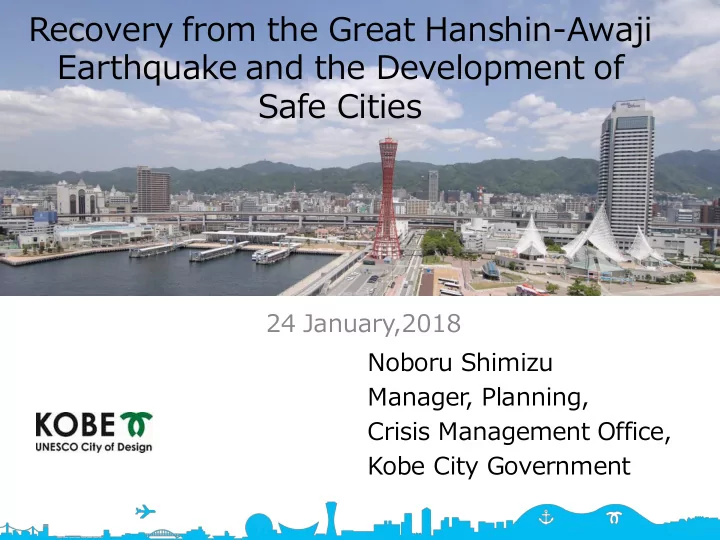
Recovery from the Great Hanshin-Awaji Earthquake and the Development - - PowerPoint PPT Presentation
Recovery from the Great Hanshin-Awaji Earthquake and the Development of Safe Cities 24 January,2018 Noboru Shimizu Manager , Planning, Crisis Management Office, Kobe City Government The Great Hanshin-Awaji earthquake occurred on January 17,
2
3
Damage on Urban Infrastructures (Residences / Buildings)
Fire in residential area (Suma Ward)
Collapse of Hanshin Expressway (Higashinada Ward)
4
Damage on Urban Infrastructures (Railways /Expressway)
Collapse of Railways(Higashinada Ward)
5
Collapse of the municipal office’s mid floors(Chuo-Ward)
Damage on Urban Infrastructures (Municipal Offices)
6
7
8
Key
Earthquake Restoration Land Readjustment Project (Implemented by Kobe City) Earthquake Restoration Land Readjustment Project (Implemented by local unions) Earthquake Restoration Urban Redevelopment Project Land Readjustment Project, including replotting for restoration of war-damaged areas and urban renewal
Junction well Disaster prevention base Distribution reservoir
Establish a new water route in addition to waterline in Mt. Rokko
System to activate an emergency stop valve
Okuhirano Control Center
Supervisory control equipment Seismometer Telemeter slave station Reservoir equipped with an emergency stop valve Reservoir connected to distribution network Inflow pipe Inflow pipe Secured drinking waterEmergency distribution reservoir
Connection pipe Emergency stop valve Distribution Distribution pipeDisaster prevention base Filling fire engines and water tank trucks with water Emergency water supply using emergency water taps Connection pipe to distribution line Connection pipe to transmission line High-capacity transmission pipe In-house power generation facility Pump facility
Establishment of a center of excellence for highly advanced medical technology on Kobe’s Port Island to attract healthcare-related industry Establishment of integrated process from basic research to clinical application and industrialization
■ Formation of Japan’s first biomedical cluster ■ Promotion of translational research
■ Objectives
Disaster-Safe Welfare Community Volunteer fire Corps Fire Station Ward Office Cooperation DRR Activity Drills / Seminars, Crime Prevention Activities, Community Safety Plan Preparation etc. Welfare Activity Friendship Visit, Providing Meals to Elderly, Housework Support etc. Measure to support people who need assistance (Disabled, Elderly etc.), Combination of community DRR and welfare activities ・Maintenance and Support for DRR Equipments ・Guidance of Disaster Drills & Seminars ・Consolidation of Regional Welfare Center ・Support for activities Resident's Association Business entities Women's Association Eldery Association Child Committees Member PTA Youth Association Crime Prevention Association
12
134 136 138 140 142 144 146 148 150 152 154 156 4 5 6 7 8 9 10 11 12 13 14 15 16 17 18 19 20 21 22 23 24 25
万
(10,000 persons)
Earthquake
National Census as of October 1, 1995
Estimated population as of November 1, 2011
13