
SLIDE 1
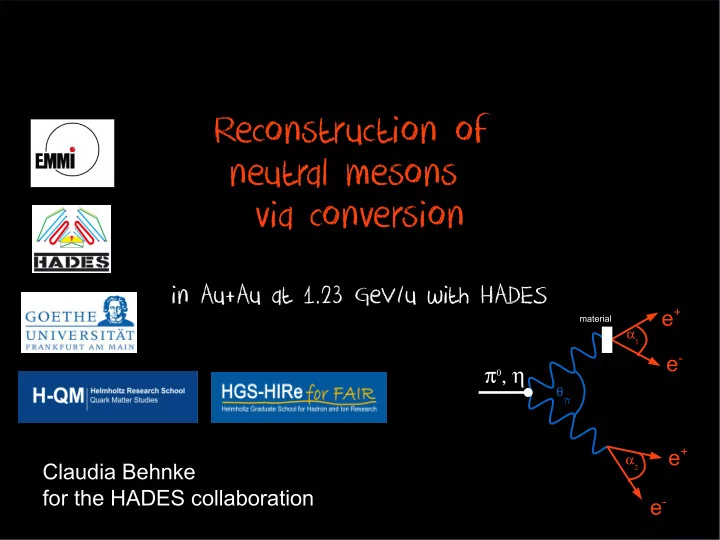
Reconstruction of neutral mesons via conversion
in Au+Au at 1.23 GeV/u with HADES
Claudia Behnke for the HADES collaboration
material
θγγ
e+ e- e+ e- π0, η
α1 α2
Reconstruction of neutral mesons via conversion in Au+Au at 1.23 - - PowerPoint PPT Presentation
Reconstruction of neutral mesons via conversion in Au+Au at 1.23 GeV/u with HADES e + material 1 e - 0 , e + 2 Claudia Behnke for the HADES collaboration e - Motivation Heavy-ion collision at 1-2 GeV/u First-chance NN
in Au+Au at 1.23 GeV/u with HADES
Claudia Behnke for the HADES collaboration
material
θγγ
e+ e- e+ e- π0, η
α1 α2
26-30.01.15
2/19
Hot and dense stage ( 10 fm/c) ~ Freeze-out stage First-chance NN collisions
Baryonic sources:
In-medium spectral functions
Long-lived mesons:
τπ = 7.7 × 10⁷ fm/c τη = 1.5 × 10⁵ fm/c τω = 23 fm/c Heavy-ion collision at 1-2 GeV/u
26-30.01.15
3/19
Phys.Rev. C84 (2011)
✔ Multπ0 is essential for
spectrum normalization
✔ “no Multη , no MultExcess !”
π0 ,η → γ e+e-
How to reconstruct π0 and η ?
26-30.01.15
4/19
Multiplicity of π0 and η mesons, as a function of beam energy and system size. Au+Au points from extrapolation to the measured data. No measurements at 1.23 GeV/u
Uncertainties
MultAuAu(π0) = 6.4 ± 15% MultAuAu(η) = 0.09 ± 50%
η
1.23
experiment simulation
Phys.Rev. C84 (2011) 014902
27/01/15 5
Beams provided by SIS18: proton, nuclei (EBeam 1~2 GeV/u ) Secondary beam: π High Acceptance (Fixed target) Full azimuthal coverage 18° to 85° in polar angle Hadron and lepton identification: Tracking with 4x6 Multiwire
Drift Chambers and superconducting magnet
Time of flight measurement
with ToF and RPC Walls
Specific energy loss in MDC
and ToF
RICH and shower detectors to identify leptons
26-30.01.15
6/19
How to measure π0
and η with HADES?
How to reconstruct γ without dedicated photon detector?
STAR: PhysRevC.70.044902 CDF: PhysRevD.70.074008 ALICE: Phys. Lett. B 717,162
Identifying 4 leptons using photon conversion!
π0,η → γγ ⇒ e+e-e+e- π0,η → γ e+e- ⇒ e+e-e+e-
conv conv
Target holder (C) Target(Au) Beam pipe (C)
HADES: - p+Nb 3.5 GeV: PhysRevC.88.024904
Material Conv [%] (π0)
Conv [%] (η)
Target 0.05 0.09 δ-shield 0.05 0.08 Beam pipe 0.04 0.06 Radiator gas 0.11 0.18
Mirror
0.08 0.14 Sum* 0.36 0.58 RICH radiator gas (C4F10) *all values are obtained from Geant3 simulations!
26-30.01.15
7/19
Lepton identification:
Momentum < 1000 MeV/c Momentum dependent
velocity cuts
No RICH information
is used
Sharing of inner MDC
segments is allowed
p · sign |q| [MeV/c]
π- π+ K+ p d/He4 He3 t e- e+
26-30.01.15
8/19
Combine 4 fully reconstructed lepton candidates
Background rejection cuts:
Topological cuts on angles between e+e- and γ:
α1 <2.5º, α2<20º π0 :10º< Θγγ < 40º η :40º< Θγγ < 140º
η → γ∗γ π0 → γγ η → γγ
γγ e+e-e+e-
UrQMD simulation
material
θγγ
e+ e- e+ e- π0, η
α1 α2
27/01/15 Claudia Behnke 9
π0 statistics from 4.3 * 109 high multiplicity Au+Au events
Background estimated using event mixing technique (red line)
material
θγγ
e+ e- e+ e- π0
α1 α2
Background rejection cuts:
Topological cuts on angles between e+e- and γ:
α1 <2.5º, α2<20º π0 : 10º< Θγγ < 40°
P R E L I M I N A R Y
26-30.01.15
10/19
Motivation for event-mixing technique
e+ e- π0 e+ e- π0
π0 → γ∗γ
γγ
eeeX π0 → γγ γ∗γ
Uncorrelated γγ pairs are the main background.
UrQMD simulation analysed with same method
26-30.01.15
11/19
Spectrum after background
subtraction is corrected with εtot and normalized to the number of analysed events (4.3 •109 )
Integration of the spectra in
the 2σ range gives Mult(π0): 9.1 ± 3
Comparable with result of
charged π from FOPI Mult(π0): 10.4 and TAPS Mult(π0): 6.4 (Min bias!)
P R E L I M I N A R Y
26-30.01.15
12/19
Rapidity coverage: Coverage: -0.25 <Ycm <1 Transverse momentum coverage:
π0 with low momentum are not covered due to
the acceptance of the decay products in HADES Coverage: 300 MeV/c <p⊥ <650 MeV/c
26-30.01.15
13/19
Invariant mass for different phase space bins, together with event-mixing
P R E L I M I N A R Y
26-30.01.15
14/19
The efficiency corrected
differential yields, together with Boltzmann fits
Single slope fit can
describe the data
Points with large
corrections are excluded from fit PRELIMINARY
26-30.01.15
15/19
Filled circles:
measured points
Open circles:
reflected around mid-rapidiy
Resulting slopes can be
fitted with a 1/cosh(y) distribution
Inverse slope parameter
at mid-rapidity: TB (Ycm=0): 76 ± 15 MeV
PRELIMINARY
27/01/15 Claudia Behnke 16
η statistics from 4.3 * 109 high multiplicity Au+Au events
Background estimated using event mixing technique (red line)
material
θγγ
e+ e- e+ e- η
α1 α2
Background rejection cuts:
Topological cuts on angles between e+e- and γ:
α1 <2.5º, α2<15º η : 40º< Θγγ < 140°
P R E L I M I N A R Y
26-30.01.15
17/19
Integration of the
spectra in the 2σ range gives raw η counts: #(η): 551 ± 207
Corrections not yet
done
207
PRELIMINARY
26-30.01.15
18/19
Reconstruction of π0 and η
via γ conversion
Number of π0 per event: Mult( π0): 9.1 ± 3 Phase space coverage
- 0.25 <Ycm <1.0 300 <p⊥ <650 MeV/c Reconstructed inverse slope: TB (Ycm = 0): 76 ± 15 MeV Number of η in full beam time #(η): 551 ± 207
HADES PRELIMINARY
26-30.01.15
19/19
Apart dependent analysis of π0 and η Phase space dependent analysis of η Systematic error estimations Compare the resulting cross sections with the
results from dilepton analysis
EM Calorimeter
will be added for SIS100, FAIR
27/01/15 Claudia Behnke 20
27/01/15 Claudia Behnke 21
material
θγγ
e+ e- e+ e- π0, η
α1 α2
26-30.01.15
22/19
Simulation: 1011 π0 with Pluto Event Generator [PoS ACAT2007 076]
T1= 39 MeV, T2= 79 MeV
Propagation through detector geometry using Geant3 package εAcc Tracking and event selection like in measured data ε4e
reco
Conversion and Branching Ratio: BRγγ · convγ
2 + BRe+e-γ · convγ
Identification of leptons, γ and π0 εPID εTot = εAcc · ε4e
reco · (BRγγ · convγ 2 + BRe+e-γ · convγ ) · εPID = 1.7% · 3.5% · (3.2 · 10-4) · 44% = 8.99 · 10-8
26-30.01.15
23/19
HADES Au+Au beam time
✔ 24 days Au beam ✔ 8 kHz trigger rate ✔ 7.3 billion events ✔ Trigger on high multiplicity events
(40% of most central collisions) Simulations
✔ UrQMD transport model ✔ Transport through the detector
system using Geant3 and realistic digitizers Analysis of experimental and simulated data is identical
26-30.01.15
24/19
✔
Low momenta
behind the inner MDCs
is between 15 - 55%
Pluto
11% of e+/e- p< 50 MeV/c: ε = 15% 44% of e+/e- p< 100 MeV/c: ε = 55%
α <3◦
p · sign |q| [MeV/c]
✔ Small opening angle
– in 93% cases α is <3◦ – RICH ring finder will often
identify only 1 ring beam
The SIS18 heavy-ion energy regime
Evolution of average ρB ( τsystem)
Probing nuclear matter at:
densities: ρB/ρ0 > 2 temperature: T < 100 MeV
Composition of a hot π∆N gas (T) τ ∼10 fm/c
“Resonance matter”:
excitation and decay of baryonic
resonances are the dominant contribution
life time resonance: ~1fm/c
System stays above ground state density for ~10 fm/c
Hot and dense stage: a look inside
hot and dense stage
In-medium spectral functions
Additional contributions to the ρ-meson self-energy in the medium
How to measure? How to model?
Dalitz-decay of baryonic resonances is dominant source at low beam energies
SPS, RHIC, LHC SIS
Date System Ekin beam 2002 C+C 2.0 GeV/u 2004 C+C 1.0 GeV/u 2005 Ar+KCl 1.76 GeV/u 2006 p+p 1.25, 2.2, 3.5 GeV 2007 d+p 1.25 GeV 2008 p+Nb 3.5 GeV 2012 Au+Au 1.25 GeV/u
HADES at SIS 18 and SIS 100
HADES < 8-10 GeV CBM > 8 GeV
✓ Running experiment, well understood
performance
✓ Deliver high quality data ✓ Setup tests with coming heavy-ion runs
at SIS-18
✓ Upgrade improved stability, DAQ
and time resolution of the Spectrometer Measure the whole evolution of the fireball...
Energy and system size dependence of the excess yield
UrQMD
Multiplicity of e+e- pairs from π0, η, ∆ and ρ
Good agreement for π0 and η (implemented according to the TAPS data) UrQMD can't fully account for the enhanced pair yield in the intermediate mass region
26-30.01.15
29/19
Vertex of leptons coming from conversion in full phase space (left) and in acceptance (right) Different colours represent different materials
Pluto