RARE PRESENTATION OF RUPTURED RUDIMENTARY HORN PREGNANCY Shergill - - PDF document

rare presentation of ruptured rudimentary horn pregnancy
SMART_READER_LITE
LIVE PREVIEW

RARE PRESENTATION OF RUPTURED RUDIMENTARY HORN PREGNANCY Shergill - - PDF document

Available online at: www.ijmrhs.com DOI: 10.5958/2319-5886.2015.00189.7 Case report Open Access RARE PRESENTATION OF RUPTURED RUDIMENTARY HORN PREGNANCY Shergill Harbhajan K 1 , Grover Suparna 2 , Chhabra Ajay 3 ABSTRACT ARTICLE INFO Received:


slide-1
SLIDE 1

925 Shergill Harbhajan et al., Int J Med Res Health Sci. 2015;4(4):925-927

Available online at: www.ijmrhs.com DOI: 10.5958/2319-5886.2015.00189.7 Case report Open Access

RARE PRESENTATION OF RUPTURED RUDIMENTARY HORN PREGNANCY

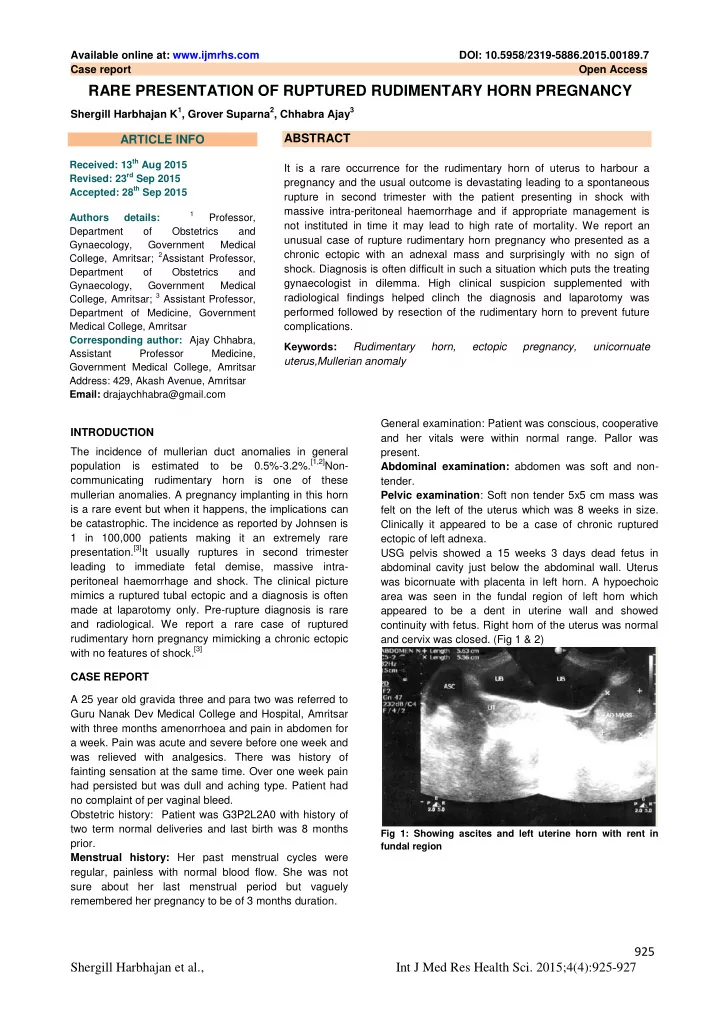
Shergill Harbhajan K1, Grover Suparna2, Chhabra Ajay3 INTRODUCTION The incidence of mullerian duct anomalies in general population is estimated to be 0.5%-3.2%.[1,2]Non- communicating rudimentary horn is one of these mullerian anomalies. A pregnancy implanting in this horn is a rare event but when it happens, the implications can be catastrophic. The incidence as reported by Johnsen is 1 in 100,000 patients making it an extremely rare presentation.[3]It usually ruptures in second trimester leading to immediate fetal demise, massive intra- peritoneal haemorrhage and shock. The clinical picture mimics a ruptured tubal ectopic and a diagnosis is often made at laparotomy only. Pre-rupture diagnosis is rare and radiological. We report a rare case of ruptured rudimentary horn pregnancy mimicking a chronic ectopic with no features of shock.[3] CASE REPORT A 25 year old gravida three and para two was referred to Guru Nanak Dev Medical College and Hospital, Amritsar with three months amenorrhoea and pain in abdomen for a week. Pain was acute and severe before one week and was relieved with analgesics. There was history of fainting sensation at the same time. Over one week pain had persisted but was dull and aching type. Patient had no complaint of per vaginal bleed. Obstetric history: Patient was G3P2L2A0 with history of two term normal deliveries and last birth was 8 months prior. Menstrual history: Her past menstrual cycles were regular, painless with normal blood flow. She was not sure about her last menstrual period but vaguely remembered her pregnancy to be of 3 months duration. General examination: Patient was conscious, cooperative and her vitals were within normal range. Pallor was present. Abdominal examination: abdomen was soft and non- tender. Pelvic examination: Soft non tender 5x5 cm mass was felt on the left of the uterus which was 8 weeks in size. Clinically it appeared to be a case of chronic ruptured ectopic of left adnexa. USG pelvis showed a 15 weeks 3 days dead fetus in abdominal cavity just below the abdominal wall. Uterus was bicornuate with placenta in left horn. A hypoechoic area was seen in the fundal region of left horn which appeared to be a dent in uterine wall and showed continuity with fetus. Right horn of the uterus was normal and cervix was closed. (Fig 1 & 2)

Fig 1: Showing ascites and left uterine horn with rent in fundal region

ABSTRACT

It is a rare occurrence for the rudimentary horn of uterus to harbour a pregnancy and the usual outcome is devastating leading to a spontaneous rupture in second trimester with the patient presenting in shock with massive intra-peritoneal haemorrhage and if appropriate management is not instituted in time it may lead to high rate of mortality. We report an unusual case of rupture rudimentary horn pregnancy who presented as a chronic ectopic with an adnexal mass and surprisingly with no sign of

  • shock. Diagnosis is often difficult in such a situation which puts the treating

gynaecologist in dilemma. High clinical suspicion supplemented with radiological findings helped clinch the diagnosis and laparotomy was performed followed by resection of the rudimentary horn to prevent future complications. Keywords: Rudimentary horn, ectopic pregnancy, unicornuate uterus,Mullerian anomaly

ARTICLE INFO

Received: 13th Aug 2015 Revised: 23rd Sep 2015 Accepted: 28th Sep 2015 Authors details:

1

Professor, Department

  • f

Obstetrics and Gynaecology, Government Medical College, Amritsar; 2Assistant Professor, Department

  • f

Obstetrics and Gynaecology, Government Medical College, Amritsar; 3 Assistant Professor, Department of Medicine, Government Medical College, Amritsar Corresponding author: Ajay Chhabra, Assistant Professor Medicine, Government Medical College, Amritsar Address: 429, Akash Avenue, Amritsar Email: drajaychhabra@gmail.com

slide-2
SLIDE 2

926 Shergill Harbhajan et al., Int J Med Res Health Sci. 2015;4(4):925-927

Fig 2: Fetus surrounded by ascitic fluid lying in the abdominal cavity Fig 3: Showing rent in the rudimentary horn on the left side

Operative findings: on entering the peritoneal cavity, there was altered blood and clots in the pelvis. There was a rudimentary non-communicating horn on left side measuring about 6x6 cm with a rent on its anterior and superior aspect with a cord like structure coming out of it which was traced to a dead fetus wrapped up in the

  • mentum. ( Fig 3)

Ovaries and tubes were normal on both sides. Excision of rudimentary horn with ipsilateralsalpingectomy was done, hemostatic stitches taken and right sided partial tubectomy was done. Peritoneal lavage was done and abdomen closed in layers. Postoperative period was uneventful. DISCUSSION During embryogenesis, the uterus is normally formed by the fusion of the two Müllerian ducts. Defective fusion or absorption of these ducts leads to congenital uterine

  • abnormalities. In 1988, American Fertility Society (AFS)

classified mullerian duct abnormalities on the basis of magnitude of failure of normal uterine development.[4] Unicornuate uterus is a result of incomplete development

  • f one of the müllerian ducts. As per AFS classification, it

is a type 2 mullerian anomaly. A unicornuate uterus can be present alone [Type 2a] or with a rudimentary horn or bulb on the opposite side [Type 2b].[4] Unicornuate uterus occurs in 1 in 4020 women in the general population and a rudimentary horn is present in about 84% of the cases.[5,6] Heinonen et al reported a case series of 13 unicornuate uteri of which 11 had a rudimentary horn and the remaining two patients no rudimentary horn. More than 90% rudimentary horns are noncommunicating.[7] Urinary tract anomalies are associated with a unicornuate uterus in around 36% cases and should always be searched for in these patients.[7] A unicornuate uterus is often asymptomatic till a chance discovery as a result of complications of pregnancy. The condition favours abortion and premature labour, breech presentation of the foetus and fundal insertion of the

  • placenta. Various studies have published a live birth rate

ranging from 29%-61%.[5,6,8]The poor obstetric outcome may be due to the abnormal shape, the insufficient muscular mass of the uterus, abnormal vasculature, cervical incompetence and the reduced uterine volume and inability to expand. In our patient, previous two vaginal deliveries were term vaginal deliveries with no complications that could suggest a uterine anomaly based on the obstetric history

  • alone. There was no history of dysmenorrhoea or pelvic

pain as is seen sometimes due to any obstruction to communication between the horn and the main uterine cavity or the vagina. Ectopic pregnancy occurring in a non-communicating rudimentary horn has an estimated incidence of 1 per 100,000 to 140,000 pregnancies.[9] Pregnancy in the non- communicating rudimentary horn results from transperitoneal migration of sperm or fertilised ovum from the opposite side.[5] If not diagnosed earlier the pregnant rudimentary horn will eventually rupture and the patient will present with signs and symptoms mimicking a ruptured ectopic pregnancy.The highly vascularised wall

  • f

the rudimentary horn may rupture leading on to sudden and severe intraperitoneal haemorrhage and shock. Most common outcome of pregnancy in rudimentary horn is rupture that occurs in the second trimester. It is associated with serious hemodynamic changes although a few studies have reported continuation of pregnancy as secondary abdominal pregnancy after a silent rupture.[10]In our patient, in spite of the rupture, patient was surprisingly not in a state of hypovolemic shock. It was probably due to no major vessels being involved. In general, the pregnancy lasts longer than tubal pregnancy because of the variable musculature of the

  • horn. 50% of cases rupture usually in second trimester,

while 30% go to term with a 0-13% fetal salvage rate.[11] At operation the attachment of the round ligament was lateral to the gestational sac which was suggestive of pregnancy in rudimentary horn rather than the tubal

  • pregnancy. Rudimentary horn had a tube and an ovary

attached to it. The rudimentary horn was removed together with the corresponding fallopian tube to avoid a future ectopic pregnancy in a blind residual tube via sperm transmigration.[5] Over last few years, cases of pregnancies in rudimentary horns have been managed laparoscopically.[12,13] Prerupture diagnosis is indeed challenging but when possible, medical management with methotrexate is an

  • ption although surgical excision of the horn is still

recommended.[14]

slide-3
SLIDE 3

927 Shergill Harbhajan et al., Int J Med Res Health Sci. 2015;4(4):925-927

CONCLUSION Being a rare entity and due to potentially atypical presentations, diagnosis of rudimentary horn pregnancy is often delayed and many a times it may surprise a surgeon operating with provisional diagnosis of ectopic

  • pregnancy. This possibility should always be considered

in differential diagnosis of a woman presenting with acute abdomen and/or features of shock in second trimester of

  • pregnancy. Surgical excision of a non-communicating

horn is always indicated even when diagnosis is incidental.Ipsilateral fallopian tube should never be left in such cases as they are a potential site of ectopc pregnancy in future. Conflict of Interest- nil REFERENCES 1. Nahum GG. Uterine anomalies. How common are they, and what is their distribution among subtypes? The Journal of Reproductive Medicine. 1998;43:877– 87. 2. Simon C, Martinez L, Pardo F, Tortajada M and Pellicer A. Mullerian defects in women with normal reproductive

  • utcome.

Fertility and Sterility. 1991;56:1192–3. 3. Johnsen K. Pregnancy in a rudimentary horn, two case reports. Obstetrics and Gynecology. 1983;62:334-42. 4. American Fertility Society. Classification of mullerian

  • anomalies. Fertility and Sterility.1988;49:952.

5. Reichman D, Laufer MR and Robinson BK. Pregnancy outcomes in unicornuate uteri: a review. Fertility and Sterility. 2009; 91(5):1886-94. 6. Heinanen PK. Unicornuate uterus and rudimentary

  • horn. Fertility and Sterility. 1997; 168: 224-30.

7. Jayasinghe Y, Rane A, Stalewski H and Grover S. The presentation and early diagnosis of the rudimentary uterine horn. Obstetrics and

  • Gynecology. 2005;105:1456–67.

8. Akar M, Bayar D, Yildiz S, Ozel M and Yilmaz Z. Reproductive outcome of women with unicornuate

  • uterus. Australia New Zealand Obstetrics and

Gynaecology Journal. 2005;45:148–50. 9. O’Leary JL and O’Leary JA. Rudimentary horn

  • pregnancy. Obstetrics and Gynecology.1963;22:371.
  • 10. Shin JW and Kim HJ. Case of live birth in a non-

communicating rudimentary horn pregnancy. Journal Obstetrics and Gynaecology Research. 2005;31:329-31.

  • 11. Nahum GG. Rudimentary uterine horn pregnancy.

The 20th century worldwide experience of 588

  • cases. Journal of Reproductive Medicine. 2002;

47:151-63.

  • 12. Sharma D, Usha MG, Gaikwad R and Sudha S.

Laparoscopic resection of unruptured rudimentary horn pregnancy. International Journal

  • f

Reproduction, Contraception, Obstetrics and

  • Gynecology. 2013;2:95-8.
  • 13. Yahata T, Kurabayashi T, Ueda H, Kodama S,

Chihara T and Tanaka K. Laparoscopic Management

  • f Rudimentary horn Pregnancy: A case report.

Journal of Reproductive Medicine. 1998; 43(3): 223- 6.

  • 14. Edelman AB, Jensen JT, Lee DM and Nichols MD.

Successful medical abortion of a pregnancy within a non-communicating rudimentary uterine horn. American Journal of Obstetrics and Gynecology. 2003;189:886-7.