Random Variables Overview Taylor Series Expansion Probability - - PowerPoint PPT Presentation

random variables overview taylor series expansion
SMART_READER_LITE
LIVE PREVIEW

Random Variables Overview Taylor Series Expansion Probability - - PowerPoint PPT Presentation

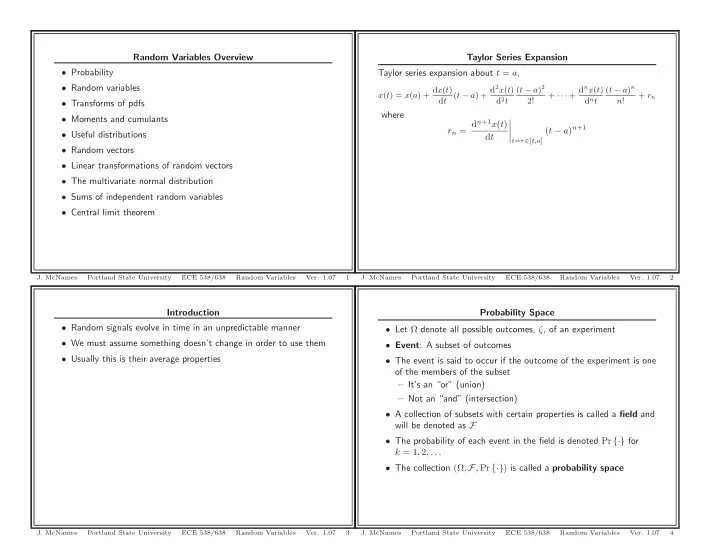
Random Variables Overview Taylor Series Expansion Probability Taylor series expansion about t = a , Random variables ( t a ) + d 2 x ( t ) ( t a ) 2 x ( t ) = x ( a ) + d x ( t ) + + d n x ( t ) ( t a ) n + r n d t d 2


slide-1
SLIDE 1

Introduction

  • Random signals evolve in time in an unpredictable manner
  • We must assume something doesn’t change in order to use them
  • Usually this is their average properties
  • J. McNames

Portland State University ECE 538/638 Random Variables

  • Ver. 1.07

3

Random Variables Overview

  • Probability
  • Random variables
  • Transforms of pdfs
  • Moments and cumulants
  • Useful distributions
  • Random vectors
  • Linear transformations of random vectors
  • The multivariate normal distribution
  • Sums of independent random variables
  • Central limit theorem
  • J. McNames

Portland State University ECE 538/638 Random Variables

  • Ver. 1.07

1

Probability Space

  • Let Ω denote all possible outcomes, ζ, of an experiment
  • Event: A subset of outcomes
  • The event is said to occur if the outcome of the experiment is one
  • f the members of the subset

– It’s an “or” (union) – Not an “and” (intersection)

  • A collection of subsets with certain properties is called a field and

will be denoted as F

  • The probability of each event in the field is denoted Pr {·} for

k = 1, 2, . . .

  • The collection (Ω, F, Pr {·}) is called a probability space
  • J. McNames

Portland State University ECE 538/638 Random Variables

  • Ver. 1.07

4

Taylor Series Expansion Taylor series expansion about t = a,

x(t) = x(a) + dx(t) dt (t − a) + d2x(t) d2t (t − a)2 2! + · · · + dnx(t) dnt (t − a)n n! + rn

where rn = dn+1x(t) dt

  • t=τ∈[t,a]

(t − a)n+1

  • J. McNames

Portland State University ECE 538/638 Random Variables

  • Ver. 1.07

2

slide-2
SLIDE 2

Random Variable Properties Continued

  • Notation: x(ζ) = x

– x(ζ) denotes a random variable (function of the experimental

  • utcome)

– x denotes its value

  • A random variable may be Discrete-Valued,

Continuous-Valued, or Mixed

  • Similar to spectral densities

– If x(t) is nearly periodic, it has discrete spectra – Most stationary random signals x(t) have continuous spectra – A combination of the two types has mixed spectra

  • J. McNames

Portland State University ECE 538/638 Random Variables

  • Ver. 1.07

7

Random Variables

Real Line Range

x(ζ) ζ Ω

  • Random variable: a function that assigns a real number, x(ζ), to

each outcome ζ in the sample space of a random experiment

  • Conditions

– {ζ : ζ ∈ Ω and − ∞ < x(ζ) ≤ x0} ∈ F for all x0 ∈ R1 – Pr {x(ζ) = ∞} = 0 – Pr {x(ζ) = −∞} = 0

  • J. McNames

Portland State University ECE 538/638 Random Variables

  • Ver. 1.07

5

Cumulative Distribution Function (cdf)

  • Recall that probability is defined on the field of possible events
  • Some of these events (subsets of outcomes) can be defined as

{ζ : x(ζ) ≤ x}

  • Cumulative Distribution Function (cdf): The probability of

these events, Pr {x(ζ) ≤ x}

  • Note the cdf is a function of x ∈ R1:

Fx(x) Pr {x(ζ) ≤ x}

  • The cdf is continuous from the right
  • J. McNames

Portland State University ECE 538/638 Random Variables

  • Ver. 1.07

8

Random Variable Properties

  • The sample space Ω is the domain of the random variable
  • The set of all values that x(·) can have is the range of the

random variable

  • For now the range is the real line, R1
  • Later we will generalize to allow it to be a vector or a sequence
  • This is a many to one mapping. That is, a set of points, ζ1, ζ2, . . .

may take on the same value of the random variable

  • Will sometimes abbreviate RV
  • The RV may be real- or complex-valued
  • Random variables are actually a deterministic function of any

event in the field: {ζ1, ζ2, . . . , ζk}

  • J. McNames

Portland State University ECE 538/638 Random Variables

  • Ver. 1.07

6

slide-3
SLIDE 3

Properties of the pdf

  • fx(x) ≥ 0
  • Pr {a ≤ x(ζ) ≤ b} =

b

a fx(u) du

  • Fx(x) =

x

−∞ fx(u) du

  • +∞

−∞ fx(u) du = 1

  • A valid pdf can be formed from any nonnegative, piecewise

continuous function g(x) that has a finite integral

  • The pdf must be defined for all real values of x
  • If x does not take on some values, this implies fx(x) = 0 for those

values

  • J. McNames

Portland State University ECE 538/638 Random Variables

  • Ver. 1.07

11

Properties of the cdf

  • 0 ≤ Fx(x) ≤ 1
  • limx→+∞ Fx(x) = 1
  • limx→−∞ Fx(x) = 0
  • Fx(x) is a nondecreasing function of x

– Thus, if a < b, then Fx(a) ≤ Fx(b)

  • Fx(x) is continuous from the right

– That is, for h > 0, Fx(b) = limh→0 Fx(b + h) = Fx(b+)

  • Pr {a < x(ζ) ≤ b} = Fx(b) − Fx(a)
  • Pr {x(ζ) = b} = Fx(b) − Fx(b−)
  • J. McNames

Portland State University ECE 538/638 Random Variables

  • Ver. 1.07

9

Point Statistics, Averages, and Moments

  • In general, we will often not have a complete description of an RV

(the pdf or cdf)

  • Estimating a pdf or cdf is difficult in general, especially if x(ζ) is a

sequence or vector

  • However, we can often estimate some properties of the

distribution without estimating the distribution itself

  • These are called point statistics
  • We will only discuss a subset of point statistics: statistical

averages or moments

  • These are useful because

– In many cases, we can estimate them accurately from data – They give us useful information about the distribution – We don’t have to know the distribution to estimate them

  • J. McNames

Portland State University ECE 538/638 Random Variables

  • Ver. 1.07

12

Probability Density Function (pdf)

  • Probability Density Function (pdf): When it exists, is defined

as fx(x) dFx(x) dx

  • Thus, we also have

Fx(x) = x

−∞

fx(u) du

  • For a small interval △x, can be thought of as

fx(x)△x ≈ Fx(x + △x) − Fx(x) = Pr {x < x(ζ) ≤ x + △x}

  • J. McNames

Portland State University ECE 538/638 Random Variables

  • Ver. 1.07

10

slide-4
SLIDE 4

Moments Defined mth-order Moment of x(ζ) is defined as r(m)

x

E [xm(ζ)] = ∞

−∞

xmfx(x) dx mth-order Central Moment of x(ζ) is defined as γ(m)

x

E [(x(ζ) − µx)m] = ∞

−∞

(x − µx)mfx(x) dx

  • Mean-Squared Value: The second-order moment, r(2)

x .

  • Note that

E

  • x2(ζ)
  • = E2 [x(ζ)]
  • J. McNames

Portland State University ECE 538/638 Random Variables

  • Ver. 1.07

15

Expected Values Defined Expected value: defined for a random variable x(ζ) as E[x(ζ)] µx = +∞

−∞

xfx(x) dx If x(ζ) is discrete-valued, the pdf consists only of impulses and can be alternatively written in terms of the pmf E [x(ζ)] = +∞

−∞

x

  • k

pkδ(x − xk)

  • dx

=

  • k

pk +∞

−∞

xδ(x − xk) dx =

  • k

pkxk

  • J. McNames

Portland State University ECE 538/638 Random Variables

  • Ver. 1.07

13

Moments and Definitions r(m)

x

  • E [xm(ζ)] =

−∞

xmfx(x) dx γ(m)

x

  • E [(x(ζ) − µx)m] =

−∞

(x − µx)mfx(x) dx

  • Variance of x(ζ) is defined as

var[x(ζ)] σ2

x γ(2) x

= E

  • (x(ζ) − µx)2
  • Standard deviation of x(ζ) is defined as σx =
  • var[x(ζ)]
  • Obvious moments

r(0)

x

= 1 r(1)

x

= µx

  • Trivial central moments

γ(0)

x

= 1 γ(1)

x

= 0 γ(2)

x

= σ2

x

  • J. McNames

Portland State University ECE 538/638 Random Variables

  • Ver. 1.07

16

Expectation Properties E [x(ζ)] µx = +∞

−∞

xfx(x) dx

  • Also called the mean of x(ζ)
  • The mean can be regarded as the “center of gravity” of fx(x)
  • If fx(x) is symmetric about a, f(x − a) = f(a − x), then µx = a
  • If fx(x) is even, µx = 0
  • This is a linear operation

E [αx(ζ) + β] = αµx + β

  • If y(ζ) = g(x(ζ)), a function of the random variable x(ζ), y(ζ) is

also a random variable such that E [y(ζ)] E [g(x(ζ))] = ∞

−∞

g(x)fx(x) dx

  • J. McNames

Portland State University ECE 538/638 Random Variables

  • Ver. 1.07

14

slide-5
SLIDE 5

Moment Generating Functions Moment Generating Function of x(ζ) is defined as ¯ Φ(s) E

  • esx(ζ)

= ∞

−∞

fx(x)esx dx

  • Similar to the continuous-time Laplace transform
  • However, the exponent is positive (why?)

Using a Taylor series expansion of esx at x close to zero we have ¯ Φ(s) = E

  • esx(ζ)

= E

  • 1 + sx(ζ) + [sx(ζ)]2

2! + · · · + [sx(ζ)]m m! + . . .

  • =

1 + sµx + s2 2! r(2)

x

+ · · · + sm m! r(m)

x

+ . . .

  • J. McNames

Portland State University ECE 538/638 Random Variables

  • Ver. 1.07

19

Relationship of Moments Moments and central moments are related: γ(m)

x

=

m

  • k=0

m k

  • (−1)kµk

xr(m−k) x

It also possible to calculate the first m moments from the first m central moments.

  • J. McNames

Portland State University ECE 538/638 Random Variables

  • Ver. 1.07

17

Moment Generating Functions ¯ Φ(s) = 1 + sµx + s2 2! r(2)

x

+ · · · + sm m! r(m)

x

+ . . .

  • If all the moments of x(ζ) are known and exist, we can create

¯ Φ(s) and solve for fx(x) by inverse Laplace transform

  • Thus the set of all moments (if they exist) completely define the

pdf!

  • If ¯

Φ(s) is known and analytic (not in the book), we can use it to solve for the moments r(m)

x

= dm[¯ Φ(s)] dsm

  • s=0

= (−j)m dm[¯ Φ(ξ)] dξm

  • ξ=0
  • J. McNames

Portland State University ECE 538/638 Random Variables

  • Ver. 1.07

20

Characteristic Functions Characteristic Function of x(ζ) is defined as Φ(ξ) E

  • ejξx(ζ)

= ∞

−∞

fx(x)ejξx dx

  • Similar to the continuous-time Fourier transform
  • However, the exponent is positive (why?)
  • Will not use Fx(ξ) to avoid confusion with cdf (same as text)
  • Text claims the independent variable ξ should not be thought of

as frequency (why?)

  • This will be useful for handling sums of random variables because

the distribution of the sum is the convolution of the pdf’s

  • J. McNames

Portland State University ECE 538/638 Random Variables

  • Ver. 1.07

18

slide-6
SLIDE 6

Uniform Distribution fx(x) =

  • 1

b−a

a ≤ x ≤ b

  • therwise
  • Useful for situations in which outcomes are equally likely
  • Often denoted as x(ζ) ∼ U[a, b]
  • Mean and variance

µx = a + b 2 σ2

x = (b − a)2

12

  • J. McNames

Portland State University ECE 538/638 Random Variables

  • Ver. 1.07

23

Cumulants Cumulant Generating Function of x(ζ) is defined as ¯ Ψx(s) ln ¯ Φx(s) = ln E

  • esx(ζ)

Second Characteristic Function of x(ζ) is defined as Ψx(ξ) ln Φx(ξ) = ln E

  • ejξx(ζ)

mth Cumulant of x(ζ) is defined as κ(m)

x

dm[¯ Ψ(s)] dsm

  • s=0

= (−j)m dm[¯ Ψ(ξ)] dξm

  • ξ=0

Useful for high-order moment analysis (advanced SSP topic) and working with products of characteristic functions

  • J. McNames

Portland State University ECE 538/638 Random Variables

  • Ver. 1.07

21

Normal Distribution

−5 −4 −3 −2 −1 1 2 3 4 5 0.2 0.4 0.6 0.8 1 x F(x) Gaussian Distribution Function −5 −4 −3 −2 −1 1 2 3 4 5 0.1 0.2 0.3 0.4 x f(x) Gaussian Density Function

fx(x) = 1

  • 2πσ2

x

exp

  • −(x − µx)2

2σ2

x

  • Also called the Gaussian distribution
  • Often denoted as x(ζ) ∼ N(µx, σ2

x)

  • Arises naturally in many applications
  • Central limit theorem (more later)
  • J. McNames

Portland State University ECE 538/638 Random Variables

  • Ver. 1.07

24

Common Random Variables

  • Uniform distribution
  • Normal distribution
  • Cauchy distribution
  • J. McNames

Portland State University ECE 538/638 Random Variables

  • Ver. 1.07

22

slide-7
SLIDE 7

Random Vectors

x(ζ) ∈ RM ζ Ω

  • Much of what we have discussed generalizes to vector

random-variables in an obvious manner

  • However, the lower order moments have special properties and are

important to signal processing

  • Each outcome of the assumed underlying random experiment

produces an entire random vector

  • Each element of the vector is not generated independently from a

separate experiment

  • This is an important concept
  • J. McNames

Portland State University ECE 538/638 Random Variables

  • Ver. 1.07

27

Normal Distribution Properties fx(x) = 1

  • 2πσ2

x

e

− (x−µx)2

2σ2 x

Φx(ξ) = exp(jµxξ − 1

2σ2 xξ2)

  • Defined completely by µx and σ2

x

  • All higher-order moments can be determined in terms of the first

two moments

  • Higher-order moments provide no additional information
  • Due to the central limit theorem, would like to know how the

distribution of random variables differs from a normal distribution

  • Cumulants generally provide this information
  • For normally distributed random variables, κ(m)

x

= 0 for m > 2

  • J. McNames

Portland State University ECE 538/638 Random Variables

  • Ver. 1.07

25

Random Vectors

x(ζ) ∈ RM ζ Ω

Random M vector: a real-valued vector containing M random variables x = [x1(ζ), x2(ζ), . . . , xm(ζ)]T

  • Transpose is denoted by T
  • Maps an abstract probability space to a vector-valued real space

RM

  • Thus the range is an M-dimensional space
  • J. McNames

Portland State University ECE 538/638 Random Variables

  • Ver. 1.07

28

Cauchy Random Variable fx(x) = β π 1 (x − µ)2 + β2 Fx(x) = 0.5 + 1 π arctan x − µ β Φx(ξ) = exp(jµξ − β|ξ|)

  • A heavy-tailed distribution (relative to Gaussian)
  • Two parameters, µ and β
  • Mean: µx = µ
  • Variance does not exist because E[x2] does not exist
  • Moment generating function does not exist for some values of s
  • The sum of M independent Cauchy random variables is also

Cauchy!

  • Example of an infinite-variance random variable
  • J. McNames

Portland State University ECE 538/638 Random Variables

  • Ver. 1.07

26

slide-8
SLIDE 8

Independence Independent Two random variables x1(ζ) and x2(ζ) are independent if the events {x1(ζ) ≤ x1} and {x2(ζ) ≤ x2} are jointly independent Pr {x1(ζ) ≤ x1, x2(ζ) ≤ x2} = Pr {x1(ζ) ≤ x1} Pr {x2(ζ) ≤ x2} Equivalent conditions are Fx1,x2(x1, x2) = Fx1(x1)Fx2(x2) fx1,x2(x1, x2) = fx1(x1)fx2(x2)

  • J. McNames

Portland State University ECE 538/638 Random Variables

  • Ver. 1.07

31

Distribution and Density Functions Fx(x1, . . . , xM)

  • Pr {x1(ζ) ≤ x1, . . . xM(ζ) ≤ xM}

fx(x) = lim

△x1→0

. . .

△xM →0

Pr {x1 < x1(ζ) ≤ x1 + △x1, . . . , xM < xM(ζ) ≤ xM + △xM} △x1 . . . △xM

  • The commas denote an and condition: it is the probability that all

M random variables xi(ζ) are less than the stated values

  • A RV is completely characterized by its joint cdf or pdf
  • Often written as Fx(x) = Pr {x(ζ) ≤ x}
  • J. McNames

Portland State University ECE 538/638 Random Variables

  • Ver. 1.07

29

Vector Statistics

  • In general it is very difficult to estimate vector pdf’s and/or cdf’s
  • Called the “curse of dimensionality”
  • Even if they are known, they are difficult to work with in general
  • However, there is a rich statistical theory developed for second
  • rder moments (mean and variance)
  • We will on this aspect of SSP for this course
  • Higher-order moments is an advanced topic covered later in the

text – Worth self-study

  • J. McNames

Portland State University ECE 538/638 Random Variables

  • Ver. 1.07

32

Distribution and Density Functions fx(x)

∂x1 · · · ∂ ∂xm Fx(x) Fx(x) = x1

−∞

· · · xM

−∞

fx(u) du1 · · · duM = x

−∞

fx(u) du

  • J. McNames

Portland State University ECE 538/638 Random Variables

  • Ver. 1.07

30

slide-9
SLIDE 9

Autocovariance Matrix Autocovariance matrix: defined for a random variable x(ζ) as Γx E

  • (x(ζ) − µx)(x(ζ) − µx)H

= ⎡ ⎢ ⎣ γ11 . . . γ1M . . . ... . . . γM1 . . . γMM ⎤ ⎥ ⎦ where γii

  • E
  • |xi(ζ) − µi|2

= σ2

xi

γij

  • E [(xi(ζ) − µi)(xj(ζ) − µj)∗] = E
  • xi(ζ)x∗

j(ζ)

  • − µiµj = γ∗

ji

  • Sometimes γij is denoted as σij
  • γii is sometimes called the self variance of xi(ζ)
  • γij is called the covariance of xi(ζ) and xj(ζ)
  • The covariance matrix Γx is Hermitian: Γx = ΓH

x

  • J. McNames

Portland State University ECE 538/638 Random Variables

  • Ver. 1.07

35

Vector Mean Mean Vector: defined for a random variable x(ζ) as µx = E [x(ζ)] = ⎡ ⎢ ⎣ E [x1(ζ)] . . . E [xM(ζ)] ⎤ ⎥ ⎦ = ⎡ ⎢ ⎣ µ1 . . . µM ⎤ ⎥ ⎦

  • The integral of the vector expectation is taken over the entire CM

space, if the random vector is complex-valued

  • The mean vector is simply the vector of means
  • J. McNames

Portland State University ECE 538/638 Random Variables

  • Ver. 1.07

33

Correlation Coefficients Correlation coefficient: is denoted as ρij and is defined for random variables xi(ζ) and xj(ζ) as γij = ρijσiσj ρij γij σiσj

  • ρii = 1 and −1 ≤ ρij ≤ 1
  • Extreme values of ρij indicate a linear relationship between xj(ζ)

and xi(ζ): xj(ζ) = αxi(ζ) + β – Does not tell you what α or β are – ρij = 1 implies α > 0, ρij = −1 implies α < 0

  • If ρij = 0, xi(ζ) and xj(ζ) are said to be uncorrelated
  • J. McNames

Portland State University ECE 538/638 Random Variables

  • Ver. 1.07

36

Autocorrelation Matrix Autocorrelation matrix: defined for a random vector x(ζ) as Rx E

  • x(ζ)xH(ζ)
  • =

⎡ ⎢ ⎣ r11 . . . r1M . . . ... . . . rM1 . . . rmm ⎤ ⎥ ⎦ where rii E

  • |xi(ζ)|2

rij E [xi(ζ)xj(ζ)∗] = r∗

ji

  • H denotes conjugate transpose operation
  • This is a completely different definition than the autocorrelation

defined for deterministic signals

  • rii are second-order moments of xi(ζ), denoted earlier as r(2)

xi

  • rij measure correlation between two random variables
  • This will be precisely defined later
  • The autocorrelation matrix Rx is Hermitian: Rx = RH

x

  • J. McNames

Portland State University ECE 538/638 Random Variables

  • Ver. 1.07

34

slide-10
SLIDE 10

Linear Transformations y(ζ) = Ax(ζ) µy = E [y(ζ)] = E [Ax(ζ)] = A E [x(ζ)] = Aµx Ry = E

  • y(ζ)y(ζ)H

= E

  • Ax(ζ) x(ζ)HAH

= ARxAH Γy = AΓxAH Rxy = RxAH Ryx = ARx Γxy = ΓxAH Γyx = AΓx

  • J. McNames

Portland State University ECE 538/638 Random Variables

  • Ver. 1.07

39

Autocorrelation and Autocovariance Γx = Rx − µxµH

x

  • If µx = 0, Γx = Rx
  • If ρij = 0 or γij = 0, xi(ζ) and xj(ζ) are uncorrelated
  • If rij = 0, xi(ζ) and xj(ζ) are orthogonal
  • The degree of correlation is a weaker measure of interaction than

independence – If xi(ζ) and xj(ζ) are independent, γij = ρij = 0 – Converse is not true (sufficient, but not a necessary condition) – If xi(ζ) and xj(ζ) have a normal distribution, then γij = ρij = 0 implies xi(ζ) and xj(ζ) are independent

  • If one or both random variables have zero mean and are

uncorrelated, they are orthogonal

  • J. McNames

Portland State University ECE 538/638 Random Variables

  • Ver. 1.07

37

Normal Random Vectors fx(x) = 1 (2π)M/2|Γx|

1 2 exp

  • − 1

2(x − µx)TΓ−1 x (x − µx)

  • Φx(ξ)

= exp(jξTµx − 1

2ξTΓxξ)

  • Often denoted as x(ζ) ∼ N(µx, Γx)
  • The exponent is a positive definite quadratic function of x
  • The pdf is completely specified by µx and Γx
  • Both are relatively easy to estimate in practice
  • All higher-order moments can be calculated from these
  • If all pairs uncorrelated, are also independent
  • A linear transformation, y = Ax + b is also normally distributed,

y(ζ) ∼ N(µx + b, AΓxAH)

  • J. McNames

Portland State University ECE 538/638 Random Variables

  • Ver. 1.07

40

Cross-Correlation and Cross-Covariance Cross-correlation matrix: defined for a random vectors x(ζ) ∈ CM and y(ζ) ∈ CL as Rxy E

  • x(ζ)yH(ζ)
  • =

⎡ ⎢ ⎣ E [x1(ζ)y∗

1(ζ)]

. . . E [x1(ζ)y∗

L(ζ)]

. . . ... . . . E [xM(ζ)y∗

1(ζ)]

. . . E [xM(ζ)y∗

L(ζ)]

⎤ ⎥ ⎦ Cross-covariance matrix: defined for a random vectors x(ζ) ∈ CM and y(ζ) ∈ CL as Γxy E

  • (x(ζ) − µx)(y(ζ) − µy)H

= Rxy − µxµH

y

  • Uncorrelated if Γxy = 0 or, equivalently, Rxy = µxµH

y

  • Orthogonal if Rxy = 0
  • J. McNames

Portland State University ECE 538/638 Random Variables

  • Ver. 1.07

38

slide-11
SLIDE 11

Stable Distributions y(ζ) =

M

  • k=1

xk(ζ)

  • Stable Distributions: distributions that are preserved

(self-reproduce) under convolution

  • Examples: Gaussian distribution, Cauchy distribution
  • The only stable distribution with finite variance is the Gaussian

distribution

  • The other distributions have infinite variance and possibly infinite

mean

  • Examples: some diffusion processes, electrical noise, some random

walks, coupled oscillators with friction

  • Useful to model signals with large variability
  • Very good discussion in text (not critical to this class)
  • J. McNames

Portland State University ECE 538/638 Random Variables

  • Ver. 1.07

43

Sums of Independent Random Variables y(ζ) =

M

  • k=1

ckxk(ζ) µy =

M

  • k=1

ckµxk σ2

y = M

  • k=1

|ck|2σ2

xk

Let y(ζ) = x1(ζ) + x2(ζ) Φy(ξ) = E

  • ejξy(ζ)

= E

  • ejξ[x1(ζ)+x2(ζ)]

= E

  • ejξx1(ζ)

E

  • ejξx2(ζ)

= Φx1(ξ)Φx2(ξ) Therefore fy(y) = fx1(y) ∗ fx2(y)

  • J. McNames

Portland State University ECE 538/638 Random Variables

  • Ver. 1.07

41

Central Limit Theorem y(ζ) =

M

  • k=1

xk(ζ)

  • If xi(ζ) are independent identically distributed (IID) random

variables and the distribution fx(x) is stable, clearly y(ζ) converges to the same distribution as M → ∞

  • Central Limit Theorem: If

– The mean and variance of each random variable exist (finite) – The random variables are mutually independent – The random variables are identically distributed then the distribution of y(ζ) approaches a normal distribution as M → ∞

  • J. McNames

Portland State University ECE 538/638 Random Variables

  • Ver. 1.07

44

Sums of Independent Random Variables Continued This generalizes in the obvious manner y(ζ) =

M

  • k=1

xk(ζ) fy(y) = fx1(y) ∗ fx2(y) ∗ · · · ∗ fxM (y) Φy(ξ) =

M

  • k=1

Φxk(ξ) Ψy(ξ) =

M

  • k=1

Ψxk(ξ) κ(m)

y

=

M

  • k=1

κ(m)

xk

  • J. McNames

Portland State University ECE 538/638 Random Variables

  • Ver. 1.07

42

slide-12
SLIDE 12

Central Limit Theorem Comments y(ζ) =

M

  • k=1

xk(ζ)

  • The convergence often occurs even if the distributions are not

identical

  • The convergence is more accurate (rapid) near the mean (center)
  • f the distribution

– The approximation may be poor in the tails

  • The convergence is in the cdf, not the pdf. Consider discrete RV’s
  • Does not apply when the variance of the RV’s is infinite
  • J. McNames

Portland State University ECE 538/638 Random Variables

  • Ver. 1.07

45