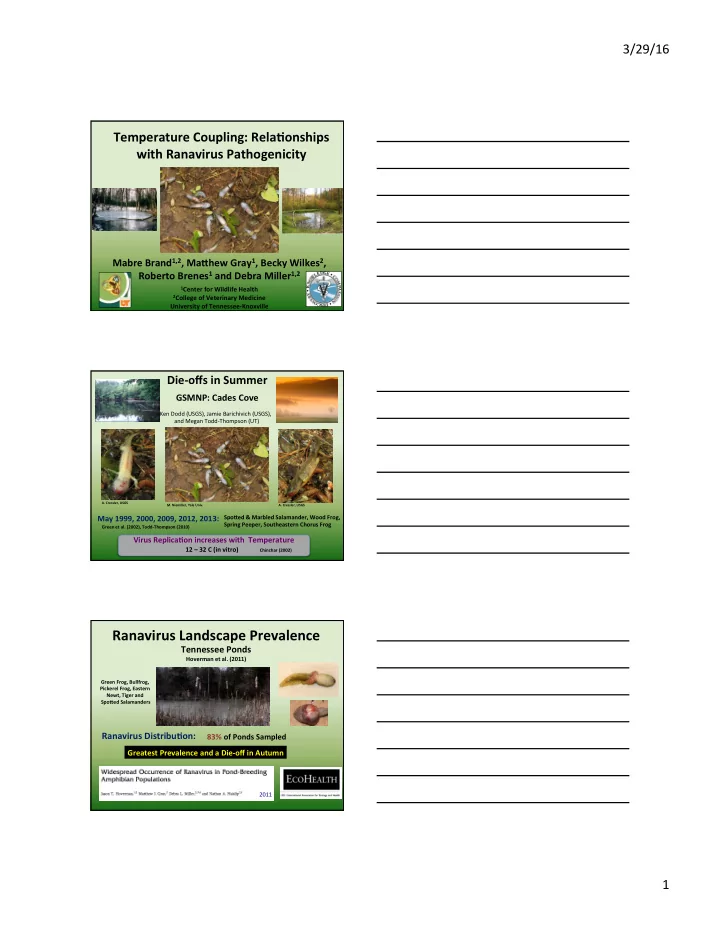
Ranavirus Landscape Prevalence Tennessee Ponds Hoverman et - - PDF document

ranavirus landscape prevalence
SMART_READER_LITE
LIVE PREVIEW

Ranavirus Landscape Prevalence Tennessee Ponds Hoverman et - - PDF document

3/29/16 Temperature Coupling: Rela2onships with Ranavirus Pathogenicity Mabre Brand 1,2 , MaAhew Gray 1 , Becky Wilkes 2 , Roberto Brenes 1 and Debra Miller 1,2 1


slide-1
SLIDE 1

3/29/16 ¡ 1 ¡ Temperature ¡Coupling: ¡Rela2onships ¡ with ¡Ranavirus ¡Pathogenicity ¡

Mabre ¡Brand1,2, ¡MaAhew ¡Gray1, ¡Becky ¡Wilkes2, ¡ ¡ Roberto ¡Brenes1 ¡and ¡Debra ¡Miller1,2 ¡ ¡

1Center ¡for ¡Wildlife ¡Health ¡ 2College ¡of ¡Veterinary ¡Medicine ¡ ¡

University ¡of ¡Tennessee-­‑Knoxville ¡ ¡

Die-­‑offs ¡in ¡Summer ¡

Ken ¡Dodd ¡(USGS), ¡Jamie ¡Barichivich ¡(USGS), ¡ ¡ and ¡Megan ¡Todd-­‑Thompson ¡(UT) ¡

  • A. ¡Cressler, ¡USGS ¡
  • A. ¡Cressler, ¡USGS ¡
  • M. ¡Niemiller, ¡Yale ¡Univ. ¡

SpoAed ¡& ¡Marbled ¡Salamander, ¡Wood ¡Frog, ¡ Spring ¡Peeper, ¡Southeastern ¡Chorus ¡Frog ¡

May ¡1999, ¡2000, ¡2009, ¡2012, ¡2013: ¡

GSMNP: ¡Cades ¡Cove ¡

Green ¡et ¡al. ¡(2002), ¡Todd-­‑Thompson ¡(2010) ¡

Virus ¡Replica2on ¡increases ¡with ¡ ¡Temperature ¡

12 ¡– ¡32 ¡C ¡(in ¡vitro) ¡

Chinchar ¡(2002) ¡

Ranavirus ¡Landscape ¡Prevalence ¡

Tennessee ¡Ponds ¡

Green ¡Frog, ¡Bullfrog, ¡ Pickerel ¡Frog, ¡Eastern ¡ Newt, ¡Tiger ¡and ¡ SpoAed ¡Salamanders ¡

Ranavirus ¡Distribu2on: ¡

83% ¡of ¡Ponds ¡Sampled ¡

Hoverman ¡et ¡al. ¡(2011) ¡

Greatest ¡Prevalence ¡and ¡a ¡Die-­‑off ¡in ¡Autumn ¡

2011 ¡

slide-2
SLIDE 2

3/29/16 ¡ 2 ¡

Seasonal ¡Trends ¡in ¡Prevalence ¡ ¡

0.57 0.15 0.15 0.24 0.45 0.1 0.2 0.3 0.4 0.5 0.6 0.7 Bullfrog Green Frog FV3 Prevalence Winter Summer Fall Season

A A B B

n =104 tadpoles n =80 tadpoles P< 0.02 P =0.006

B

No Winter Captures

DAO ¡77:97-­‑103 ¡

  • Increase ¡in ¡pathogenicity ¡of ¡the ¡ranavirus ¡ATV ¡at ¡colder ¡temperatures ¡
  • Decrease ¡in ¡immune ¡func2on ¡of ¡ectothermic ¡vertebrates ¡ ¡

at ¡colder ¡temperatures ¡

Rojas ¡et ¡al. ¡(2005) ¡ Raffel ¡et ¡al. ¡(2006) ¡

Gray ¡et ¡al. ¡(2007) ¡

Seasonal ¡ Trends ¡

Brunner ¡et ¡al. ¡(2015): ¡ Rv ¡Book ¡ n ¡= ¡109 ¡events, ¡ ¡40 ¡publica2ons ¡ Most ¡die-­‑offs ¡occur ¡ in ¡summer ¡during ¡ warmer ¡months ¡

Does ¡Temperature ¡Play ¡a ¡Role ¡in ¡the ¡ Emergence ¡of ¡Ranaviruses? ¡

  • Seasonal ¡Trends: ¡

– Density ¡dependent ¡factors ¡ – Changes ¡in ¡natural ¡(predator ¡density, ¡development) ¡

  • r ¡anthropogenic ¡stressors ¡(nitrogen ¡concentraKon) ¡

¡

  • Water ¡Temperature’s ¡Role: ¡ ¡

– Viral ¡ReplicaKon ¡vs. ¡Immune ¡FuncKon ¡ ¡ – FuncKon ¡as ¡a ¡Natural ¡Stressor ¡

¡

Chinchar ¡(2002), ¡Raffel ¡et ¡al. ¡(2006) ¡

Long ¡et ¡al. ¡(2012) ¡

– Fish: ¡regulaKon ¡of ¡transcripKon, ¡ nucleosome ¡assembly, ¡chromaKn ¡

  • rganizaKon ¡and ¡protein ¡folding ¡ ¡ ¡
slide-3
SLIDE 3

3/29/16 ¡ 3 ¡

Compe2ng ¡Hypotheses ¡

  • Virus ¡Replica2on ¡Hypothesis ¡

– Ranavirus ¡replicaKon ¡increases ¡with ¡temperature ¡ up ¡to ¡32 ¡C ¡ – Caveat: ¡Immune ¡funcKon ¡in ¡ectotherms ¡also ¡ increases ¡with ¡temperature ¡

  • Temperature ¡Induced ¡Stress ¡Hypothesis ¡

– Early ¡Spring ¡Breeding ¡Species: ¡ ¡

  • Stressed ¡by ¡Warm ¡Temp ¡

– Summer ¡Breeding ¡Species: ¡

  • Stressed ¡by ¡Cold ¡Temp ¡

High ¡Pathogenicity ¡at ¡Higher ¡Temperatures ¡ Pathogenicity ¡is ¡ Species-­‑specific ¡and ¡ Related ¡to ¡Typical ¡ Water ¡Temperature ¡ Experienced ¡During ¡ Tadpole ¡Development ¡ ¡

Objec2ve ¡

Test ¡for ¡Differences ¡in ¡Pathogenicity ¡of ¡Ranavirus ¡at ¡ Two ¡Temperatures ¡(10 ¡and ¡25 ¡C) ¡among ¡Four ¡ Amphibian ¡Species ¡ ¡

(two ¡spring ¡breeding ¡and ¡two ¡summer ¡breeding ¡species) ¡ Indices ¡of ¡Pathogenicity: ¡ ¡

  • Percent ¡Mortality ¡
  • Infec2on ¡Prevalence ¡

Species ¡Tested ¡ ¡

  • Early ¡spring ¡breeders ¡ ¡

– SpoWed ¡Salamander ¡ ¡ – ¡Wood ¡Frog ¡

  • Summer ¡breeders ¡ ¡ ¡

– Cope’s ¡Gray ¡Tree ¡Frog ¡ – Green ¡Frog ¡ ¡

Larvae ¡Metamorphose ¡Prior ¡to ¡June ¡ Larvae ¡Metamorphose ¡Prior ¡to ¡Sept ¡ Larvae ¡Overwinter ¡& ¡Metamorphose ¡ following ¡Summer ¡

slide-4
SLIDE 4

3/29/16 ¡ 4 ¡

Experimental ¡Design ¡ ¡

  • Two ¡environmental ¡chambers ¡

– Low ¡temperature ¡(10°C ¡= ¡50°F) ¡ ¡ – High ¡temperature ¡(25°C ¡= ¡77°F) ¡

  • Two ¡treatments ¡in ¡a ¡RBD ¡ ¡ ¡ ¡(n ¡= ¡20/trt) ¡

– Exposed: ¡ ¡103 ¡PFU/mL ¡of ¡FV3-­‑like ¡isolate ¡ – Control: ¡ ¡ ¡ ¡ ¡Virus ¡culture ¡media ¡(MEM) ¡ ¡ ¡ ¡

  • 2-­‑L ¡containers ¡ ¡
  • 3-­‑d ¡Exposure ¡
  • 28 ¡days ¡ ¡

Acclimated ¡ ¡ 1 ¡wk ¡

Wood Frog

0 ¡ 10 ¡ 20 ¡ 30 ¡ 40 ¡ 50 ¡ 60 ¡ 70 ¡ 80 ¡ 90 ¡ 100 ¡ 1 3 5 7 9 11 13 15 17 19 21 23 25 27 Survival ¡(%) ¡

¡ ¡ ¡ ¡ ¡ ¡ ¡ ¡ ¡ ¡ ¡Warm ¡ ¡ ¡ ¡ ¡ ¡ ¡ ¡ ¡ ¡ ¡Cold ¡

Survival ¡and ¡Infec2on ¡Prevalence ¡

No ¡Control ¡ Mortality ¡ 100% ¡Mortality ¡in ¡7 ¡d ¡

= ¡84 ¡

Subclinical ¡

= ¡152484 ¡

Clinical ¡

Spotted Salamander

¡ ¡ ¡ ¡ ¡ ¡ ¡ ¡ ¡ ¡ ¡Warm ¡ ¡ ¡ ¡ ¡ ¡ ¡ ¡ ¡ ¡ ¡Cold ¡

0 ¡ 10 ¡ 20 ¡ 30 ¡ 40 ¡ 50 ¡ 60 ¡ 70 ¡ 80 ¡ 90 ¡ 100 ¡ 1 ¡ 3 ¡ 5 ¡ 7 ¡ 9 ¡ 11 ¡ 13 ¡ 15 ¡ 17 ¡ 19 ¡ 21 ¡ 23 ¡ 25 ¡ 27 ¡ Survival ¡(%) ¡ Days ¡of ¡exposure ¡

Survival ¡and ¡Infec2on ¡Prevalence ¡

No ¡Control ¡ Mortality ¡ 45% ¡Mortality ¡ 45% ¡ 15% ¡ 10% ¡

= ¡6837 ¡

Clinical ¡

= ¡1700 ¡

Subclinical ¡

= ¡10 ¡

Subclinical ¡

slide-5
SLIDE 5

3/29/16 ¡ 5 ¡

Green Frog

¡ ¡ ¡ ¡ ¡ ¡ ¡ ¡ ¡ ¡ ¡Warm ¡ ¡ ¡ ¡ ¡ ¡ ¡ ¡ ¡ ¡ ¡Cold ¡

0 ¡ 10 ¡ 20 ¡ 30 ¡ 40 ¡ 50 ¡ 60 ¡ 70 ¡ 80 ¡ 90 ¡ 100 ¡ 1 ¡ 3 ¡ 5 ¡ 7 ¡ 9 ¡ 11 ¡ 13 ¡ 15 ¡ 17 ¡ 19 ¡ 21 ¡ 23 ¡ 25 ¡ 27 ¡ Survival ¡(%) ¡ Days ¡of ¡exposure ¡

Survival ¡and ¡Infec2on ¡Prevalence ¡

15% ¡ Control ¡ Mortality ¡ in ¡Warm ¡ Chamber ¡ 40% ¡Mortality ¡ 40% ¡ 30% ¡ 5% ¡

= ¡1871 ¡

Clinical ¡

= ¡9 ¡

Subclinical ¡

= ¡103 ¡

Clinical ¡

Cope’s Gray Treefrog

¡ ¡ ¡ ¡ ¡ ¡ ¡ ¡ ¡ ¡ ¡Warm ¡ ¡ ¡ ¡ ¡ ¡ ¡ ¡ ¡ ¡ ¡Cold ¡

0 ¡ 10 ¡ 20 ¡ 30 ¡ 40 ¡ 50 ¡ 60 ¡ 70 ¡ 80 ¡ 90 ¡ 100 ¡ 1 ¡ 3 ¡ 5 ¡ 7 ¡ 9 ¡ 11 ¡ 13 ¡ 15 ¡ 17 ¡ 19 ¡ 21 ¡ 23 ¡ 25 ¡ 27 ¡ Survival ¡(%) ¡ Days ¡of ¡exposure ¡

Survival ¡and ¡Infec2on ¡Prevalence ¡ ¡

65% ¡ Control ¡ Mortality ¡ in ¡Cold ¡ Chamber ¡ 50% ¡Mortality ¡ 100% ¡ Mortality ¡ in ¡8 ¡d ¡ 50% ¡ 15% ¡ 85% ¡

= ¡512 ¡

Clinical ¡

= ¡5 ¡

Clinical? ¡

Reilly et al. (unpubl. data)

25oC Chamber 15oC Chamber

2 4 6 8 10 12 14 16 18 20 1 3 5 7 9 11 13 15 17 19 21

Number of Individuals Days Tennessee Minnesota

2 4 6 8 10 12 14 16 18 20 1 2 3 4 5 6 7 8 9 10 11 12 13 14 15 16 17 18 19 20 21

Number of Individuals Days Tennessee Minnesota

Median days to mortality:

  • Minnesota = 5.5 d
  • Tennessee = 6 d

Median days to mortality:

  • Minnesota =15.5 d
  • Tennessee =18 d

TN and MN Wood Frogs 10 – 12 d Faster

slide-6
SLIDE 6

3/29/16 ¡ 6 ¡

Hypothesis Support

  • Virus ¡Replica2on ¡Hypothesis ¡

– Mortality ¡Greater ¡in ¡Warm: ¡ ¡

  • Wood ¡frogs, ¡spoWed ¡salamanders, ¡and ¡green ¡frogs ¡ ¡ ¡

– InfecKon ¡Greater ¡in ¡Warm: ¡

  • All ¡species ¡(wood ¡frog: ¡100% ¡infecKon ¡in ¡both) ¡ ¡
  • Morbidity-­‑Infec2on ¡Threshold ¡(Wood ¡Frogs) ¡ ¡

– 10 ¡C ¡= ¡100% ¡infecKon, ¡no ¡mortality ¡ – 15 ¡C ¡= ¡ ¡80 ¡– ¡90% ¡mortality ¡(Reilly ¡et ¡al.) ¡ ¡

In ¡vitro ¡ 12 ¡– ¡32oC ¡

Chinchar ¡(2002) ¡

775X ¡greater ¡in ¡warm ¡

10 20 30 40 50 60 70 80 90 100 1 3 5 7 9 11 13 15 17 19 21 23 25 27 29 31 33 35 37 39 41

% Survival Day

15°C TN Isolate

12°C RC Isolate

10°C RC Isolate

25°C RC Isolate 25°C TN Isolate

Increased 10 C to 12 C

Temperature Dependency

FV3-like ranaviruses appears to become pathogenic at 12 C (54 F) but infection in vivo can occur at lower temperatures.

Survival: Brand, Chaney, Reilly et al. (in review)

FV3 In Vitro Replication Stops at 12 C (Chinchar 2002)

10oC RC Isolate

  • L. sylvaticus

Temperature: Common frog tadpoles

20 ¡C ¡ 15 ¡C ¡

Bayley ¡et ¡al ¡(2013) ¡

slide-7
SLIDE 7

3/29/16 ¡ 7 ¡

Grant ¡et ¡al. ¡(2003) ¡

Temperature: LMBV (SSRV)

Ariel ¡et ¡al. ¡(2009) ¡

Temperature: Ranavirus Replication

EHNV: ¡ SERV: ¡short-­‑finned ¡eel ¡(cold ¡water ¡host!) ¡ Time ¡to ¡reach ¡2ter ¡

  • f ¡>8.6 ¡x ¡106 ¡

TCID50/ml ¡– ¡ ¡ ¡ Across ¡6 ¡ranavirus ¡ isolates ¡ Schock ¡et ¡al ¡(unpubl. ¡data) ¡

Temperature: ATV & Tiger Salamanders

% mortality per temperature

10 20 30 40 50 60 15oC 20oC 25oC % mortality ATV-MAN ATV-DOT

MAN ¡= ¡Manitoba ¡ DOT ¡= ¡Arizona ¡ RRV ¡= ¡ Saskatchewan ¡

slide-8
SLIDE 8

3/29/16 ¡ 8 ¡

Allender ¡et ¡al ¡(2013) ¡

Temperature: FV3 & Red-eared Sliders

Echaubard ¡et ¡al. ¡(2014) ¡

Complexities of Temperature

ME ¡ WI ¡ Host ¡Differences ¡ Isolate ¡(and ¡Loca2on) ¡

Summary

  • Ranavirus ¡pathogenicity ¡is ¡temperature ¡dependent ¡

– InteracKon ¡between ¡opKmal ¡replicaKon ¡temperature ¡and ¡ temperature-­‑dependent ¡host ¡immune ¡responses ¡ – Virus ¡replicaKon ¡hypothesis ¡may ¡be ¡supported, ¡but ¡also ¡may ¡be ¡ related ¡to ¡macrophage ¡disseminaKon ¡(Grayfer ¡et ¡al., ¡2015) ¡ ¡ – Temperatures ¡may ¡stress ¡ectothermic ¡vertebrates, ¡but ¡also ¡may ¡ kill ¡the ¡host ¡for ¡other ¡reasons ¡when ¡outside ¡of ¡their ¡TNZ ¡

  • Temperature ¡rela2onships ¡are ¡not ¡consistent ¡ ¡

– Vary ¡depending ¡on ¡ranavirus ¡species/isolate ¡and ¡host ¡species ¡ – New ¡hypothesis: ¡Pathogenicity ¡may ¡be ¡affected ¡by ¡the ¡ environment ¡(locaKon); ¡thermal ¡opKmum ¡of ¡Rv ¡may ¡be ¡coupled ¡ with ¡historical ¡condiKons ¡in ¡the ¡host’s ¡habitat. ¡

slide-9
SLIDE 9

3/29/16 ¡ 9 ¡

Questions??

Brand: mbrand1@utk.edu Gray: mgray11@utk.edu Miller: dmille42@utk.edu

Photo: M. Niemiller