3/8/16 Ranavirus Pathology in Chelonians Matt Allender, DVM, MS, - - PDF document

3 8 16
SMART_READER_LITE
LIVE PREVIEW

3/8/16 Ranavirus Pathology in Chelonians Matt Allender, DVM, MS, - - PDF document

3/8/16 Ranavirus Pathology in Chelonians Matt Allender, DVM, MS, PhD, Dipl. ACZM University of Illinois Ranavirus epidemiology Disease events are often clustered in local epizootics Some occur on annual basis Several sources


slide-1
SLIDE 1

3/8/16 1

Ranavirus Pathology in Chelonians

Matt Allender, DVM, MS, PhD, Dipl. ACZM University of Illinois

Ranavirus epidemiology

§ Disease events are often clustered in local epizootics

– Some occur on annual basis

§ Several sources report a significant threat to biodiversity

– Population density mortality in salamander studies

§ Environmental factors change prevalence

§ Restoration efforts

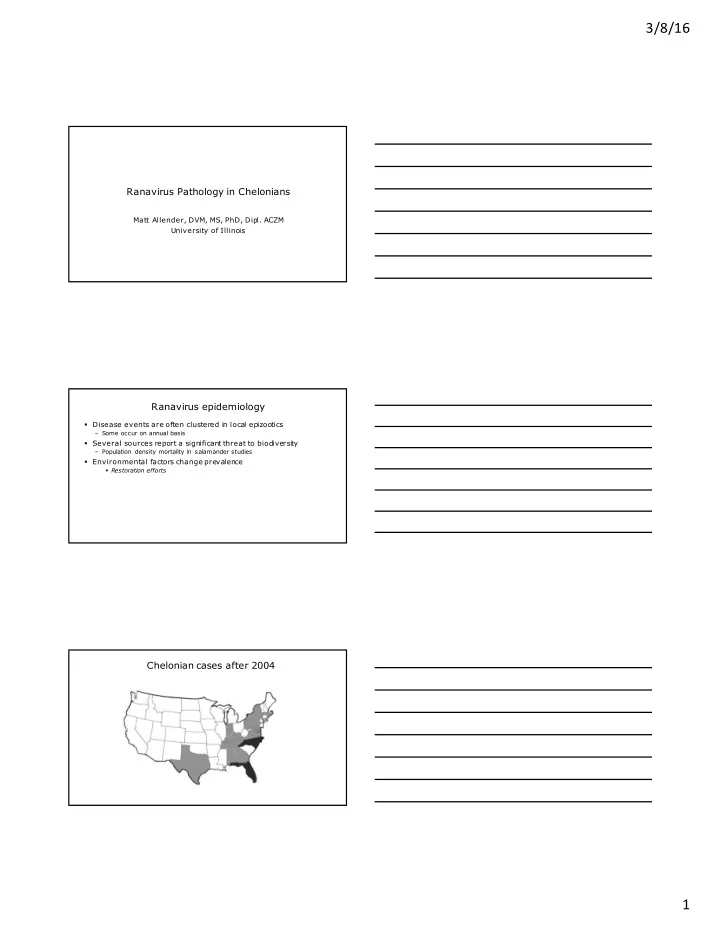
Chelonian cases after 2004

slide-2
SLIDE 2

3/8/16 2

Numerous cases

An Outbreak

Transmission

§ Role of temperature well-established in development of clinical signs from iridoviruses

– Epizootic Hematopioetic Necrosis virus in red perch § 11 day incubation at 19-21C § No disease below 12C – EHN in white sturgeon § Higher cumulative mortality and longer disease course at lower temperatures § Higher daily mortality and secondary infections at higher temperatures – Tiger salamanders with ATV § Survived infection at 26C § All or most died at 18C or 10C

slide-3
SLIDE 3

3/8/16 3

Results

§ Survival

– 22°C – all inoculated turtles were euthanized due to severity of signs – 28°C – only 2 turtles were euthanized due to clinical signs § One uninfected control died of sepsis

§ Median survival times

– 22°C = 24 days (14 -30) – 28°C = 30 days (17-30)

22C 28C

Results

§ *Significant increase over time (F=11.1, p=0.045)

– Significant difference between control and inoculated turtles (p=0.035)

§

#Significant increase over time (F=7.13, p=0.026)

Time 22°C Weight 28°C Weight

Pre-inoculation 1693.5625* 2063.1250# Initial post- inoculation 1692.50* 2082.50# Terminal 1802.50* 2159.50#

Results

Time Sample Viral copies 22°C Viral copies 28°C Pre- inoculation Whole Blood Oral swab Cloacal swab Initial post- inoculation Whole Blood Oral swab Cloacal swab Terminal Whole Blood 1.23 x 10 7 2.45 x 10 3 Oral swab 7.23 x 10 6 Cloacal swab 1.37 x 10 6 1.15 x 10 3
slide-4
SLIDE 4

3/8/16 4

Results

§ Lethargy and leg swelling

– Present in all 6 infected turtles at both temperatures

§ Nasal discharge, ocular discharge, and oral plaque

– Present in all 4 infected turtles at 22°C and none of the infected turtles at 28°C

§ Skin abscess

– Present in 3 of 4 positive turtles at 22°C and 1 of 2 positive turtles at 28°C

§ Uninfected controls

– Lethargy observed in one animal – Leg swelling observed in two animals

slide-5
SLIDE 5

3/8/16 5

Results

Tissue Parameter 22C Viral Copies 28C Viral Copies Tongue Mean/median* 1.25 x 109* 5.94 x 106* Skeletal Muscle Mean/median* 3.7 x 101 0* 3.64 x 108* Lung Mean/median* 6.29 x 109* 5.01 x 109* Heart# Mean/median* 2.92 x 101 0 1.27 x 10⁹* Liver^ Mean/median* 2.15 x 10⁹ 1.70 x 10⁷* Spleen Mean/median* 2.23 x 101 0* 5.44 x 107* Ovary Mean/median* 8.93 x 109* 9.06 x 106* Kidney Mean/median* 3.46 x 101 0* 2.54 x 108*

# Significant difference

between environmental temperatures, p=0.012 ^ Significant difference between environmental temperatures, p=0.011

slide-6
SLIDE 6

3/8/16 6

Results Results Results

Lung Liver

slide-7
SLIDE 7

3/8/16 7

Discussion

§ Mortality

– 22°C § Significant association between inoculation and disease (p=0.014) – 28°C § No significant association between inoculation and disease (p=0.214)

§ Non-significant mortality was seen at lower temperature (100%) than higher temperature (50%)

– Power = 0.34

§ Clinical signs

– Weight gain (p=0.045; p=0.026) – Nasal discharge (p=0.018) – Ocular discharge (p=0.018) – Lethargy (p=0.002) – Inoculation site swelling (p=0.007)

Animals

§ Four species – Red-eared slider – Mississippi map turtle – False map turtle – River Cooter § 24 individuals

  • f each species

– 12 housed at 22C, 12 housed at 27C § Inoculated and Control groups – 8 inoculated and 4 control for each temperature and species

Results - Juveniles

10 20 30 40 50 60 1 3 5 7 9 11 13 15 T u rtl e s S ti l l Li vi n g D a y s a fte r In n

  • cu

l a ti o n H ot R

  • om

C

  • l d R
  • om

§ 100% mortality in all inoculated individuals of all species at both temperatures § Survived 6 to 16 days § Only clinical sign was lethargy and was present for 12-48 hours prior to death/euthanasia § No control animal demonstrated clinical signs or tested positive for FV3

slide-8
SLIDE 8

3/8/16 8

Results

1000000 2000000 3000000 4000000 5000000 6000000 7000000 8000000 9000000 10000000 2 4 6 8 10 12 R ed-eared sl i der Fal se M ap M i ssi ssi ppi M ap R i ver C

  • oter

Me a n FV 3 vi ra l co p y n u mb e r Me d i a n S u rvi va l T i me (d )

Experimental Ranavirus Infection at 27C

M ean D aysToD eath

Results

2 4 6 8 10 12 14

Red-eared slider False M ap M ississippi M ap River Cooter

Median Survival Time (d) in Ranavirus Infected Turtles

H ot C

  • l d

Previously infected experimental infection

slide-9
SLIDE 9

3/8/16 9

Results

slide-10
SLIDE 10

3/8/16 10

Discussion

§ Hematology

– Transient elevation of WBC in FV3-infected red-eared sliders § Occurs earlier post-inoculation in 28C trial – Total solids decreased in terminal sample – Trend toward reduction in lymphocytes § Observed power = 0.05 through 0.448 – Inclusions not reliable method to diagnose ranavirus infection

Ranavirus outbreak

Number of infected turtles Mortality rate Total study population 22 50% RV negative 3 0% HV & Myco co-infected 2 0% RV positive (including all co-infections) 19 42% RV alone 4 50% RV & Myco 5 60% RV & HV 2 50% RV, HV & Myco 8 37%

aRV, Ranavirus; HV, herpesvirus; Myco., Mycoplasma sp.

Ranavirus outbreak

slide-11
SLIDE 11

3/8/16 11

Conclusions

§ Ranavirus causes high morbidity and mortality in affected species § Temperature plays a role in the pathogenesis and severity of clinical and histopathological signs § Chelonians surviving from ranavirus are to be considered lifelong carriers of the disease

Questions

§ Thank You!!