Radiation from accelerating charges 1 We now concentrate in - - PowerPoint PPT Presentation

radiation from accelerating charges 1
SMART_READER_LITE
LIVE PREVIEW

Radiation from accelerating charges 1 We now concentrate in - - PowerPoint PPT Presentation

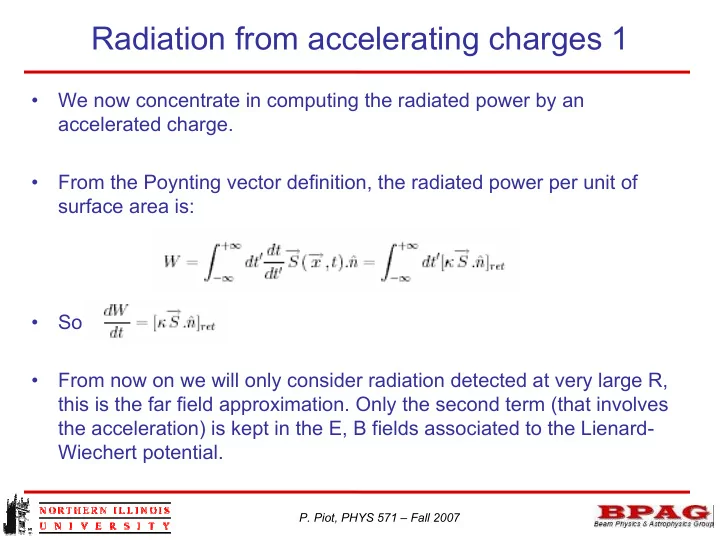
Radiation from accelerating charges 1 We now concentrate in computing the radiated power by an accelerated charge. From the Poynting vector definition, the radiated power per unit of surface area is: So From now on we will


slide-1
SLIDE 1
  • P. Piot, PHYS 571 – Fall 2007

Radiation from accelerating charges 1

  • We now concentrate in computing the radiated power by an

accelerated charge.

  • From the Poynting vector definition, the radiated power per unit of

surface area is:

  • So
  • From now on we will only consider radiation detected at very large R,

this is the far field approximation. Only the second term (that involves the acceleration) is kept in the E, B fields associated to the Lienard- Wiechert potential.

slide-2
SLIDE 2
  • P. Piot, PHYS 571 – Fall 2007

Radiation from accelerating charges 2

  • From

, the instantaneous power radiated at time t’ per unit solid angle dΩ is

  • In the far field approximation we have
  • Let consider n,E
slide-3
SLIDE 3
  • P. Piot, PHYS 571 – Fall 2007

Radiated power per unit of time

  • So finally
  • and
slide-4
SLIDE 4
  • P. Piot, PHYS 571 – Fall 2007

Radiated energy per unit of time

  • If we want to know dP(t)/dt, the power radiated per unit solid angle at

time t it arrived at the enveloping surface, then we must trace back to the proper retarded time

  • Note also that , so if a particle is suddenly accelerated

for a time ∆t’=τ, an observer will see a light pulse at time t=R/c with a duration

  • Energy is conserved: total energy radiated = total energy lost by the

particle.

  • The fact that implied that energy radiated per

unit of time is κret times the energy lost by the particle in the far field per unit of time.

slide-5
SLIDE 5
  • P. Piot, PHYS 571 – Fall 2007

Instantaneous rate of radiation 1

  • Hgf
  • Work out the integrant
  • From we get
slide-6
SLIDE 6
  • P. Piot, PHYS 571 – Fall 2007

Instantaneous rate of radiation 2

  • So
  • Recall and define the integrals
  • So the power is
slide-7
SLIDE 7
  • P. Piot, PHYS 571 – Fall 2007

Instantaneous rate of radiation 3

  • We finally have
  • The last line is the relativistic generalization of Larmor’s formula; to

recover the Larmor formula just take the limit β→0.

slide-8
SLIDE 8
  • P. Piot, PHYS 571 – Fall 2007

Power radiated in linear accelerators 1

  • In linear accelerators
  • We need to evaluate the acceleration. Start from the momentum
  • Thus the radiated power is

Lighter particles are subject to higher loss

slide-9
SLIDE 9
  • P. Piot, PHYS 571 – Fall 2007

Power radiated in linear accelerators 2

  • One important question is how does the emission of radiation

influence the charge particle dynamics.

  • The accelerator induce a momentum change of the form

(where we assumed the acceleration is along the z-axis)

  • Let be the power associated to the external force.

The particle dynamics is affected when Pext is comparable to the radiated power:

slide-10
SLIDE 10
  • P. Piot, PHYS 571 – Fall 2007

Power radiated in linear accelerators 3

  • Consider a relativistic electron then
  • …..
  • So the effect seems to be negligible.
  • This is actually part of the story some coherent effect can kick in an

induce some distortion when considering highly charged electron bunches for instance…

slide-11
SLIDE 11
  • P. Piot, PHYS 571 – Fall 2007

Power radiated in circular accelerators 1

  • Now and
  • The radiated power is

where E is the energy. Let’s introduce

  • So radiative energy loss per turn is
slide-12
SLIDE 12
  • P. Piot, PHYS 571 – Fall 2007

Power radiated in circular accelerators 2

  • That is
  • For an e- synchrotron this becomes
  • Take E=1 TeV, R=2 km we have
  • Conclusion bad idea to build circular accelerator for HEP but good as

copious radiation sources (e.g. APS in Argonne).