
SLIDE 1
How Charges Behave Bill Nye: Electricity Electrons carry a negative - - PowerPoint PPT Presentation
How Charges Behave Bill Nye: Electricity Electrons carry a negative charge, and protons carry a positive charge. Negative charges : The charges of electrons Surround the nucleus; can be rubbed off a material Positive charges : The
The charges of electrons Surround the nucleus; can be
The charges of protons Part of the nucleus of atoms
Charging by friction: Charging a material by rubbing
When electrons are rubbed off a material, it becomes positively
charged
Material gains electrons and becomes negatively charged
Electrically Neutral and Electrically Charged Materials
Uncharged Materials:
Before two materials are
rubbed together: they have equal numbers of positively charged protons and negatively charged electrons
Materials are electrically
neutral (equal numbers
charges cancel each
Electrically Neutral and Electrically Charged Materials (continued) Charged Materials:
If electrons rubbed off
stay behind and the material becomes electrically charged
The material that gains
the electrons also becomes electrically charged
Electrically charged
materials have an unequal number of positive and negative charges
Electrically Neutral and Electrically Charged Materials (continued)
Figure 3.10: Two materials before and after being rubbed together.
Positive and Negative charges
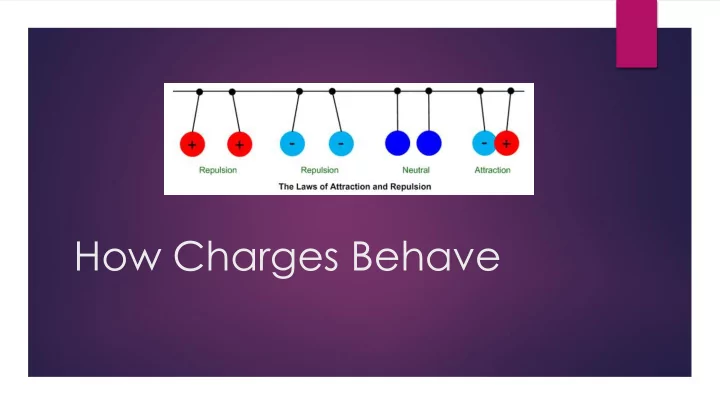
The Law of Electric Charge
Opposite charges attract each other Like charges repel each other
The law of electric charge applies to all individual charges
Every negative charge attracts every positive
charge
Every negative charge repels every other negative
charge
Every positive charge repels every other positive
charge
All neutral objects have
Figure 3.11: The comb is charged, and the water is neutral.
Why a charged balloon sticks to an electrically neutral wall:
When a charged object (balloon)
is brought near a neutral object (wall), the electrons in the neutral
Negative charges in the wall are
pushed away from the surface by the negative charges on the balloon
Positive ends of the molecules in
the wall are attracted to the negative charges on the balloon
This attraction is strong enough to
hold the balloon to the wall
120-125
Attracting Neutral Objects