HORACE NYE TASK FORCE TRADITIONS MANAGEMENT PRESENTATION August 30, - - PDF document

horace nye task force traditions management presentation
SMART_READER_LITE
LIVE PREVIEW

HORACE NYE TASK FORCE TRADITIONS MANAGEMENT PRESENTATION August 30, - - PDF document

HORACE NYE TASK FORCE TRADITIONS MANAGEMENT PRESENTATION August 30, 2010 Roby Politi, Chairman Noel Merrihew, Vice-Chairman Chairman Politi called this Horace Nye Task Force to order at 2:30 p.m. with the following supervisors in attendance:


slide-1
SLIDE 1

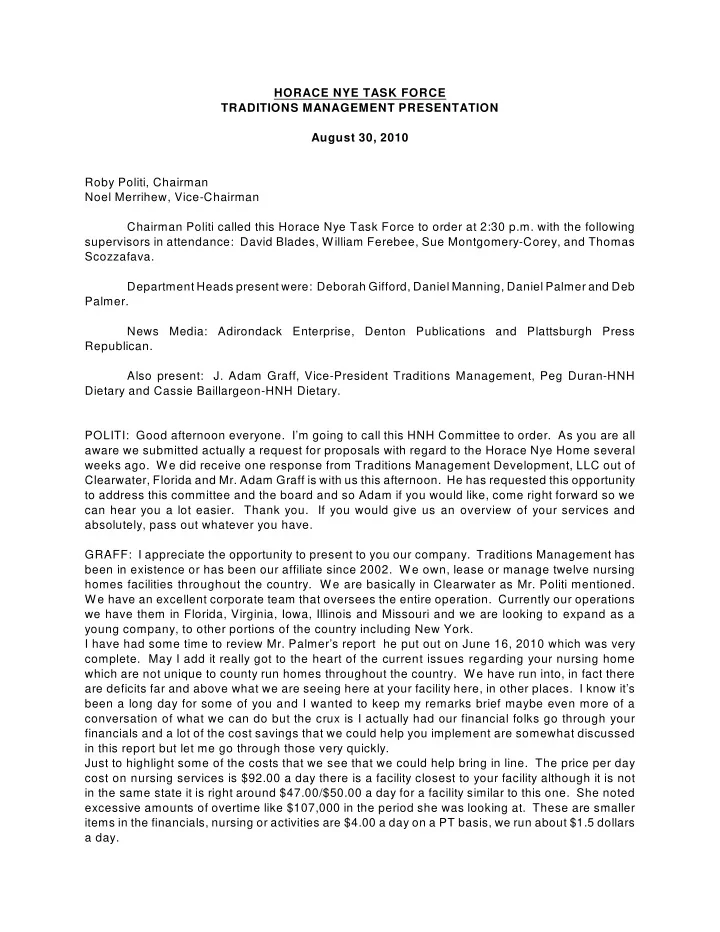
HORACE NYE TASK FORCE TRADITIONS MANAGEMENT PRESENTATION August 30, 2010 Roby Politi, Chairman Noel Merrihew, Vice-Chairman Chairman Politi called this Horace Nye Task Force to order at 2:30 p.m. with the following supervisors in attendance: David Blades, W illiam Ferebee, Sue Montgomery-Corey, and Thomas Scozzafava. Department Heads present were: Deborah Gifford, Daniel Manning, Daniel Palmer and Deb Palmer. News Media: Adirondack Enterprise, Denton Publications and Plattsburgh Press Republican. Also present: J. Adam Graff, Vice-President Traditions Management, Peg Duran-HNH Dietary and Cassie Baillargeon-HNH Dietary. POLITI: Good afternoon everyone. I’m going to call this HNH Committee to order. As you are all aware we submitted actually a request for proposals with regard to the Horace Nye Home several weeks ago. W e did receive one response from Traditions Management Development, LLC out of Clearwater, Florida and Mr. Adam Graff is with us this afternoon. He has requested this opportunity to address this committee and the board and so Adam if you would like, come right forward so we can hear you a lot easier. Thank you. If you would give us an overview of your services and absolutely, pass out whatever you have. GRAFF: I appreciate the opportunity to present to you our company. Traditions Management has been in existence or has been our affiliate since 2002. W e own, lease or manage twelve nursing homes facilities throughout the country. W e are basically in Clearwater as Mr. Politi mentioned. W e have an excellent corporate team that oversees the entire operation. Currently our operations we have them in Florida, Virginia, Iowa, Illinois and Missouri and we are looking to expand as a young company, to other portions of the country including New York. I have had some time to review Mr. Palmer’s report he put out on June 16, 2010 which was very

  • complete. May I add it really got to the heart of the current issues regarding your nursing home

which are not unique to county run homes throughout the country. We have run into, in fact there are deficits far and above what we are seeing here at your facility here, in other places. I know it’s been a long day for some of you and I wanted to keep my remarks brief maybe even more of a conversation of what we can do but the crux is I actually had our financial folks go through your financials and a lot of the cost savings that we could help you implement are somewhat discussed in this report but let me go through those very quickly. Just to highlight some of the costs that we see that we could help bring in line. The price per day cost on nursing services is $92.00 a day there is a facility closest to your facility although it is not in the same state it is right around $47.00/$50.00 a day for a facility similar to this one. She noted excessive amounts of overtime like $107,000 in the period she was looking at. These are smaller items in the financials, nursing or activities are $4.00 a day on a PT basis, we run about $1.5 dollars a day.

slide-2
SLIDE 2

Page 2 Horace Nye Task Force 8/30/2010 POLITI: When you say she, you are talking about? GRAFF: I’m sorry. I apologize. The person that went through these financials is a woman by the name of Linda Hevlin, she is our Vice-President of Finance and Accounting, but she is not in this

  • brochure. She handles all of our reimbursement and oversees all of the accounting of all of our

facilities. Dietary housekeeping, laundry – I was trying to get a specific number on how much we can save in each one of those areas on a pt basis but I would guess, not knowing exactly I’m still waiting on the numbers about 20%. Accounting fees there looks like there is $232,000 in the period we looked at, in one year spent on accounting fees. Our services, our management fee will include some accounting services typically all we would need in the facility is an office manager and potentially a collection, an accounts payable person but it may not even be necessary depending on the situation. W age cost for your plant operation is $120,000, typically we run about $40,000 and obviously last but not least the employee benefits are actually mentioned in this report which are extremely high when you project other facilities in the industry or industry standard and which again is not typical for a county run facility. Our proposal simply would be – with nursing homes there are so many facets and so many moving parts to how we can improve things and how to make them more efficient but at the same time make sure the quality of care remains high, the same or better. There is an adage in this facility and I think it personally, that sometimes when you add more staff especially to nursing homes it doesn’t necessarily guarantee quality care but efficiency and team work is much more critical then adding more people sometimes it makes it worse and there is less accountability. Our proposal would be to come in and implement, to use all of the collective resources that we have, the years

  • f experience of all the people that are outlined in this brochure. I could go through them one by
  • ne but needless to say it’s people that have been in this industry their whole lives and basically

have been through every experience. W hat we have proposed is to simply have a month to month contract where we would charge a 5% management fee on total revenue which aligns our interest to increase revenue as much as possible and we would give the county a right to out with a thirty day notice. It’s actually a contract with a thirty day notice so effectively; it is a month to month contract. Really and truly I think that is the only way. I could speak all day on what we have done in the past, we have done this before in St. Louis, Virginia and Florida, places all around the country facilities that were losing millions a year and have turned them around at least they break even or even make money and the proof would be allowing us to come in for at least a thirty to sixty day period to see what we can do and if you are not satisfied then you can cancel the contract. POLITI: New York State, have you looked at the procedural requirements in terms of management in nursing homes in NYS verses other facilities? GRAFF: Yes. Typically, Florida tends to lead the way when it comes to legislation and requirements, staffing requirements, minimum staffing and those sorts of things in the country. Our head nurse Debbie Afasano, she is listed as the last one in the brochure, is heading up the team with a Professor at the University of Colorado to develop QIS which is the new standard for surveys throughout the country and it is being rolled out in select states and Florida is one of those states. So you talk about the New York environment, we have people that have experience within the

  • State. Jorg Daco who is not in the brochure, he has had experience in the state and actually with
slide-3
SLIDE 3

Page 3 Horace Nye Task Force 8/30/2010 hospital systems, very similar to other states. Basically every state has some small differences but essentially they are all the same. POLITI: You don’t see New York State to be somewhat onerous? GRAFF: Oh yeah - on the survey side or the reimbursement side? POLITI: Either I would think. GRAFF: Every state has its challenges and its nuances but I think that having a vast experience in multiple states it actually gives us a fresh prospective. PALMER: How do you address the issue of the labor? Clearly our issue is labor and benefits. How does your management address that issue? GRAFF: The benefit issue has to be worked out in conjunction with the county obviously, ultimately that is the county’s decision how they handle benefits and if they want to them back to industry standards or not and what the ramifications would be for doing so. W hen it comes to labor and simply hours and what I mentioned before was efficiency’s, is actually I think in 2004 you pointed out that the PPD in this facility, I think on CNA’s you ran on 25 and on Nurses you were 10 and it may be a little higher than that but it has gone higher than that ever since. W e were in a similar situation the last building that we kind of turned around and that takes daily precise micro-managing effort from individuals who have been there before so when they hear excuses like we have to run this sort of a ratio, we can’t do this - we can say no, you can do it and this is why you can do it. So it takes daily micro-management of the staffing hours to bring those in line but eventually it comes. It is a process though to bring kind of a culture of a building, you have a Nurse who is use to having three other people helping her or a CNA, sometimes people leave unfortunately because they are use to not having to work as hard or whatever the case may be, but it does take daily effort. PALMER: Under your proposal, how many people do you actually put in the building? GRAFF: Typically and I am talking generalities in the facility, typically a nursing home has the amount of employees that it has beds. So there is usually 100 to 120 employees for a 100 bed nursing home and obviously they are working different times depending on PRN and part timers. The staffing in the building would be dependent on that day census. PALMER: I understand that part but what I am saying is how many do you have in the building? GRAFF: Oh, Traditions. W e would have the resources of, we have 25 people at our corporate

  • ffice that are doing all sorts of functions from accounting to assisting to operations. It includes

some of the people in this brochure and we would have our corporate structure - Mike Ward is our COO and he would oversee a person who would be a regional overseer of buildings and who we put in that role we don’t know yet but that individual would be in the building at least monthly, maybe for a couple of days. Then you would have a Nurse that would be assigned to go in and would be here more frequency to check in and then other individuals - our CEO or CFO or an HR

slide-4
SLIDE 4

Page 4 Horace Nye Task Force 8/30/2010 could be at the building at any time. POLITI: So I guess what I am hearing you are not there? GRAFF: W e wouldn’t employ a person full time at the building. The Administrator, under our proposal, the Administrator would be under the payroll of the county typically as it is now but we would not have a person on our payroll that would be full time at the building. We would supplement and help the Administrator. POLITI: As I understand your answer to the question that Dan has asked you about, what do you anticipate the number of employees being and you really can’t answer that? GRAFF: The number of employees for the building or the number from Traditions? POLITI: For the building. GRAFF: For the building, it is hard to say. The lay out of the building and acuity of the residents play a big part in that but we make a recommendation of the number of employees that would be most efficient and provide the highest and best care. POLITI: So you aren’t in a position at this stage to make a recommendation? GRAFF: Honestly you could have company’s like our spend time telling you what they are going to do but until they get their hands in the building and get around what they are doing, it is hard to do that. W e would, I am confident that once we are in the building for 30 days, we would more than save enough money to cover the fee that we are charging. SCOZZAFAVA: So it sounds like in a snap shot that you are going to increase revenues for the county by decreasing our expenses? GRAFF: That is correct. SCOZZAFAVA: Not by taking on any more residents and so on. How many public facilities do you manage? GRAFF: Zero. W e manage on behalf of a not-for-profit board and have in the past but that is as close to public as we have gotten. SCOZZAFAVA: The overtime, apparently you have looked at some of the numbers and the

  • vertime is a big number and I think partially some of that has to do with the fact that we changed
  • ur policy a while back where we required 40 hours before the overtime kicked in or before we

would pay them at the end of an eight hour day - I don’t know if you get into that or not? PALMER: It is 80 hours, Tom. SCOZZAFAVA: The price for a PPD for a resident, $92.00 per day for nursing?

slide-5
SLIDE 5

Page 5 Horace Nye Task Force 8/30/2010 GRAFF: That is what she calculated, yes. SCOZZAFAVA: That is like double what you are use to seeing? GRAFF: Yes, roughly. SCOZZAFAVA: I know there is a lot to look at here but generally what is the reason you see here? GRAFF: W ell I think it was pointed out in the report, the union issues. Typically with unions you have a higher than typical wage rate and then over-staffing. W ages that are out of the industry norm and over-staffing would be the only two reasons. SCOZZAFAVA: Thank you. PALMER: I think that goes a little beyond that - those staffing levels as well include how many days

  • f vacation, how many days of personal leave and when those people take that time you have to

get someone in to cover with a 24/7 staffing, so you bring people in to cover and that drives up your

  • verall labor costs.

SCOZZAFAVA: W hen you come in, if we decide to, you said there would be a 30 day escape clause? GRAFF: That is right. SCOZZAFAVA: I mean the nursing obviously is a big item because that is the business we are in, it is a nursing home. I would expect you to also look at administration, other costs that are not directly associated with the care of the residents? You look at that also I would assume? GRAFF: Yes. Dietary, housekeeping, laundry, accounting functions. SCOZZAFAVA: Thank you. FEREBEE: You as well would give a 30 day clause. If you come in and say this isn’t working for

  • ur company, you will give us a 30 day out?

GRAFF: Yes, we would want it both ways. We can get out of the contract and you can too with proper notice. FEREBEE: I know that you talked about staffing and number of staff and payroll, do you normally keep - you don’t bring in a whole new staff of your own to the hospital, you use theirs? That is one

  • f our biggest concerns. Of course we have the people on our payroll now employed and you have

ways of trimming the costs by using the same employees? GRAFF: Correct. MONTGOMERY-COREY: Let’s say that we vote today and decide that we are going to give you a contract to do this. Leaving this room, what is the road map?

slide-6
SLIDE 6

Page 6 Horace Nye Task Force 8/30/2010 GRAFF: I have a team of people on an airplane as soon as possible to come up here and meet with the staff, meet with the administrator and dig into the numbers, understand the care and we start

  • immediately. W e are a company that likes to move quickly and we could give you

recommendations within 7 days of being on the ground. PALMER: Do you take over billing functions in these buildings? GRAFF: Like I said before, we have - depending on what the office manager is capable of doing. W e typically have the office manager, who would be employed by you, and then there would be support in the corporate office. To be honest, I am not exactly sure how the accounting folks would handle that, exactly what they would need to support that but I would venture to guess that we wouldn’t have to add anything to the billing side and hopefully make things a little more efficient for you. PALMER: We have three individuals who are working in the finance department how who are looking at the early retirement incentive and we are considering going out for services outside for an outside contract for the billing services. So I guess my question is, if you came in would you be able to fill that roll? GRAFF: To answer that question fully I would have to make a phone call and just get my CFO to find out exactly what functions they are performing and I could tell you that it is very possible that

  • ur fee would cover those functions.

SCOZZAFAVA: The 12 nursing homes that you currently own or lease or manage, they are all private, correct? GRAFF: Private in what sense? SCOZZAFAVA: They are not public facilities. GRAFF: No. SCOZZAFAVA: How many of those 12 operate in the black? Operate without a deficit? GRAFF: As of today, everyone. SCOZZAFAVA: Everyone. I am presuming that the majority of them are private pay? GRAFF: No, we run typical to the industry and depending on the state upwards to 80% medicaid. SCOZZAFAVA: You do, that high? GRAFF: It depends. In the mid-west they shy away from public aid and there tends to be a lot more private pay in the mid-west. In Florida they have a high, typical medicaid percentage of 70% to 80% and Virginia is that way. MONTGOMERY-COREY: In the facilities that you operate, do you have the right to reject

slide-7
SLIDE 7

Page 7 Horace Nye Task Force 8/30/2010 someone if a person wants to enter the facility? GRAFF: That is illegal to discriminate. The only way that you can reject somebody is if you are not able to provide care. If that resident were a danger to the resident. If you can’t meet their needs. Endangering the resident is really the only reason or endangering the staff would be a big reason we would reject a resident. MANNING: W hen someone applies to become a resident at the nursing home you can reject them then, right? GRAFF: Only if we can’t meet their needs. If they have zero payer source, no medicaid or medicare or no way to pay, I am not clear what the law would be in the State of New York. PALMER: Ultimately that is our problem or part of our problem, I am not saying it is all of our problem, but upward to 95% or 97% are medicaid so that certainly limits our revenue and our reimbursement level. GRAFF: Your re-basing issue too, you mentioned that in your report. PALMER: The re-basing is not going to gain me a whole lot even if you built a new home, it isn’t going to raise that much. The other thing that I am concerned about is the regional pricing model that is proposed and I don’t know that it will necessarily go through but if it goes through it will hurt us even more. The State

  • f New York is looking at taking a regional price per day and finding the reimbursement.

GRAFF: Reimbursement in every state is challenging especially for medicaid. There is one other round, typically and it is not really a secret in the industry, but throughout the country states typically lose or underpay their medicaid residents by anywhere between $5.00 a day and $40.00 or $50.00 a day. The federal government knows that medicare actually pays and is profitable. W ith medicare it looks to your base rate for caring for residents and it is $170.00 a

  • day. If you add $30.00 for drugs or $200 and you add $80.00 for therapy, you are at $280.00 and

the average rate for a medicare resident in this area would be probably around $400.00 a day so with medicare you can make up a lot of the deficit. Medicare typically is short term stay. It is usually residents that can be as young as 55 and usually you have to have a flat screen television and a private room to attract them. There is a facility up in Plattsburgh that runs about 40 medicare residents and probably makes a serious amount of money. PALMER: Meadow Brook. GRAFF: One thing you could look into, I am sure there are probably residents, with the age of the facility, that when they rehabilitate from a knee or hip surgery or something else that it requires a community hospital stay and they have medicare days, you can provide a suite, maybe five rooms that are private - renovate to attract those rooms and those residents would go a long way in

  • ffsetting some of the other costs.

Throughout the country you can run anywhere between 10% and 15% of your residents can be medicare so in the surrounding area that I looked at that wasn’t quite that high, but potentially you could maybe get 10 to 12 medicare residents in that building with a minimal amount of renovation.

slide-8
SLIDE 8

Page 8 Horace Nye Task Force 8/30/2010 MANNING: W e have the hospital that takes care of that for us. GRAFF: You have swing beds in the hospital. PALMER: W hen they no longer have any medicare money they roll them down the hallway. That is the problem, in order to attract medicare patients you are going to have to have a different type

  • f facility.

One of the things that Dan Manning and I have talked about is downsizing the facility and maybe doing something with 20 of the units either for day care or something along those lines. There is some money out there throughout New York State for downsizing. New York State wants you to right-size they call it so there may be some money for doing that because clearly that is the key and if you are going to attract some of those either private pays or medicare pays you are going to have to have something that looks different than what our facility currently does, it has to look more like a home setting. POLITI: Did you anticipate operating the facility the way it is now or were you anticipating some modifications? GRAFF: Our plan would be to continue to operate the way it has been operating. The census has been strong. I think for the last five years you are always above 90 residents out of 100 and to 96

  • n average which means sometimes you are getting to that 100 level. The census is strong. Our

goal would just be to bring the census in with expenses. POLITI: I don’t know how you do that. PALMER: This is clearly not fair to the nursing home either. Clearly the union agreement should be a separate union agreement for the nursing home with a different scale and a different benefit

  • level. It is often difficult for the home to operate without losses with the current rate of pay that we

are doing. People get mad at me when I say that we are paying to high over there. Well we are paying too high for the industry standard. It doesn’t mean that I don’t think the individual doing the work is not necessarily worth the value that we are paying them but it is higher than it is anywhere else in the industry, so that is an issue. If we are going to remain in the business then the union should understand that we need a different bargaining unit. W hether it is a different agreement within our current bargaining agreement or whether it is a different bargaining unit, we do need that in order to survive. GRAFF: And we would be willing to help with that process, we have some experience in collectively working with the union. Ultimately with the losses and from the report that I read, ultimately something is going to have to happen. Residents will have to move out and close the facility unless the county wants to continue to subsidize the program that is already designed to be a break even through medicaid and medicare dollars. POLITI: With the cost of labor being an important role in this cost savings, when you viewed this documentation was it taken into consideration that there was a union contract in place and how are you going to save money with a union contract in place? GRAFF: I was at a disadvantage, I did not have a full union contract in front of me to understand

slide-9
SLIDE 9

Page 9 Horace Nye Task Force 8/30/2010 it completely but just from other expenses other than the nursing expense, I think if we kept the nursing expense the same and didn’t negotiate with the union at all and also, I don’t know if the union has stipulation on what the staffing ratio has to be. Do they have that in their contract? PALMER: No, we have the right to employ, it is the Dept. Of Health that determines the staff. GRAFF: Right. So I am positive that we could bring the cost of nursing in line through efficient

  • peration, reduction of over time and bring it in line with what the State of New York requires. On

top of that in other areas that don’t involve the union contract, we would make it a point to cover our fee. DOUGLAS: I am curious, you said that you operate or run or manage or lease how many facilities? GRAFF: Twelve. DOUGLAS: And you don’t own all of them, you don’t lease them all, some you just manage. I am curious for the RFP that we put out there, why you just came back with this one and put in a proposal just to manage? GRAFF: It is certainly a challenging building and I think that us wanting to own it in the future if you were willing to sell is a possibility. I think that with the extent of the losses that you are seeing now it would be difficult for anyone, including us, to take an ownership role, lease or purchase at this moment. Having said that we could approach this one of two ways. If the county was to do an RFP to lease

  • r sell the facility. Obviously one of the thoughts is to divest the assets. To avoid any conflict of

interest we could enter into this contract and say that us or any of our affiliates can not bid to own

  • r lease this building so you we know and you know that we are doing everything we can to make

this mission possible and to increase the value so you can divest it. Or, if you want to go the

  • pposite direction and give us an incentive to take you out, it can work that way too, that is up to

the board. To answer your question, I think the level of loss right now would make it difficult for us to jump in and try to make it work without actually being in the building. SCOZZAFAVA: For Dan, what is our average revenue? PALMER: You are looking at around $750,000 to $800,000. SCOZZAFAVA: Is that a month? PALMER: No, that is yearly. If in fact you hired them at 5% you are somewhere around $3300 a month probably. SCOZZAFAVA: $3300 revenue? PALMER: No, what is what the 5% would represent, $3300 a month.

slide-10
SLIDE 10

Page 10 Horace Nye Task Force 8/30/2010 SCOZZAFAVA: That is what I am trying to get clear. GRAFF: Don’t you have $6 million a year in revenue? SCOZZAFAVA: That is what I am looking at. I am coming up with $25,000 a month average. He is not up here for $3300. He didn’t fly in from Florida for $3300 a month, I can guarantee you that. GRAFF: And we would be willing to even negotiate that and maybe even do a flat rate. SCOZZAFAVA: So you are looking at our total yearly which is about $6.6 million and that comes

  • ut to about $25,000 a month.

So, I guess my question is, do you also - let’s say that the board decided that not necessarily come in and manage but do you come in and look at an operation and then make recommendations back to the board that these are changes that we feel you should make and so on? GRAFF: That is something we can do. I would recommend giving a little bit more authority and get us more involved so that we can really implement. I think even in this report, I think that four years ago you had a report done and there were some recommendations that were made. SCOZZAFAVA: The Rotenberg report. GRAFF: Then there were difficulties in implementing them so the price would be able the same for a one month management contract but we can certainly do that as well. POLITI: Are there any other questions gentlemen and ladies? SCOZZAFAVA: I guess at this point, I really haven’t seen what you propose but I certainly would be interested in some kind of a formal proposal. Some kind of formal proposal on both ends here, not only the management aspect but the - GRAFF: W ho do I give it to? SCOZZAFAVA: But to come in and to look at the operation also. POLITI: Do we have any other questions here? If not, I am going to ask Deborah if she has some questions? I am going to have a hard time hearing you so could you come to a mike please? GIFFORD: Many of my questions have already been answered. My questions have more to do with your experience with unions. POLITI: I am going to stop you right there. Deborah is the Administrator of the Horace Nye Home, just to clarify. GRAFF: Nice to meet you. GIFFORD: A question that I had, it has been touched on by several individuals here - it has to do with respecting and honoring the mission and the philosophy of the building and alteration of

slide-11
SLIDE 11

Page 11 Horace Nye Task Force 8/30/2010 admission practices because as Mr. Palmer has indicated, our census for medicaid is high. I think in part that is a reflection of our environment and the challenges that are posed to us by being next to a hospital that has swing beds. So your comment having to do with that I think answered that part. My question having to do with many of the facilities you are in, you indicated that they are for-profit. Do they have unions and what has been your experience dealing with the unions? GRAFF: W e have two facilities that have unions. The experience with the unions has been

  • positive. I am sure that the union contracts in facilities that we have been in are vastly different

from the one at this facility. Generally speaking, we can get along with the union and come to an agreement usually that is most beneficial for the residents. GIFFORD: Typically in the facilities that you are in, are the ancillary services such as dietary, housekeeping, laundry, fiscal - staff based or are they contract based? GRAFF: Combination and actually that is the same for therapy as well. We have some facility’s where we provide our own therapy, dietary, housekeeping, laundry. I think it is about half and half for all ancillary services. Depending on the situation, sometimes we use a company called HCSG, I think you have probably heard of them, health care services group. Depending on the region we may use them for some facilities and some we simply staff the facility with the facility’s staff. GIFFORD: W hen you are looking at staffing for nursing and you are looking at your resident mix, sometimes the case mix index is rather misleading, particularly for your lowest function physicals such as a Physical E. Does your individual who is working with administration in determining the best mix of licensed and unlicensed nursing staff recognize and work with the mix that is the reality

  • f the home?

GRAFF: Absolutely. I think that even Mr. Palmer’s report pointed out that Alzheimer’s sometimes is not captured correctly in the case mix and at times our facilities have been one on one care.

  • Absolutely. We are not a company that blanketly says this is what the PPD and ratio is going to

be, we look at every individual case and make sure that we are properly staffing. That is number

  • ne in our company is making sure the residents have the support that they need.

GIFFORD: Typically when you come in do you work with the administrative team that is there initially, daily and then look to being less and less in the picture as an active member? GRAFF: That depends on the situation. Sometimes there could be the initial survey of the building. A particular tag or site that we need to be involved with on a daily basis. It depends on the administrative team. Sometimes we are there all the time providing support and sometimes we realize that we have to let the facility be for a second, let it calm down or whatever the case may be and to let the Administrator have ownership of the building which is really what we see our job is to be the help center and to be the support center for you as the Administrator and then to the extent that we are not being helpful in our efforts, we are not going to add to your work, we are going to make life easier and bring in a world of knowledge that we have within the company. GIFFORD: You raised survey - typically in your facilities what has been your survey experience?

slide-12
SLIDE 12

Page 12 Horace Nye Task Force 8/30/2010 GRAFF: If you actually go to medicare.gov you can look at them. W e have noticed a pattern. W hen we take over a building it takes us 12 months. If the facility has had some survey issues it is usually 12 to 18 months before we really get our arms around those issues, it takes a long time to change a culture in a building. Specifically, if you called the surveyors in the State of Missouri to talk about us and what we have done in the facility in St. Louis, we have gone from a facility with the worse reputation and a survey of saying I do not want to go to that building because I know what kind of a building it is going to be to - we are helping to set the standard in that state and with Debbie Afasano, our Head Nurse, what she has done, she is absolutely phenomenal in putting programs in. W e have had issues but they are issues with facilities that we have just taken on. W e have been

  • successful. Every one of our buildings actually is in a very good position survey wise.

PALMER: Do you have comparative reports of where you have gone in and where they were and the case mix index of where they were on state revenues and where they were on financial compared to where they are now? GRAFF: The St. Louis one that I just mentioned is probably a great one to bring in, in fact that is a facility where we had certified med techs delivering medication which in that state was

  • unnecessary. W e brought those med techs back in which made the operation more efficient and

at the same time we were bringing in, it was a very, very large building, we were bringing in staffing ratios and improving the quality of care. GIFFORD: Do you routinely do satisfaction survey’s with residents and their families? GRAFF: Yes. W hen I as an owner go into a building, I don’t spend much time with the administration; I leave that to our support team. I go and talk with the families first off. One of the first things we did as our company grew was to hire a full time person to call every admit and every discharge or their responsible party and find out how the care was and make sure that we have an exchange immediately. W e have 800 numbers that people can call in if they have an issue. W e now use a service called My Interview. Yes, we do that. GIFFORD: My last comment, QIS is going to come to New York, we are rolling out. GRAFF: Yes, and in fact Debbie is, I can’t remember the name of the professor in Colorado but she is friends with him and very excited about QIS. We are actually ahead of the curve in Colorado, we are building with her and rolling out. It will drastically effect the way the survey’s are conformed. Have you heard of Advicus with Med Line? It has been a phenomenal product in really determining where to focus our attention to prepare for survey and we have had a tremendous amount of success in Florida and Iowa and Missouri. POLITI: Questions by any other board members? Anyone? Ladies? Is there anyone else that would like to address? Thank you very much. GRAFF: Thank you very much for your time. I look forward to the next step. Do we wait for the committee or the board to meet? Who makes the next decision? POLITI: The committee will meet again and go over the contract.

slide-13
SLIDE 13

Page 13 Horace Nye Task Force 8/30/2010 SCOZZAFAVA: So you don’t necessarily come in to do the management for the same 5%, you come in and do an overall assessment on the operation? GRAFF: It would be close to that number, I just have to go back to my operations team and find

  • ut what that cost would be. I would want to be more detailed.

SCOZZAFAVA: W hat do you think a time frame would be for something like that? GRAFF: Like I said, it would be close -I hate to give you a number and then be way off. SCOZZAFAVA: Within 60 days. GRAFF: Oh, how long it would take? SCOZZAFAVA: Yeah. GRAFF: Less than that, I think it would be a 30 day process. SCOZZAFAVA: Thank you. PALMER: You are saying having them just come in and do an assessment? SCOZZAFAVA: Yes. GRAFF: If you want to have that done let us know and we can get a proposal. PALMER: Okay. GRAFF: Thank you very much. POLITI: Thank you. If there is nothing else to come before this committee, we are adjourned. DOUGLAS: Thank you. AS THERE W AS NO FURTHER BUSINESS TO COME BEFORE THIS HORACE NYE TASK FORCE, W E ADJOURNED AT 3:18 P.M. Respectfully submitted, Deborah Palmer, Clerk Board of Supervisors

slide-14
SLIDE 14

Page 14 Horace Nye Task Force 8/30/2010