Radiation from accelerating charges We showed the Linard Wiechert - - PowerPoint PPT Presentation

radiation from accelerating charges
SMART_READER_LITE
LIVE PREVIEW

Radiation from accelerating charges We showed the Linard Wiechert - - PowerPoint PPT Presentation

Radiation from accelerating charges We showed the Linard Wiechert potential are P. Piot, PHYS 571 Fall 2007 Radiation from accelerating charges: application In principle the field are easily obtained from the potentials using


slide-1
SLIDE 1
  • P. Piot, PHYS 571 – Fall 2007

Radiation from accelerating charges

  • We showed the Liénard Wiechert potential are
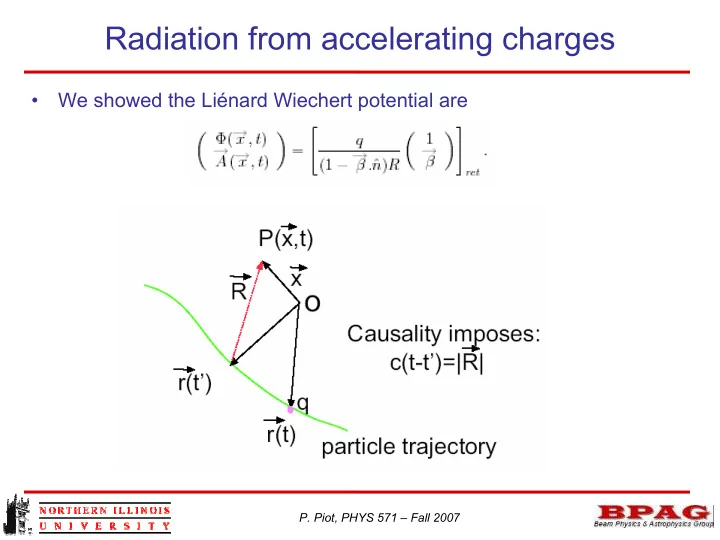
slide-2
SLIDE 2
  • P. Piot, PHYS 571 – Fall 2007
  • In principle the field are easily obtained from the potentials using
  • Problem: here all the quantities have to be evaluated at a retarded

time…

  • So we need to express in term of retarded quantities.

Radiation from accelerating charges: application

slide-3
SLIDE 3
  • P. Piot, PHYS 571 – Fall 2007

∂/∂t as function of retarded quantities

  • Consider
  • On another hand, the chain rule gives
  • Which can be expressed from
  • So
  • The two highlighted

equation result in

slide-4
SLIDE 4
  • P. Piot, PHYS 571 – Fall 2007

∇ as function of retarded quantities

  • Consider
  • Let be the gradient evaluated at t’. Then (chains rule)
  • The two previous equations result in
  • That is
slide-5
SLIDE 5
  • P. Piot, PHYS 571 – Fall 2007

Electric field I

  • In term of retarded quantities the E-field is
  • with
  • We have
  • So finally

)R

slide-6
SLIDE 6
  • P. Piot, PHYS 571 – Fall 2007

Electric field II

  • And finally
  • Now let’s consider
  • This gives
  • With
  • and
slide-7
SLIDE 7
  • P. Piot, PHYS 571 – Fall 2007

Electric field III

  • Thus
  • From the two latest highlighted equation we get
  • Now we consider
  • The t-derivative of A is :
slide-8
SLIDE 8
  • P. Piot, PHYS 571 – Fall 2007

Electric field IV

  • So the E- field is finally given by
  • Which simplifies to
slide-9
SLIDE 9
  • P. Piot, PHYS 571 – Fall 2007

Electric field V

  • /………..

Near field Velocity fields Far field Radiation fields

slide-10
SLIDE 10
  • P. Piot, PHYS 571 – Fall 2007

Electric field of a uniformly moving charge I

  • dβ/dt =0 so
  • Does this agree with what we learnt?
  • Yes! Consider the drawing:
slide-11
SLIDE 11
  • P. Piot, PHYS 571 – Fall 2007

Electric field of a uniformly moving charge II

  • Geometric considerations give