Radiation Belt Storm Probes Ion Composition Experiment (RBSPICE) - - PowerPoint PPT Presentation

radiation belt storm probes ion composition
SMART_READER_LITE
LIVE PREVIEW

Radiation Belt Storm Probes Ion Composition Experiment (RBSPICE) - - PowerPoint PPT Presentation

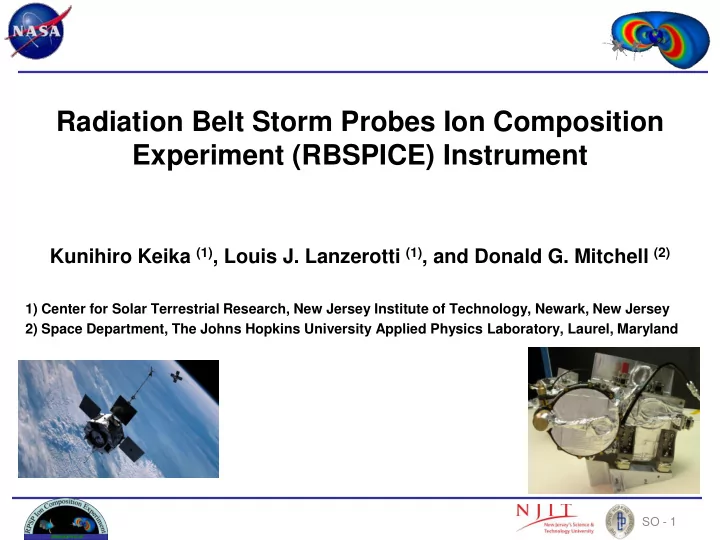
Radiation Belt Storm Probes Ion Composition Experiment (RBSPICE) Instrument Kunihiro Keika (1) , Louis J. Lanzerotti (1) , and Donald G. Mitchell (2) 1) Center for Solar Terrestrial Research, New Jersey Institute of Technology, Newark, New Jersey


slide-1
SLIDE 1

Radiation Belt Storm Probes Ion Composition Experiment (RBSPICE) Instrument

Kunihiro Keika (1), Louis J. Lanzerotti (1), and Donald G. Mitchell (2)

1) Center for Solar Terrestrial Research, New Jersey Institute of Technology, Newark, New Jersey 2) Space Department, The Johns Hopkins University Applied Physics Laboratory, Laurel, Maryland

SO - 1

slide-2
SLIDE 2

RBS RBSPIC PICE E Org Organ aniz izat ation ion

Louis Lanzerotti Principal Investigator Donald Mitchell Instrument Scientist Marian Titerence Instrument Lead Engineer Scott Cooper Instrument Lead Engineer Cindy Kim Instrument Program Manager Felicia Margolies NJIT Program Manager

  • T. Armstrong

Fundamental Technologies

  • J. Manweiler

Fundamental Technologies

  • A. Ukhorskiy

JHUAPL

  • A. T. Lui

JHUAPL

  • P. Brandt

JHUAPL

  • M. Sitnov

JHUAPL

  • G. Ganguli

Naval Research Laboratory

  • D. Summers

University of Newfoundland

  • Y. Miyoshi

Nagoya University

  • N. Tsyganenko
  • St. Petersburg University

Co-Investigators

SO - 2

slide-3
SLIDE 3

Scienc Science Ove e Overview rview

SO - 3

RBSP Mission Overarching Science Questions

  • Which physical processes produce radiation belt enhancement

events?

  • What are the dominant mechanisms for relativistic electron loss?
  • How do ring current and other geomagnetic processes affect

radiation belt behavior? RBSPICE makes critical contributions, by determining:

  • How does space weather create the storm-time ring current

around Earth?

  • How does the ring current supply and support the creation of

the radiation belt populations?

  • How can the ring current also quickly reduce radiation belt

particle intensities?

slide-4
SLIDE 4

Trapp Trapped ed Radiation Radiation: Early : Early Rese Resear arch ch Mot

  • tivation

ivation

Sir Arthur Clark

  • Dr. John

Pierce

ATS1 GEO Electrons Drift Mirror Instability Explorer 26 Ring Current Protons

Pioneers of satellite communications Early views of deleterious trapped radiation

Energetic electron acceleration Radiation affects design and ops

4

slide-5
SLIDE 5

How How do does es spa space ce weat weathe her r cr crea eate te th the e ring ring cu curre rrent nt ar arou

  • und

nd Earth Earth?

  • Ring current intensity, composition, morphology can change

dramatically within a few hours in geomagnetic storms.

SO - 5

  • These changes can produce profound effects on

radiation belt electrons via local and global mechanisms.

slide-6
SLIDE 6

SO - 6

slide-7
SLIDE 7

Pc5 ULF waves

Mitchell et al., Space Sci. Rev., 2003.

Hydrogen and oxygen can have significantly different time & energy dependencies in their contribution to ring current dynamics.

Dr Drama amatic tic cha hang nge e in in th the ring e ring cu curren ent: t: Dif Differ eren ence ces s be betw twee een n H+ H+ an and d O+ O+

SO - 7

Keika et al., J. Geophys. Res., 2010.

slide-8
SLIDE 8

How How do does es th the ring e ring cur curre rent nt affec affect the t the dyna dynamics mics

  • f
  • f ra

radiat diation be ion belt p lt pop

  • pulat

ulations? ions?

Storm-time ring current produces significant distortion of the magnetic field, affecting electron drift paths and in turn transport and loss

Global Effects

SO - 8

Waves producing particle transport and loss during electron azimuthal drift orbit

Local Effects

slide-9
SLIDE 9

RBS RBSPIC PICE E : : Key Key Instru Instrumen ment t Measu Measure remen ments/ ts/Perfor Performan mance ce

SO - 9

  • Measurement quality independent of the angle

between the B- Field and the spin axis ( α)

  • Ion composition energy range low enough to

determine complete Ring Current energy density

  • High angle and energy resolution provide detailed

energy spectra and pitch angle.

Parameter Goal (Capability) Electron Energies 25 - 1000 keV (NOT REQUIRED) Ion Energies H: 10 - 10000 keV He: 25 -10000 keV O: 40 - 10000 keV Energy Resolution 20% for required energy range. 50% above and below required energy Time sampling 0.33 sec (1/36 spin) Angle resolution 15 ° x 12 ° Pitch Angle (PA) Coverage 0°-90° or 90°-180° Time for Full PA 1 spin Ion Composition H above 10 keV He above 50 keV O above 45 keV Electron Sensitivity: I=Intensity (1/cm2.sr) Sensor-G:0.0036-0.00018 (cm2.sr) Pixel-G: 0.0007-0.000035 (cm2.sr) Up to 6E5 1/s counting Ion Sensitivity Sensor-G:0.0036-0.00018 (cm2.s.sr) Pixel-G: 0.0007-0.000035 (cm2.s.sr) Up to 3.5E5 1/s counting (TOF)

slide-10
SLIDE 10

RBS RBSPIC PICE: E: A A Ti Time me-of

  • f-Flight

Flight (TOF) (TOF) ver versus sus Energ Energy y (E) mea (E) measur sureme ement nt syste system

  • Total particle energy measured with solid state

detectors (SSDs).

  • Ion velocity determined by measuring particle

flight time through the sensor: its “time-of- flight” (TOF)

  • A microchannel plate (MCP) records a

particle’s passage as it knocks secondary electrons off very thin foils at the sensor entrance and exit (Start Foil and Stop Foil).

Incident particle

Time-of-Flight

SO - 10

160.0º 16.9º

To Sun

slide-11
SLIDE 11

Design Design Drivers Drivers an and d App Appro roac ache hes

11

Design Drivers and Approaches

High radiation - Electronics

  • High Z housing reduces environment to ~25 krad
  • Significant parts testing program

Intense natural particle Environment

  • Dynamic range of foreground rates (fast timing

circuitry, two ranges of SSD)

  • High electron rates (same above + particle

trajectory modeling with GEANT4, extra 4.5 gr/cm2 shielding, “witness” SSD)

High temporal and angular resolution

  • Fast binning
  • Multiple view sectors
  • Sufficient telemetry allocation

High energy resolution

  • Low detector noise
  • High TOF resolution
  • Sufficient telemetry allocation
slide-12
SLIDE 12

RBS RBSPIC PICE E use uses a small s a small elec electro tron pixe n pixel a l as s “wi witn tness ess” de dete tect ctor

  • r to mea

to measur sure e pe pene netra trating ting ba back ckgr grou

  • und

nds s

Aft Deck 16.9°, Deck- Sensor angle

12° Collimator blockage for additional sun avoidance, centered on end electron detector, which is used as witness detector

SO - 12 Electron measurements are not required by science, but necessary for measuring

  • background. (up to 500 keV)

RBSPICE Mass 6.6 kg Telemetry 5.4 kbps Power 2.0 W

slide-13
SLIDE 13

Telemetr Telemetry y Produ Product cts

SO - 13

[#E bins, #polar, #azimuthal, time resolution]

  • Ion energy spectra: SSD only, No composition

– 64 Ebins, 6 polar, 4 azimuth, 2 min – 14 Ebins, 6 polar, 18 azimuth, 2 min

  • Low proton energy: TOF vs. MCP pulse height

– 10 Ebins, 6 polar, 18 azimuth, 12 sec – 18 Ebins, 6 polar, 4 azimuth, 2 min

  • Ion energy with composition

– 14 Ebins, 6 polar, 18 azimuth, 12 sec for H – 10 Ebins, 6 polar, 12 azimuth, 12 sec for He – 6 Ebins, 6 polar, 12 azimuth, 12 sec for O

  • Real-time Space Weather Data

– 50 – 300 keV (proton): 4 Ebins, 1 polar, 18 azimuth, 12 sec – 1 – 10 MeV (ions): 2 Ebins, 1 polar, 4 azimuth, 2 min

slide-14
SLIDE 14

Summ Summary: ry: The The RBSP RBSPICE ICE inst instru rume ment

  • RBSPICE’s statement of task is to investigate the ring current ion

plasma pressure and pitch angle distributions which change dramatically during geomagnetic storms.

  • RBSPICE is a TOF x Energy particle detector with substantial

heritage with previous flight instruments such as Galileo EPD and New Horizons PEPSSI.

  • RBSPICE is designed to make clean measurements in a harsh

radiation environment that includes Earth’s ring current.

SO - 14

slide-15
SLIDE 15

SO - 15

Topic/Objective Conditions

Structure of the pressure-driven ring current SYMH < -100 nT Structure and dynamics of the storm-time ring current ion distribution SYMH < -100 nT A dawn-side source of energetic O+ ions on low L-shells SYMH < -100 nT with injections Role of injections and pressure enhancements in the inner magnetosphere SYMH < -100 nT with injections Spectral dynamics of ring current ions and implications for global E-field variability SYMH < -50 nT with variable IMF Spatial and temporal scales of ion temperature anisotropies and EMIC wave coherence scales Storm/injections in post-midnight sector Relation between pressure and field inflation and stretching SYMH < -50 nT

Summ Summary: y: RBSPICE RBSPICE sc scien ience

slide-16
SLIDE 16

SO - 16

Thank you!!

slide-17
SLIDE 17

SO - 17

Extra Slides

slide-18
SLIDE 18

SO - 18

slide-19
SLIDE 19

RBSPICE Mass, Telemetry, Power 2W for instrument

SO - 19

Mass6.6kg Telemetry 5.4 Power 2.0W

slide-20
SLIDE 20

RBSPICE : Key Instrument Measurements/Performance

Parameter Required Goal (Capability) Comment/Heritage Electron Energies

  • N/A-

25 - 1000 keV (NOT REQUIRED) Electron capability from JEDI, helps with calibration as well Ion Energies H: 20 - 1000 keV He: 30 - 1000 keV O: 50 - 1000 keV H: 10 - 10000 keV He: 25 -10000 keV O: 40 - 10000 keV Capability partially based on JEDI goals; requirements meet MRD requirements Energy Resolution 25% for required energy range 20% for required energy range. 50% above and below required energy 20 % resolution met by deconvolution for protons 30 to 70 keV Time sampling 0.33 sec (1/36 spin) 0.33 sec (1/36 spin) Can accommodate 4-6 rpm spin Angle resolution 15 ° x 12 ° 15 ° x 12 ° By deconvolution Pitch Angle (PA) Coverage 0°-90° or 90°- 180° 0°-90° or 90°-180° 148° FOV swept through spin Time for Full PA 1 spin 1 spin Subset of products for LBR Ion Composition H above 20 keV He above 70 keV O above 50 keV H above 10 keV He above 50 keV O above 45 keV He composition above 70 keV Electron Sensitivity: I=Intensity (1/cm2.sr) No Requirement Sensor-G:0.0036-0.00018 (cm2.sr) Pixel-G: 0.0007-0.000035 (cm2.sr) Up to 6E5 1/s counting I=Intensity (1/cm2.sr) G=geom. factor x eff. (cm2.sr) Variable G; 6 pixels/sensor Ion Sensitivity I = 1E4-1E8/cm2.s.sr Sensor-G:0.0036-0.00018 (cm2.s.sr) Pixel-G: 0.0007-0.000035 (cm2.s.sr) Up to 3.5E5 1/s counting (TOF) Variable Geometric Factor (*20) SO - 20

slide-21
SLIDE 21

Telem Telemetry try Prod Products ts [Reso [Resolution lutions] s] & [Bullets & [Bullets on

  • nly]

ly]

SO - 21

slide-22
SLIDE 22

Space Weather Data

Particle Count Rates

Proton energy *(all ions at 1 and 10 MeV) # particle species (Protons) per # spins #polar (spin plane) angles #az angles #values / spin #bits/ value Data Product Report Rate (bps): 50 keV 1 1 1 36 36 10 30 100 keV 1 1 1 36 36 10 30 150 keV 1 1 1 36 36 10 30 300 keV 1 1 1 36 36 10 30 1 MeV* 1 10 1 4 0.4 10 .33 10 MeV* 1 10 1 4 0.4 10 .33

Notes: #polar corresponds to “look direction”, #az corresponds to “spin sector”. Data will be log compressed. All values reported once per (~12 second) spin, except 1 & 10 MeV ions (2 minute resolution) Total bit rate: 120.67 bps.

  • RBSPICE will broadcast data in real-time as part of the RBSP mission

support of space weather modeling, forecast and prediction efforts

  • (#Energy bins, #polar angles, #azimuthal angles) = (6, 1, 4-36)
  • All protons, per 1 – 10 spins, with 30 bps.

SO - 22

slide-23
SLIDE 23

RBSPICE mounting

  • The RBSPICE sensor mounted

at a 16.9° angle, such that its 160° FOV covers from beyond the anti-sunward spin axis to 16.9° off the sunward pointing spin axis. The sun moves back and forth, at times as much as 27° off the spin axis, so the RBSPICE FOV is blocked for an additional 12°. The (electron) detector behind this look direction becomes the “Witness” detector.

160.0º 16.9º

To Sun

SO - 23

slide-24
SLIDE 24

Collimator-mounted front foil protects Start Foil from

  • verwhelming low energy electrons / ions

Multi-hole collimator Start foil Stop foil New “Front” Background foil Low energy particles scatter out of transmission trajectories in the Front Foil

SO - 24

slide-25
SLIDE 25

Collimator-mounted front foil protects Start Foil from

  • verwhelming low energy electrons / ions
  • However, high energy electrons,

and ions are transmitted at 100% efficiency: Therefore collimator transparency must be adjusted such that the total number of electrons and/or ions entering the sensor is not so high as to drive the electronics into saturation.

  • To that end, an analysis was done
  • f the sensor response to very high

intensities, consistent with the most extreme electron and ion events thought to have at least a modest probability of occurring during the RBSP mission.

SO - 25

slide-26
SLIDE 26

Angular response of RBSPICE collimator performs well with energetic electron beam test

RBSPICE Collimator

Counts/s Counts/s

SO - 26

slide-27
SLIDE 27

RBSPICE Counting Rates

5.7.3.1 RBSPICE will be able to handle a total electron count rate across all six detectors of ≥ 5E5 electrons per second, with a goal of ≥ 6E5 electrons per second (note: rates above 2.5E5 may require time-multiplexing the electron channels) 5.7.3.2 RBSPICE will be able to handle electron count rates in any given detectors of ≥ 1E5 electrons per second, with a goal of ≥ 2E5 electrons per second. 5.7.3.3 RBSPICE will be able to handle a total ion count rate across all six detectors of ≥ 2E4 ions per second, with a goal of ≥ 6E5 ions per second. 5.7.3.4 RBSPICE will be able to handle ion count rates in any given detectors of ≥ 2E4 ions per second, with a goal of ≥ 2E5 ions per second. 5.7.3.5 RBSPICE will be able to handle a total MCP start count rate of 1E6 counts per second, with a goal of 1.5E6 counts per second. 5.7.3.6 RBSPICE will be able to handle a total MCP stop count rate of 5E5 counts per second, with a goal of 7.5E5 counts per second. 5.7.3.7 RBSPICE will be able to handle a total MCP Valid (start+stop) count rate of 3.5E5 counts per second, with a goal of 7.5E5 counts per second.

SO - 27

slide-28
SLIDE 28

ΔE/E = 0.2; Δθ = 22.5

  • Measurement quality independent of the angle

between the B- Field and the spin axis ( α)

  • Ion composition energy range low enough to

determine complete Ring Current energy density

  • High angle and energy resolution provide detailed

energy spectra and pitch angle.

RBSPICE: Sensor Overview

SO - 28

slide-29
SLIDE 29

Green identifies Level-1 Requirements specific to RBSPICE

4.1.2 Baseline Science Measurement Requirements (from Level – 1) The mission shall acquire concurrently from both platforms, the particle measurements defined in Table 4.1. In Table 4.1, a distribution is with respect to energy, pitch angle, and where appropriate, ion elemental composition (H, He, O). Table 4.1. Particle Measurements REQ# Measurement Cadence Energy Range Angular Res. Energy Res. 4.1.2.1 High energy electrons 1 distribution per minute 1 – 10 MeV 30° 30% at 3 MeV 4.1.2.2 Medium energy electrons 1 distribution per minute 0.05 – 1 MeV 20° 30% at 0.3 MeV 4.1.2.3 High energy protons 1 distribution per minute 20 – 75 MeV 30° 40% at 30 MeV 4.1.2.4 Medium energy protons 1 distribution per minute 0.1 – 1 MeV 20° 40% at 0.3 MeV 4.1.2.5 Medium energy ion composition 1 distribution per minute 0.02 – 0.3 MeV 30° 40% at 0.05 MeV

SO - 29

slide-30
SLIDE 30

How How do does es th the ring e ring cur curre rent nt affec affect the t the dyna dynamics mics

  • f
  • f ra

radiat diation be ion belt p lt pop

  • pulat

ulations? ions?

Pc5 ULF waves

Storm-time ring current produces significant structural changes in electron drift paths, affecting particle transport and loss

Global Effects

  • f ring current

Electron drift orbits can be distorted and disrupted by ring current effects

SO - 30

slide-31
SLIDE 31

Importance of Storm-Time Ring Current for Radiation Belt Dynamics

Pc5 ULF waves

SO - 31

Pc5 ULF waves

Waves producing particle transport and loss during electron azimuthal drift orbit

Local Effects produced by plasmasphere and ring current on azmuthally-drifting electrons

ULF waves

Energetic electron injection and azimuthal drift: Higher energies drift faster around Earth

slide-32
SLIDE 32

Science Overview

 RBSP Mission Science Objectives

Provide understanding, ideally to the point of predictability, of how populations of relativistic electrons and penetrating ions in space form or change in response to variable inputs of energy from the Sun

SO - 32

slide-33
SLIDE 33

Design Design Drivers Drivers an and d App Appro roac ache hes [TA [TABLE] BLE]

  • High radiation - Electronics

– High Z housing reduces environment to ~25 krad – Significant parts testing program

  • Intense Natural Particle Environment

– Dynamic range of foreground rates

  • Very fast timing circuitry, two ranges of solid state detector (SSD) pixel size

– High Electron Rates

  • Very fast timing circuitry, two ranges of SSD pixel size
  • Background counts in both SSDs and MCPs
  • Modeling of particle trajectory and stopping using GEANT4 code
  • Extra 4.5 gr/cm2 shielding around SSDs
  • “Witness” SSD created by shielding a small pixel SSD
  • High Temporal and Angular Resolution Required

– Fast binning, multiple view sectors , sufficient telemetry allocation

  • High Energy Resolution Required

– Low detector noise, high TOF resolution, sufficient telemetry allocation

33