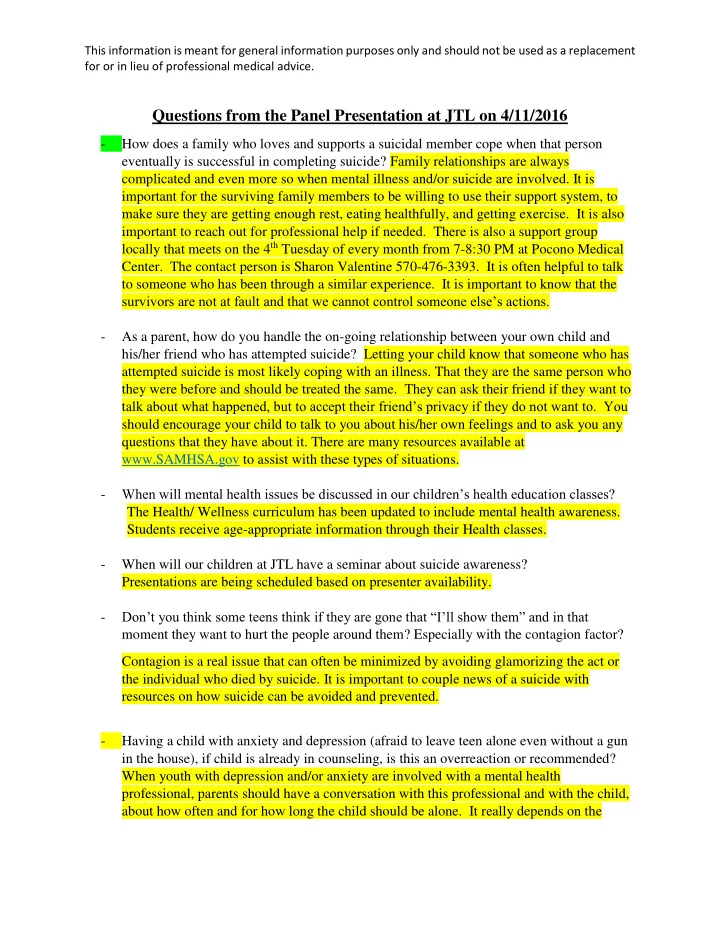
Questions from the Panel Presentation at JTL on 4/11/2016 - How does - - PDF document

questions from the panel presentation at jtl on 4 11 2016
SMART_READER_LITE
LIVE PREVIEW

Questions from the Panel Presentation at JTL on 4/11/2016 - How does - - PDF document

This information is meant for general information purposes only and should not be used as a replacement for or in lieu of professional medical advice. Questions from the Panel Presentation at JTL on 4/11/2016 - How does a family who loves and


slide-1
SLIDE 1

This information is meant for general information purposes only and should not be used as a replacement for or in lieu of professional medical advice.

Questions from the Panel Presentation at JTL on 4/11/2016

  • How does a family who loves and supports a suicidal member cope when that person

eventually is successful in completing suicide? Family relationships are always complicated and even more so when mental illness and/or suicide are involved. It is important for the surviving family members to be willing to use their support system, to make sure they are getting enough rest, eating healthfully, and getting exercise. It is also important to reach out for professional help if needed. There is also a support group locally that meets on the 4th Tuesday of every month from 7-8:30 PM at Pocono Medical

  • Center. The contact person is Sharon Valentine 570-476-3393. It is often helpful to talk

to someone who has been through a similar experience. It is important to know that the survivors are not at fault and that we cannot control someone else’s actions.

  • As a parent, how do you handle the on-going relationship between your own child and

his/her friend who has attempted suicide? Letting your child know that someone who has attempted suicide is most likely coping with an illness. That they are the same person who they were before and should be treated the same. They can ask their friend if they want to talk about what happened, but to accept their friend’s privacy if they do not want to. You should encourage your child to talk to you about his/her own feelings and to ask you any questions that they have about it. There are many resources available at www.SAMHSA.gov to assist with these types of situations.

  • When will mental health issues be discussed in our children’s health education classes?

The Health/ Wellness curriculum has been updated to include mental health awareness. Students receive age-appropriate information through their Health classes.

  • When will our children at JTL have a seminar about suicide awareness?

Presentations are being scheduled based on presenter availability.

  • Don’t you think some teens think if they are gone that “I’ll show them” and in that

moment they want to hurt the people around them? Especially with the contagion factor? Contagion is a real issue that can often be minimized by avoiding glamorizing the act or the individual who died by suicide. It is important to couple news of a suicide with resources on how suicide can be avoided and prevented.

  • Having a child with anxiety and depression (afraid to leave teen alone even without a gun

in the house), if child is already in counseling, is this an overreaction or recommended? When youth with depression and/or anxiety are involved with a mental health professional, parents should have a conversation with this professional and with the child, about how often and for how long the child should be alone. It really depends on the

slide-2
SLIDE 2

This information is meant for general information purposes only and should not be used as a replacement for or in lieu of professional medical advice.

  • individual. However, if the youth is actively suicidal or expressing suicidal ideation, they

should not be left alone, regardless of the presence of guns in the home. It is important to know that if a member of the family is suffering with severe depression,

  • r if they have suicidal ideation or actions, any type of weapon in the home increases

their risk.

  • What do you do when your child doesn’t want to talk to anyone and refuses to take

medication? In these instances, it is important to continue to let the child know that you care and want to help. It is also suggested that you contact and follow up with your child’s medical provider.

  • At what age should a parent talk to a child about suicide? Is there any early intervention

for children of elementary age? The most important thing is to talk to your child about being

able to share their thoughts and feelings with a trusted adult, teaching him/her coping skills, and helping them understand that when they experience something sad or difficult, there is always hope that things can and will get better. Very young children are concrete in their thinking and don’t often understand the concept of suicide. But it is important to be open and honest with them but using terms that are appropriate to their developmental stage. Here are a few resources that you could use: http://www.supportaftersuicide.org.au/what-to-do/communicating-with-children

http://theconnectprogram.org/sites/default/files/site- content/docs/talkingtochildrenaboutsuicide.pdf

  • Is there anything in the curriculum, in 1st or 2nd grade or up?

Students at the elementary level receive age-appropriate information through their Health classes as well as through Guidance lessons.

  • Are school staff prepared to know the signs? Kids feel they are “telling on” their friends.

School staff have received training on suicide prevention. The district is required to provide 4 hours of training every 5 years.

  • Are there Spanish resources/ materials?

www.SAMHSA.gov has a number of Spanish materials available. The American Foundation for Suicide Prevention (AFSP) also has Spanish materials.

  • Why wasn’t something done to stop bullying? Why did the bullying posters go up after

(the first student) passed?

slide-3
SLIDE 3

This information is meant for general information purposes only and should not be used as a replacement for or in lieu of professional medical advice.

School counselors conduct lessons on bullying. School police conduct lessons on

  • cyberbullying. Bullying posters went up during the observance of Unity Day, which is in

October. For more information on Unity Day: http://www.pacer.org/bullying/nbpm/unity-day.asp

  • Why weren’t Crisis Teams in school to talk to the students after the first incident? Maybe,

if they had, a 6th grader wouldn’t have committed suicide. The district collaborates with the Colonial Intermediate Unit 20 in crisis situations. Once a call to the IU is made by the district, the “Flight Team”, which consists of school psychologists, counselors, and other mental health providers through the IU20/Resolve program, is activated. These professionals go to the site to provide grief support for the school staff and students. The district also has school counselors that will go to assist at another district building to provide support. The Flight Team will assist with the immediate response. The district and building staff, such as the school psychologists, counselors, and other mental health providers provide continuing support to those students and staff who require more than triage support at the onset of the crisis. Grief support groups were run throughout the school year.

  • What prevention measures are being taken to protect the children in school?

 School staff have received training on suicide prevention. The district is required to provide 4 hours of training every 5 years.  School counselors conduct guidance lessons on various topics, including bullying.  School police conduct lessons on cyberbullying.  Students receive age-appropriate information through their Health classes.

  • Why aren’t there prevention specialists coming in to talk to the kids?

School psychologists, school counselors, and licensed clinicians who are based at the school building meet with students both in groups and individually. These staff also run various groups throughout the year.

  • What is the district protocol when something like this happens?

The district collaborates with the Colonial Intermediate Unit 20 in crisis situations. Once a call to the IU is made by the district, the “Flight Team”, which consists of school psychologists, counselors, and other mental health providers through the IU20/Resolve program, is activated. These professionals go to the site to provide grief support for the school staff and students. The district also has school counselors that will go to assist at another district building to provide support. The Flight Team will assist with the immediate response. The district and building staff, such as the school psychologists, counselors, and other mental health providers provide continuing support to those students and staff who require more than triage support at the onset of the crisis.

  • How come no one talks about bullying being a cause of suicide?
slide-4
SLIDE 4

This information is meant for general information purposes only and should not be used as a replacement for or in lieu of professional medical advice.

Bullying can certainly be a contributing factor in suicide, as it may induce emotional pain, depression, and anxiety. . In today’s world of social media, it is next to impossible for people to escape bullying and bullying must be addressed. It is important to teach young people coping skills to help deal with their reactions to being treated badly.

  • How come no one talked about kids (younger than 16 years of age) committing suicide

and how to talk to them? The panel presenters discussed situations as they related to them personally and professionally.

  • What about those youth that are bullied? What can we do to help those that are too afraid

because in the past 4 years there have been 10 youth deaths from the ages of 12-15 years

  • ld? It is important to help young people develop coping skills and protective factors to

assist them in dealing with situations, like bullying. It is also important to help youth get involved with positive activities such as sports, clubs, and activities like Aevidum (www.aevidum.com ).

  • How would you counsel a youth who is experiencing suicidal thoughts but does not have

parental support to talk? A youth who is experiencing suicidal thoughts should be taken to the emergency room (ER) and evaluated by a physician.

  • A youth experiences and shares suicidal thoughts, then what? Are the parents called? The

police? (What are the proper next steps?) The school district follows district policy #819 in regard to dealing with a youth who shares suicidal thoughts. Staff members make an immediate call/referral to the school counselor when a student shares suicidal thoughts or informs them of a concern for another student. The school counselor makes arrangements to see the student immediately. During the course of the counselor’s meeting with the student, he/she will ask the student questions as well as observe the student’s behavior. The counselor’s recommendation may consist of one or more of the following:

  • a. Involuntary mental health assessment @ emergency room of local
  • hospital. Student will be taken by either school security, state/regional

police, or ambulance to the local hospital.

  • b. Voluntary mental health assessment @ local hospital. Student will be

picked-up at the school by parent/guardian and directly taken to the local hospital.

slide-5
SLIDE 5

This information is meant for general information purposes only and should not be used as a replacement for or in lieu of professional medical advice.

  • c. Parent closely monitors student in the home & parent contacts a

community mental health agency and/or private therapist for follow-up treatment. Parents are contacted and given resources when a child has expressed suicidal thoughts. To learn more about how to handle a person in crisis, you could seek out a Youth Mental Health First Aid Course (570-421-2901 or mhfatraining@cmpmhds.org) If you do not feel you are able to deal with the situation, you can call the local crisis intervention line at 570-992-0879 or 911. If the student is an ESASD resident, the district tip line on the district website or a phone call to the school district police at 570-424-7833 can be utilized to report concerns for a student who may be in immediate crisis when no known means of communication to the home is known (ex- social media)

  • What are some examples of good coping skills that we can encourage in our kids?

Some positive coping skills include exercise, deep breathing, listening to music, taking a shower, going for a walk, talking to a friend, writing your feelings down, painting, coloring, drawing (even if you are not good at it) using worry stones, play with a pet, punching a punching bag or pillow, cleaning, read a book, cooking. Coping skills are endless, it depends on the person.

  • How do you handle a child who won’t open up? What do you do if you know your child

feels, but s/he says s/he doesn’t feel? What do you do when your child won’t talk to you? Continuing to offer your love and support is essential. It is helpful to have information on hand in a convenient place (Maybe on the refrigerator) so that if and when the person decides they do want help, they can easily access the info. You may be have a conversation with the person, stating that you hear what they are saying, and that if they do ever feel like they need help, they can rely on you to assist them. Let them know that you don’t want to nag them, but you care about them, so you hope they understand that you will regularly be encouraging them to talk about their feelings and to seek assistance.

  • How can we reach these kids that are under 15? What programs are being implemented?

When? Each school has a Student Assistance Program (SAP) team. Any person can make a referral to this team, including but not limited to school staff, teachers, parents, community members, students, and self-referrals. Contact your child’s building administrator or school counselor for more information or to make a referral.

  • How can parents and the district work together? The district can’t wait until next year to

start a program. We have kids threatening or attempting, almost usually here!

slide-6
SLIDE 6

This information is meant for general information purposes only and should not be used as a replacement for or in lieu of professional medical advice.

The school district staff and parents need to work together to support our children. Parents and school staff can assist our students by being aware of what is going on in student lives, recognizing and monitoring changes in mood, friends, work completion, grades, etc. When concerns arise, a sharing of information is of utmost importance. Additionally, if concerns persist or worsen, a referral to additional support, whether school-based or community-based, may be necessary. Student Assistance Program (SAP) teams are also available in every school, and can provide information on school-based as well as community-based services.

  • Why were kids turned away from the counselors after the recent suicides? (They were told

to return to class?) The Flight Team staff as well as school counselors and school psychologists met with multiple groups of students for several days after each crisis situation. Additional grief support groups were arranged and held throughout the year.

  • How do we get teachers to see children’s behavior (positive/ negative) acting out, anger,

hyper, loss of focus, or shut down, quiet) as a possible mental health issue and not a child being a “behavior problem”? Teachers are getting more training in mental health issues. There have been recent mandates for schools to have suicide prevention training. Many schools are partnering with mental health agencies to receive Mental Health First Aid Training and/or QPR Suicide Prevention Training (Question-Persuade-Refer). The East Stroudsburg District has sponsored both of these trainings within the past year.

  • Schools are not aware of children’s background and what they are experiencing or have
  • experienced. How do we help teachers see this and understand why kids act the way they

do? School staff is getting more training in mental health issues. There have been recent mandates for schools to have suicide prevention training. Many schools are partnering with mental health agencies to receive Mental Health First Aid Training and/or QPR Suicide Prevention Training (Question-Persuade-Refer). The East Stroudsburg District has sponsored both of these trainings within the past year.

  • What can be done to assist children in learning how to communicate with peers? They

don’t know what to do when peers are sad or how to act. Children learn their social skills from the adults around them. The best thing to do is to model compassionate behaviors for your children and other children who are around you. Also, sharing with youth about times when you helped a friend who was having a hard time or when someone helped you is a good way of teaching them how to respond appropriately. It is important for kids to know that it is good to reach out to help others; they can in no way control the actions of

  • thers. Their responsibility is to be kind, to offer assistance when they feel capable, and to

tell an adult. Some quick and easy things to help them along is to teach them to tell the

  • ther person that they are sorry they are sad and that they care about them. To have them
slide-7
SLIDE 7

This information is meant for general information purposes only and should not be used as a replacement for or in lieu of professional medical advice.

ask their friend if there is anything they can do to help. They should also tell their friend that there are adults they can trust and can talk to.

  • How do we empower kids to tell someone if they know, hear a friend, say they want to

hurt themselves? Young people need to know that they are not expected to handle everything on their own, even if they think they would be betraying the trust of someone

  • else. They need to know that it is more important for their friends to be safe and alive

thank to avoid a friend being mad at them. You can share that in the long run, the friend will know that they told an adult because they care. This is a difficult thing, especially for adolescents, but we as adults have to earn their trust so that they will confide in us. One of the best ways to do this is to be open and honest with them. If we are going to need to tell someone else what they told us, we need to let them know this and why.

  • Mental health in this community- we are lacking doctors to address this. There are also

major insurance issues- they say there are too many providers so they don’t allow more into their network, but really there aren’t enough. What can be done? There is a shortage

  • f psychiatrists across the country. A very small percentage of medical school graduates

choose to specialize in psychiatry, for many reasons. There are multiple activities going

  • n through the local and state mental health organizations to attempt to increase the

number of doctors who consider psychiatry and to draw current psychiatrist to more rural areas such as ours. However, there are a large number of psychologists and therapists in

  • ur area who can assist youth who are experiencing depression, anxiety, or many other

mental health issues. There are also crisis services available 24/7 through local agencies and national hotlines. New Perspectives Crisis Intervention- 570-992-0879 National Suicide Prevention Lifeline – 1800-273-8255

  • What are alternatives in our county, due to the psychiatric shortage?
  • There is a shortage of psychiatrists across the country. A very small percentage of

medical school graduates choose to specialize in psychiatry, for many reasons. There are multiple activities going on through the local and state mental health organizations to attempt to increase the number of doctors who consider psychiatry and to draw current psychiatrist to more rural areas such as ours. For instance, Tele-Psychiatry has been implemented in many of the Out Patient Clinics. Physician extenders are also being utilized whenever possible (Nurse Practitioners and Physician Assistants). It is important to know that there are a large number of psychologists and therapists in our area who can assist youth who are experiencing depression, anxiety, or many other mental health issues.

slide-8
SLIDE 8

This information is meant for general information purposes only and should not be used as a replacement for or in lieu of professional medical advice.

It does not always need to be a doctor. There are also crisis services available 24/7 through local agencies and national hotlines. New Perspectives Crisis Intervention- 570-992-0879 National Suicide Prevention Lifeline – 1800-273-8255

  • Is it possible that I can receive the PowerPoint Presentation? Please see attached.