Question What is the pH of a liter of water to which you add 1 mL of - - PDF document

question
SMART_READER_LITE
LIVE PREVIEW

Question What is the pH of a liter of water to which you add 1 mL of - - PDF document

CEE 680 Lecture #8 1/31/2020 Print version Updated: 31 January 2020 Lecture #7 Acids & Bases: Analytical Solutions with simplifying assumptions I (Stumm & Morgan, Chapt.3 ) (Benjamin, Chapt. 3) David Reckhow CEE 680 #7 1 Question


slide-1
SLIDE 1

CEE 680 Lecture #8 1/31/2020 1

Lecture #7 Acids & Bases: Analytical Solutions with simplifying assumptions I

(Stumm & Morgan, Chapt.3 )

David Reckhow CEE 680 #7 1

(Benjamin, Chapt. 3)

Updated: 31 January 2020

Print version

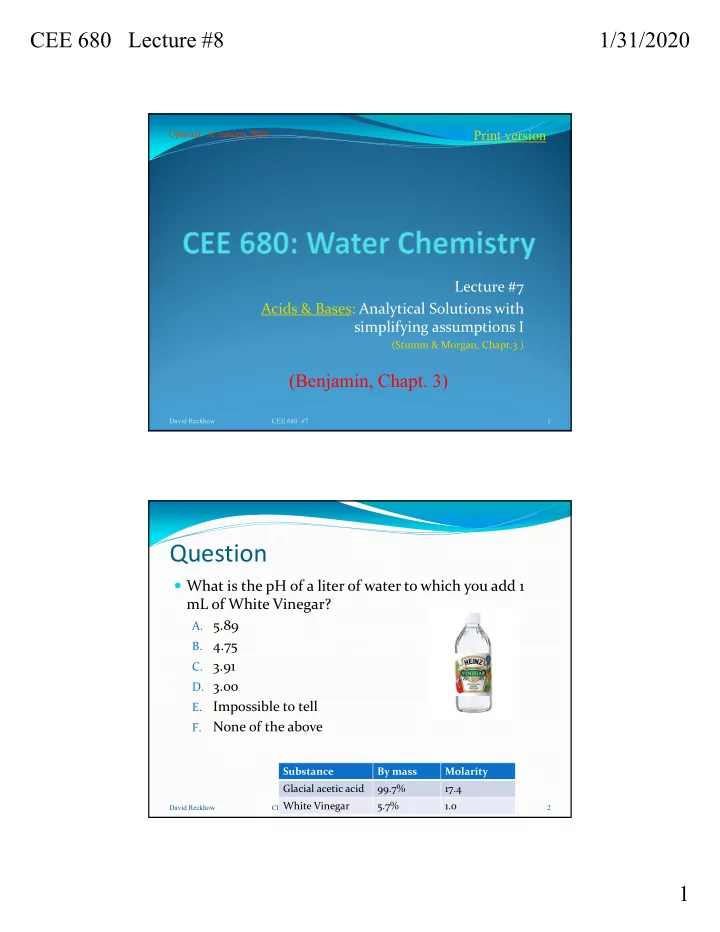
Question

 What is the pH of a liter of water to which you add 1

mL of White Vinegar?

  • A. 5.89
  • B. 4.75
  • C. 3.91
  • D. 3.00
  • E. Impossible to tell

F.

None of the above

David Reckhow CEE 680 #7 2

Substance By mass Molarity Glacial acetic acid 99.7% 17.4 White Vinegar 5.7% 1.0

slide-2
SLIDE 2

CEE 680 Lecture #8 1/31/2020 2

David Reckhow CEE 680 #7 3

NAME EQUILIBRIA pKa

Perchloric acid HClO4 = H+ + ClO4-

  • 7 STRONG

Hydrochloric acid HCl = H+ + Cl-

  • 3

Sulfuric acid H2SO4= H+ + HSO4-

  • 3 (&2) ACIDS

Nitric acid HNO3 = H+ + NO3-

Hydronium ion H3O+ = H+ + H2O Trichloroacetic acid CCl3COOH = H+ + CCl3COO- 0.70 Iodic acid HIO3 = H+ + IO3- 0.8 Dichloroacetic acid CHCl2COOH = H+ + CHCl2COO- 1.48 Bisulfate ion HSO4- = H+ + SO4-2 2 Phosphoric acid H3PO4 = H+ + H2PO4- 2.15 (&7.2,12.3) Ferric ion Fe(H2O)6+ 3 = H+ + Fe(OH)(H2O)5+ 2 2.2 (&4.6) Chloroacetic acid CH2ClCOOH = H+ + CH2ClCOO- 2.85

  • -Phthalic acid

C6H4(COOH)2 = H+ + C6H4(COOH)COO- 2.89 (&5.51) Citric acid C3H5O(COOH)3= H+ + C3H5O(COOH)2COO- 3.14 (&4.77,6.4) Hydrofluoric acid HF = H+ + F- 3.2 Formic Acid HCOOH = H+ + HCOO- 3.75 Aspartic acid C2H6N(COOH)2= H+ + C2H6N(COOH)COO- 3.86 (&9.82) m-Hydroxybenzoic acid C6H4(OH)COOH = H+ + C6H4(OH)COO- 4.06 (&9.92) Succinic acid C2H4(COOH)2 = H+ + C2H4(COOH)COO- 4.16 (&5.61) p-Hydroxybenzoic acid C6H4(OH)COOH = H+ + C6H4(OH)COO- 4.48 (&9.32) Nitrous acid HNO2 = H+ + NO2- 4.5 Ferric Monohydroxide FeOH(H2O)5+ 2 + H+ + Fe(OH)2(H2O)4+ 4.6 Acetic acid CH3COOH = H+ + CH3COO- 4.75 Aluminum ion Al(H2O)6+ 3 = H+ + Al(OH)(H2O)5+ 2 4.8

David Reckhow CEE 680 #7 4

NAME FORMULA pKa

Propionic acid C2H5COOH = H+ + C2H5COO- 4.87 Carbonic acid H2CO3 = H+ + HCO3- 6.35 (&10.33) Hydrogen sulfide H2S = H+ + HS- 7.02 (&13.9) Dihydrogen phosphate H2PO4- = H+ + HPO4-2 7.2 Hypochlorous acid HOCl = H+ + OCl- 7.5 Copper ion Cu(H2O)6+ 2 = H+ + CuOH(H2O)5+ 8.0 Zinc ion Zn(H2O)6+ 2 = H+ + ZnOH(H2O)5+ 8.96 Boric acid B(OH)3 + H2O = H+ + B(OH)4- 9.2 (&12.7,13.8) Ammonium ion NH4+ = H+ + NH3 9.24 Hydrocyanic acid HCN = H+ + CN- 9.3 p-Hydroxybenzoic acid C6H4(OH)COO- = H+ + C6H4(O)COO-2 9.32 Orthosilicic acid H4SiO4 = H+ + H3SiO4- 9.86 (&13.1) Phenol C6H5OH = H+ + C6H5O- 9.9 m-Hydroxybenzoic acid C6H4(OH)COO- = H+ + C6H4(O)COO-2 9.92 Cadmium ion Cd(H2O)6+ 2 = H+ + CdOH(H2O)5+ 10.2 Bicarbonate ion HCO3- = H+ + CO3-2 10.33 Magnesium ion Mg(H2O)6+ 2 = H+ + MgOH(H2O)5+ 11.4 Monohydrogen phosphate HPO4-2 = H+ + PO4-3 12.3 Calcium ion Ca(H2O)6+ 2 = H+ + CaOH(H2O)5+ 12.5 Trihydrogen silicate H3SiO4- = H+ + H2SiO4-2 12.6 Bisulfide ion HS- = H+ + S-2 13.9 Water H2O = H+ + OH- 14.00 Ammonia NH3 = H+ + NH2- 23 Hydroxide OH- = H+ + O-2 24 Methane CH4 = H+ + CH3- 34
slide-3
SLIDE 3

CEE 680 Lecture #8 1/31/2020 3

Analytical Solutions

 Basic Approach

 combine mass balances with thermodynamic equilibria  consider exact solutions, as well as approximations  similar approaches used for other topics in CEE 680

 Four principal steps

 1. List all species present  2. List all independent equations

 equilibria, mass balances, proton balance (or electroneutrality

equation)  3. Combine equations and solve for proton  4. Solve for other species

David Reckhow CEE 680 #7 5

General Example

 1. List all species present

 H+, OH‐, HA, A‐

 2. List all independent equations

 equilibria

 Ka = [H+][A‐]/[HA]  Kw = [H+][OH‐]

 mass balances

 [HA]+[A‐] = C (formal or “analytical” concentration)

 proton balance (or electroneutrality equation)

 PBE: (proton rich species) = (proton poor species)  ENE: (cationic species) = (anionic species)

 [H+]=[OH‐]+[A‐]

David Reckhow CEE 680 #7 6

1 2 3 4 Four total

slide-4
SLIDE 4

CEE 680 Lecture #8 1/31/2020 4

General Example (cont.)

 3. Combine equations and solve for proton

 use PBE or ENE and eliminate non‐H+ species by

substituting in the other equations

 4. Solve for other species

David Reckhow CEE 680 #7 7

Acetic Acid Example

 What is the pH and solution composition when

you add 1 mM acetic acid to 1 liter of water

 The Reaction:  The overall Gibbs Free Energy:  Recall:  at 25oC:  so for this problem:

David Reckhow CEE 680 #7 8

K RT K RT Go log 303 . 2 ln    

R=1.987 x10⁻³ kcal/mole oK

Kcal G G G G G

  • HAc

f

  • H

f

  • Ac

f

  • f

i

  • 51

. 6 ) 8 . 94 ( 29 . 88           

       

 



  

K K Go log 364 . 1 log 13 . 298 001987 . 303 . 2    

  

 Ac H HAc

77 . 4 364 . 1 51 . 6 364 . 1 log      

  • G

K

We will explain this further in Lecture #11

slide-5
SLIDE 5

CEE 680 Lecture #8 1/31/2020 5

Acetic Acid Example (cont.)

 1. List all species present

 H+, OH‐, HAc, Ac‐

 2. List all independent equations

 equilibria

 Ka = [H+][Ac‐]/[HAc] = 10‐4.77  Kw = [H+][OH‐] = 10‐14

 mass balances

 C = [HAc]+[Ac‐] = 10‐3

 proton balance: (proton rich species) = (proton poor species)

 [H+] = [OH‐] + [Ac‐]

David Reckhow CEE 680 #7 9

1 2 3 4 Four total

H2O HAc

HAc Example (cont.)

 3. Combine equations and solve for H+

 [H+] = [OH‐] + [Ac‐]

 [H+] = KW/ [H+] + [Ac‐]  [H+] = KW/ [H+] + KaC/{Ka+[H+]}

 [H+]2 = KW + KaC[H+]/{Ka+[H+]}  Ka[H+]2 + [H+]3 = KWKa + Kw[H+] + KaC[H+]

 [H+]3 + Ka[H+]2 ‐ {Kw + KaC}[H+] ‐ KWKa = 0

 4. Solve for other species

David Reckhow CEE 680 #7 10

4 2+4

Kw = [H+][OH-] [OH-] = Kw/[H+]

2

C = [HAc]+[Ac-] [HAc] = C-[Ac-]

3 1 Ka = [H+][Ac-]/[HAc]

Ka = [H+][Ac-]/ {C-[Ac-]} KaC-Ka[Ac-]= [H+][Ac-] KaC=[Ac-]{Ka+[H+]} [Ac-]=KaC/{Ka+[H+]}

1+3 1+2+3+4

slide-6
SLIDE 6

CEE 680 Lecture #8 1/31/2020 6

Exact Solution

Exact solution: pH = 3.913

 [H+] = 1.22 x 10‐4  [OH‐] = 8.19 x 10‐11  [Ac‐] = 1.22 x 10‐4  [HAc] = 8.78 x 10‐4

David Reckhow CEE 680 #7 11

[OH-] = Kw/[H+] [HAc] = C-[Ac-] [Ac-]=KaC/{Ka+[H+]}

Exact Solution: Is it really necessary?

Can we simplify?

 What about the PBE?

 [H+] = [OH‐] + [Ac‐]

David Reckhow CEE 680 #7 12

[ [H H+

+]

]3

3

+ + K Ka

a[

[H H+

+]

]2

2 -

  • K

Kw

w[

[H H+

+]

] -

  • K

Ka

aC

C[ [H H+

+]

] -

  • K

KW

WK

Ka

a

= =

1.82E-12 2.53E-13 1.22E-18 2.07E-12 1.70E-19

~0

slide-7
SLIDE 7

CEE 680 Lecture #8 1/31/2020 7

Simplified HAc Example

 3. Use simplified PBE & solve for H+

 [H+] = [OH‐] + [Ac‐]  [H+]  [Ac‐]

 [H+]  KaC/{Ka+[H+]}

 [H+]2  KaC[H+]/{Ka+[H+]}  Ka[H+]2 + [H+]3  KaC[H+]

 [H+]2 + Ka[H+] ‐ KaC  0

 4. Solve for other species

David Reckhow CEE 680 #7 13

4

Kw = [H+][OH-] [OH-] = Kw/[H+]

2

C = [HAc]+[Ac-] [HAc] = C-[Ac-]

3 1 Ka = [H+][Ac-]/[HAc]

Ka = [H+][Ac-]/ {C-[Ac-]} KaC-Ka[Ac-]= [H+][Ac-] KaC=[Ac-]{Ka+[H+]} [Ac-]=KaC/{Ka+[H+]}

1+3 1+3+4

Assumes [H+]>>[OH-]

Simplified solution #1

Exact solution: pH = 3.9132779

 [H+] = 1.22 x 10‐4  [OH‐] = 8.19 x 10‐11  [Ac‐] = 1.22 x 10‐4  [HAc] = 8.78 x 10‐4

David Reckhow CEE 680 #7 14

[OH-] = Kw/[H+] [HAc] = C-[Ac-] [Ac-]=KaC/{Ka+[H+]}

Same as exact to at least 3 significant figures!

slide-8
SLIDE 8

CEE 680 Lecture #8 1/31/2020 8

So how do we know when to use a simplified method?

 Use both & Compare answers

 Exact:

pH = 3.9132777

 Simplified: pH = 3.9132779

 Use simplified equation, and check assumptions!

 [OH‐] << [H+]  8.19 x 10‐11 << 1.22 x 10‐4

 yes!

David Reckhow CEE 680 #7 15

Types of Simplifying Assumptions for Acids

 Basis: one additive term is negligible

 MBE: C = [HA] + [A]  PBE: [H+] = [A] + [OH]

 Combinations

 Acidic Solution: [OH‐] << [H+]  Weak Acid: [HA] >> [A]  Strong Acid: [A] >> [HA]  Weak Acid & Acidic Solution  Strong Acid & Acidic Solution

David Reckhow CEE 680 #7 16

0 (acidic solution) 0 (weak acid) 0 (strong acid)

slide-9
SLIDE 9

CEE 680 Lecture #8 1/31/2020 9

Simplified HAc Example #2

 3. Use simplified PBE & MBE

 [H+] = [OH‐] + [Ac‐]  [H+]  [Ac‐]

 [H+]  KaC/[H+]

 [H+]2  KaC

 [H+]  (KaC)0.5

 4. Solve for other species

David Reckhow CEE 680 #7 17

4

Kw = [H+][OH-] [OH-] = Kw/[H+]

2

C = [HAc]+[Ac-] [HAc]  C

3 1 Ka = [H+][Ac-]/[HAc]

Ka  [H+][Ac-]/ C [Ac-]  KaC/[H+]

1+3 1+3+4

Assumes [H+]>>[OH-] Assumes [HAc]>>[Ac-]

Simplified solution #2

Solution: pH = 3.885

 [H+] = 1.3 x 10‐4  [OH‐] = 7.7 x 10‐11  [Ac‐] = 1.3 x 10‐4  [HAc] = 8.7 x 10‐4

David Reckhow CEE 680 #7 18

[OH-] = Kw/[H+] [HAc] = C-[Ac-] [Ac-]=KaC/[H+]}

slide-10
SLIDE 10

CEE 680 Lecture #8 1/31/2020 10

Assumptions

 Use both & Compare answers

 Exact:

pH = 3.9132777

 Simplified:

pH = 3.885

 Use simplified equation, and check

assumptions!

 [OH‐] << [H+]

 7.7 x 10‐11 << 1.3 x 10‐4 yes!

 [Ac‐] << [HAc]

 1.3 x 10‐4 << 8.7 x 10‐4 probably OK

David Reckhow CEE 680 #7 19

To next lecture

David Reckhow CEE 680 #7 20