CFC U.S. Bank One Card July 29, 2010 How to Submit Your Question - - PDF document

cfc u s bank one card
SMART_READER_LITE
LIVE PREVIEW

CFC U.S. Bank One Card July 29, 2010 How to Submit Your Question - - PDF document

CFC U.S. Bank One Card July 29, 2010 How to Submit Your Question Step 1: Type in your question here. Step 2: Click on the Send button. 2 3 CFC U.S. Bank One Card July 29, 2010 Polling Question Of the following five comic strips, which


slide-1
SLIDE 1

CFC U.S. Bank One Card

July 29, 2010

2

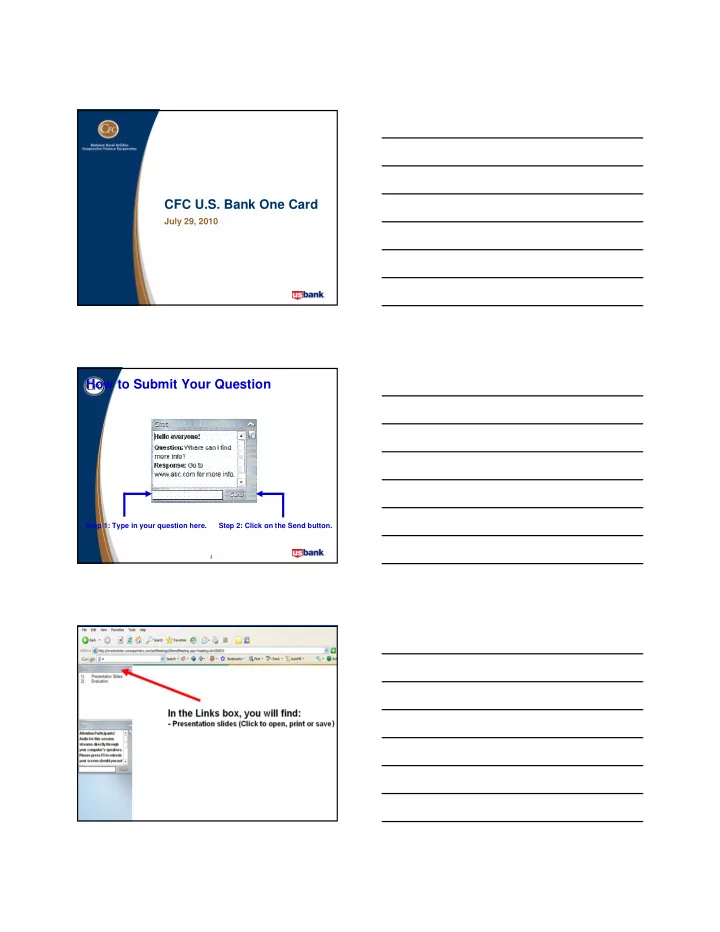
How to Submit Your Question

Step 2: Click on the Send button. Step 1: Type in your question here.

3
slide-2
SLIDE 2

CFC U.S. Bank One Card

July 29, 2010

5

Polling Question

  • Of the following five comic strips, which one

has been continuously published for the longest time? a) Hazel b) Blondie c) Dennis the Menace d) Beetle Bailey e) The Lockhorns

CFC U.S. Bank One Card

July 29, 2010

slide-3
SLIDE 3

7

Background

  • Original card programs began in 2001
  • Consolidated products into One Card program

in August 2006

  • Program currently has 158 participants and

generated about $16 million in aggregated spending last year

8

U.S. Bank – A Strategic Resource

  • $281 billion in assets
  • 6th-largest commercial bank in the United States
  • Unparalleled industry experience
  • Solutions for the entire payment continuum
  • Program design/implementation expertise
  • Unsurpassed resource commitments
  • World-class, U.S.-based customer service

9

  • A strong commitment to the payments business
  • More industry experience than all other banks

combined

  • Ubiquitous merchant acceptance
  • Competitive commercial card advantages for

CFC members

  • Long-term relationship with a strong and stable

commercial bank

U.S. Bank Strategic Benefits

slide-4
SLIDE 4

Does My Co-op Need a Commercial Card?

11

Commercial Card Opportunity

2008 Commercial Consumption Expenditures (CCE) 100% = $19.7T

Commercial Cards 3.1% Cash, Checks and ACH 96.9% 12

Purchasing Landscape

  • Annual purchasing card spending in

North America grew from $110 billion in 2005 to $137 billion in 2007

  • Purchasing card spending in North America is

expected to increase to $218 billion by 2012— that’s about 12-percent growth each year

slide-5
SLIDE 5

13

Purchasing Landscape

14

Bottom-Line Results

  • Average net savings of $69+ per transaction
  • Average procurement cycle time reduction
  • f 6.3 days
  • Average reduction in supplier base of 31%
  • 38% increase in ability to negotiate preferred

pricing

  • Happier and more productive employees

15

Real-World Successes*

Procure-to-pay and commercial card programs build the bottom line.

– One electric utility expanded its card program from emergency purchases only to all its routine purchasing, reducing manual AP check payments by more than 65%. – A leading provider of technology and business solutions plans to move more than $8 million of company spend from paper checks to its commercial card program. – A construction company saved more than $100,000 and grew its commercial card program from $1 million to $6 million by eliminating local “house” charge accounts.

*2008 Visa Global Procure-to-Pay and Commercial Best Practices Study, Deloitte Consulting

slide-6
SLIDE 6

The Program

17

What is a One Card?

Meets the needs of every co-op’s spending activity—combining the benefits of corporate and purchasing cards in a single card program

  • Purchasing Card

Designed to pay for small dollar, frequently purchased items Office equipment and supplies Maintenance, repair and

  • perations

Budgetary spend Computer hardware, software and peripherals Printing and duplicating services Professional, temporary and janitorial services Designed to pay for travel and entertainment (T&E) expenses

Corporate Travel Card

Airfare Hotel Car rental Meals Entertainment Meeting and event planning Employee relocation Designed to manage both T&E and procurement expenses

One Card

Office equipment and supplies T&E Maintenance, repair and

  • perations

Budgetary spend Meeting and event planning Miscellaneous services Employee relocation

18

Program Benefits

  • No annual fees or interest
  • No credit check on cardholders
  • No individual liability
  • Flexible online reporting and administration

capabilities

  • Exciting rebate opportunity
slide-7
SLIDE 7

19

Program Benefits

  • Simplify and streamline operations
  • Save time, money and resources
  • Stay in control and in compliance
  • Tailor the card program to your specific needs
  • Provide a convenient payment tool to

employees

  • Make better-informed business decisions

20

Types of One Card Accounts

  • Individual Cardholder Accounts

– A card assigned to an individual employee that has the employee’s name on the card

  • Department Cardholder Accounts

– A card that is commonly used by a department

  • r for a specific type of purchase
  • Ghost Accounts

– A virtual, card-free purchasing account tied to a single department, supplier or spend category

21

One Card for Purchasing

  • Reduces volume of purchase orders, invoices

and check payments

  • Improves purchasing management and provides

reporting for IRS and state regulators

  • Enables monitoring of corporate policy

compliance

  • Improves employee spending controls
  • Reduces supplier base by an average of 48%
  • Facilitates vendor negotiations
slide-8
SLIDE 8

22

One Card for T&E

  • Customized authorization controls
  • Online account access
  • Cash advance option
  • Ability to interface with your accounting

software

  • Comprehensive travel benefits

– Worldwide automatic travel accident insurance: $250,000 – Excess lost/damaged luggage coverage: $1,250

23

Typical Co-op Cardholders

  • Human resources
  • Plant and maintenance employees
  • Technical and office staff
  • General administration
  • Purchasing department
  • Advertising/marketing staff
  • Sales force

24

Typical Co-op Expenditures

  • Oil and fuel
  • Computer and software purchases
  • Utilities payments
  • Office supplies
  • Continuing education expenses
  • Online purchases
  • Airfare and hotel expenses
slide-9
SLIDE 9

25

Polling Question

  • In which decade did using commercial credit

cards for fleet management take off? a) 1950’s b) 1960’s c) 1970’s d) 1980s e) 1990’s

One Card Rebate Opportunity

27

Rebate Overview

  • Participating cooperatives have the
  • pportunity to qualify for an annual

cash rebate

  • The rebate period runs annually from

September through August

  • Program attained a rebate for the 2009-2010

rebate year with $16 million in total spend and an average transaction size of $125.

  • On track to receive a rebate this year with

$15.9 million total spend and $144 average transaction size (as of 6/10).

slide-10
SLIDE 10

28

How the Rebate Works

  • Participating cooperatives must collectively

generate at least $5 million in annual charge volume and have an average transaction size

  • f at least $120
  • The higher the collective charge volume, the

higher the percentage of rebate

  • Once the collective program rebate is attained,

cooperatives can earn a portion of that rebate if they meet the individual eligibility requirement

29

Individual Rebate Eligibility

  • The cooperative’s annual spend must be at

least $175,000

  • If the cooperative has an average transaction

size of least $120, the rebate is even higher

Making One Card Work for You

slide-11
SLIDE 11

31

Access Online

Free Web-based access tool provides: – Convenient, secure online access to data— anytime, anywhere – Account setup and maintenance – Ability to adjust cardholder spending limits – Access to view cardholder statements online – Reports to better understand spending patterns, vendor usage and policy compliance – Automated posting capabilities to integrate card data with accounting and general ledger entries

32

AutoPay

  • Amount due is automatically drawn from

specified account

  • Cycling date is the 16th of every month unless
  • n a weekend or holiday
  • Cooperative chooses a draft date that is within

14 days of the 16th

33

Fleet Capabilities

  • Cards issued at a driver or vehicle level
  • Enhanced spending controls

– Ability to limit spending to fuel and/or maintenance only – Prompts for driver ID and odometer reading – Velocity controls and hard limits

  • Accepted by Visa and MasterCard merchants

worldwide

  • Enhanced fleet data capture─provided by most

major oil companies

slide-12
SLIDE 12

34

Merchant Category Codes

  • Provide a method of understanding and

managing company spending by category code

  • Use merchant category codes (MCCs) to

prevent employee misuse

  • Open and close MCC blocks for flexibility

as necessary to your organization and supplier base

  • Automate annual IRS Form 1099-MISC reporting

35

Flexible Spending Management

  • Authorization parameters

– Monthly spending limit – Daily spending limit – Single-purchase limit (SPL)

  • Supplier category restrictions

– Travel, casinos, jewelry, liquor, etc.

36

Automated Accounting Methods

  • Default account code assigned to each card

– Cost center, budget code, company code, etc.

  • General Ledger object codes assigned by type
  • f purchase

– Office supplies, computer equipment, hotels, hardware stores, etc.

  • Accounting codes can be changed/edited as

needed

  • Transaction data can be exported for integration

with accounting software

slide-13
SLIDE 13

Addressing Cooperative Concerns

38

Cooperative Concern 1

Spend Out of Policy

– (also known as “Maverick Spend”) – A commercial card is used in a way that does not conform to the spending policies of the

  • rganization

39

Do commercial cards increase

  • ut-of-policy spending?
  • Out-of-policy spending for purchasing cards accounts for
  • nly 0.075 percent of annual purchasing card spend,

which is equivalent to $7.50 for every $10,000 spent 1

  • Out-of-policy spending for corporate cards accounts for

0.163 percent of annual travel and entertainment spend, or $16.30 for every $10,000 spent 2

  • Transaction and monthly limits can significantly reduce

the number of purchases made out of policy

1 RPMG Research Group, 2005 Purchasing Card Benchmark Survey Report 2 RPMG Research Group, 2004 Corporate Travel Card Benchmark Survey Results

slide-14
SLIDE 14

40

Cooperative Concern 2

Card Misuse

– An employee charges a personal expense through a commercial card and misrepresents it as a business expense

41

Will employees misuse commercial cards?

  • Purchasing card misuse accounts for 0.034 percent of

purchasing card spend, which is the equivalent of $3.40 for every $10,000 of purchasing card spend1

  • Corporate card misuse currently accounts for less than

0.01 percent of travel and entertainment spend, or less than $1.00 for every $10,000 spent2

  • With the Visa Liability Waiver Program, companies with

Visa commercial card programs are covered up to $100,000 per cardholder in the event of employee card misuse

1 RPMG Research Group, 2005 Purchasing Card Benchmark Survey Report 2 RPMG Research Group, 2004 Corporate Travel Card Benchmark Survey Results

Dedicated Program Support

slide-15
SLIDE 15

43

U.S. Bank Support

Greg Wenisch, Account Manager – Custom implementation – Ongoing strategic consultation – Training on Web-based access tools – Problem resolution – A complete partnership approach to your business success

44

CFC Program Support

  • Manages relationship with U.S. Bank
  • Provides day-to-day member contact
  • Establishes new cooperative accounts
  • Answers general member questions and

concerns

45

Get Started Today!

Contact Lauren Harris for more details: – Phone: 800-424-2954, ext. 2065 – E-mail: onecard@nrucfc.coop