
SLIDE 1
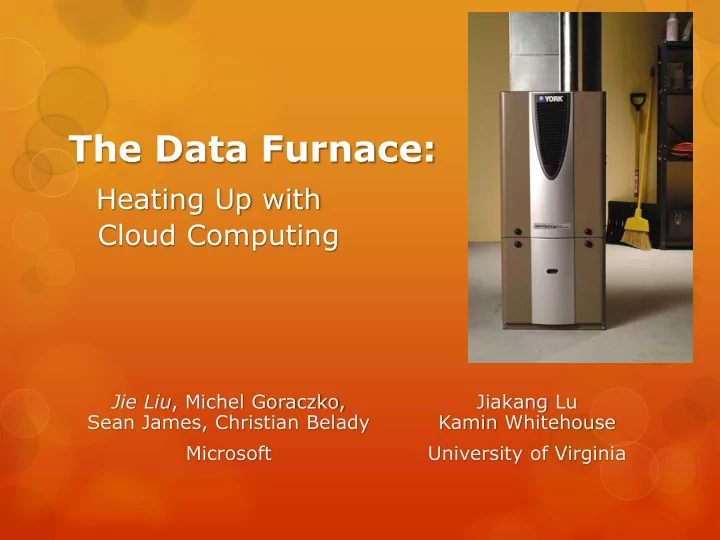
The Data Furnace:
Heating Up with
Cloud Computing
Jie Liu, Michel Goraczko, Sean James, Christian Belady Microsoft Jiakang Lu Kamin Whitehouse University of Virginia
The Cloud Is Big! The Cloud Is Hot! IT industry Constitutes about - - PowerPoint PPT Presentation
The Data Furnace: Heating Up with Cloud Computing Jie Liu , Michel Goraczko, Jiakang Lu Sean James, Christian Belady Kamin Whitehouse Microsoft University of Virginia The Cloud Is Big! The Cloud Is Hot! IT industry Constitutes about 2%
Jie Liu, Michel Goraczko, Sean James, Christian Belady Microsoft Jiakang Lu Kamin Whitehouse University of Virginia
consumption
power 5.8 Million average US households
industrial sector
current trend
Data from James Hamilton and Mike Manos
2% 9% 42% 18% 19% 10%
Infrastructure Cost Breakdown
Land Core Electrical Mech Other Architectural
50,000 server facility
REDUCE RENEW REUSE
12% provisioned power (30kW)
US Energy Information Administration Twice the entire IT!
DOE EnergyPlus simulator 1700 sqft single family house 70F set point 5 climate zones Outdoor Temp. < 70F > 95F Minneapolis 82% 0.11% Pittsburgh 82% DC 77% 0.13% San Francisco 96% Houston 46.5% 0.15% 1 min time granularity. Max power required. Assume 300W servers. MN SFO
MN PA DC CA TX Provisioned server # 112 114 101 46 37 Current heating exp. ($/year) 3K 2K 2.5K 1.5K 700
heating use ($/year) 9525 6733 5742 3514 1666
full use ($/year) 14.7K 15K 13.3K 6K 4.9K Current host cost ($/year) 44.8K 45.6K 40.4K 18.4K 14.8K
Amortized cost in conventional DC: $400/server/year Urban electricity price overhead: $0.05/kWh Possible T1 network cost: $2640/year
Low-Cost Seasonal Data Centers
Opportunistic cycles (SETI) Developing communities hobbyists
Low-Bandwidth Neighborhood Data Centers
Email serving Ultra-local web services Neighborhood content sharing Delay-tolerance jobs
Eco-Friendly Urban Data Centers
Small scale cloud computing Content caching Casual collaborations/games
Hardware reliability (Vishwanath et al. SOCC10)
92% servers never need touch 8% servers failed (repeatedly) Average touches per failed server: 3~4/14months Predominantly HDD failures
Run a service truck: $100/visit/house Technical Challenges – System Design & Management:
Improve reliability by hardware design (low power density, low vibration) Increase replication Fail gracefully
Home circuit capacity Usage is increasing with electrical cars Consumer power generators are emerging Residential power quality challenges Technical Challenges – Power Management:
Close monitoring and control are critical Power availability prediction Power capping and tracking Local energy storage
Physical security: Storage and communication security: Computing security: Technical Challenges – Security:
Embedded sensors for anti-tampering. Isolation and encryption. Secure execution.
Not to replace centralized data centers. The services can be close to end user physically Technical challenges – performance:
Networking Placement Elasticity Opportunistic processing
Data Furnace
Reuse existing power infrastructure Reuse heating energy for computing Be close to end users
Other forms of heat reuse:
Water pre-heating Apartments/office buildings Agriculture
Many, many challenges