
SLIDE 1
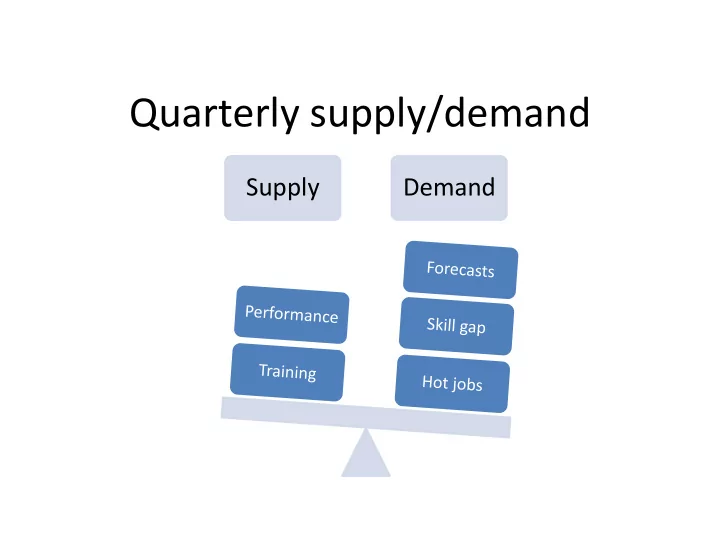
Quarterly supply/demand Supply Demand Quarterly numbers Supply - - PowerPoint PPT Presentation
Quarterly supply/demand Supply Demand Quarterly numbers Supply numbers from the Virginia One-stop System (VOS). Demand numbers from Virginialmi.com Program year quarters run: Q1 = 07/01 9/30 Q2 = 10/01 12/31 Q3 = 1/1
4,000 6,000 8,000 10,000 12,000 14,000 16,000 18,000 I II III IV VI VII VIII IX XI XII XIII XIV XV XVI XVII Q1 Q2 Q3
LWIA Q1 Q2 Q3 Q3 Low/Mid I 521 459 405 83% II 1,578 1,484 1426 76% III 1,008 883 874 76% IV 1,441 1,376 1,000 59% VI 790 685 591 57% VII 418 317 302 77% VIII 329 311 257 71% IX 2,459 2,091 1,146 45% XI 993 1,004 698 63% XII 11,980 11,851 6,215 37% XIII 1,044 934 726 53% XIV 1,315 987 871 63% XV 728 624 541 67% XVI 2,640 2,468 1,698 54% XVII 667 611 476 70% 27,911 26,085 17,226 49%
Total of 536 people entered training, compared to 780 same time last year (Q2PY13).
Q1 = 07/01 – 9/30 Q2 = 10/01 – 12/31 Q3 = 1/1 – 3/31 Q4 = 4/1 – 6/30
1,000 1,500 2,000 2,500 3,000 Q1 Q2 Q3 Q4 TOTAL 2011 2012 2013 2014
Q1 Q2 Q3 Q4 TOTAL 2011 565 368 503 787 2,223 2012 656 336 503 719 2,214 2013 700 377 780 699 2,556 2014 807 351 536 1,694
Q1 Q2 Q3 Q4 TOTAL 2011 1,125 516 379 727 2,747 2012 968 413 425 808 2,614 2013 734 548 542 881 2,705 2014 808 516 386 1,710
Total of 386 people completed training, compared to 544 same time last year (Q1PY13).
Q1 = 07/01 – 9/30 Q2 = 10/01 – 12/31 Q3 = 1/1 – 3/31 Q4 = 4/1 – 6/30
500 1,000 1,500 2,000 2,500 3,000 Q1 Q2 Q3 Q4 TOTAL 2011 2012 2013 2014
Top occupations listed by projected statewide demand over the next five years1
Demand Entered Training Completers RNs Nursing Aides LPN and LVNs Truck drivers General Managers Nursing aides Retail Sales LPN and LVN Computer Support Computer programmers Medical Assistants Electricians Food industry RNs Accountants C/S Representatives Electricians Carpenters
Percent Growth Over the Year April 2015 Payroll Data
0.0 2.0 4.0 6.0
Total nonfarm Mining and logging Construction Manufacturing Trade, transportation, and utilities Information Finance and insurance Professional and business services Education and health services Educational services Leisure and hospitality Accommodation and food services Government
April 2015
Current Month MoM % Chg YoY % Chg Total nonfarm 3,806,400 1.3 0.9 Mining and logging 8,500
Construction 184,800 4.5 4.3 Manufacturing 233,200 0.0 1.0 Trade, transportation, and utilities 637,800 0.3 0.6 Information 69,200
Finance and insurance 142,500 0.1 1.1 Professional and business services 681,200 1.8 0.3 Education and health services 510,900 1.0 2.2 Educational services 94,200 1.3 1.7 Leisure and hospitality 370,200 4.0 0.4 Accommodation and food services 323,200 3.4 0.7 Government 719,200 0.8 0.5
Source: Virginia Employment Commission, CES
3rd Quarter 2014 Change Over Prior Quarter and Same Quarter a Year Ago
Level QoQ % Chg YoY % Chg Alexandria/Arlington (LWIA XII) 260,714 0.31
Bay Consortium (LWIA XIII) 160,035 1.22 1.41 Capital Region Workforce Partnership (LWIA IX) 529,304
1.17 Crater Area (LWIA XV) 67,532
1.28 Greater Peninsula (LWIA XIV) 225,045
Hampton Roads (LWIA XVI) 492,586
New River/Mt. Rogers (LWIA II) 137,418
0.28 Northern Virginia (LWIA XI) 901,702
0.02 Piedmont Workforce Network (LWIA VI) 159,113
1.63 Region 2000/Central VA (LWIA VII) 98,285 0.20 1.09 Shenandoah Valley (LWIA IV) 210,762
1.27 South Central (LWIA VIII) 52,733
0.65 Southwestern Virginia (LWIA I) 57,785
West Piedmont (LWIA XVII) 67,353
Western Virginia (LWIA III) 156,835
0.79
Source: Virginia Employment Commission, QCEW
April 2014 vs. April 2015
Level of UE 2015 2014 Alexandria/Arlington (LWIA XII) 7,451 3.1% 3.2% Bay Consortium (LWIA XIII) 12,278 5.0% 5.4% Capital Region Workforce Partnership (LWIA IX) 25,603 4.6% 4.9% Crater Area (LWIA XV) 4,939 6.6% 7.2% Greater Peninsula (LWIA XIV) 13,375 5.3% 5.5% Hampton Roads (LWIA XVI) 28,634 5.0% 5.2% New River/Mt. Rogers (LWIA II) 9,184 5.0% 5.5% Northern Virginia (LWIA XI) 41,474 3.7% 3.9% Piedmont Workforce Network (LWIA VI) 8,730 4.0% 4.1% Region 2000/Central VA (LWIA VII) 6,093 4.9% 5.1% Shenandoah Valley (LWIA IV) 12,030 4.5% 4.7% South Central (LWIA VIII) 4,681 5.9% 6.6% Southwestern Virginia (LWIA I) 5,777 7.6% 7.9% West Piedmont (LWIA XVII) 5,767 6.8% 7.3% Western Virginia (LWIA III) 7,838 4.6% 4.9%
Source: Virginia Employment Commission, LAUS
Source: VEC/BLS
2 4 6 8 10 12 J-07 J-08 J-09 J-10 J-11 J-12 J-13 J-14 J-15 US VA
US: 5.5 VA: 4.9
may require a high school diploma or GED certificate.
a high school diploma.
require training in vocational schools, related on-the-job experience, or an associate's degree.
require a four-year bachelor's degree, but some do not.
require graduate school. For example, they may require a master's degree, and some require a Ph.D., M.D., or J.D. (law degree).