
SLIDE 1
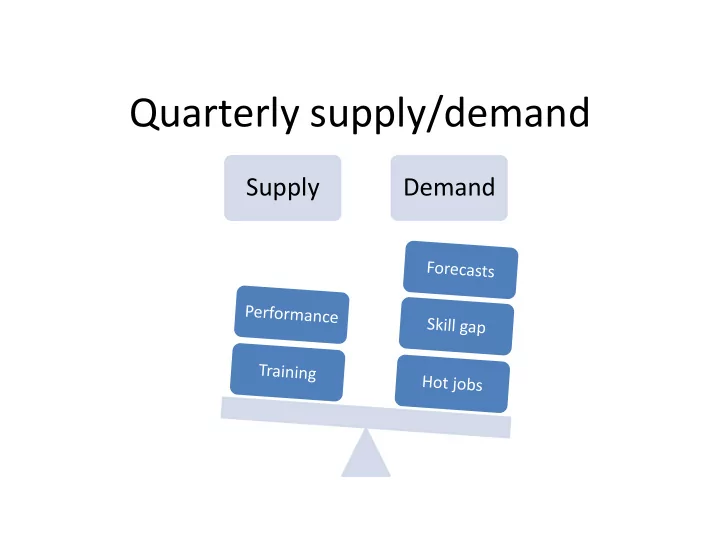
Quarterly supply/demand Supply Demand Quarterly numbers Supply - - PowerPoint PPT Presentation
Quarterly supply/demand Supply Demand Quarterly numbers Supply numbers from the Virginia One-stop System (VOS). Demand numbers from Virginialmi.com Program year quarters run: Q1 = 07/01 9/30 Q2 = 10/01 12/31 Q3 = 1/1
4,000 6,000 8,000 10,000 12,000 14,000 I II III IV VI VII VIII IX XI XII XIII XIV XV XVI XVII Q1 Q2
LWIA Q1 Q2 Q2 Low/Mid I 521 459 82% II 1,578 1,484 77% III 1,008 883 74% IV 1,441 1,376 62% VI 790 685 68% VII 418 317 71% VIII 329 311 71% IX 2,459 2,091 50% XI 993 1,004 55% XII 11,980 11,851 39% XIII 1,044 934 60% XIV 1,315 987 66% XV 728 624 67% XVI 2,640 2,468 53% XVII 667 611 69% 27,911 26,085 52%
Total of 351 people entered training, compared to 377 same time last year (Q2PY13).
Q1 = 07/01 – 9/30 Q2 = 10/01 – 12/31 Q3 = 1/1 – 3/31 Q4 = 4/1 – 6/30
1,000 1,500 2,000 2,500 3,000 Q1 Q2 Q3 Q4 TOTAL 2011 2012 2013 2014
Q1 Q2 Q3 Q4 TOTAL 2011 565 368 503 787 2,223 2012 656 336 503 719 2,214 2013 700 377 780 699 2,556 2014 807 351 1,158
Q1 Q2 Q3 Q4 TOTAL 2011 1,125 516 379 727 2,747 2012 968 413 425 808 2,614 2013 734 548 542 881 2,705 2014 808 516 808
Total of 516 people completed training, compared to 548 same time last year (Q1PY13).
Q1 = 07/01 – 9/30 Q2 = 10/01 – 12/31 Q3 = 1/1 – 3/31 Q4 = 4/1 – 6/30
500 1,000 1,500 2,000 2,500 3,000 Q1 Q2 Q3 Q4 TOTAL 2011 2012 2013 2014
Expenditures Participants Cost per unit Adult $3,536,144 4,431 $798 Dislocated Worked $2,522,433 3,002 $840 Youth $2,811,154 2,537 $1,108
Top occupations listed by projected statewide demand over the next five years1
Demand Entered Training Completers Computer Support Nursing Aides LNPs RNs General Managers Medical records C/S Reps Medical Assistants Medical Assistants Office Supervisors LNPs HVAC Truck Drivers Child Care Workers Bookkeeping Security Guards Bus Drivers Pharmacy Techs
Rank Advertised Certification group Openings 1 Certification in Cardiopulmonary Resuscitation (CPR) 6,880 2 Commercial Drivers License (CDL) 5,436 3 Basic Life Support (BLS) Certification 4,708 4 Advanced Cardiac Life Support Certification (ACLS) 2,633 5 Certified Information Systems Security Professional (CISSP) 2,334 6 Certified Nursing Assistant (CNA) 1,885 7 Information Technology Infrastructure Library Certification (ITIL) 1,872 8 Certified Public Accountant (CPA) 1,867 9 Cisco Certified Network Associate (CCNA) 1,334 10 Pediatric Advanced Life Support (PALS) 1,182
may require a high school diploma or GED certificate.
a high school diploma.
require training in vocational schools, related on-the-job experience, or an associate's degree.
require a four-year bachelor's degree, but some do not.
require graduate school. For example, they may require a master's degree, and some require a Ph.D., M.D., or J.D. (law degree).