PubMed and Beyond: Clinical Resources from the National Library of - - PDF document

pubmed and beyond clinical resources from the national
SMART_READER_LITE
LIVE PREVIEW

PubMed and Beyond: Clinical Resources from the National Library of - - PDF document

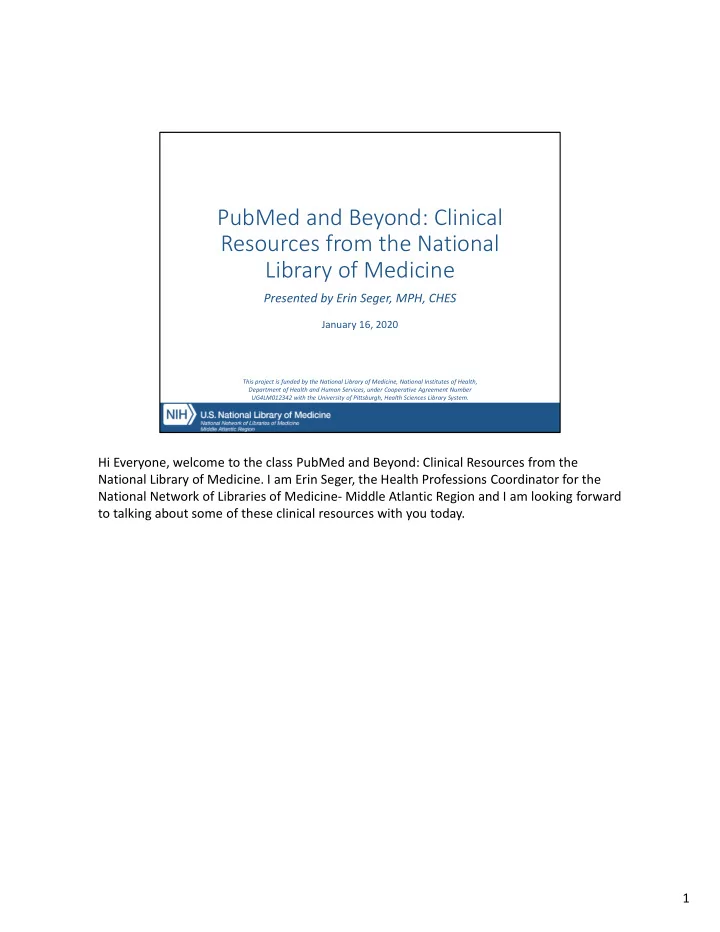
PubMed and Beyond: Clinical Resources from the National Library of Medicine Presented by Erin Seger, MPH, CHES January 16, 2020 This project is funded by the National Library of Medicine, National Institutes of Health, Department of Health and Human


slide-1
SLIDE 1

PubMed and Beyond: Clinical Resources from the National Library of Medicine

Presented by Erin Seger, MPH, CHES

January 16, 2020

This project is funded by the National Library of Medicine, National Institutes of Health, Department of Health and Human Services, under Cooperative Agreement Number UG4LM012342 with the University of Pittsburgh, Health Sciences Library System.

Hi Everyone, welcome to the class PubMed and Beyond: Clinical Resources from the National Library of Medicine. I am Erin Seger, the Health Professions Coordinator for the National Network of Libraries of Medicine‐ Middle Atlantic Region and I am looking forward to talking about some of these clinical resources with you today. 1

slide-2
SLIDE 2

Housekeeping

  • Closed captioning is available – link provided in the chat box.
  • This session is being recorded and will be available on the NNLM

YouTube Channel in a few weeks.

  • Chat your questions to “All Participants” throughout the session.
  • Participants in this class are eligible for 1 MLA CE
  • Your feedback matters! Please complete the evaluation at the

end of the webinar to receive a code for MLA CE and to help us improve future trainings.

A few housekeeping items before we jump into class… 2

slide-3
SLIDE 3

By the end of the session participants will be able to:

Find patient education information using MedlinePlus and Genetics Home Reference Access drug information using Drug Information Portal Find clinical trials by condition and limit to those with results in ClinicalTrials.gov Find systematic reviews in PubMed/ MEDLINE Limit PubMed results to free full‐ text

To start out, there are the objectives for the course. The include finding patient education information, drug information clinical trials and journal articles using a number of resources from the National Library of Medicine. The focus of this class is on resources that can be useful to a practicing healthcare provider, particularly a bedside clinician. Many of the resources that I will demonstrate today can be used by multiple types of professionals in different settings. However, the features of the resources that were chosen for today’s class with a bedside clinician in mind. 3

slide-4
SLIDE 4

Drug Information

Drug Information Portal DailyMed Pillbox

Research

Clinicaltrials.gov PubMed

Patient Education

MedlinePlus HealthReach Genetics Home Reference

Here is our agenda for today. The class is divided into three sections: drug information, research, and patient education. There 2‐3 National Library of Medicine resources that I will discuss in each section. As we discuss these resources today, I have a few poll questions that I will open as a quick knowledge check about the material we’ve covered or to hear your experience or opinion about the resources. There are also a couple instances where I will highlight opportunities to take another course where you can dive deeper into some of these resources. 4

slide-5
SLIDE 5

We’ll start with places to locate information about drugs. There are three NLM resources in this section that I will discuss today: The Drug Information Portal, DailyMed and Pillbox. 5

slide-6
SLIDE 6
  • Searches multiple NLM and

government resources

  • Information on 80,000 drugs from the

time they are entered into clinical trials through their entry in the U.S. marketplace Drug Information Portal Homepage (https://druginfo.nlm.nih.gov)

The Drug Information Portal allows a user to search for information about over 80,000 drugs in one place. The portal is a resource that links to a number of drug information resources from NLM and other U.S. Government agencies and will provide information on drugs from the time they are entered into clinical trials. Some of the information links will connect the user to basic summaries, while others will ink to journal articles or other more clinical information sources about the drug. This portal also has drug‐related resources or a variety of populations including consumers, health professionals, researchers, and

  • students. Let’s take a look at some of the ways you can search on the Drug Information

Portal. Instructor: open up the Drug Information Portal and click “show list of resources searched” On the homepage, you can see the list of resources that the Drug Information Portal will search and link you to. Each one has the option for you to see more information about the individual resource. For example, if I was unfamiliar with Toxline, I can click the “i” to learn more about this database. Instructor: demo this and show the explanation. Now, let’s look at how to search for a specific drug. If you know the name of a drug, you can search for that in the center box. Instructor: type “metformin” into the search box and 6

slide-7
SLIDE 7
  • search. You can see the results for the drug Metformin here. The Drug Information Portal will

search the generic name. So if you were to type in “Advil” it will give you information for “ibuprofen”. You can see the more basic resources at the top under “summary” and those with more detail under “detailed summary”. Instructor: briefly show examples of a resource in each section by hovering over the “i”. Instructor: return to homepage. You can also search for a drug by its category. For example, Metformin is a hypoglycemic agent, which we saw in the previous search. Instructor: type “hypoglycemic agents” into the search box. It will auto populate. Select the first one that does not say [name] after it. When I search for this as a category, I am shown the other drugs that are also hypoglycemic agents. Instructor: you can demo clicking a different drug from the list if you would like. Instructor: return to homepage. You can also use the Drug Information Portal to locate drug‐ related resources for a particular audience. Instructor: click “resources by audience/ class”. You can see here various drug related resources for a particular audience. Instead of showing information about a specific drug, it will link you to other sources of drug information. When I choose “public” Instructor: click “the public” I’m provided with a list of resources appropriate for the general public. For example, the MedlinePlus drug information page. Instructor: click “Drugs, Supplements, and Herbal Information” and show the link to the MedlinePlus page. The last thing I want to point out for today’s demo of the Drug Information Portal is where you can find more information. Instructor: return to the homepage and then choose “News and Features” > “FAQs”. The FAQ section will provide you with more information about the Drug Information Portal, including more advanced ways to search. Instructor: choose “Can I use truncation in my searches?” For example, how to use truncation in searches. 6

slide-8
SLIDE 8
  • Provides the most up to date drug

label information submitted to the FDA

  • Labels have been reformatted to be

easier to read

  • Ability to search by drug name,

class, or NDC code DailyMed Homepage (https://dailymed.nlm.nih.gov/)

The next drug resource we’ll review today is DailyMed. DailyMed provides FDA drug label information, including information about Indications, dosage, side effects and

  • contraindications. This information is the most up to date label information that has been

submitted to the FDA but has been reformatted to be easier to read. There are different ways to search for drug information, such as the name of the drug or the NDC code. It’s different from the drug information portal in that the primary information accessed is from the package insert from the selected medication. However, This resource also links to other consumer resources if further information is needed. Let’s look at the process of locating drug information with this portal. Instructor: open drug information portal. To search for a medication by name, you can type that name into the center search box. Instructor: type “metformin” into the search box and search. Select the first option on the list and open the label data. You can see the drug information here. The boxed warning will open automatically‐ this is the strongest warning that the FDA requires. Each section below will provide additional information on things such as: uses, dosage, contraindications and interactions. Instructor: open each section or others that interest your audience. Over on the left, there is safety information in addition to the boxed warning. The sections 7

slide-9
SLIDE 9

Report adverse events and Safety recalls will link to the FDA while the LactMed selection will link to another NLM database about the drug’s presence in breastmilk. In the Related resources area, you will be directed to MedlinePlus and ClinicalTrials.gov (the use of which will be covered more in depth later in presentation). Instructors: you can point these out or click to show the link from DailyMed if you wish. Instructor: return to home page. Another useful search feature on DailyMed is the option to search by the NDC code. This is a unique 10‐digit code assigned to each drug product that can be found on the package of a prescription drug. You can type this into the same place where you can type in the keyword search. Instructors: demonstrate typing in code 62756‐ 142‐02. When I search for this particular NDC code, I am given the same Metformin record that we reviewed together a moment ago. However, this would eliminate the need to scroll through the list of search results that I was given when I searched for Metformin as a keyword. Instructor: return to homepage. One last feature of DailyMed that I will highlight is the ability to search by drug class, similar to the Drug Information Portal. Instructor: click on “Browse Drug Classes” and show the classes of drugs. 7

slide-10
SLIDE 10

r

  • Helps the user identify unknown pills

based on physical description

  • Provides drug related information
  • nce a pill is identified
  • Links to other NLM drug resources fo

additional information Pillbox Homepage (https://pillbox.nlm.nih.gov/)

Pillbox is an NLM resource that helps in the identification of a pill based on its appearance. You can search the physical characteristics of the pill and get basic information about it

  • nce it is identified. If the user is seeking more in depth information after they identify a

drug, Pillbox will link them to other trusted resources. Lets do an example search using Pillbox. Instructor: open Pillbox website. Here on the Pillbox website, you can see several different physical characteristics of a medication that you can search. As an example, if I had a pill that was and oval, white in color, 13mm, and had and Imprint that said R;751, I can enter these characteristics. Instructor: enter these into the appropriate fields and hit “search”. You can see that this search returns

  • Metformin. Now that I have I identified it, I can select “more information” Instructor: select

more information to see things such as the active ingredients and product code. For additional information, Pillbox will link to the previously discussed drug resources: DailyMed and the Drug Information Portal. Instructor: demonstrate the link to these other resources. 8

slide-11
SLIDE 11

Which drug resource discussed today do you think will be the most useful to you?

  • A. Drug Information Portal
  • B. DailyMed
  • C. Pillbox

This is a poll‐ there is no right or wrong answer, but more of an opportunity for you to provide your opinion and see the opinion of the others in the class today. In addition, I’d love to see you share in the chat box some examples of how you use this resource! 9

slide-12
SLIDE 12

Which drug resource discussed today will allow you to search for information on a drug from the time they are entered into clinical trials?

  • A. Drug Information Portal
  • B. DailyMed
  • C. Pillbox

Before we move on to our research resources, I’m going to open a similar poll, but this one gives you a change to check your knowledge of the drug content that we just discussed. While people answer, you can read the responses in the chat box from the last poll Instructor: the correct answer is the Drug information portal. If you would like to show this to the audience, you can return to where it is stated on the “About this portal” page under “news and features” 10

slide-13
SLIDE 13

Now we’ll move on to some research related resources: clinicaltrials.gov and PubMed. 11

slide-14
SLIDE 14
  • Offers a reliable and generally

comprehensive list of completed and ongoing trials

  • Centralized place to search by

condition, location, and other trial characteristics Clinicaltrials.gov Homepage (https://clinicaltrials.gov/)

The purpose of ClinicalTrials.gov is to provide patient information on clinical trials. It allows patients to connect to studies by providing a centralized place to search by condition, location, and other trial characteristics to find ongoing trials that people may consider enrolling in. ClinicalTrials.gov can also help a provider who wants to find information about a specific trial that is enrolling or a researcher or other professional who may be interested in evidence from past clinical trials. Lets look at how someone can locate information in clinicaltrials.gov. Instructor: open the clinicaltrials.gov homepage. You can see the homepage here, where you can search for trials by a few different

  • characteristics. As an example, if I was interested in a trial about child obesity, I could

search that in the “condition” section. Instructor: type “child obesity” and hit search. You can see here a list of all the trials that match this search in clinicaltrials.gov. This includes those that have been completed. If I was only interested in finding trials that are recruiting participants, I can search for that. Instructor: on the left side in the box titled, “status” choose “recruiting”. This helps narrow down the search to only the trials I am interested in. If you want to know more about what these status categories mean, you can select the blue i in this box for definitions. Instructor: select this and demonstrate how the box

  • pens that shows the definitions.

12

slide-15
SLIDE 15

Another useful feature of clinicaltrials.gov is the ability to search based on geography. You can search this on the homepage, or you can use the map feature. Instructor: select the “map” tab at the top of the screen. You can see the recruiting studies for childhood obesity

  • n the map here. Instructor: select the USA. You can then narrow it by state. Instructor:

select a state and show the list of trials. Once you find a study you are interested in, you can select it to see the specifics. Instructor: select a study from the list and show the information that a user can see. If you are interested in a completed trial that has results available, you can also search for this as opposed to trials that are recruiting. Instructor: uncheck “recruiting” and hit apply. Scroll down to the box that says “study results” and select “with results”. If nothing shows up, this means that the selected state does not have any studies with results. There is a link at the top of the page that will show all the studies with results. You can explain this to the audience. You can see now that we have a list of all the studies with results and when you select one Instructor: select a study from the list you can choose the results tab Instructor: select the tab at the top of the screen you can see the results of the trial. 12

slide-16
SLIDE 16
  • Contains more than 30 million

citations, primarily from the biomedicine and health fields

  • Ways to speed up a clinical search:
  • 1. Use clinical queries to limit to

clinical research areas

  • 2. Use topic filters to limit your

search quickly PubMed Homepage (https://pubmed.ncbi.nlm.nih.gov/)

Now we’ll move on to PubMed. This is an NLM resource that I find many people are already familiar with. It is a database that contains more than 30 million citations to journal articles in biomedical sciences and beyond. Citations in PubMed are primarily from the field of biomedicine and health as well as related disciplines such as life sciences, behavioral sciences, chemical sciences, and bioengineering. There are lots of things to learn about searching in PubMed, but our focus today is going to be on it’s use to clinicians or other health professionals, who may not have the time to do an extensive search. We’re going to focus primarily on the activities that are listed here: using clinical queries and topic specific searches. These are great things for health professionals to know about in order to quickly locate articles relevant to their work. They’re also easy to learn and teach. Before I demonstrate these features, I’d like to know about your experience with them. POLL. Then click back to this slide to open PubMed. Instructor: Open PubMed homepage The first thing that we will look at is Clinical Queries. These can be accessed from the PubMed homepage. Instructor, click “Clinical Queries”. These are searches that have been 13

slide-17
SLIDE 17

created to limit search results to articles that would be of relevance to clinicians or relate to clinical topics. You can see three categories under the search box: clinical study categories, systematic reviews and medical genetics. Each is a search for the keyword run through a different filter. Let’s look at an example. Instructor: type sickle cell disease into the search box and click

  • search. When I type in sickle cell disease, I’m given search results in each column. Each

column is providing the first few results, but you can click “see more” to see the full list of

  • results. Instructor: select “see more” to show this.

The clinical study category has 5 categories: etiology, diagnosis, therapy, prognosis, and clinical prediction guides. It will default to therapy, but you can change it based on the needs

  • f the user. Instructor: show the audience how the results change with the category is
  • changed. You can also select “broad” or “narrow” depending on your need. If you’re

interested in seeing the search terms used, you can select “filter information” at the bottom

  • f the column. Instructor: open the filter information to show to the audience.

The systematic reviews and Medical genetics sections work similarly in that you can choose to see all the articles and the filter information for each. Instructor: you can show the other search strategies if you would like/ if time permits. Medical genetics also has a dropdown

  • f different subcategories if you don’t want all the articles. Instructor: Show the audience

the dropdown. A good exercise to show the value of using clinical queries is to compare the number of search results that you get in Clinical Queries compared to typing it in on the PubMed

  • homepage. You can see that using “therapy” and “broad” in the clinical study section,

Instructor: change to this if it is not already set on these in the clinical studies section I have a total of 5,149 studies. Instructor: go to the PubMed homepage and search “sickle cell disease” When I search “sickle cell disease” on the home page, I get 25,330 results. This difference is pretty significant, making clinical queries useful for a busy clinician who just needs a few articles about a clinical topic. Instructor: return to PubMed homepage Topic‐ specific queries is another feature that can help a user speed up their search. You can access these from the PubMed homepage right under clinical queries. Instructor: select topic‐specific queries You can see several different choices when you get to this page. Some

  • f them are filter, searches that you can click to run and some of them are interfaces that

you can use to search PubMed. Clinical Queries is one of these interfaces, which is why you also see is listed here. Another interface is Comparative Effectiveness Research. Instructor: select “Comparative Effectiveness Research” You can see more information about comparative effectiveness when you scroll down on this page. Instructor: scroll down to “Description of this Project” You can see the definition of comparative effectiveness research is “the conduct and synthesis of research comparing the benefits and harms of 13

slide-18
SLIDE 18

different interventions and strategies to prevent, diagnose, treat and monitor health conditions in "real world" settings” and that “the purpose of the search strategies presented here is to help inform discussions on or relating to comparative effectiveness…”. I think this can therefore be a useful interface for those who work in clinical settings to be aware of. Instructor: scroll back up to the PubMed search box in the Comparative Effectiveness interface you can search PubMed here and can use the research categories and topics below if you are looking for a specific type of article. Instructor: return to the list of all Topic‐Specific Queries An example of a search strategy for a specific topic is electronic health records. Instructor: Select Electronic Health Records You can see that when you select it, the search is run. You can see the full search here. Instructor: select “see more” on the right side under search

  • details. This is a really long search that would be very time consuming to do on your own, so

they can be good to recommend to a clinician who has a need for the type of information that topic specific queries cover. Instructor: return to list of all Topic‐Specific Queries The last example I will show you is an example of a subset that you can access from this

  • page. For these, you can see the search strategy for each one here. Instructor: select the

search strategy for the AIDS subset. It tells me that this was created to facilitate searching for subjects in the area of AIDS. Instructor: return to the topic‐specific queries page When I select the AIDS subset, it takes me to the PubMed homepage and shows me that this has been applied. You can then type in your search with this subset applied. 13

slide-19
SLIDE 19

Have you ever used Clinical Queries or Topic‐ Specific Queries in PubMed?

  • A. Yes, I have used Clinical Queries
  • B. Yes, I have used Topic‐Specific Queries
  • C. Yes, I have used both
  • D. No, I haven’t used either one

Before I show these to you, I have another poll about your past experience with these PubMed features. I’ve opened the poll now and I’ll give you a few seconds to answer. While everyone answers, if you have used either one of these previously, please feel free to share how you’ve used them in the chat box. 14

slide-20
SLIDE 20

I’ll now discuss some patient education resources. I consider these to be an important part

  • f a set of clinical resources because patients need information that they can understand

about their health and providers need to know where to get resources for them or a trusted resource to refer at patient to. 15

slide-21
SLIDE 21
  • NLM main portal for consumer

health information

  • Available in English and Spanish
  • Offers information on over 1,000

health topics, medications and supplements MedlinePlus Homepage (https://medlineplus.gov/)

MedlinePlus is the National Library of Medicine’s main portal for consumer health

  • information. MedlinePlus information on over 1,000 health topics, including medications

and supplements. This is a great resource for someone who needs to locate information to provide to a patient or if a patient wants to research health on their own. The value of directing a patient to MedlinePlus is that all the information is from a trusted resource, so it keeps patients away from the wide range of not‐so‐trusted information that they might come across using Google. This site is also available in both English and Spanish. Lets look at the variety of information available to the public through MedlinePlus Instructor: open the MedlinePlus homepage. There are a lot of choices when you’re on the MedlinePlus homepage. In my experience, I find that the default is to search in the search box, which can be a good place to start. Instructor: type “diabetes” into the search box and search. You can see that this search turns back a good amount of information, but most importantly, the information I am provided is from trusted sources of health information. MedlinePlus doesn’t create the content, but links the user to reliable resources. This is ideal because then a consumer will not get some of the not‐so‐trusted health information that they might get if the were to search with a typical search engine. 16

slide-22
SLIDE 22

I also think it’s great if a user knows how to navigate using some of the other features of the

  • site. The first one is the health topic pages. Instructor: select Health Topics. You can see the

information organized here in a way that is easy for a consumer to navigate. The Information about physical health is organized by the system that is affects. For example, if I wanted information about diabetes, I can find that under the Endocrine system section. There is also information for different audience by gender and age and for health concerns that are not necessarily a physical condition or diagnosis. For example, when I select “social and family issues” I can access information about advance directives. Instructor: click through this as you explain. You can also access disaster information, for example, resources about

  • wildfires. Instructor: click through this as you explain.

Instructor: return to homepage In a similar way to viewing the topic pages, MedlinePlus provides information about medications and supplements. Instructor: select Drugs & Supplements You can view prescription medications at the top the page Instructor: point out the section for prescriptions on the Drugs & Supplements page, which are organized alphabetically. And if you’re interested in information about herbs and supplements, you can scroll through this

  • list. Instructor: click “herbs & supplements” and show the list. This is useful when a

consumer has a question about the effectiveness of a particular supplement. For example, bee pollen. Instructor: select “bee pollen”. You can see that there is a description of a supplement and information about how effective it is for various uses. As you can see here, more information is needed for us to know if bee pollen is effective for most uses. Instructor: return to homepage Another recent addition to MedlinePlus is the section about lab tests. Instructor: select “Lab Test Information” You can see that a number of different lab tests are included. Instructor: select any of them. And the test is described so that a patient can better understand why and how they are receiving a particular test. 16

slide-23
SLIDE 23
  • Health education materials in

various languages and formats

  • Special collections on Emergency

and Disaster, Women’s Health and Mental Health HealthReach Homepage (https://healthreach.nlm.nih.gov/)

HealthReach contains quality multilingual, multicultural health information for those working with or providing care to individuals with limited English proficiency. This is a source where various organizations or trusted authors have submitted their translated

  • materials. These patient focused materials include things like fact sheets and videos. You’re

also able to search for various topic areas in HealthReach, such as mental health or disaster information. Instructor: Open HealthReach Like MedlinePlus, there are a few ways to search for patient education materials in

  • HealthReach. If you already know what type of information you need, you can use the

search box. Instructor: type “diabetes” in the search box and hit search, filtered for patient information. You can see here a list of the patient education materials related to

  • diabetes. When I select one Instructor: select the one titled just “diabetes” you can see

the different languages that this resource is available in along with a description of the document, including the author and when the record was last updated. I mentioned that HealthReach is a collaborative. This means that these materials were all submitted by the author that you see listed on the document. This is why the handouts are formatted slightly differently and different topics are available in different languages. This particular document is available in a number of languages and shows a side by side English 17

slide-24
SLIDE 24
  • translation. Instructor: open one of the handouts and show the side by side translation.

While others have the English version as a different document. Instructor: go back to the diabetes search results and select the document titled “Health and Well‐Being 7 – Diabetes” and show the language availability. You can also see that there are formats available other than written documents. This particular resource has an audio version for some of the languages. This can be helpful for a patient who has limited literacy in their native language. Instructor: show where the audio recording can be opened. Instructor: return to homepage If you want to search for different formats, you can also do this from the homepage. Instructor: show the dropdown where a user can locate the various formats. You can similarly search here for a specific language. Instructor: show the language dropdown. If you want to see some of the special collections on different health topics that I mentioned, you can find those on the A‐Z index Instructor: select A‐Z index and highlight these topics. Instructor: return to homepage You can also see a collection of opioid related resources at the bottom of the homepage. These are all available in English and Spanish and have video and audio options. Instructor: scroll down and select one opioid resource to show the audience. 17

slide-25
SLIDE 25

Search for information about:

  • Genetic health conditions
  • Genes
  • Chromosomes & DNA

Also available:

  • Resources
  • Help me understand genetics

Genetics Home Reference Homepage (https://ghr.nlm.nih.gov/)

GHR was launched in April 2003 and the idea behind this database is to make information about genes, chromosomes and genetic conditions more accessible to the public. Genetics home reference provides information about genetic conditions, including the frequency, inheritance pattern, and genetic changes that are responsible for the condition (if known). There are links to other helpful resources and GHR has a tutorial called Help Me Understand Genetics that provides an introduction to human genetics with basic explanations. Instructor: open ghr homepage There are a few different wants to search on Genetics Home Reference, depending on if you want information on a condition, gene or chromosome. If I were searching for a specific condition, I can search alphabetically here. Instructor: select “health conditions” from the top navigation, select A and scroll through until you reach “Andersen‐Tawil Syndrome” as you scroll… you can see that there are a large number of conditions to choose from just under the letter A. Once you’ve located the condition, you can select it for more information. Instructor: select “Andersen‐Tawil Syndrome” You can see a description

  • f the condition, its frequency and the genetic changes responsible for the particular

condition and the inheritance pattern. Instructor: open these sections for the audience to

  • see. There are also links to additional resources on the topic Instructor: show these as time

18

slide-26
SLIDE 26

permits. If you are interested in learning more about the gene involved the condition you can find that information as well. Instructor: scroll back up and in the “genetic changes” section, select “learn more about the genes associated with Andersen‐Tawil Syndrome” and select KCNJ2. Here, you can see a description of the gene as well as other conditions that are associated with the gene. Instructor: select: Familial Atrial Fibrillation Syndrome and then “more about this health condition” to show the audience. Then return to the previous gene page. If you want to learn more about the chromosome on which the gene is located, you can navigate to the chromosome page. Instructor: select “chromosome 17” under “chromosomal location”. You can see that this page is setup very similarly in that you can see information about this chromosome and what conditions are associated with it. I showed you how to navigate from condition to gene to chromosome, but you could’ve also started with a gene or chromosome and searched the same was I found the condition. Instructor: show briefly the sections at the top. Another great resource on genetics home reference is the Help me Understand Genetics tutorial. Instructor: select this topic from the top right. This provides information for consumers about genetics, starting with “what is a cell”. This can be very helpful for someone who isn’t familiar with genetics in general. 18

slide-27
SLIDE 27

What is one of the two consumer resources discussed today that you can use to locate information in languages other than English?

  • A. MedlinePlus
  • B. HealthReach
  • C. Genetics Home Reference

This is the last knowledge check for today, out of the patient education resources we discussed today, we talked about two that have information in a language other than

  • English. What is one of them?

19

slide-28
SLIDE 28

QUESTIONS?

Erin Seger, MPH, CHES Health Professions Coordinator National Network of Libraries of Medicine, Middle Atlantic Region University of Pittsburgh Health Sciences Library System ers166@pitt.edu

20