Mitosis and Meiosis used for any commercial purpose without the - - PDF document

mitosis and meiosis
SMART_READER_LITE
LIVE PREVIEW

Mitosis and Meiosis used for any commercial purpose without the - - PDF document

Slide 1 / 50 Slide 2 / 50 New Jersey Center for Teaching and Learning Progressive Science Initiative This material is made freely available at www.njctl.org and is intended for the non-commercial use of students and teachers. These materials


slide-1
SLIDE 1

Slide 1 / 50

This material is made freely available at www.njctl.org and is intended for the non-commercial use of students and teachers. These materials may not be used for any commercial purpose without the written permission of the owners. NJCTL maintains its website for the convenience of teachers who wish to make their work available to other teachers, participate in a virtual professional learning community, and/or provide access to course materials to parents, students and others.

Click to go to website: www.njctl.org New Jersey Center for Teaching and Learning Progressive Science Initiative

Slide 2 / 50

www.njctl.org

Mitosis and Meiosis Multiple Choice Review

Slide 3 / 50

1 Which of the following accurately describes one

  • f the major divisions of mitosis?

A

During the mitotic phase, cells are performing their primary function and preparing for cell division.

B

During the mitotic phase, halving of the actual chromosome number occurs.

C

During interphase, halving of the actual chromosome number occurs.

D

During interphase, cells are performing their primary function and preparing for cell division .

Slide 3 (Answer) / 50

1 Which of the following accurately describes one

  • f the major divisions of mitosis?

A

During the mitotic phase, cells are performing their primary function and preparing for cell division.

B

During the mitotic phase, halving of the actual chromosome number occurs.

C

During interphase, halving of the actual chromosome number occurs.

D

During interphase, cells are performing their primary function and preparing for cell division .

[This object is a pull tab]

Answer D

Slide 4 / 50

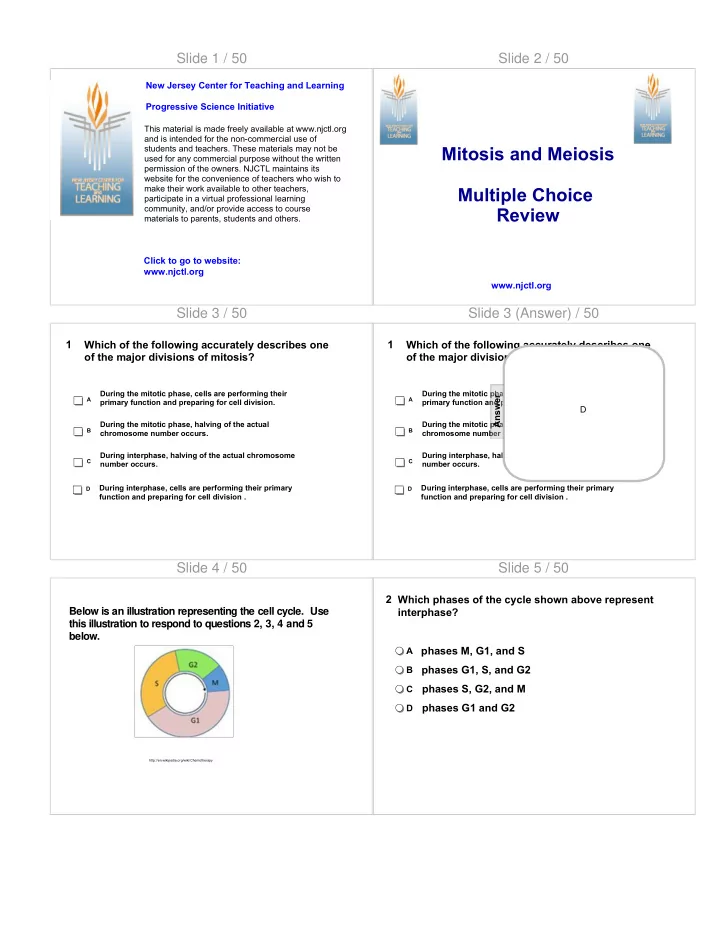
Below is an illustration representing the cell cycle. Use this illustration to respond to questions 2, 3, 4 and 5 below.

http://en.wikipedia.org/wiki/Chemotherapy

Slide 5 / 50

2 Which phases of the cycle shown above represent interphase?

A phases M, G1, and S B

phases G1, S, and G2

C

phases S, G2, and M

D

phases G1 and G2

slide-2
SLIDE 2

Slide 5 (Answer) / 50

2 Which phases of the cycle shown above represent interphase?

A phases M, G1, and S B

phases G1, S, and G2

C

phases S, G2, and M

D

phases G1 and G2

[This object is a pull tab]

Answer B

Slide 6 / 50

3 Which of the following accurately describes the actions occurring during the phase entitled S?

A Each chromosome is duplicated; each chromosome

results in two sister chromatids attached at a centromere.

B The chromosome number is halved in preparation for cell

division.

C The cell enlarges, proteins are increased and organelles

duplicated.

D Cell reaches maximum size and adds more proteins.

Slide 6 (Answer) / 50

3 Which of the following accurately describes the actions occurring during the phase entitled S?

A Each chromosome is duplicated; each chromosome

results in two sister chromatids attached at a centromere.

B The chromosome number is halved in preparation for cell

division.

C The cell enlarges, proteins are increased and organelles

duplicated.

D Cell reaches maximum size and adds more proteins.

[This object is a pull tab]

Answer A

Slide 7 / 50

4 Which of the following accurately describes the actions occurring during the phase entitled G1?

A Each chromosome is duplicated; each chromosome

results in two sister chromatids attached at a centromere.

B The chromosome number is halved in preparation for cell

division.

C The cell enlarges, proteins are increased and organelles

duplicated.

D Cell reaches maximum size and adds more proteins.

Slide 7 (Answer) / 50

4 Which of the following accurately describes the actions occurring during the phase entitled G1?

A Each chromosome is duplicated; each chromosome

results in two sister chromatids attached at a centromere.

B The chromosome number is halved in preparation for cell

division.

C The cell enlarges, proteins are increased and organelles

duplicated.

D Cell reaches maximum size and adds more proteins.

[This object is a pull tab]

Answer C

Slide 8 / 50

5 If the circle of the cell cycle also represents the time an average cell spends in each phase, which

  • f the following is correct?

A Cells spend the majority of their time in the mitosis phase. B Cells spend more than 75% of their time in interphase. C Cells spend approximately 50% of their time in interphase. D Cells spend approximately 75% of their time in mitosis and

cytokinesis.

slide-3
SLIDE 3

Slide 8 (Answer) / 50

5 If the circle of the cell cycle also represents the time an average cell spends in each phase, which

  • f the following is correct?

A Cells spend the majority of their time in the mitosis phase. B Cells spend more than 75% of their time in interphase. C Cells spend approximately 50% of their time in interphase. D Cells spend approximately 75% of their time in mitosis and

cytokinesis.

[This object is a pull tab]

Answer B

Slide 9 / 50

Below are six (6) images that represent the major phase of

  • ne type of cell reproduction. Use these images to respond to

questions 6, 7, 8, and 9 below .

x

z

y

w

v

q Slide 10 / 50

6 Which of the following represents the correct sequence, based upon the images above? (the letters used to identify each image have no bearing on the image itself)

A x,z,y,w,v,q B

q,w,x,y,v,z

C

v,z,y,x,w,q

D

z,y,x,w,q,v

Slide 10 (Answer) / 50

6 Which of the following represents the correct sequence, based upon the images above? (the letters used to identify each image have no bearing on the image itself)

A x,z,y,w,v,q B

q,w,x,y,v,z

C

v,z,y,x,w,q

D

z,y,x,w,q,v

[This object is a pull tab]

Answer D

Slide 11 / 50

7 During the phase labeled as “y” in the above images, which of the following occurs?

A Spindles are nearly complete and attached to

kinetochores; nuclear membrane is disappearing.

B Spindles are disappearing after moving the chromosomes

to the center; nuclear envelope is re-forming..

C Chromosomes duplicate and become connected by

centromeres; chromosomes are being pulled apart.

D During this section of interphase, chromosomes are not

yet duplicated.

Slide 11 (Answer) / 50

7 During the phase labeled as “y” in the above images, which of the following occurs?

A Spindles are nearly complete and attached to

kinetochores; nuclear membrane is disappearing.

B Spindles are disappearing after moving the chromosomes

to the center; nuclear envelope is re-forming..

C Chromosomes duplicate and become connected by

centromeres; chromosomes are being pulled apart.

D During this section of interphase, chromosomes are not

yet duplicated.

[This object is a pull tab]

Answer A

slide-4
SLIDE 4

Slide 12 / 50

8 During the phase labeled as “w” in the above images, which of the following occurs?

A

Spindles are complete and attached to kinetochores; spindles are pushing chromosomes to the center of the cell.

B Chromosomes have not yet duplicated; will duplicate

during this phase.

C Chromosomes duplicate and become connected by

kinetochores; chromosomes are being pulled apart.

D Chromatids separate at centromeres; spindle fibers pull

them to the poles.

Slide 12 (Answer) / 50

8 During the phase labeled as “w” in the above images, which of the following occurs?

A

Spindles are complete and attached to kinetochores; spindles are pushing chromosomes to the center of the cell.

B Chromosomes have not yet duplicated; will duplicate

during this phase.

C Chromosomes duplicate and become connected by

kinetochores; chromosomes are being pulled apart.

D Chromatids separate at centromeres; spindle fibers pull

them to the poles.

[This object is a pull tab]

Answer D

Slide 13 / 50

9 Which of the six (6) images above does not belong in the phase known as mitosis and what is this phase called?

A Z, this is interphase B

q, this is cytokinesis

C

v, this is cytokinesis

D

w, this is meiosis

Slide 13 (Answer) / 50

9 Which of the six (6) images above does not belong in the phase known as mitosis and what is this phase called?

A Z, this is interphase B

q, this is cytokinesis

C

v, this is cytokinesis

D

w, this is meiosis

[This object is a pull tab]

Answer C

Slide 14 / 50

10 Which of the following accurately describes cytokinesis in plant cells?

A A contractile ring forms followed by a cleavage furrow,

splitting the cell into two.

B A plate forms from vesicles fused together in the center of

the cell, separating the cell into two.

C A contractile ring forms followed by a plate, splitting the

cell into two.

D A plate forms from vesicles, followed by a cleavage

furrow, separating the cell into two.

Slide 14 (Answer) / 50

10 Which of the following accurately describes cytokinesis in plant cells?

A A contractile ring forms followed by a cleavage furrow,

splitting the cell into two.

B A plate forms from vesicles fused together in the center of

the cell, separating the cell into two.

C A contractile ring forms followed by a plate, splitting the

cell into two.

D A plate forms from vesicles, followed by a cleavage

furrow, separating the cell into two.

[This object is a pull tab]

Answer B

slide-5
SLIDE 5

Slide 15 / 50

11 Major checkpoints exist to regulate the cycle of cell reproduction. How do these checkpoints function?

A

Each cell will undergo cell reproduction unless at, each of three checkpoints, the message changes from “go” to “stop”.

B

Cells will not undergo cellular reproduction unless, at each

  • f three checkpoints, the message changes from “stop” to

“go”.

C Each cell will undergo cell reproduction if, at two of the

three checkpoints, a direct message of “stop” is received.

D

Cells will undergo cell reproduction unless contact inhibition occurs and the control system sends a stop signal.

Slide 15 (Answer) / 50

11 Major checkpoints exist to regulate the cycle of cell reproduction. How do these checkpoints function?

A

Each cell will undergo cell reproduction unless at, each of three checkpoints, the message changes from “go” to “stop”.

B

Cells will not undergo cellular reproduction unless, at each

  • f three checkpoints, the message changes from “stop” to

“go”.

C Each cell will undergo cell reproduction if, at two of the

three checkpoints, a direct message of “stop” is received.

D

Cells will undergo cell reproduction unless contact inhibition occurs and the control system sends a stop signal.

[This object is a pull tab]

Answer B

Slide 16 / 50

12 Trisomy 21 is the most common chromosome number abnormality. Which of the following describes the specific chromosome number abnormality and the syndrome it causes?

A Trisomy 21 occurs when there are only 21 pairs of

chromosomes and results in Turner’s syndrome.

B Trisomy 21 occurs when there are three sets of each

chromosome and results in Down’s syndrome.

C

Trisomy 21 occurs when there are three sets of 21 pairs of chromosomes, or a total of 63 chromosomes and results in Turner’s syndrome.

D Trisomy 21 occurs when there are three #21

chromosomes, and results in Down’s syndrome.

Slide 16 (Answer) / 50

12 Trisomy 21 is the most common chromosome number abnormality. Which of the following describes the specific chromosome number abnormality and the syndrome it causes?

A Trisomy 21 occurs when there are only 21 pairs of

chromosomes and results in Turner’s syndrome.

B Trisomy 21 occurs when there are three sets of each

chromosome and results in Down’s syndrome.

C

Trisomy 21 occurs when there are three sets of 21 pairs of chromosomes, or a total of 63 chromosomes and results in Turner’s syndrome.

D Trisomy 21 occurs when there are three #21

chromosomes, and results in Down’s syndrome.

[This object is a pull tab]

Answer D

Slide 17 / 50

13 Chromosome pairs are often referred to as homologous chromosomes. What does this term mean and how does an organism inherit such pairs?

A

This refers to the few chromosomes that have exactly the same gene messages for traits, with both chromosomes inherited from either mother or father.

B

This refers to the chromosomes that have exactly the same gene messages for traits, with one chromosome inherited from the mother and one from the father.

C

This refers to chromosomes that have the same shape and with genes controlling the same traits, with one chromosome inherited from the mother and one from the father.

D

This refers to chromosomes that have the same shape and with genes controlling the same traits, with both chromosomes inherited from either mother or father.

Slide 17 (Answer) / 50

13 Chromosome pairs are often referred to as homologous chromosomes. What does this term mean and how does an organism inherit such pairs?

A

This refers to the few chromosomes that have exactly the same gene messages for traits, with both chromosomes inherited from either mother or father.

B

This refers to the chromosomes that have exactly the same gene messages for traits, with one chromosome inherited from the mother and one from the father.

C

This refers to chromosomes that have the same shape and with genes controlling the same traits, with one chromosome inherited from the mother and one from the father.

D

This refers to chromosomes that have the same shape and with genes controlling the same traits, with both chromosomes inherited from either mother or father.

[This object is a pull tab]

Answer C
slide-6
SLIDE 6

Slide 18 / 50

The illustration below shows two different version of cat coat color. Use this illustration to respond to question 14 below.

Slide 19 / 50

14 In the illustration above, the white and red coat color represent which of the following?

A different alleles found on homologous chromosomes B the same alleles found on homologous chromosomes. C different alleles found on one chromosome D the same alleles found on one chromosome

Slide 19 (Answer) / 50

14 In the illustration above, the white and red coat color represent which of the following?

A different alleles found on homologous chromosomes B the same alleles found on homologous chromosomes. C different alleles found on one chromosome D the same alleles found on one chromosome

[This object is a pull tab]

Answer A

Slide 20 / 50

15 Which of the following accurately states the end result of meiosis?

A four diploid cells B

  • ne diploid cell

C

four haploid cells

D

  • ne haploid cell

Slide 20 (Answer) / 50

15 Which of the following accurately states the end result of meiosis?

A four diploid cells B

  • ne diploid cell

C

four haploid cells

D

  • ne haploid cell

[This object is a pull tab]

Answer C

Slide 21 / 50

16 During which division does the halving of chromosomes occur?

A meiosis I B

meiosis II

C

Both meiosis I and II

D

mitosis II

slide-7
SLIDE 7

Slide 21 (Answer) / 50

16 During which division does the halving of chromosomes occur?

A meiosis I B

meiosis II

C

Both meiosis I and II

D

mitosis II

[This object is a pull tab]

Answer A

Slide 22 / 50

17 A genetic rearrangement often occurs during meiosis that increases genetic variation in

  • ffspring. What is this event and when it is most

likely to occur during meiosis?

A crossing over; during anaphase II B crossing over; during telophase I C spontaneous mutations; during metaphase I D independent assortment; during metaphase I

Slide 22 (Answer) / 50

17 A genetic rearrangement often occurs during meiosis that increases genetic variation in

  • ffspring. What is this event and when it is most

likely to occur during meiosis?

A crossing over; during anaphase II B crossing over; during telophase I C spontaneous mutations; during metaphase I D independent assortment; during metaphase I

[This object is a pull tab]

Answer B

Slide 23 / 50

There are numerous ways in which homologous chromosomes can be combined during independent assortment. We can quantify this by using the following formula: Given n pairs of chromosomes, there are 2

n ways of combining

homologous chromosomes. Use this information to respond to questions 18 and 19 below.

Slide 24 / 50

18 Fruit flies (Drosophila melanogaster) have a diploid number of chromosomes of eight (8). Therefore, their haploid number is four (4). How many different ways can fruit fly homologues be combined?

A 256 different ways B

16 different ways

C

4 different ways

D

2 different ways

Slide 24 (Answer) / 50

18 Fruit flies (Drosophila melanogaster) have a diploid number of chromosomes of eight (8). Therefore, their haploid number is four (4). How many different ways can fruit fly homologues be combined?

A 256 different ways B

16 different ways

C

4 different ways

D

2 different ways

[This object is a pull tab]

Answer B

slide-8
SLIDE 8

Slide 25 / 50

19 Spinach (Spinacia oleracea) cells have a haploid number of 5 chromosomes. How many different ways can spinach homologues be combined?

A 25 different ways B

4 different ways

C

1024 different ways

D

32 different ways

Slide 25 (Answer) / 50

19 Spinach (Spinacia oleracea) cells have a haploid number of 5 chromosomes. How many different ways can spinach homologues be combined?

A 25 different ways B

4 different ways

C

1024 different ways

D

32 different ways

[This object is a pull tab]

Answer D

Slide 26 / 50

The illustration below represents the phases of one type of cellular reproduction. Use this illustration to respond to questions 20, 21 and 22 below.

http://www.tokresource.org/tok_classes/biobiobio/biomenu/meiosis

Slide 27 / 50

20 The area labeled 1 represents which type of cellular reproduction?

A mitosis 1 B

mitosis 2

C

meiosis 1

D

meiosis 2

Slide 27 (Answer) / 50

20 The area labeled 1 represents which type of cellular reproduction?

A mitosis 1 B

mitosis 2

C

meiosis 1

D

meiosis 2

[This object is a pull tab]

Answer C

Slide 28 / 50

21 During the step labeled as 2 in the illustration above, an event occurs that leads to greater genetic variation. What is this event and during which phases does it occur?

A independent assortment, anaphase 1 B

crossing over, prophase 1

C

independent assortment, metaphase 2

D

crossing over, metaphase 1

slide-9
SLIDE 9

Slide 28 (Answer) / 50

21 During the step labeled as 2 in the illustration above, an event occurs that leads to greater genetic variation. What is this event and during which phases does it occur?

A independent assortment, anaphase 1 B

crossing over, prophase 1

C

independent assortment, metaphase 2

D

crossing over, metaphase 1

[This object is a pull tab]

Answer B

Slide 29 / 50

22 The cells labeled 4 in the illustration above are considered to be which type of cells?

A diploid gametes B

haploid gametes

C

diploid body cells

D

haploid body cells

Slide 29 (Answer) / 50

22 The cells labeled 4 in the illustration above are considered to be which type of cells?

A diploid gametes B

haploid gametes

C

diploid body cells

D

haploid body cells

[This object is a pull tab]

Answer B

Slide 30 / 50

The table below shows partial data from an onion root tip lab (prometaphase, and prophase are combined in this example). Use this information to respond to questions 23, 24 and 25 below.

Phase of mitosis Total # of cells in this phase Total number of cells in all phases** Prophase 40 200 metaphase 10 200 anaphase 10 200 telophase 10 200 **interphase included although not listed in this table of data

Slide 31 / 50

23 What percentage of cells viewed were identified to be in each of the phases: prophase, metaphase, anaphase and telophase?

A 40, 10, 10, 10 B

400, 100, 100, 100

C

20, 5, 5, 5

D

2.0, 1.0, 1.0, 1.0

Slide 31 (Answer) / 50

23 What percentage of cells viewed were identified to be in each of the phases: prophase, metaphase, anaphase and telophase?

A 40, 10, 10, 10 B

400, 100, 100, 100

C

20, 5, 5, 5

D

2.0, 1.0, 1.0, 1.0

[This object is a pull tab]

Answer C

slide-10
SLIDE 10

Slide 32 / 50

24 Given the information provided in the table above, what percentage of the total cells viewed were in interphase?

A 35% B

95%

C

30%

D

65%

Slide 32 (Answer) / 50

24 Given the information provided in the table above, what percentage of the total cells viewed were in interphase?

A 35% B

95%

C

30%

D

65%

[This object is a pull tab]

Answer D

Slide 33 / 50

25 Assume that, on average, it takes 1,440 minutes for onion root tip cells to complete the cell cycle. Based upon this information, how long is an onion root cell typically in prophase?

A 144 minutes B

288 minutes

C

2,880 minutes

D

72 minutes

Slide 33 (Answer) / 50

25 Assume that, on average, it takes 1,440 minutes for onion root tip cells to complete the cell cycle. Based upon this information, how long is an onion root cell typically in prophase?

A 144 minutes B

288 minutes

C

2,880 minutes

D

72 minutes

[This object is a pull tab]

Answer B

Slide 34 / 50

26 Assume that, on average, it takes 1,440 minutes for onion root tip cells to complete the cell cycle. Based upon this information, typically how long is an onion root cell in interphase?

A 504 minutes B

936 minutes

C

1,296 minutes

D

1,008 minutes

Slide 34 (Answer) / 50

26 Assume that, on average, it takes 1,440 minutes for onion root tip cells to complete the cell cycle. Based upon this information, typically how long is an onion root cell in interphase?

A 504 minutes B

936 minutes

C

1,296 minutes

D

1,008 minutes

[This object is a pull tab]

Answer B

slide-11
SLIDE 11

Slide 35 / 50

27 During meiosis nondisjunction may occur. Which

  • f the following accurately describes

nondisjunction?

A This occurs when chromosomes fail to separate during

meiosis.

B This occurs when chromosomes break and fragments are

passed on.

C This occurs when chromosomes cross over and trade

genetic information.

D This occurs when only three instead of four cells are

produced from meiosis.

Slide 35 (Answer) / 50

27 During meiosis nondisjunction may occur. Which

  • f the following accurately describes

nondisjunction?

A This occurs when chromosomes fail to separate during

meiosis.

B This occurs when chromosomes break and fragments are

passed on.

C This occurs when chromosomes cross over and trade

genetic information.

D This occurs when only three instead of four cells are

produced from meiosis.

[This object is a pull tab]

Answer A

Slide 36 / 50

28 What determines “maleness” in humans?

A An extra Y chromosome, resulting in YY B A single X chromosome, resulting in XO C A single Y chromosome, regardless of number of X

chromosomes.

D A single X chromosome, regardless of the presence of any

Y chromosomes.

Slide 36 (Answer) / 50

28 What determines “maleness” in humans?

A An extra Y chromosome, resulting in YY B A single X chromosome, resulting in XO C A single Y chromosome, regardless of number of X

chromosomes.

D A single X chromosome, regardless of the presence of any

Y chromosomes.

[This object is a pull tab]

Answer C

Slide 37 / 50

Below is an image of a human karyotype. Use this image to respond to questions 29 and 30 below.

Slide 38 / 50

29 What condition is shown in the human karyotype seen above?

A aneuploidy B

haploidy

C

diploidy

D

polyploidy

slide-12
SLIDE 12

Slide 38 (Answer) / 50

29 What condition is shown in the human karyotype seen above?

A aneuploidy B

haploidy

C

diploidy

D

polyploidy

[This object is a pull tab]

Answer D

Slide 39 / 50

30 What is the sex chromosome designation for this individual and are they considered male or female?

A XXY, male B

XXY, female

C

YYX, male

D

YYX, female

Slide 39 (Answer) / 50

30 What is the sex chromosome designation for this individual and are they considered male or female?

A XXY, male B

XXY, female

C

YYX, male

D

YYX, female

[This object is a pull tab]

Answer A

Slide 40 / 50

31 Which of the following is accurate when describing mitosis in human cells?

A All cells in the human body are able to perform mitosis for

repair or continued growth.

B Most cells in the human body undergo mitosis, except for

those “stuck” in the Go phase or that perform meiosis.

C All human cells are able to undergo mitosis, except for

those performing meiosis.

D Once a human has stopped growing, very few cells

continue to undergo mitosis.

Slide 40 (Answer) / 50

31 Which of the following is accurate when describing mitosis in human cells?

A All cells in the human body are able to perform mitosis for

repair or continued growth.

B Most cells in the human body undergo mitosis, except for

those “stuck” in the Go phase or that perform meiosis.

C All human cells are able to undergo mitosis, except for

those performing meiosis.

D Once a human has stopped growing, very few cells

continue to undergo mitosis.

[This object is a pull tab]

Answer B

Slide 41 / 50

32 When treating many types of cancer, the treatments often result in loss of hair (as one side effect). Why is this a common side effect?

A Treatments target cells that divide infrequently, such as

cancer cells and hair follicle cells.

B Treatments target cells that divide slowly, such as cancer

cells and hair follicle cells.

C Treatments target cells that divide quickly, such as cancer

cells and hair follicle cells.

D Treatments are administered and the hair follicle cells do

not have enough resources to reproduce.

slide-13
SLIDE 13

Slide 41 (Answer) / 50

32 When treating many types of cancer, the treatments often result in loss of hair (as one side effect). Why is this a common side effect?

A Treatments target cells that divide infrequently, such as

cancer cells and hair follicle cells.

B Treatments target cells that divide slowly, such as cancer

cells and hair follicle cells.

C Treatments target cells that divide quickly, such as cancer

cells and hair follicle cells.

D Treatments are administered and the hair follicle cells do

not have enough resources to reproduce.

[This object is a pull tab]

Answer C

Slide 42 / 50

33 For which types of cancer, generally, would stem cell transplants and/or bone marrow transplant be used?

A These are more typically used to treat cancers of blood

forming tissues, such as lymphomas.

B These are more typically used to treat epithelial tissue

cancers, known as carcinomas.

C These are more typically used to treat connective tissue

cancers known as sarcomas.

D These are more typically used to treat dangerous skin

cancers, known as melanomas.

Slide 42 (Answer) / 50

33 For which types of cancer, generally, would stem cell transplants and/or bone marrow transplant be used?

A These are more typically used to treat cancers of blood

forming tissues, such as lymphomas.

B These are more typically used to treat epithelial tissue

cancers, known as carcinomas.

C These are more typically used to treat connective tissue

cancers known as sarcomas.

D These are more typically used to treat dangerous skin

cancers, known as melanomas.

[This object is a pull tab]

Answer A

Slide 43 / 50

Below is an image representing an event that often occurs during cell reproduction. Use this image to respond to questions 34, 35 and 35 below.

http://www2.estrellamountain.edu/faculty/farabee/biobk/biobookmeiosis.html

1. 2.

Slide 44 / 50

34 In the illustration above, two pairs of chromosomes are labeled “1”. Which of the following is the accurate text label for these chromosomes?

A heterogeneous chromosomes B

nondisjunction chromosomes

C

homologous chromosomes

D

male sex chromosomes

Slide 44 (Answer) / 50

34 In the illustration above, two pairs of chromosomes are labeled “1”. Which of the following is the accurate text label for these chromosomes?

A heterogeneous chromosomes B

nondisjunction chromosomes

C

homologous chromosomes

D

male sex chromosomes

[This object is a pull tab]

Answer C

slide-14
SLIDE 14

Slide 45 / 50

35 In the illustration above, one set of chromosomes is labeled “2”; most specifically an area found where the chromosomes are twisted. What is this specific area called?

A crossing junction B

chiasmata

C

centromere

D

kinetochore

Slide 45 (Answer) / 50

35 In the illustration above, one set of chromosomes is labeled “2”; most specifically an area found where the chromosomes are twisted. What is this specific area called?

A crossing junction B

chiasmata

C

centromere

D

kinetochore

[This object is a pull tab]

Answer B

Slide 46 / 50

36 During which type of cellular reproduction does crossing over occur?

A Only during mitosis B

During mitosis and meiosis.

C

Only during meiosis.

D

During mitosis of eukaryotic cells.

Slide 46 (Answer) / 50

36 During which type of cellular reproduction does crossing over occur?

A Only during mitosis B

During mitosis and meiosis.

C

Only during meiosis.

D

During mitosis of eukaryotic cells.

[This object is a pull tab]

Answer C

Slide 47 / 50

37 Chromosomes in humans and many other

  • rganisms can be divided into two types. What

are these two types, and for which type is aneuploidy typically more harmful?

A Somatic and autosomal chromosomes; somatic B Sex and autosomal chromosomes; autosomal C Sex and somatic chromosomes; sex D Sex and autosomal; sex

Slide 47 (Answer) / 50

37 Chromosomes in humans and many other

  • rganisms can be divided into two types. What

are these two types, and for which type is aneuploidy typically more harmful?

A Somatic and autosomal chromosomes; somatic B Sex and autosomal chromosomes; autosomal C Sex and somatic chromosomes; sex D Sex and autosomal; sex

[This object is a pull tab]

Answer B

slide-15
SLIDE 15

Slide 48 / 50

38 Polyploidy is lethal in human beings, however for some organisms it can results in larger

  • rganisms. Which organisms may flourish under

polyploidy conditions?

A protists B

bacteria

C

prokaryotic cells

D

plants

Slide 48 (Answer) / 50

38 Polyploidy is lethal in human beings, however for some organisms it can results in larger

  • rganisms. Which organisms may flourish under

polyploidy conditions?

A protists B

bacteria

C

prokaryotic cells

D

plants

[This object is a pull tab]

Answer D

Slide 49 / 50

39 Comparing mitosis and meiosis, which of the following is an accurate statement?

A Most plant and animal cells undergo mitosis however only

animals are able to perform meiosis.

B Most plant and animal cells undergo mitosis however only

plants are able to perform meiosis.

C Most plant and animal cells undergo mitosis; both plants

and animals are able to perform meiosis.

D Plants perform mitosis while animals perform meiosis.

Slide 49 (Answer) / 50

39 Comparing mitosis and meiosis, which of the following is an accurate statement?

A Most plant and animal cells undergo mitosis however only

animals are able to perform meiosis.

B Most plant and animal cells undergo mitosis however only

plants are able to perform meiosis.

C Most plant and animal cells undergo mitosis; both plants

and animals are able to perform meiosis.

D Plants perform mitosis while animals perform meiosis.

[This object is a pull tab]

Answer C

Slide 50 / 50

40 Which of the following accurately describes a phase we call the Go phase?

A This is a part of mitotic interphase where certain cells are

never given the signal to proceed with cell reproduction.

B This is a part of meiosis interphase where sex cells are not

given the signal to proceed with cell division.

C This is a part of mitotic interphase where cells are not

given a “stop” signal and cancer cells are produced.

D This is a part of meiosis interphase where sex cells are not

given a “stop” signal and cancer cells are produced.

Slide 50 (Answer) / 50

40 Which of the following accurately describes a phase we call the Go phase?

A This is a part of mitotic interphase where certain cells are

never given the signal to proceed with cell reproduction.

B This is a part of meiosis interphase where sex cells are not

given the signal to proceed with cell division.

C This is a part of mitotic interphase where cells are not

given a “stop” signal and cancer cells are produced.

D This is a part of meiosis interphase where sex cells are not

given a “stop” signal and cancer cells are produced.

[This object is a pull tab]

Answer A