Psychophysics, Estimating Perceptual Scales with Interval Properties - - PowerPoint PPT Presentation

psychophysics
SMART_READER_LITE
LIVE PREVIEW

Psychophysics, Estimating Perceptual Scales with Interval Properties - - PowerPoint PPT Presentation

Psychophysics, Estimating Perceptual Scales with Interval Properties quest-ce que cest ? Kenneth Knoblauch & Laurence T. Maloney Gustav Fechner (1801 - 1887) 1. Inserm, U846 Stem Cell and Brain Research Institute A body of


slide-1
SLIDE 1

Estimating Perceptual Scales with Interval Properties

Kenneth Knoblauch & Laurence T. Maloney

  • 1. Inserm, U846

Stem Cell and Brain Research Institute

  • Dept. Integrative Neurosciences

Bron, France

  • 2. Department of Psychology

Center for Neural Science New York University New York, NY 10003, USA

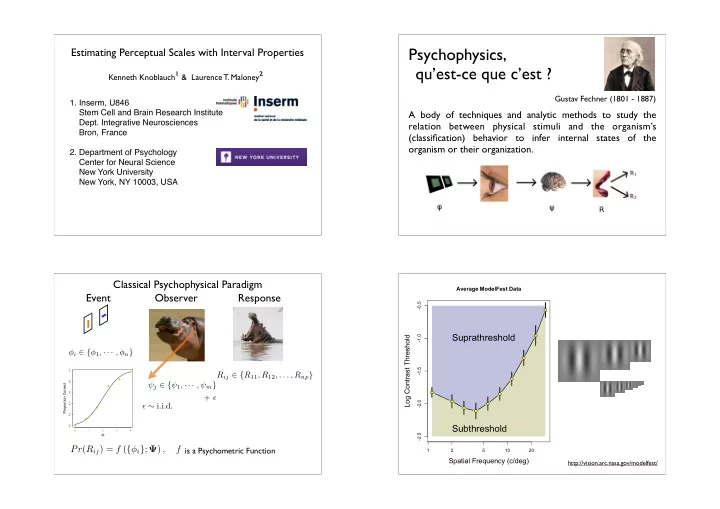
Psychophysics, qu’est-ce que c’est ?

A body of techniques and analytic methods to study the relation between physical stimuli and the organism’s (classification) behavior to infer internal states of the

  • rganism or their organization.

Gustav Fechner (1801 - 1887)

Classical Psychophysical Paradigm Event

φi ∈ {φ1, · · · , φn}

Observer

ǫ ∼ i.i.d. ψj ∈ {ψ1, · · · , ψm} + ǫ

Pr(Rij) = f ({φi}; Ψ) , f is a Psychometric Function

1 2 3 4 0.0 0.2 0.4 0.6 0.8 1.0

  • Proportion Correct

Response

Rij ∈ {R11, R12, . . . , Rnp}

1 2 5 10 20

  • 2.5
  • 2.0
  • 1.5
  • 1.0
  • 0.5

Average ModelFest Data

Spatial Frequency (c/deg) Log Contrast Threshold

Suprathreshold Subthreshold

http://vision.arc.nasa.gov/modelfest/

slide-2
SLIDE 2

Paired Comparisons

a b Find numbers, such that when b is judged of higher contrast than a, .

(ψa, ψb), ψb > ψa

Decision variable:

∆ = ψb − ψa + ǫ, ǫ ∼ N(0, σ2) (ψ1, ψ2, . . . , ψn)

Only yields an ordinal scale! Any monotonic transformation of the above scale is equally valid!

Equal-variance, Gaussian Signal Detection Model

Series of Suprathreshold contrasts

How to quantify the evolution of suprathreshold perception along a physical dimension (like contrast)? How do different perceptual dimensions combine?

0.05 0.07 0.10 0.13 0.19 0.26 0.36 0.50 0.70

Two Questions to be considered in this talk 1) Difference Scaling: MLDS

(Maloney & Yang (2003). J Vision)

2) Conjoint Measurement: MLCM

(Luce & Tukey (1964) J Math Psych; Ho, Landy & Maloney (2008) Psych Science)

Both methods based on ordering intervals between stimuli and not on ordering stimuli, per se. Ordering intervals leads to scales with interval properties, i.e, equal scale differences correspond to equal perceptual differences. Methods that yield an interval scale

Knoblauch & Maloney, J. Stat. Soft., 25, 1 - 26.

Difference Scaling: Correlation in scatterplots

  • r = 0
  • r = 0.1
  • r = 0.2
  • r = 0.3
  • r = 0.4
  • r = 0.5
  • r = 0.6
  • r = 0.7
  • r = 0.8
  • r = 0.9
  • r = 0.98
  • 0.0

0.2 0.4 0.6 0.8 1.0 0.0 0.2 0.4 0.6 0.8 1.0

r Difference Scale Value

ψ(r) ≈ r2

slide-3
SLIDE 3

Difference Scaling: Triads

a b c

Between which pair, (a, b) or (b, c), is the contrast difference greatest?

Conjoint Measurement

Ho, Landy & Maloney (2008) Psych Science

Conjoint Measurement is a psychophysical procedure used to estimate the interaction of perceptual scales for stimuli distributed along physical continua. n ≥ 2 Luce & Tukey (1964) J Math Psych

TIME Fixation 200ms Surface 1 400ms ISI (blank screen) 200ms Surface 2 400ms Response

!"#$!%&'()&'*+, !"#$!%&'()&'*+,

From a set of p stimuli varying along 2 dimensions, a random pair, , is chosen and presented to the observer as in this example. Which is bumpier (glossier)? (Iij, Ikl) The aim of the Maximum Likelihood Difference Scaling (MLDS) procedure is to estimate scale values, that best capture the observer’s judgments of the perceptual difference between the stimuli in each pair.

Maximum Likelihood Difference Scaling: MLDS The decision model

where are estimated scale values, and a scale factor. ψi σ Given a quadruple, from a single trial, we assume that the observer chooses the upper pair to be further apart when q = (a, b ; c, d), ǫ ∼ N(0, σ2)

∆(a, b ; c, d) = (ψd − ψc) − (ψb − ψa) + ǫ > 0

slide-4
SLIDE 4

B1 = ψb(b1) + χg(g1) B2 = ψb(b2) + χg(g2) ∆ = B1 − B2 + ǫ > 0 ⇔ “First” ǫ ∼ N(0, σ2)

Ho, Landy & Maloney (2008), Psych Science

The decision model

b2 g2 b1 g1 Bumpier? Maximum Likelihood Conjoint Measurement: MLCM Estimation of Scale Values: MLDS

L(Ψ, σ) =

n

  • k=1

Φ

  • δ
  • qk

σ 1−Rk 1 − Φ

  • δ
  • qk

σ Rk

  • Maloney and Yang (2003) used a direct method for estimating

the maximum likelihood scale values, where δ(qk) = |ψd − ψc| −| ψb − ψa| Φ Rk Ψ =( ψ2, ψ3, . . . , ψp−1) is the cumulative standard Gaussian (a probit analysis) is 0/1 if the judgment is lower/upper ψ1 = 0, ψp = 1 for identifiability, p − 1 leaving parameters to estimate

Maloney LT, Yang JN (2003). “Maximum Likelihood Difference Scaling.” Journal of Vision, 3(8), 573–585. URL http://www.journalofvision.org/3/8/5.

Estimation of Scale Values: MLCM

Ho, Landy & Maloney (2008) used a direct method for estimating the maximum likelihood scale values, L(Ψ, σ) =

n

  • k=1

Φ

  • δ
  • qk

σ 1−Rk 1 − Φ

  • δ
  • qk

σ Rk

  • where

Ψ = (ψ2, · · · , ψp, χ2, · · · , χq) δ(qk) = (ψb1 + χg1) − (ψb2 + χg2)

Φ Rk is the cumulative standard Gaussian (a probit analysis) is 0/1 if the judgment is left/right image

ψ1 = χ1 = 0

and for identifiability, leaving parameters to estimate

σ = 1 p + q − 2

Estimation of Scale Values: MLDS

This problem can, also, be conceptualized as a GLM. Each level of the stimulus is treated as a covariate in the design matrix, taking on values of , depending on the presence of the stimulus in a trial and its weight in the decision variable. 0 or ± 1 For model identifiability, we drop the first column (fixing and ), equal variance, Gaussian, signal detection model. ψ1 = 0 σ = 1

p p p p p p p p p p p

The estimated scale is unique up to linear transformations.

resp S1 S2 S3 S4 1 4 8 2 3 2 1 2 3 6 11 3 1 2 6 7 10 4 4 11 1 2 5 9 11 7 8 6 7 10 1 3         1 −1 −1 1 1 −1 −1 1 1 −1 −1 1 1 −1 −1 1 1 −1 −1 1 1 −1 −1 1        

. . . . . .

slide-5
SLIDE 5

Estimation of Scale Values: MLCM

The problem can also be conceptualized as a GLM. Each level of the stimulus is treated as a covariate in the model matrix, taking on values of in the design matrix, depending on the presence of the stimulus in a trial and its weight in the decision variable. 0 or ± 1 For model identifiability, we drop the first two columns along each dimension, fixing and .

Resp G1 G2 B1 B2 1 1 3 4 4 3 2 1 3 5 4 2 3 0 1 1 1 4 4 0 2 3 1 2 5 0 1 4 3 4 6 1 1 5 5 2

p p p p p q q q q q         1 −1 −1 1 1 −1 −1 1 1 −1 1 −1 1 −1 1 −1 1 −1 1 −1 −1 1        

ψ1 = χ1 = 0 σ = 1

Equi-Response Differences

Correlation Stimulus 1 Correlation Stimulus 2

0.2 0.4 0.6 0.8 0.2 0.4 0.6 0.8

r2

1 − r2 2 = 0.5

Equi-Response Differences

Correlation Stimulus 1 Correlation Stimulus 2

ψ(r) ≈ r2 r2

1 − r2 2 = 0.5

= 0.1

Correlation Stimulus 1 Correlation Stimulus 2

0.2 0.4 0.6 0.8 0.2 0.4 0.6 0.8 0.0 0.2 0.4 0.6 0.8 1.0

= 0.5

Correlation Stimulus 1 Correlation Stimulus 2

0.2 0.4 0.6 0.8 0.2 0.4 0.6 0.8 0.2 0.4 0.6 0.8 1

σ = 0.1 σ = 0.5

  • 4
  • 2

2 4 0.0 0.2 0.4 0.6 0.8 1.0 Difference Prob >

Equi-Response Differences

Correlation Stimulus 1 Correlation Stimulus 2

0.2 0.4 0.6 0.8 0.2 0.4 0.6 0.8

r2

1 − r2 2 = 0.5

x y u

v

Indifference Curve: MLDS

but also

(ψx − ψy) = (ψu − ψv) (ψx − ψu) = (ψy − ψv)

slide-6
SLIDE 6

B1 = B2

ψb(b1) + χg(g1) = ψb(b2) + χg(g2) ψb(b1) − ψb(b2) = χg(g2) − χg(g1)

Indifference Curves: MLCM

∆1 = ∆2 ≈ ∆′

2

∆1 ∆2

Equi-Response Curves

Scale 1 Scale 2

0.2 0.4 0.6 0.8 0.2 0.4 0.6 0.8

∆′

2

Equi-Response Curves

Scale 1 Scale 2

The MLDS package

The MLDS package provides a modeling function, mlds(), that is essentially a wrapper for either glm()

  • r optim(), and will enable estimation of the

perceptual scale values, given a data frame with the previously described structure.

mlds(data, stimulus, method = "glm", lnk = "probit",

  • pt.meth = "BFGS", opt.init = NULL,

control = glm.control(maxit = 50000, epsilon = 1e-14), ... )

It outputs an S3 object of class ‘mlds’ which can be examined further using several method functions: summary, plot, predict, fitted, logLik, boot, coef, vcov The data sets have class ‘mlds.df’ that inherits from ‘data.frame’. It differs in including two attributes, “stimulus” and “invord”. > str(kk1) Classes 'mlds.df' and 'data.frame': 330 obs. of 5 variables: $ resp: int 1 0 0 0 1 1 1 1 0 1 ... $ S1 : int 2 6 7 6 6 6 1 3 2 3 ... $ S2 : int 4 9 9 7 7 9 2 5 5 4 ... $ S3 : int 6 1 2 2 1 1 8 10 7 5 ... $ S4 : int 8 4 3 5 3 5 9 11 8 10 ...

  • attr(*, "invord")= logi FALSE TRUE TRUE TRUE TRUE

TRUE ...

  • attr(*, "stimulus")= num 0.0 0.1 0.2 0.3 0.4 ...

stimulus is a numeric vector of the physical stimulus levels invord is a logical vector indicating whether on each trial the higher scale values were on the botton or top.

The MLDS package The MLCM package

The MLCM package provides a modeling function, mlcm(), that is essentially a wrapper for glm() and will enable estimation of the perceptual scale values, given a data frame with the appropriate structure.

mlcm(x,

  • model = "add",

whichdim = NULL,

  • lnk = "probit",
  • control = glm.control(maxit = 50000, epsilon = 1e-14),

...)

It outputs an S3 object of class ‘mlcm’ which can be examined further using several method functions: summary, anova, plot, logLik, coef, vcov Default model is “additive”, but 2 others may be specified: “independent” (must specify whichdim) and “full”.

slide-7
SLIDE 7

The data sets have class ‘mlcm.df’ that inherits from ‘data.frame’. > str(BumpyGlossy) Classes ‘mlcm.df’ and 'data.frame': 975 obs. of 5 variables: $ Resp: Factor w/ 2 levels "0","1": 2 2 2 1 1 2 1 2 2 2 ... $ G1 : num 3 2 3 1 2 1 1 1 2 2 ... $ G2 : num 4 2 5 1 3 1 4 5 2 3 ... $ B1 : num 4 3 4 1 1 3 3 5 3 3 ... $ B2 : num 3 3 2 4 2 3 4 2 3 2 ...

The MLCM package

> ( bg.add <- mlcm(BumpyGlossy) ) Maximum Likelihood Conjoint Measurement Model: Additive Perceptual Scale: G B Lev1 0.000 0.000 Lev2 0.132 1.693 Lev3 0.185 2.947 Lev4 0.504 4.281 Lev5 0.630 5.275 > ( bg.ind <- mlcm(BumpyGlossy, model = "ind", whichdim = 2) ) Maximum Likelihood Conjoint Measurement Model: Independence Perceptual Scale: [,1] B1 0.00 B2 1.66 B3 2.88 B4 4.16 B5 5.11

Additive Model Independent Model

> anova(bg.ind, bg.add, test = "Chisq") Analysis of Deviance Table Model 1: resp ~ B2 + B3 + B4 + B5 - 1 Model 2: resp ~ (G2 + G3 + G4 + G5 + B2 + B3 + B4 + B5) - 1

  • Resid. Df Resid. Dev Df Deviance P(>|Chi|)

1 971 500.12 2 967 476.48 4 23.635 9.452e-05 ***

We can also test a “full” model with 24 parameters!

> bg.full <- mlcm(BumpyGlossy, model = "full") Model: Full Perceptual Scale: B1 B2 B3 B4 B5 G1 0.00 2.93 4.30 5.58 6.33 G2 1.20 2.95 4.07 5.55 6.73 G3 1.12 3.12 4.45 5.50 6.52 G4 1.96 3.45 4.33 5.93 6.88 G5 1.73 3.21 4.82 6.08 7.25 > anova(bg.add, bg.full, test = "Chisq") Analysis of Deviance Table Model 1: resp ~ (G2 + G3 + G4 + G5 + B2 + B3 + B4 + B5) - 1 Model 2: resp ~ (`G2:B1` + `G3:B1` + `G4:B1` + `G5:B1` + `G1:B2` + `G2:B2` + `G3:B2` + `G4:B2` + `G5:B2` + `G1:B3` + `G2:B3` + `G3:B3` + `G4:B3` + `G5:B3` + `G1:B4` + `G2:B4` + `G3:B4` + `G4:B4` + `G5:B4` + `G1:B5` + `G2:B5` + `G3:B5` + `G4:B5` + `G5:B5`) - 1

  • Resid. Df Resid. Dev Df Deviance P(>|Chi|)

1 967 476.48 2 951 461.53 16 14.947 0.5285

plot(bg.add, type = "b", col = c("red", "blue"), lwd = 3, cex = 1.5)

1 1 1 1 1

1 2 3 4 5 1 2 3 4 5 m

2 2 2 2 2

slide-8
SLIDE 8

Mixed-effects models with MLDS (MLCM)

Three Strategies

  • 1. Re-parameterize in terms of parametric

decision variable

  • 2. Normalize to common scale
  • 3. Regression on estimated coefficients

0.0 0.2 0.4 0.6 0.8 1.0 2 4 6 8 10

r Difference Scale

  • indiv. runs

combined average

Mixed-effects models with MLDS (MLCM):

Re-parameterize in terms of decision variable Φ−1(E[Y ]) = (β + bi)DV, b ∼ N(0, σ2)

re-parameterized as empirical decision variable: then, fit GLMM

DV = ρ2

d − ρ2 c − ρ2 b + ρ2 a

∆ = ψd − ψc − ψb + ψa

resp S1 S2 S3 S4 Run dv 1 1 2 4 6 8 kk1 0.16 2 0 6 9 1 4 kk1 -0.30 3 0 7 9 2 3 kk1 -0.25 4 0 6 7 2 5 kk1 0.04 5 1 6 7 1 3 kk1 -0.07 6 1 6 9 1 5 kk1 -0.23 ... kk.glmm <- glmer(resp ~ dv + (dv + 0 | Run) - 1, data = kk123, family = binomial("probit")) summary(kk.glmm) Generalized linear mixed model fit by the Laplace approximation Formula: resp ~ dv + (dv + 0 | Run) - 1 Data: kk123 AIC BIC logLik deviance 650.8 660.6 -323.4 646.8 Random effects: Groups Name Variance Std.Dev. Run dv 2.2752 1.5084 Number of obs: 990, groups: Run, 3 Fixed effects: Estimate Std. Error z value Pr(>|z|) dv 6.604 0.962 6.865 6.65e-12 ***

0.0 0.2 0.4 0.6 0.8 1.0 2 4 6 8 10

r Difference Scale

  • indiv. runs

combined average glmm pred.

> coef(kk.glmm) $Run dv kk1 5.433941 kk2 8.459360 kk3 5.761285

Mixed-effects models with MLDS (MLCM):

Re-parameterize in terms of decision variable

slide-9
SLIDE 9

Experiment of Fleming, Jäkel and Maloney. Perception of transparency as a function of rendered index of refraction

Mixed-effects models with MLDS (MLCM):

Normalize to common scale

No simple functional description of relation because of kink in curve Use each individual’s scale value to compute decision variables and fit GLMM to these value; normalizes out individual shape differences.

1.2 1.4 1.6 1.8 2.0 2.2 5 10 15 20 Index of Refraction Difference Scale

  • DVo = ˆ

ψd,o − ˆ ψc,o − ˆ ψb,o + ˆ ψa,o

Mixed-effects models with MLDS (MLCM):

Normalize to common scale

Index of Refraction Difference Scale

5 10 15 1.2 1.6 2.0

  • O1
  • O2

1.2 1.6 2.0

  • O3
  • O4

1.2 1.6 2.0

  • O5

5 10 15

  • O6

Mixed-effects models with MLDS (MLCM):

Regression on estimated coefficients

For this approach we use lmer and fit the coefficients as a function of the stimulus level using MLDS directly.

1.2 1.4 1.6 1.8 2.0 2.2 5 10 15 20 Index of Refraction Difference Scale

  • ˆ

ψ(S) ∼ (β1 + b1)S + (β2 + b2)S2 + · · · + ǫ

By taking the log of the coefficients, we transform the multiplicative effect to additive. We use polynomials to fit the fixed effect but also to model random differences in the shapes of the function across observers

log( ˆ ψ(S)) ∼ (β0 + b0) + (β1 + b1)S + (β2 + b2)S2 + · · · + ǫ

Mixed-effects models with MLDS (MLCM):

Regression on estimated coefficients

First, test random effects:

log( ˆ ψ(S)) ∼ (β0 + b0) + (β1 + b1)S + (β2 + b2)S2 + · · · + ǫ

slide-10
SLIDE 10

Mixed-effects models with MLDS (MLCM):

Regression on estimated coefficients

Then, test fixed effects:

Mixed-effects models with MLDS (MLCM):

Regression on estimated coefficients

Index of Refraction Difference Scale

5 10 15 1.2 1.4 1.6 1.8 2.0 2.2

  • O1
  • O2

1.2 1.4 1.6 1.8 2.0 2.2

  • O3
  • O4

1.2 1.4 1.6 1.8 2.0 2.2

  • O5

5 10 15

  • O6

Index of Refraction Log Difference Scale

0.0 0.5 1.0 1.2 1.4 1.6 1.8 2.0 2.2

  • O1
  • O2

1.2 1.4 1.6 1.8 2.0 2.2

  • O3
  • O4

1.2 1.4 1.6 1.8 2.0 2.2

  • O5

0.0 0.5 1.0

  • O6

Linear Scale Log Scale

  • Difference Scaling and Conjoint Measurement are

psychophysical techniques that permit estimation

  • f interval perceptual scales by maximum likelihood
  • The two approaches are implemented in R packages

MLDS and MLCM, respectively, on CRAN.

  • We can introduce mixed-effects into the MLDS

and MLCM (not shown) models using the lme4 package (and perhaps others).

Thank you.