ProtoDUNE-Dual Phase CRP construction, cold box operation and tests - - PowerPoint PPT Presentation

protodune dual phase crp construction cold box operation
SMART_READER_LITE
LIVE PREVIEW

ProtoDUNE-Dual Phase CRP construction, cold box operation and tests - - PowerPoint PPT Presentation

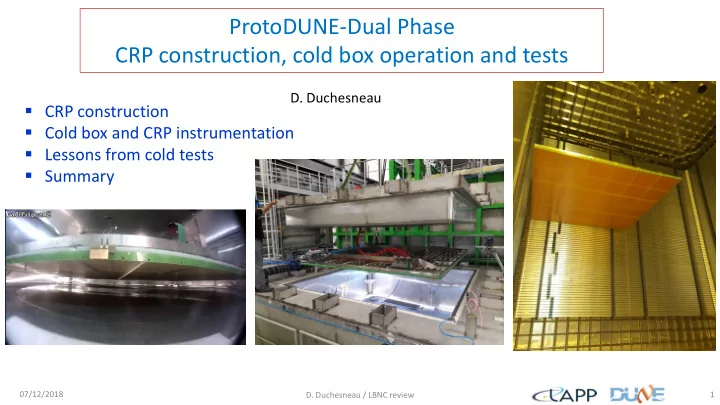
ProtoDUNE-Dual Phase CRP construction, cold box operation and tests D. Duchesneau CRP construction Cold box and CRP instrumentation Lessons from cold tests Summary 07/12/2018 1 D. Duchesneau / LBNC review Charge Readout Plane


slide-1
SLIDE 1
  • D. Duchesneau / LBNC review

1

ProtoDUNE-Dual Phase CRP construction, cold box operation and tests

  • CRP construction
  • Cold box and CRP instrumentation
  • Lessons from cold tests
  • Summary
  • D. Duchesneau

07/12/2018

slide-2
SLIDE 2
  • D. Duchesneau / LBNC review

2

Invar Frame G10 Frame + Extraction Grid Instrumentation Detection plane LEM + Anodes

Charge Readout Plane (CRP)

C R P

Components and operating conditions

Seen from top 17mm 4 CRPs

07/12/2018

In NP02 CRYOSTAT

slide-3
SLIDE 3

CRP construction steps: first CRP assembled in May 2018

3/05/18 3/05/18 9/05/18 9/05/18 17/05/18 24/05/18 25/05/18 31/05/18

Invar frame of 1st CRP in clean room Complete assembly of the G10 frame from 9 submodules Coupling of the G10 with invar frame with 50 special decouoling devuces Installation of HV distribution box and cabling + anodes Installation of anodes and LEMs

07/12/2018

  • D. Duchesneau / LBNC review

3

slide-4
SLIDE 4
  • D. Duchesneau / LBNC review

4

CRP: grid production

The grid production and installation: for 1 CRP 30 modules => less than 10 days

  • The grid wires have a tension at warm of

1.5N /wire (0.6N originally)

  • At Liquid Argon temperature: G10 should

contract less than inox => wire tension should increase to 3.5 N/wire Grid + combs + LEMs seen from bottom 64 wires/module

07/12/2018

slide-5
SLIDE 5
  • D. Duchesneau / LBNC review

5

CRP3:« fake » anodes installed on 17/09

CRP3 assembly in September 2018

CRP3 and CRP4: no LEMs and anodes. Those are replaced by 'fake anodes' which are similar to real anodes but with a copper surface on one side and no strip. A test in cold box done beginning of October Installation in NP02 cryostat: Nov 19th

« Fake » anodes

Entering CRB on 17/10

+ full grid mounted CRP3 started while waiting CRP2 LEM and anode production

07/12/2018

slide-6
SLIDE 6
  • D. Duchesneau / LBNC review

6

CRP4 assembly

Started in November but paused to allow modifications on CRP1 and CRP2 Will be resumed in January with grid production and short cold test

07/12/2018

This CRP will have 4 real anodes without LEMs put on this corner CRP1 CRP2 New top LEM HV DB And Bottom LEM cabling

CRP2 assembly in October 2018

slide-7
SLIDE 7
  • D. Duchesneau / LBNC review

7

The planarity of the CRP is measured and adjusted on 50 points and 2-3 iterations. This is performed in one day by CRP.

CRP planarity tuning

Planarity defect and defect repartition for CRP3 : Results for measurements in CR185 (four CRPs) :

07/12/2018

slide-8
SLIDE 8

07/12/2018

  • D. Duchesneau / LBNC review

8

Cold box fulfils the requirements defined in December 2017:

  • Built from January and commissioned in May 2018
  • O2 contamination < 50 ppm
  • LAr evaporation less than 1 mm/h (< 700 W heat input)
  • No boiling nor bubbles, level very quiet
  • Control level +/-0.5 mm with constant refilling

Goals: Electrical and mechanical tests of each final CRP in nominal conditions on points where the 3x1x1 showed problems

  • Characterisation of the operation voltage of each LEM
  • Characterisation of the operation voltage of the grid
  • Test the planarity of the CRP
  • Test the tensioning of the extraction grid wires
  • Test the HV contacts and connections (LEM & grid)

NP02 Cold box 5 sessions of cold test: CRP1, CRP2 and CRP3

slide-9
SLIDE 9
  • D. Duchesneau / LBNC review

9

Cold box test procedure

When CRP and box closed (1 hour)

  • Inject dry air during > 1 day and test the

LEM HV

  • Purge and flush with Gas argon for 1 day
  • Cool down and fill LAr : 10 hours
  • start tests of LEMs + grid

To adjust horizontality the CRP wrt the liquid argon level:

The CRP is lowered or raised manually using the 3 suspension feedthroughs. => 3 days between closure and cold operation Liquid argon consumption during the various processes:

  • Flushing/purge: 500Kg
  • Cool-down: 750Kg
  • Filling: mini 4000Kg
  • Normal operation: 750Kg/24h (about 1400W)

During last CRP1 test

07/12/2018

slide-10
SLIDE 10

Cold box monitoring instrumentation:

TT118 22 cm TT117 20 cm TT116 18 cm TT115 16 cm TT114 4 cm TT113 2 cm TT112 0 cm For cryo operation:

  • Cylindrical level meter AMI LE01

Pressure meter PE04 1 camera in the liquid looking below the CRP:

07/12/2018

  • D. Duchesneau / LBNC review

10

A third camera has been added for the second test:

7 temperature probes (distance from the floor in cm):

1 camera in the gas looking above the CRP:

3 cameras

slide-11
SLIDE 11

Used after the second cold test in July

4 additional level meters have been added on the sides of the CRP => total + 8 Pt sensors have been added to the 4 corners to give an indication of horizontality and if liquid is between grid and LEMs 2 per corner: 1 just above the grid and the 2nd just below the LEM

Level meters and Pt probes

07/12/2018

  • D. Duchesneau / LBNC review

11

CRP instrumentation:

slide-12
SLIDE 12

Measurements done with the 8 level meters during 3 complete regulation cycles on 9/10/18 All 8 LM are seeing the same amplitude and level changes The slopes are similar and trend is linear in this range The blue LM02 seems to be higher by 2mm But same systematic offset for CRP1, CRP3 and CRP2 => the mechanical support under investigation

CRP3 test in October

0.7 V = 1.75 mm

07/12/2018

  • D. Duchesneau / LBNC review

12

Similar spread with CRP1 and CRP2 compatible with planarity survey

slide-13
SLIDE 13
  • During CRP1 third test with optimum argon level sitting between the grid and LEMs:

The regulation on CRP LE02 was 57% from 24/10 to 30/10

Comparisons of stability of LE01 (coaxial in cold box) with respect to LE02 (CRP level meter)

Variation of LE01 is

  • f the order of 0.2

which could translate in uncertainty of 2 mm

Stability over 5.5 days The coaxial level meter response varies with time and effects can be of the order of a 1-3 mm over several hours

No visible level change AMI LE02 LE01 27/10 24/10

07/12/2018

  • D. Duchesneau / LBNC review

13

slide-14
SLIDE 14

07/12/2018

  • D. Duchesneau / LBNC review

14

Cold box tests of CRP from June to November

22/06 09/07 27/11 27/07 17/08 03/1010/10 15/10 30/10 12/11

CRP1 CRP1 CRP1 CRP3 CRP2

Initial HV LEM DB design + Grid Liquid argon level regulated using coaxial level meter Regulation using 1 CRP level meter

slide-15
SLIDE 15

07/12/2018

  • D. Duchesneau / LBNC review

15

Two Upgrades and modifications on CRP were performed after the first 2 cold box tests of CRP1

  • The grid tension and HV connection
  • The HV distribution to the LEM top and bottom layer

HV operation and operating points of the LEMs => 2 interventions needed after the last cold box tests of CRP1 and CRP2

  • CRP1: 4 LEMs showed a problem => had to remove them
  • CRP2: 1 LEM showed a problem => had to remove them

Lessons from the cold box tests

(cf: E. Mazzucato’s talk)

slide-16
SLIDE 16

12/6/2018

  • D. Duchesneau / ProtoDUNE-DP status

16

Second modification on the LEM top distribution box (DB) done in Sept 2018 a few channels have lost the contact within the distribution box. This has been traced back, after a deep investigation, to a failure of the resistor which is embedded completely in Arathane glue in the box and suffer from some differential thermal behaviour. This happened only on 1 or 2 channel per box (each having 6).

After the second cold box test of CRP1: Modifications of the HV distribution of the LEM

Firs modification on the HV distribution of the LEMs bottom on the CRP1 in order to avoid any possible limitation due to sparking in the SHV connectors  => distribution boxes have been removed during first week of September (3-5/09) and replaced them by 6m long HV cables going directly from LEM to outside of the cryostat.

CRP1: new bottom LEM cabling

The CRP1 and CRP2 cold box tests in October and November ran with those modifications: no problem was seen with this new design new PCB boards without the use of Arathane
slide-17
SLIDE 17

HV distribution for LEM and grid

For tests of CRP1 and CRP2 after September:

Connect directly the cables from the LEMs outside the box => Cables pass through special flange with 36 cables for LEM bot, 6 cables for LEM top DB and 1 cable for grid The 36 cables with SHV are connected to a distribution box with 1 output for 6 inputs The 36 Bottom LEM cables are soldered on 3 patch panels Power supply crate used for the LEMs and grid

  • D. Duchesneau / LBNC review

17 07/12/2018

(cf: E. Mazzucato talk)

slide-18
SLIDE 18

Results of the first cold box tests of the first CRP (22/06 – 9/07):

07/12/2018

  • D. Duchesneau / LBNC review

18

HV tests of Grid:

  • Shorts were present with a few (6 to 8) LEMs
  • The maximum voltage was limited of the order of 2 kV in nominal CRP position

Extraction grid test and perfomance

Add 1.5 mm spacers to increase the grid wire tension along the 4 sides of the CRP Spacers: 1 m long Vetronit material Net result: tension at warm went from 0.6 N to 2 N

Modifications performed on CRP1 from 24/07 to 25/07 to : Increase the tension of the grid HV connection to grid

Remove the soldered HV cable to the grid connection and the cable soldered on the main PCB plate Replace the two by soldering an HV cable coming through the flange directly on the grid at the liquid level

slide-19
SLIDE 19

07/12/2018

  • D. Duchesneau / LBNC review

19

High Voltage tests: The 9 m2 CRP has been operated in the dual phase configuration with its entire system of 36 LEMs and grid powered at High voltage for several cycles of liquid argon regulation (more than 10 hours).

Extraction grid: Results of the second cold box test for the CRP1

The solution was to remove the humidity around the SHV connector outside of the cold box to avoid discharges in the connector => thanks to the hair dryer which was heating the

  • utside connector

After drying the connector there was no limit for the grid voltage > 7500 V with current less than 2 nA Before that the situation was not simple: Current fluctuating and some discharges from time to time

Results of the CRP3, last CRP1 and CRP2 tests: the grid has been operated successfully at any voltage needed; no problem of humidity anymore for them (HV cable outside was longer)

  • The 36 LEMs have been operated for several hours at a ∆V up to 31 kV/cm
  • There was no interference nor contact with the grid wires or anything else
  • The grid was operated at full capacity up to 7.5 kV together with the 36 LEMs

turned on over several days.

slide-20
SLIDE 20

12/6/2018

  • D. Duchesneau / ProtoDUNE-DP status

20

Grid wires

  • Unfortunately a problem appeared during the insertion of

CRP3 in the cryostat where 3 wires broke in the process and 7 more in the following days.

  • The manipulation was not soft at all due to an abnormal use
  • f the chain hoist and it has been requested to proceed much

more smoothly for the next manipulations

  • There are 1920 wires of 3m long on each CRP grid.
  • For the 3 CRPs tested in the cold there was no broken wire or faulty soldering among the nearly 6000 wires
  • CRP1 did also 3 times the cold test and the grid experienced the manual retensioning by 2N/wire in July

After investigation and careful check of the 1920 wires it appeared that on a few wires of this CRP there was a sort of small coloration with small deposit along the wires. This was usually located between 1 and 10cm from the PCB supporting plate

  • This is identified as a possible remnant of soldering flux which was not cleaned as it

should have been after soldering. This flux is usually aggressive and may attack the metal. This could eventually explained the breaking of wires.

  • The process of cleaning with distilled water was not properly done on a few wires for this

CRP.

  • We artificially increase the tension of the full grid to see which wires could have been

weakened.

  • In the meantime a thorough inspection of the other CRP grid wire by wire is going on.
slide-21
SLIDE 21

07/12/2018

  • D. Duchesneau / LBNC review

21

Cold box tests of CRP from June to November

22/06 09/07 27/11 27/07 17/08 03/1010/10 15/10 30/10 12/11

CRP1 CRP1 CRP1 CRP3 CRP2

New grid tensionning and HV connection ⇒ Validated ⇒ Found some broken channels on LEM top DB Fake anodes: Test of grid + new LEM top DB + level meters => succesful => EHN1 Initial HV LEM DB design + Grid => some contacts

  • f grid wires with

some LEMs CRP1: removal of LEM bot HV DB and production of new type

  • f LEM top DB

Construction of CRP3 CRP1 with upgraded LEM HV DB 4 LEMs showed bad operating behaviour CRP2 constructed with all upgrades CRP1: 4 LEMs reinstalled after cleaning and tests New cold test next week Liquid argon level regulated using coaxial level meter Regulation using 1 CRP level meter CRP4 to complete and test in Jan. ‘19

slide-22
SLIDE 22
  • D. Duchesneau / LBNC review

22

CRP#1:

  • Reinstall grid after the replacements of 4 LEMs by

10/12

  • Cold box test in December
  • Bring to EHN1 beginning of January 2019

CRP#2:

  • replace 1 LEM and some grid from 11/12 to 14/12
  • Bring to EHN1 before Christmas

CRP#4:

  • Resume the assembly and grid production mid January
  • Short cold box test
  • Bring to EHN1 end January

Next steps for the CRPs:

slide-23
SLIDE 23

Summary:

  • 3 CRPs are constructed and the last one will be completed in January.
  • Several modifications and upgrades have been applied to CRP1 after the various cold box tests
  • The CRP2 is built from this knowledge and is behaving as expected
  • CRP1 and CRP2 LEM HV have been studied in details and results will be shown in the next talk
  • Grid design and nominal performance have been reached and validated for the 3 constructed CRP
  • The cold box is operating in an efficient way with a reasonable turn around; The sequence of operation is well

defined and can be set up rather rapidly. It has worked for CRP1, CRP2 and CRP3

  • The goal is to install the 4 CRPs in the cryostat by the end of January

23

  • D. Duchesneau / LBNC review

07/12/2018