
SLIDE 1
Plans for ProtoDUNE-DP (NP02) after LS2 Dario Autiero SPSC132 - - PowerPoint PPT Presentation
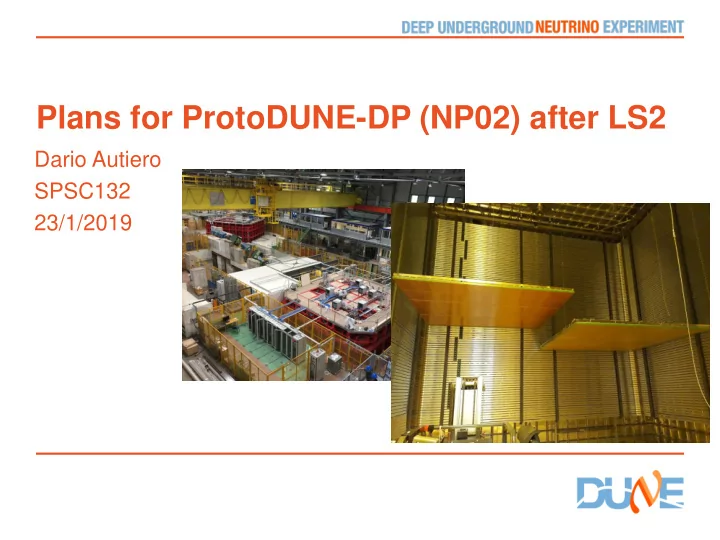
Plans for ProtoDUNE-DP (NP02) after LS2 Dario Autiero SPSC132 23/1/2019 Dual-phase 10 kton design is based on ProtoDUNE dual-phase 1/20 of active area of a DP 10 kton module: ProtoDUNE-DP 4 CRPs DUNE 80 CRPs Digital electronics in uTCA
23/1/2019 D.Autiero | ProtoDUNE-DP after LS2 2
Charge Readout Planes Field Cage sub-modules (common structural elements with SP) Cathode modules
36 cryogenic photomultipliers Hamamatsu R5912-02mod with TPB coating Digital electronics in uTCA crates Accessible cold FE electronics in SFT “chimneys” Dual-phase 10 kton design is based on ProtoDUNE dual-phase 1/20 of active area of a DP 10 kton module: ProtoDUNE-DP 4 CRPs DUNE 80 CRPs
Anode LEM Extraction Grid
23/1/2019 D.Autiero | ProtoDUNE-DP after LS2 3
Editorial team for the TDR DP Volume:
Summary Dario Autiero Charge Readout Planes: Dominique Duchesneau, Edoardo Mazzucato TPC Electronics: Jaime Dawson, Slavic Galymov HV System: Francesco Pietropaolo, Jae Yu Photon Detection System: Burak Bilki, Michel Sorel Data Acquisition System: Jim Brooke, Gerogia Karagiorgi, Brett Viren Calibration Sowjanya Gollapinni, Kendall Mahn Slow Controls and Cryo. Inst.: Glenn Horton-Smith, Carmen Palormares Integration and Installation: Filippo Resnati
DP TDR based on ProtoDUNE-DP design Completion of TDR editing by June 2019 IDR Volume 3 (Dual-Phase Module)
1) Design motivations 2) Charge Readout Planes 3) TPC Electronics 4) HV system 5) Photon Detection System 6) Data Acquistion System 7) Slow Controls and Cryogenic Instrumentation 8) Technical Coordination https://arxiv.org/abs/1807.10340
Consortia:
CRP suspension system
readout electronics, signal chimneys, digital electronics for charge and light readout
VHV power supply and feedthrough
Photomultipliers system, light calibration system
back-end for trigger and storage
Instrumentation (Joint): Slow control system for LAr, GAr, CRP specific SC +
3x1x1 detector operation June-November 2017
at the 3m2 readout scale.
the CRP extraction grid limited to 5 kV
DV (effective gain ~3), max DV reached 3.1 kV ProtoDUNE-DP design improved gaining ~300V in max DV
HV connections
https://arxiv.org/abs/1806.03317
23/1/2019 D.Autiero | ProtoDUNE-DP after LS2 4
Procurement, preparation and QA/QC chain at Saclay All LEMs individually characterized at at 35kV/cm in a high pressure argon gas chamber 3.3 bar (similar gas density conditions as at cold immediately above LAr level)
LEM A143 V I LEM A143
23/1/2019 D.Autiero | ProtoDUNE-DP after LS2 5
23/1/2019 D.Autiero | ProtoDUNE-DP after LS2 6
Conservative guard ring design allowed increasing by about 300V the max. operating voltage
5 + 10 mm clearance 2 + 2 mm clearance
86% active area 96% active area
23/1/2019 D.Autiero | ProtoDUNE-DP after LS2 7
anodes:
phase-like readout on 4 anodes
CRP1 CRP2
First produced Charge Readout Plane inserted in the Cold Box on June 22nd Perform electrical and mechanical tests of each final CRP in nominal thermodynamic conditions:
each LEM
the extraction grid
grid wires
connections (LEM & grid)
23/1/2019 D.Autiero | ProtoDUNE-DP after LS2 8
First cold-box tests on CRP1 22/6-9/7
voltage over the entire plane could be reached in a few minutes
voltage limited to 2 kV
max HV reached ∼4.2kV Inspection to CRP at cold and tests at warm showed that wires were becoming loose at cold because of a thermal contraction differential aspect
to LEM: input connectors and also removal insulating glue around resistors for top LEM (breaking some resistors, implemented recently) Second cold-box test on CRP1 27/7-18/8 (wires tension increased and HV connection improved)
kV/cm
turned on over several days. CRPs 3 and 4 also tested in Cold Box (CRP4 in January) CRPs cabling inside the cryostat being performed this week
23/1/2019 D.Autiero | ProtoDUNE-DP after LS2 9
CRP1 and CRP2 LEM HV Test Results (Oct. – Nov./2018)
with∼1 spark/hour per CRP 9m2 (typical rate per unit of surface of micro-pattern gas detectors)
conditions
tested in parallel to ProtoDUNE-DP operation with dedicated cold-box tests
* PS TRIP time set too
short
VTOP (kV) VBOT (kV) ELEM (kV/cm) Time (h) Spark Rate (h-1) Patm (mbar) Estimated Geff (no ch. up) 0.25 3.35 31.0 12 1.3 968 - 972 20 0.50 3.55-3.60 30.5-31.0 13 1.3 962 - 966 24 - 31 0.75 3.70 29.5 42 0.6 943 - 953 20 1.00 3.80 28.0 18 2 trips* 970 - 976 9 1.00 3.85 28.5 12 3 trips 936 - 947 15 VTOP (kV) VBOT (kV) ELEM (kV/cm) Time (h) Spark Rate (h-1) Patm (mbar) Estimated Geff (no ch. up) 0.10 3.15 – 3.20 30.5 – 31.0 17 0.8 969 - 973 9 - 11 0.25 3.34 30.9 16 1.3 968 – 970 19 0.50 3.55 30.5 11 0.9 957 – 965 24 0.50 3.555 30.55 42 0.5 962 – 964 25
23/1/2019 D.Autiero | ProtoDUNE-DP after LS2 10
23/1/2019 D.Autiero | ProtoDUNE-DP after LS2 11
Analog cryogenic FE:
performed at the beginning of 2016 uTCA 64 channels AMC digitization cards (2.5 MHz, 12 bits
in 2017: batch of 120 cards for 4 CRPs completed and tested White Rabbit timing/trigger distribution system:
system operational on the 3x1x1 since the fall 2016 AMC digitization cards:
Charge readout electronics components:
(R&D since 2006, long standing effort aimed at producing low cost electronics)
3x1x1 since the fall 2016
2017: batch of 120 cards for 4 CRPs completed and tested Main components ASIC amplifiers, ADCs, FPGAs, IDT memories already procured in 2015-2016. 3x1x1 pre-production batch in 2016.
23/1/2019 D.Autiero | ProtoDUNE-DP after LS2 12
system for the online storage facility
Storage servers from CCIN2P3: 20 machines + 5 spares, installed in September 2017 (DELL R510, 72 TB per machine): up to 1.44 PB total disk space for 20 machines, 10 Gbit/s connectivity for each storage server.
~1k cores procured by CERN installed in June 2017, 12 racks, 10
Gbit/s connectivity per rack Additional 40 servers Poweredge C6200 from CCINP3 installed in fall 2018 (more than doubling the computing power of the online farm)
network architecture:
Network infrastructure: 40 Gbit/s DAQ switch + 40/10 Gbit/s router procured by CERN: installation completed in January 2018 Data challenge in April 2018: transfer rate to CERN central EOS steady 20 Gbit/s (peak 35 Gbit/s) over the 40 Gbit/s link to IT 9 Poweredge R610 service units of the DAQ cluster procured from CCIN2P3, installed in May 2018 DAQ back-end: 2 LV1 event builders + 2 LV2 event builders procured by CERN + 2 LV2 event builders procured by KEK: Installed in August 2018 Additional 6 uTCA crates needed for 4 CRPs configuration already procured by KEK
Storage facility Storage facility 2 LV1 + 4 LV2 Event Builders DAQ Service machines Online computing farm New C6200 servers
23/1/2019 D.Autiero | ProtoDUNE-DP after LS2 13 Cryogenic test facility Coating facility
Full characterization of 36 (+4 spares) 8” Hamamatsu PMTs completed at room and cryogenic temperature → arXiv:1806.04571 (submitted to JINST)
mechanical support and 23 m cables)
curves
frequency, tests at different T regimes
➜40 PMTs at CERN ready for installation PMT calibration system
the cryostat + 6 fibers into the cryostat divided at the end in 7 fibers arriving to each PMT)
and tested in LN2
➜Full light calibration system tested in May 2018 and ready for installation
Coated PMT
Completion of 4 CRPs installation in January 2019
23/1/2019 D.Autiero | ProtoDUNE-DP after LS2 14
23/1/2019 D.Autiero | ProtoDUNE-DP after LS2 15
23/1/2019 D.Autiero | ProtoDUNE-DP after LS2 16
(including finalization of cathode installation, ground grid, HV FT, PMTs): 45 days
installation of beam-plug + possible improvements based on ProtoDUNE-DP running experience/parallel tests. Additional improvements (as foreseen for SP): cryo instrumentation, trigger as in 10 kton, calibration systems
23/1/2019 D.Autiero | ProtoDUNE-DP after LS2 17
Motivations for large statistics beam data taking
already mentioned since WA105 (ProtoDUNE-DP) TDR (SPSC-TDR-004). This program was reiterated and refined in the 2016 (SPSC-SR-184) and 2017 (SPSC-SR-206) SPSC reports Proposed beam-based program, including 120 days of beam data, yielding the collection of 175 million beam triggers including both beam polarities and various momenta bins In-depth understanding of detector response and valuable data for FD analysis and systematics: data useful for calibration and enabling precision studies of the hadronic cross sections to improve the nuclear re-scattering models and the modeling of the neutrino energy reconstruction. Assessment of several issues directly relevant to DUNE physics analyses:
kaons in the beam, providing useful information to DUNE’s nucleon decay search
fraction as a function of primary hadron incident energy; (more general interest in hadronic showers modelization
exchange cross section is very important for understanding the background uncertainty in the DUNE far detector oscillation analysis. The branching ratio of this process is small (approximately 10% at 1 GeV) large data sample required to measure this cross section precisely
and the modeling of the neutrino energy reconstruction
23/1/2019 D.Autiero | ProtoDUNE-DP after LS2 18
23/1/2019 D.Autiero | ProtoDUNE-DP after LS2 19
23/1/2019 D.Autiero | ProtoDUNE-DP after LS2 20