
SLIDE 1
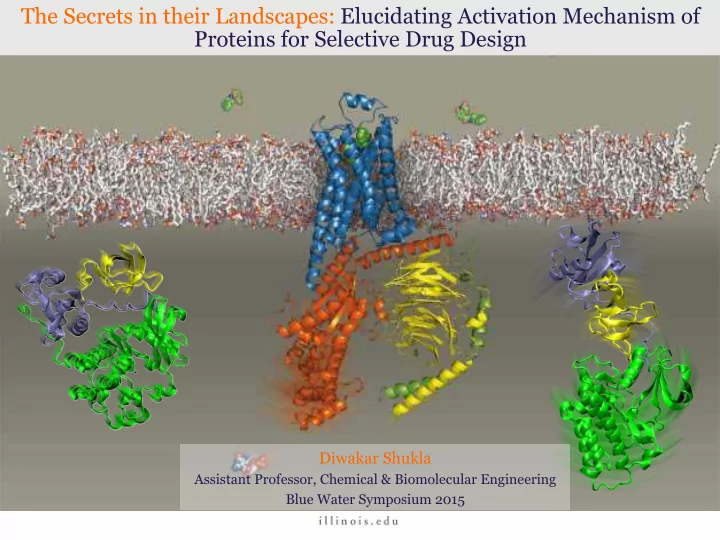
The Secrets in their Landscapes: Elucidating Activation Mechanism of Proteins for Selective Drug Design
Diwakar Shukla
Assistant Professor, Chemical & Biomolecular Engineering Blue Water Symposium 2015
Proteins for Selective Drug Design Diwakar Shukla Assistant - - PowerPoint PPT Presentation
The Secrets in their Landscapes: Elucidating Activation Mechanism of Proteins for Selective Drug Design Diwakar Shukla Assistant Professor, Chemical & Biomolecular Engineering Blue Water Symposium 2015 Cellular Signaling and human diseases
The Secrets in their Landscapes: Elucidating Activation Mechanism of Proteins for Selective Drug Design
Diwakar Shukla
Assistant Professor, Chemical & Biomolecular Engineering Blue Water Symposium 2015
Rosenbaum et. al., Nature, 2009.
Cellular Signaling and human diseases Cellular Signaling and human diseases
Cellular Signaling and diseases Cellular Signaling and diseases
Zanoni et. al., FEBS letters, 583, 11, 2009
Transporters 4% GPCRs 30% Kinases 47% Other Receptors 8% Ion channels 7% Others 4%
Challenge: Long time scale associated with conformational change Challenge: Long time scale associated with conformational change
Markov State Models (MSM) Markov State Models (MSM)
The most basic ingredients of Markov State Models are the states and rate constants connecting them.
familiar in the context
states and transitions are possible
dP
i
dt = kjiPj
j≠i
∑
− kijP
i j≠i
∑
i, j = A, B,C, D
dP
i
dt = kjiPj
j≠i
∑
− kijP
i j≠i
∑
i, j =[0,3000]
Long timescale phenomena as series of Markov jump processes
How do we get rates ?
A B
C
kAB kAC
nanoseconds 100’s of microseconds
Adaptive sampling of the conformational landscape
Adaptive sampling of the conformational landscape
MSM Adaptive Sampling MSM Adaptive Sampling Single MD Trajectory Single MD Trajectory
G-Protein Coupled Receptors G-Protein Coupled Receptors
Kobilka and coworkers, Nature, 2011.
2012 Nobel Prize in Chemistry 14 Angstroms
Kinetics of GPCR molecular switches Kinetics of GPCR molecular switches
Activating ligand bound
μs Connector rmsd from active Helix 5 bulge rmsd from active NPxxY rmsd from active Helix 3-Helix6 Distance Angstroms NPxxY rmsd from active Connector rmsd from active Helix 3-Helix6 Distance Helix 5 bulge rmsd from active Angstroms μs
Receptor without ligand
Intermediate states select for novel drug molecules Intermediate states select for novel drug molecules
Connector rmsd from inactive (Å) H3-H6 distance (Å) Connector rmsd from inactive (Å) H3-H6 distance (Å)
BI-167107 Carazolol inactive active kcal/mol
Conformational changes in Calmodulin
Shukla et al., Nat. Commun., in review, 2015
Conformational changes in Calmodulin
Shukla et al., Nat. Commun., In press, 2015
apo-CaM holo-CaM
Intermediate states along the highest flux pathway
Shukla et al., Nat. Commun., In review, 2015
red: Phe, orange: hydrophobic, grey: other
Hydrophobic repacking of the core determines the substrate selectivity
Prediction of chemically and sterically distinct binding interfaces
red: Phe; orange: hydrophobic; cyan: Met; grey: other
Prediction of chemically and sterically distinct binding interfaces
colorbar units: kcal/mol
White dots represent the available CaM crystal structures in PDB. Simulations were started from only two structures of CaM.
Molecular Design of Drought resistant plants
Fine tuning plants at molecular level
Motivation: Climate Change, Population Growth, Improved Agrochemicals, Links to Human Health
Steroid signaling and plant development
1 2 3
Simulation and experiments for obtaining mechanistic insights in growth signaling
System Ecosystem Molecule Cell
Model Types MM – Molecular Modeling ODE – Ordinary Diff. Eq. ABM – Agent Based Modeling FE – Finite Element PDE – Partial Diff. Eq. ABM FE MM ODE/PDE O’Dwyer: Ecosystem Long: System Marshall-Colon: Cell/Gene Shukla: Molecule
Computational Plant Engineering on Blue Waters
Long et al., Cell, 2015
Acknowledgements
Blue Waters Supercomputer Alexander S. Moffett Zahra Shamsi