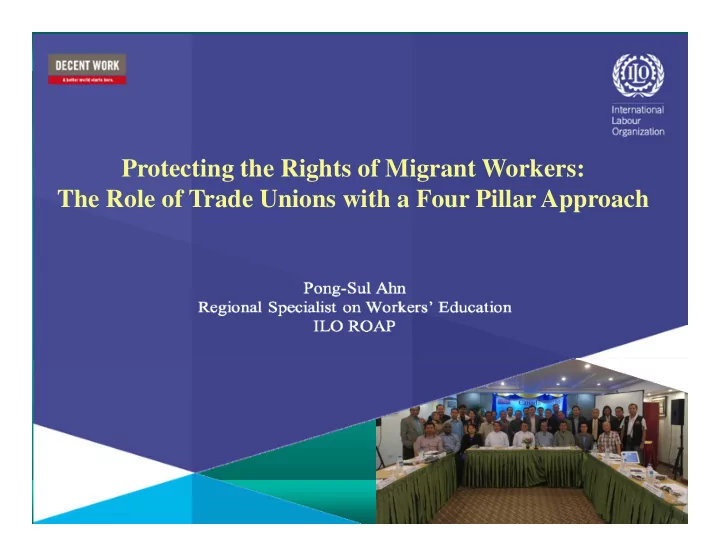
Protecting the Rights of Migrant Workers: The Role of Trade Unions - - PowerPoint PPT Presentation

protecting the rights of migrant workers the role of
SMART_READER_LITE
LIVE PREVIEW

Protecting the Rights of Migrant Workers: The Role of Trade Unions - - PowerPoint PPT Presentation

Protecting the Rights of Migrant Workers: The Role of Trade Unions with a Four Pillar Approach 1 ILO Multilateral Framework on Labour Migration : Non-binding principles and guidelines for a rights-based approach to labour migration Adopted at


slide-1
SLIDE 1

1

Protecting the Rights of Migrant Workers: The Role of Trade Unions with a Four Pillar Approach

slide-2
SLIDE 2

ILO Multilateral Framework on Labour Migration : Non-binding principles and guidelines for a rights-based approach to labour migration Adopted at the 92nd ILC in 2004 Objectives

  • Harnessing benefits from labour migration, while

protecting rights of migrant workers through safe migration;

  • Identify priority areas for development cooperation to assist

member states

Role of TU in protecting migrants 2

slide-3
SLIDE 3

Plan of Action

Wider application of international labour standards and other

relevant instruments

Implementation of the Global Employment Agenda Social Protection of Migrant Workers Capacity building, awareness raising and technical assistance Strengthening social dialogue Improving information and knowledge database

Role of TU in protecting migrants 3

slide-4
SLIDE 4

Four pillars’ approach is based on “An ACTRAV manual for trade unionists: In Search of Decent Work-Migrant Workers’ Rights (2008) Pillar 1: Promoting a rights-based migration policy Pillar 2: Creating a network between trade unions in sending and receiving countries (MOU) Pillar 3: Reaching out to migrant workers Pillar 4: Educating, training and advocacy

Role of TU in protecting migrants 4

slide-5
SLIDE 5

Pillar 1 – promoting a rights-based policy on migration

Role of TU in protecting migrants 5

slide-6
SLIDE 6

Role of TU in protecting migrants 6

 International labour migration is a unavoidable phenomenon  Migrant workers are workers whose human rights are protected

regardless of their status – documented or undocumented

 Trade union is an institution fighting for social justice and

human rights and migrant workers are potential members of trade unions.

 ILO promotes labour rights for the protection of migrant

workers through compliance with domestic and international labour standards

slide-7
SLIDE 7

Role of TU in protecting migrants 7

ALL ILO Standards ratified in the receiving countries apply to migrant workers: Especially 8 core conventions apply to them ,

 Freedom of Association (C87, C98)  Non-discrimination (C100, C111)  Eradication of Child Labour (C138, C182)  Prohibition of forced labour (C29, C105)

slide-8
SLIDE 8

Pillar 2 – Promoting MOUs between trade unions in sending and receiving countries

Role of TU in protecting migrants 8

slide-9
SLIDE 9

 Trade union can take an easy, quick action

  • because the ratification of ILO instruments is low
  • because there are many legal restrictions on migration in

both sending and receiving countries

  • Because trade unions are excluded in the process of G-G

MOUs

 Trade unions have a network to monitor the process of

migration and working conditions on duty and exchange relevant information each other

Role of TU in protecting migrants 9

slide-10
SLIDE 10

Role of TU in protecting migrants 10

The ACTRAV Model MOU

  • n the Protection of Migrant Workers’ Rights

 Why: The development of the model MOU aimed to

assist trade unions to make an easy reference and adoption.

 How: drafted at an inter-continental meeting between

trade unions in sending Asian countries and receiving Middle East countries held in Amman, Jordan in Dec. 2008

slide-11
SLIDE 11

Case 1: a MOU between Thai unions and Cambodian unions, which details areas of their joint action

Role of TU in protecting migrants 11

  • Thai-Cambodian Union MOU signed in Nov.2013
slide-12
SLIDE 12

Role of TU in protecting migrants 12

Signing ceremony

slide-13
SLIDE 13

Role of TU in protecting migrants 13

slide-14
SLIDE 14

Role of TU in protecting migrants 14

Case 2: a MOU between VGCL and MTUC

1. A VGCL delegation constituted by four members visited Malaysia from 28 to 31 Oct. 2012 to understand the concerns of Vietnamese migrant workers. 2. At a VGCL workshop on migration held in Thang Hoa on 26-27 Feb. 2013, a MTUC leader was invited as a resource person to share the experience of MTUC on migration.

3.

Another VGCL delegation composed of 4 members visited Malaysia from 13-16 Dec. 2014 to discuss a draft MOU for bilateral cooperation 4. The president of MTUC who led a six member delegation to Hanoi (13-17 March 2015) signed the MOU with the VGCL president. 5. A VGCL delegation is planning to visit KL in early Feb 2018 to review the MOU.

slide-15
SLIDE 15

Signing ceremony on16 March 2015

Role of TU in protecting migrants 15

slide-16
SLIDE 16

Case 3: MOU signed by ATUC, SARTUC Arab TUC

 Signed in Kochi, India in September 2015  With a goal for i.

campaigning for the ratification and application of ILO migrant labor conventions;

  • ii. establishment of information centers or Migrant Resources

Centers for networking, awareness, pre-departure orientation and post-arrival programs and direct services by unions;

  • iii. Organizing migrant workers in both destination and origin

countries; etc.

 Its review meeting being planned in Asia, mid-2017

Role of TU in protecting migrants 16

slide-17
SLIDE 17

Pillar 3 – reaching out (organising) migrant workers

Role of TU in protecting migrants 17

slide-18
SLIDE 18

Role of TU in protecting migrants 18

Case 1: FADWU in Hong Kong

ACTRAV launched one year project with the partnership of HKCTU, aiming at federating domestic migrant workers in Hong Kong.

The project succeeded in forming the “Federation of Asian Domestic Workers’ Unions (FADWU) on Nov. 21, 2010.

The FADWU is constituted by six domestic workers, including:

Indonesian Migrant Workers Union

Hong Kong Domestic Workers General Union

Filipino Domestic Helpers General Union, Hong Kong

Union of Nepalese Domestic Workers in Hong Kong

Overseas Domestic Workers’ Union – HK

Thai Migrant Workers’ Union Hong Kong

May Day 2013: http://www.youtube.com/watch?v=FD1eCPTKFaI

slide-19
SLIDE 19

19

The Executive Committee elected

slide-20
SLIDE 20

ILO Policies on Migration 20

Future tasks of FADWU

  • Need to improve communication and coordination

among the six unions

  • Increase paid membership
  • How to respond to union members’ high expectation

for more direct benefits

  • Respond to increasing individual grievances
  • Campaign for the coverage of the minimum wage for

domestic workers

slide-21
SLIDE 21

Role of TU in protecting migrants 21

Case 2: GEFONT in Nepal

  • GEFONT is proactive in protecting the rights of migrant

workers as well as organising the Nepali migrants.

  • GEFONT has started to work on Nepali Migrant workers' issue

since 1996.

  • Set up a Migration Dept. and Migrant Committee constituted by

four members in 2004

  • GEFONT-Migrant Committee has organized Nepali migrant

workers and had its support groups in such countries as Korea, Malaysia, UAE, Saudi Arabia, Israel, Hong Kong and India

slide-22
SLIDE 22

Case 3: Migrants’ Trade Union (MTU) in Korea

Role of TU in protecting migrants 22

In 2005, Migrants’ Trade Union (MTU) was formed and 91 foreign workers in Seoul, Incheon and Gyeonggi Province filed a suit against MOEL denying its recognition. In 2006, the administrative court ruled that the law here does not recognize them as workers entitled to legal protection.

slide-23
SLIDE 23

 That ruling was overturned by the Seoul High Court in Feb. 2007,

which ruled that the undocumented migrants are recognised workers who have rights to form and join unions.

 Then the Labour Ministry appealed it to the Supreme Court.  On 25 June 2015, the supreme court ruled that illegal foreign workers

are entitled to form or join trade unions to defend their rights.

 The MTU has a membership of approximately 1,500 as of 2015 who

are from Bangladesh, Nepal, the Philippines, Sri Lanka, Indonesia and Vietnam.

 Of total 700,000 migrant workers, as many as 105,000, accounting

for 15 per cent, are undocumented.

Role of TU in protecting migrants 23

slide-24
SLIDE 24

Pillar 4 – Education, training and advocacy for union members

24

slide-25
SLIDE 25

Role of TU in protecting migrants 25

A few examples on the role of trade unions in education/ training and advocacy

 Migrant Worker Resource Centres (MRCs) run by trade unions in

Cambodia, Lao PDR, Thailand, Myanmar and Malaysia

 Information and counselling services  Future tasks

– visualization of the MRC to migrants ‐ capacity building of the MRC staff;

‐Better collaboration of government

authorities to resolve complaint cases

slide-26
SLIDE 26

 Mark “World Day for the Rights of Migrant Workers” on 18th

December and raise public awareness on the positive role of migrant workers in both sending and receiving countries

 Engage in pre-departure training and providing potential migrant

workers on information on law and useful contacts in destination countries

 Rehabilitation programme for return migrants (ex. LFTU)  Establish a helpdesk (or Migration Dept.) (ex. Trade unions in

Nepal and Korea)

Role of TU in protecting migrants 26

slide-27
SLIDE 27

Role of TU in protecting migrants 27

 Campaign for the revision of labour law or the

government policy on migration, in order to guarantee the fundamental labour rights (ex. unions in Cambodia and Vietnam).

 Adopt a Code of Conduct for ethical recruitment by

recruitment agencies (ex. VGCL)

 Provide helpline services (through mobile SMS) (ex.

TU SMS Helpline - a joint initiative by BWI, PSI, UNI and their affiliates in Malaysia)

  • sending text messages to Helpline
slide-28
SLIDE 28

 Organise social and cultural events (OSH, talent shows,

etc) regularly with migrant workers to help them integrate in the society (ex. Trade unions in Nepal and Singapore)

 Provide legal services (ex. Trade unions in Korea and the

Philippines)

 Develop a union policy and action plan and influence the

government’s policy and legislation on migration (ex. trade unions in Thailand, Cambodia and Myanmar)

Role of TU in protecting migrants 28

slide-29
SLIDE 29

Role of TU in protecting migrants 29

THANK YOU